
By 2026, the traditional model of simply securing a trade license to claim a presence in the Middle East will no longer suffice for serious investors. While national economic authorities recorded a 13% increase in new business registrations during the final quarter of 2023, many of these entities fail to convert their presence into sustainable revenue. You likely recognize that doing business in dubai requires more than just administrative compliance; it demands a sophisticated understanding of a market that's rapidly maturing. The challenge isn't just entering this market, it's staying relevant as regional competition intensifies and operational costs continue to evolve.
This guide provides a strategic roadmap to help you master the regulatory and cultural nuances necessary for long-term growth. We'll move beyond the basics of incorporation to address the real-world friction of finding reliable distributors and managing your local supply chain. You'll gain a clear perspective on the strategic choice between the leading economic center in the region and other major strategic locations for your regional headquarters based on the latest 2026 economic projections. This analysis outlines the precise steps required to transform your market entry into a measurable commercial success through methodical execution.
Key Takeaways
- Understand why doing business in dubai in 2026 requires shifting focus from simple tax-free incorporation toward deep integration within the D33 Economic Agenda.
- Learn to navigate the critical intersection of relationship-based commerce and the complex regulatory roadmaps required for industrial and technical market entry.
- Evaluate the strategic trade-offs between Dubai’s mature logistics ecosystem and Riyadh’s emerging frontier to optimize your regional headquarters placement.
- Identify specific vetting criteria for local partners to avoid passive distribution channels that can stall your revenue growth and market penetration for years.
- Develop a robust 12-month execution roadmap that adapts your global value proposition to resonate with GCC decision-makers and ensures sustainable ROI.
The Dubai 2026 Business Landscape: Moving Beyond Setup
By 2026, the concept of doing business in dubai has transitioned from a tax-arbitrage play to a sophisticated integration into a global logistics and financial node. While the absence of personal income tax remains a draw, the real value lies in the city's mature ecosystem. Dubai's diversified economy now prioritizes high-value sectors over simple trade intermediation. Success in this environment requires moving beyond the "setup phase" and focusing on deep market penetration. The distinction between legal presence and market presence is sharper than ever. Having a commercial license is a regulatory formality, but establishing a sales pipeline requires local cultural intelligence and physical networking. By 2026, specialized free zones like Dubai Internet City or DIFC have implemented higher substance requirements. This shift ensures that companies contribute to the local GDP rather than operating as "brass plate" entities.The D33 Agenda: Doubling the Economy by 2033
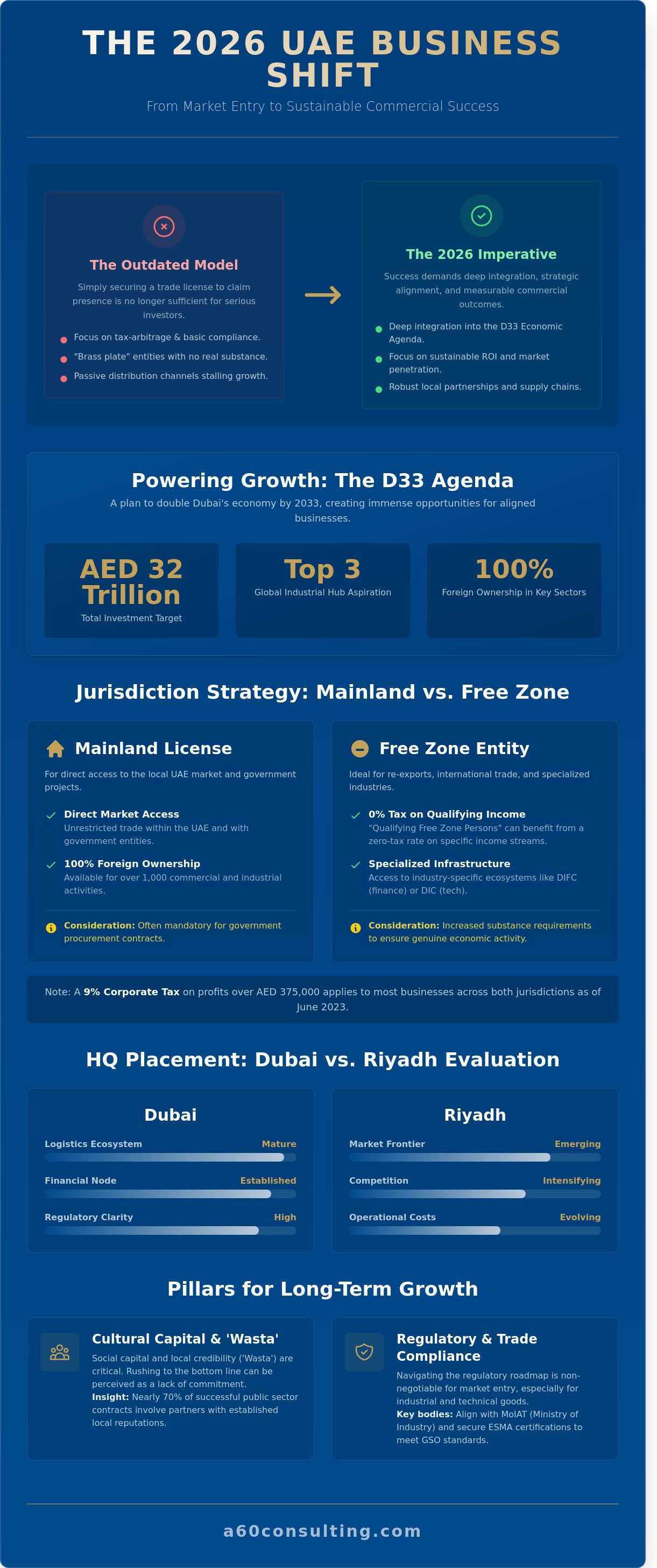
The Dubai Economic Agenda (D33) aims to double the size of the economy by 2033 through a total investment target of AED 32 trillion. This plan isn't merely aspirational; it targets specific industrial clusters like green energy and advanced manufacturing. Businesses must align their operations with these national priorities to access government procurement and R&D grants. The D33 Agenda aims to position Dubai as one of the top three global industrial hubs by integrating 100% foreign-owned manufacturers into the local supply chain.
Mainland vs. Free Zone: A Strategic Decision
The 2020 changes to the Commercial Companies Law, allowing 100% foreign ownership on the mainland for over 1,000 activities, changed the calculus for investors. Choosing between mainland and free zone now depends on your target audience. If your primary clients are UAE government entities, a mainland license is often mandatory. If you focus on re-exports, a free zone remains optimal. The 9% Corporate Tax on profits exceeding AED 375,000, introduced in June 2023, applies across the board, though certain "Qualifying Free Zone Persons" still benefit from a 0% rate on specific income. This tax environment demands rigorous accounting and a clear understanding of where your value is generated. When doing business in dubai, your choice of jurisdiction is no longer just about cost, but about long-term regulatory compliance and market access.
- Mainland: Direct access to the local market and government contracts.
- Free Zones: Specialized infrastructure and 0% tax on qualifying income.
- Regulatory Standards: Increased focus on Anti-Money Laundering (AML) and Ultimate Beneficial Ownership (UBO) reporting.
Strategic Pillars of the Dubai Market: Culture and Regulation
Success in the UAE depends on understanding that legal frameworks and personal relationships aren't separate entities. They're deeply intertwined. When doing business in dubai, your social capital often dictates the speed of your regulatory progress. The market operates on a foundation of trust that takes time to build but yields significant dividends for those who prioritize long-term presence over transactional gains.
Understanding 'Wasta' and Cultural Capital
Wasta represents the influence and networking power that drives business development across the GCC. It isn't merely about "who you know" but about the credibility you've established within the local ecosystem. In a 2023 study of regional trade, nearly 70% of successful contract awards in the public sector involved partners with established local reputations. High-level meetings require strict adherence to protocol. Always accept refreshments with your right hand and allow time for personal inquiries before discussing technical specifications. Rushing to the bottom line is often perceived as a lack of commitment to the partnership.
Regulatory and Trade Compliance in 2026
Manufacturers of complex industrial goods must align with the Ministry of Industry and Advanced Technology (MoIAT) standards. This involves securing certifications from ESMA (Emirates Authority for Standardization and Metrology) to ensure products meet regional GSO requirements. Software firms face a different set of hurdles, specifically the UAE Data Protection Law (Federal Decree-Law No. 45 of 2021). This law mandates strict controls on how personal data is processed and stored. You should consult Dubai's official business setup guide to identify the specific compliance certificates required for your specific activity code before shipping any hardware.
For companies targeting government tenders or large-scale energy projects, the National In-Country Value (ICV) program is a critical hurdle. This procurement initiative weighs your bid based on how much economic value you retain within the UAE. Scores are calculated based on your local investment, manufacturing spend, and the percentage of Emirati employees in your workforce. A low ICV score can disqualify a technically superior bid, making local supply chain integration a strategic necessity rather than an option.
Managing specialized talent has become more streamlined through the Golden Visa program, which was significantly expanded in April 2022. This 10-year residency allows experts in science, engineering, and technology to remain in the country without a traditional corporate sponsor. It's a powerful tool for firms that need to retain high-level R&D staff in a competitive global market. If your leadership team is struggling to align these regulatory requirements with your growth targets, evaluating your implementation strategy can help bridge the gap between planning and execution. Doing business in dubai requires this blend of technical compliance and cultural fluency to achieve measurable results.
Doing Business in Dubai vs. Riyadh: A Comparison
Dubai operates as a refined, global logistics powerhouse. Riyadh represents a massive-scale frontier fueled by unprecedented sovereign investment. For leaders, the choice isn't necessarily about picking one over the other, but about understanding how their different stages of development impact organizational strategy. Doing business in dubai offers the security of a mature ecosystem where the majority of regional expertise is currently concentrated. Riyadh, conversely, provides the high-growth potential of an emerging market that's rapidly scaling its infrastructure to meet Vision 2030 goals.
The implementation of Saudi Arabia’s Regional Headquarters (RHQ) program on January 1, 2024, changed the regional dynamic. Firms seeking government contracts exceeding AED 1 million must now establish their primary regional base in Riyadh. This policy hasn't triggered an exodus from Dubai, but it's forced a shift toward a dual-hub model. Companies maintain their sophisticated logistics and lifestyle operations in the UAE while building dedicated execution teams in the Saudi capital to capture domestic demand.
Logistical efficiency remains a primary differentiator. Jebel Ali Port handles over 14 million TEUs annually, providing seamless access to the wider GCC. While Saudi Arabia is investing heavily in the Global Supply Chain Resilience Initiative, the UAE's established trade corridors offer immediate reliability for companies distributing high-value goods across the Middle East and North Africa. Talent acquisition also follows this split; while Riyadh is attracting fresh specialists, the senior management layer with decades of regional experience often remains anchored in Dubai’s established residential and educational infrastructure, which supports specialized vocational training through institutions like FET academy. This demographic also values high-end lifestyle services, including Kilimanjaro climbing tours from Dubai, which offer unique networking and personal growth opportunities for the city's executive class.
Market Maturity and Competition
Dubai’s markets are highly competitive and, in sectors like retail or luxury real estate, reaching saturation. This maturity demands high operational efficiency and clear brand differentiation. Riyadh offers "blue ocean" opportunities in industrial manufacturing and digital transformation where demand often outstrips supply. According to JLL’s 2024 data, Grade A office vacancy in Riyadh dropped to 1%, driving rents upward as firms rush to comply with RHQ mandates. Many strategic partners use Dubai as a gateway, testing products in the UAE’s controlled environment before scaling into the larger Saudi market.
Vision 2030 and Regional Synergies
The economic blueprints of the UAE and Saudi Arabia are complementary rather than contradictory. Trade between the two nations reached AED 136.09 billion in 2022, highlighting a deep-rooted economic interdependence. Cross-border trade benefits from the GCC Customs Union, though navigating specific local content requirements in Riyadh requires a nuanced approach to implementation. While the UAE offers established 100% foreign ownership in free zones and a 9% corporate tax rate, Saudi Arabia provides a 30 year tax holiday for companies establishing regional headquarters in Riyadh. This synergy allows businesses to leverage Dubai’s financial sophistication alongside Riyadh’s massive project pipeline.
Partner Identification: Building a Resilient Local Ecosystem
Choosing a local partner is often the single most critical decision when doing business in dubai. It's the bridge between a theoretical market entry strategy and sustainable revenue. Many international firms fall into the trap of signing with "passive" distributors. These entities act as trophy hunters, collecting prestigious brands for their brochures without investing in a dedicated sales force. This results in market stagnation where your products sit in a warehouse while competitors with more active representation capture the 15% annual growth seen in many UAE industrial sectors.
Technical capability must be verified through rigorous audits. A partner needs a minimum of 8 years of experience in your specific niche to navigate the local regulatory environment effectively. Financial liquidity is also paramount. In sectors like energy or infrastructure, local partners often need to bridge cash flow gaps for 90 to 120 days. You must also evaluate their In-Country Value (ICV) score. Since the 2022 updates to UAE procurement rules, a partner's ICV score directly impacts your ability to win government contracts worth over AED 5,000,000.
Effective contracts now benefit from the UAE Commercial Agency Law (Federal Law No. 3 of 2022). This legislation provides a more balanced framework for terminating non-performing agents. It's vital to define non-performance using clear, measurable KPIs. Protecting your intellectual property requires specific clauses that prevent distributors from registering your trademarks locally under their own names, a mistake that has cost foreign firms millions in legal fees.
The Vetting Process: Beyond the Brochure
Due diligence requires reviewing the last 36 months of a potential partner's project delivery history. Physical site visits to their warehouses in Jebel Ali or Al Quoz are non-negotiable to verify their actual inventory management capabilities. You should interview their existing clients to see if their after-sales support matches their sales pitch. Don't rely on digital presentations; demand to see the technical team in action.
Managing the Sales Channel
A "set and forget" approach fails in the Middle East. You need a dedicated regional manager to act as the "local face" of your brand. This person ensures the distributor prioritizes your portfolio over the other 20 brands they might represent. Implementing shared CRM tools bridges the gap between your headquarters and the Dubai office. This transparency allows for real-time tracking of sales pipelines and ensures that sales pressure remains consistent throughout the fiscal year.
Strategic growth requires more than just a signature; it demands a partner who can execute your vision on the ground. Partner with A60 Consulting to identify and vet the right local allies for your expansion.
Execution: Moving from Entry to Sustainable Revenue
Success when doing business in dubai requires a disciplined transition from administrative setup to a structured 12-month go-to-market roadmap. The first 90 days involve intense networking and regulatory alignment, while the subsequent nine months focus on pipeline velocity and contract conversion. Data from the Dubai Chamber of Commerce suggests that 60% of international firms struggle during their first year due to a lack of local implementation depth rather than product deficiency. A sustainable roadmap must include specific milestones for lead generation, stakeholder mapping, and local partnership development to avoid the common trap of "market tourism."
Adapting the Sales Pitch for the GCC
Global pitches often fail in the UAE because they over-emphasize technical specifications while neglecting local commitment. GCC decision-makers view "best-in-class" technology as a baseline, not a differentiator. They prioritize long-term support and the physical presence of your team. Your value proposition should focus on localized ROI, taking into account the 5% VAT and specific regional operational costs denominated in AED. High-value contracts in Dubai are rarely closed over a video call. The closing process typically requires four to six face-to-face follow-ups to build the necessary trust. Showing up in person demonstrates that your firm is invested in the region's long-term vision, such as the Dubai Economic Agenda D33.
Measuring success during the first year involves tracking specific key performance indicators that go beyond top-line revenue. Consider these metrics:
- Qualified Pipeline Value: The total value of opportunities in AED that have reached the proposal stage.
- Stakeholder Engagement Score: The number of face-to-face meetings with C-level executives or government entities.
- Pilot-to-Contract Conversion: The percentage of Proof of Concept (PoC) projects that transition into annual recurring revenue.
Choosing between direct hiring and retainer-based representation is a critical financial decision. A senior sales director in Dubai often commands a monthly salary between 40,000 AED and 65,000 AED, excluding housing allowances and commissions. A retainer-based model provides immediate access to established networks at a fraction of the cost, allowing you to test the market before committing to a permanent headcount.
Partnering for Growth: The A60 Approach
Strategic market entry requires a bridge between high-level theory and daily sales management. A60 Consulting functions as your regional sales office, providing the professional higgadtság needed to navigate complex local hierarchies. We don't just hand over a strategy; we manage the implementation to ensure your objectives align with local commercial realities. You can scale your business in the GCC with A60’s market entry expertise to transform your initial entry into a source of sustainable revenue. Our focus remains on measurable results and the systematic execution of your growth plan in the UAE.
Navigating Your Strategic Entry Into the 2026 Dubai Market
Success in the 2026 landscape requires moving beyond mere administrative setup. It's about integrating into a local ecosystem that values deep cultural alignment and regulatory precision. While the D33 Economic Agenda targets a total economic output of AED 32 trillion by 2033, your immediate priority is establishing a resilient footprint that bridges the gap between strategy and execution. Doing business in dubai today demands a nuanced approach that distinguishes between the mature UAE market and the rapid transformation occurring in Riyadh.
Our team brings over 30 years of regional expertise to your project. We specialize in complex technology and manufacturing sectors, providing the analytical depth needed to navigate specialized free zones and mainland requirements. We've built a proven track record across both the UAE and Saudi Arabia, ensuring your entry results in measurable, sustainable revenue rather than just a registered office.
Book a strategic consultation to plan your GCC market entry and leverage our experience to secure your competitive advantage in the Middle East. Your path to regional leadership starts with a single, well-timed decision.
Frequently Asked Questions
Is 100% foreign ownership available for all businesses in Dubai?
Yes, 100% foreign ownership is available for more than 1,000 commercial and industrial activities following the landmark amendment to the Commercial Companies Law in June 2021. This change removed the previous requirement for a local Emirati shareholder to hold a 51% stake in mainland companies. While strategic sectors like oil and gas, utilities, and defense still require local participation, most investors doing business in Dubai can now maintain full control over their operations.
How has the 9% UAE Corporate Tax affected doing business in Dubai?
The 9% Corporate Tax, which took effect on June 1, 2023, establishes a transparent fiscal framework while keeping the UAE among the most competitive markets globally. Small businesses benefit from a 0% rate on taxable profits up to AED 375,000, which protects the margins of startups and growing firms. It's a strategic shift that aligns the city with international standards, yet many free zone companies still enjoy a 0% tax rate on qualifying income earned outside the mainland.
What is the Regional Headquarters (RHQ) program in Saudi Arabia, and how does it affect Dubai firms?
The RHQ program is a Saudi government initiative that, as of January 1, 2024, restricts state entities from signing contracts with multinational firms that don't have their regional headquarters in Riyadh. This policy creates a new competitive dynamic for companies that have traditionally managed their Middle Eastern operations from the UAE. Many firms are now adopting a dual-hub strategy, maintaining their core talent and logistics in Dubai while establishing a strategic presence in Riyadh to secure government tenders.
Do I need a local partner to sell to the Dubai government?
You don't always need a local equity partner to bid on tenders, but registering on the "e-Supply" portal often requires a local trade license or a registered local agent. Government procurement processes often prioritize companies that demonstrate a commitment to the local economy through "In-Country Value" scores. Working with a local partner who understands the specific regulatory nuances can improve your chances of success and reduce administrative delays by 30% during the registration phase.
What are the most common mistakes foreign firms make when entering the Dubai market?
Foreign firms often fail by choosing a restrictive free zone license that prevents them from trading directly with customers in the UAE mainland. Another frequent error is underestimating the time required for relationship building, leading to 20% higher costs in the first year due to stalled business development. Success requires a balance between a robust legal strategy and a deep understanding of the local market's cultural expectations and operational rhythms.
How long does it typically take to go from market entry planning to the first sale?
It typically takes between six and nine months to move from the initial planning phase to closing your first significant B2B sale. While the administrative task of setting up a legal entity might only take 10 working days, the process of building trust and navigating procurement cycles is much longer. Doing business in Dubai requires a systematic approach where the first three months focus on licensing and the subsequent six months focus on market implementation and networking.
What is 'Wasta' and how much does it matter for B2B sales in the UAE?
Wasta refers to the use of personal connections or influence to facilitate business transactions and it remains a vital component of the UAE's commercial culture. In B2B sales, having the right introductions can shorten your sales cycle by several months because trust is the primary currency in the region. While the market's becoming more data-driven and meritocratic, professional networks still act as the bridge between a cold proposal and a signed contract.
Are there specific industries that Dubai is prioritizing for 2026?
Dubai is prioritizing high-tech manufacturing, renewable energy, and the digital economy as part of its D33 Economic Agenda, which aims to double the economy's size by 2033. By 2026, the government expects to see significant growth in green hydrogen projects and artificial intelligence applications within the logistics sector. Companies that align their business models with these sustainability and innovation goals will find more streamlined regulatory pathways and specific incentive programs.