
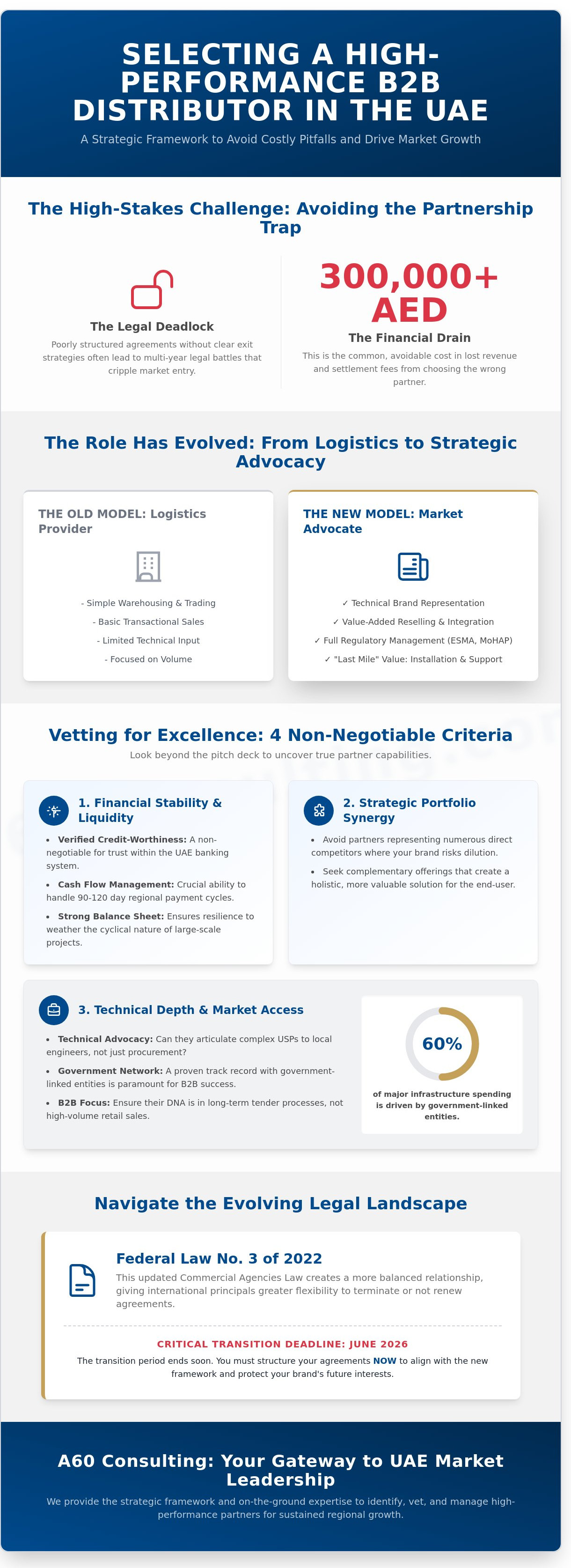
Signing a standard distribution agreement in the UAE without a structured exit strategy often leads to a multi-year legal deadlock that costs international firms upwards of 300,000 AED in lost revenue and settlement fees. You likely recognize that finding the right distributors in uae is the single most critical factor for your Middle Eastern expansion, yet the challenge of verifying local market claims from thousands of miles away remains a constant source of anxiety. It's difficult to distinguish between a partner with a genuine network and one that simply holds a trade license without the infrastructure to scale your brand effectively.
This strategic guide outlines how to move beyond superficial pitch decks to identify, vet, and manage high-performance partners who align with your long-term B2B objectives. We'll provide a clear framework for auditing potential distributors, ensuring regulatory compliance under the latest UAE Commercial Agencies Law, and establishing a management system that yields measurable sales growth. By the end of this article, you'll have the tools to build a shortlist of vetted partners and maintain control over your local operations without needing a permanent physical presence in the region.
Key Takeaways
- Understand why successful market entry in complex sectors requires moving beyond logistics to find partners who act as technical advocates for your brand.
- Identify high-performance distributors in uae by evaluating their ability to communicate complex USPs to local engineers and their credit-worthiness within the national banking system.
- Learn a rigorous due diligence process that looks beyond glossy company profiles to uncover a partner's true sales execution and implementation capabilities.
- Shift from tracking total sales to measuring strategic market penetration while providing the sales enablement training necessary for long-term local success.
- Discover how to bridge the gap between strategy and execution by establishing a regional presence without the immediate overhead of a local entity.
Understanding the UAE Distribution Landscape for Complex Sectors
The role of a partner in the Middle East has evolved from a simple logistics provider to a strategic market advocate. Success for international brands no longer depends on finding someone with a warehouse; it hinges on identifying distributors in uae who possess the technical depth to represent complex B2B solutions. The UAE economic landscape has shifted toward a knowledge-based model, meaning that "trading" is being replaced by value-added reselling. This transition is particularly visible in sectors like industrial automation, healthcare technology, and enterprise software where the sale is just the beginning of the relationship.
In this environment, a distributor acts as the bridge between global innovation and local execution. They manage the specific regulatory requirements of the Emirates, such as ESMA certifications or MoHAP registrations, which can take between 3 to 12 months depending on the product category. For technical products, the distributor must provide the "last mile" of value, including installation, localized training, and 24/7 support. Without these capabilities, a principal risks brand dilution and failed implementations in a market that prizes reliability and face-to-face accountability.
B2B vs. B2C Distribution Dynamics
Industrial manufacturers must avoid the "retail-first" distributor trap. While many distributors in uae claim broad coverage, their DNA is often rooted in high-volume consumer goods. B2B success requires a different skill set: long-term relationship management and deep integration into government procurement cycles. Since government-linked entities drive approximately 60% of major infrastructure spending, your partner's existing network within these organizations is more valuable than their physical fleet. They must demonstrate a proven track record of managing multi-year tender processes rather than simple transactional sales.
The Legal Framework of UAE Distribution
Understanding the legal distinction between registered and unregistered commercial agencies is critical for risk management. Federal Law No. 3 of 2022 introduced significant updates to the regulatory environment, with a pivotal transition period ending in June 2026. These changes provide more flexibility regarding the termination and non-renewal of agency agreements, which historically favored the local agent heavily. Under the new law, international principals can terminate contracts upon expiry or for "material reasons," provided they follow the specific notice periods. It's essential to structure agreements now that anticipate the 2026 landscape to ensure your brand interests remain protected as the market matures.
Key Criteria for Selecting a High-Performance UAE Partner
Selecting the right partner requires a shift from superficial sales metrics to deep operational analysis. In the UAE's competitive B2B environment, finding the most capable distributors in UAE means identifying a partner who acts as your brand's technical and cultural ambassador. You need an entity that doesn't just list your products but actively integrates them into the local industrial fabric through strategic implementation.
Financial stability is the first non-negotiable pillar. You should verify their credit-worthiness within the national banking system, ensuring they possess the liquidity to manage 90-day or 120-day payment cycles common in regional trade. A partner with a strong balance sheet can weather the cyclical nature of large-scale infrastructure projects. You should also scrutinize their portfolio synergy. If a distributor represents ten direct competitors, your brand risks becoming a secondary priority. Ideally, their existing lines should complement your offering, creating a comprehensive solution for the end-user.
Marketing responsibility is a frequent point of friction. You must define early on who manages the top of the funnel. Relying on MEED business intelligence helps both parties track upcoming tenders and project awards, but the distributor must possess the local field force to convert these leads into revenue. Without a clear agreement on lead generation budgets and specific AED allocations for local trade shows, momentum often stalls after the initial launch.
Assessing Technical and Operational Capability
Technical synergy is the alignment of a partner's existing expertise with your product's complexity. You shouldn't settle for a generalist if your equipment requires specialized calibration or maintenance. Verify the distributor's physical infrastructure by visiting their facilities in hubs like Jebel Ali or KIZAD. Check if their sales team holds recent technical certifications or if they've completed training programs within the last 18 months. A distributor who can't explain your Unique Selling Proposition to a senior engineer at a utility provider won't successfully penetrate the market.
Market Reach and Access
A high-performance partner demonstrates a proven track record in high-growth sectors like renewable energy or advanced manufacturing. They must be proficient in navigating national procurement portals such as Tejari or the ADNOC supplier system. In the UAE, "Wasta" remains a critical element of business. This isn't about shortcuts; it's about the depth of their professional network and the trust they've built over decades. This networking capability is what secures seats at the table for large-scale industrial contracts. If you're looking to refine your selection process, our team can help you evaluate potential partner metrics to ensure long-term ROI and organizational growth.
The Vetting Process: Moving Beyond the Company Profile
A glossy brochure often masks poor sales execution. In the UAE market, many entities possess impressive corporate profiles but lack the boots-on-the-ground capability to drive volume. Relying on a PDF presentation is a strategic risk that leads to stagnant inventory. You must look past the marketing layer to find distributors in uae who possess genuine market access and technical competence. This requires a shift from passive observation to active investigation.
Site visits are non-negotiable. You shouldn't just visit the head office; you need to see the warehouse and meet the actual sales leads who will carry your brand. Interviewing these individuals reveals whether they understand your value proposition or if they'll simply add your product to a list of a thousand others. Aligning commercial terms is the final hurdle. You must balance margin expectations, which often range from 15% to 30% in B2B sectors, against specific service level agreements (SLAs) regarding lead response times and technical support.
The 3-Stage Vetting Framework
- Stage 1: Desktop research and screening. Verify the company's legal status through the Dubai Economy (DED) or relevant Free Zone authorities. Check their standing with the UAE Chambers of Commerce to ensure they're active and compliant.
- Stage 2: Operational audit. Conduct reference checks with their existing principals. Ask specific questions about their payment consistency and reporting frequency. A partner who fails to provide monthly sell-out data won't help you scale.
- Stage 3: Commercial alignment. Run "test-case" sales scenarios. Ask the potential distributors in uae to outline a 90-day go-to-market plan for a specific target account. This reveals their strategic depth and existing relationships.
Verifying Regulatory and Trade Compliance
Compliance is a foundational pillar of UAE trade. You must ensure the partner meets national product certification standards set by the Ministry of Industry and Advanced Technology (MoIAT). If your strategy involves government tenders or entities like ADNOC, you must verify their In-Country Value (ICV) score. A low ICV score can disqualify a bid regardless of product quality. Finally, check their internal protocols against UAE trade sanctions and global compliance lists to protect your brand's reputation. This analytical approach ensures that your partnership is built on a foundation of legal and operational security.
From Appointment to ROI: Managing Your UAE Distribution Network
Signing an agreement with distributors in UAE is merely the foundation; the real work begins with implementation. Foreign firms often see a 40% drop in projected revenue within the first 18 months because they treat the partnership as a passive income stream. This "fire and forget" mentality ignores the competitive nature of the Dubai and Abu Dhabi markets. Success requires moving beyond "total sales" as the sole metric. You need to track market penetration, which measures how deeply your partner is reaching specific industrial zones like JAFZA or KIZAD. A 2023 industry report suggests that B2B partnerships in the Gulf region require at least 12 touchpoints per year to maintain momentum.
Sales Enablement for Local Partners
Your global sales pitch won't work unchanged in a region where personal trust precedes technical specifications. You must adapt your collateral to reflect local business etiquette and technical standards. This includes translating complex documentation and, more importantly, participating in joint sales calls. When a principal manufacturer joins a meeting in Dubai, it signals commitment to the end-customer. Providing marketing materials in both English and Arabic ensures your message reaches the diverse decision-makers within the Emirates. Effective enablement involves:
- Adapting technical specifications to meet UAE Ministry of Industry and Advanced Technology (MoIAT) standards.
- Co-hosting webinars or seminars for local engineers to establish authority.
- Creating case studies that feature existing projects within the GCC region.
Monitoring and Performance Management
Accountability depends on a structured reporting cadence. While quarterly reviews are standard for high-level strategy, weekly pipeline updates via CRM are essential for tracking lead conversion rates. Data from 2023 shows that distributors who share real-time CRM access with their principals see a 22% higher conversion rate on high-value B2B contracts. This transparency allows you to identify bottlenecks before they impact your annual ROI. Annual reviews should focus on market share growth rather than just gross volume, ensuring your partner isn't just "cherry-picking" easy wins.
If your internal resources are stretched, an outsourced sales manager can act as your eyes and ears on the ground. They bridge the gap between your headquarters and the distributors in UAE, ensuring that annual growth targets aren't just numbers on a page but achievable milestones. This role involves verifying that the local team is actually using the tools you provide and following the agreed-upon strategy. It's about maintaining a constant presence without the overhead of a full regional office.
Ready to turn your distribution strategy into measurable market share? Partner with A60 Consulting to bridge the gap between strategy and execution in the UAE.
A60 Consulting: Your Gateway to UAE Market Leadership
Entering the Middle East requires more than a digital presence; it demands a physical, strategic foothold. A60 Consulting FZ-LLC serves as your regional sales office, providing the infrastructure of a local entity without the substantial overhead costs typically associated with trade license renewals, office leases, and visa quotas. Since 1994, our 30-year legacy has focused on identifying high-performance GCC partners who align with specific technical requirements. We bridge the gap between high-level strategy and the granular reality of sales execution, ensuring your brand doesn't just enter the market but thrives within it.
Our engagement models are designed for flexibility. Whether you require fixed-fee project support for a specific market entry or long-term strategic representation, we adapt to your scale. We act as your eyes and ears on the ground, delivering the "A60 perspective" that balances analytical rigor with human-centered business relationships. This approach allows your team to maintain focus on global product development while we handle the complexities of regional growth.
Our Partner Search and Vetting Methodology
Public directories often list thousands of distributors in uae, yet the most effective partners frequently operate below the radar. Our methodology identifies these "hidden gem" distributors through a proprietary network built over three decades. We don't just provide a list of names; we facilitate high-level introductions and lead the negotiation of terms that protect your interests. This process ensures your entry strategy remains resilient even when regional market shifts occur, as we prioritize partners with proven financial stability and technical competence.
- In-depth Vetting: We analyze the distributor's existing portfolio to ensure no conflicts of interest exist.
- Strategic Alignment: We verify that the partner's sales cycle matches your product’s complexity.
- Negotiation Support: Our team ensures that exclusivity clauses and performance KPIs are realistic and enforceable.
Sustainable Growth Through Local Representation
Winning technical contracts in the Emirates often requires a "local face" to build trust with government entities and private stakeholders. A60 Consulting FZ-LLC provides this presence, managing your chosen distributors in uae to ensure they meet their sales targets. We move beyond theoretical advice to implement practical solutions, monitoring inventory levels and customer feedback in real time. This hands-on management style prevents the common pitfall where a distributor signs an agreement only to let the product sit idle in a warehouse.
Sustainable growth is a result of systematic work and methodological depth. We don't promise instant miracles; we deliver a structured path to market dominance through facts and measurable results. Contact A60 Consulting FZ-LLC to start your UAE partner search today and secure your position in this high-growth region.
Securing Your Competitive Advantage in the Emirates
Building a resilient network in the Middle East requires moving past surface-level company profiles to identify partners who truly mirror your organizational values. Success depends on a rigorous vetting process and a management framework that prioritizes measurable ROI over simple presence. Selecting high-performance distributors in uae is the first step in a long-term transformation that links your technical innovation with local market depth. At A60 Consulting, we bring 30+ years of regional GCC experience to every partnership, with a specialized focus on technical and software sectors. Our methodology has successfully scaled businesses across both Saudi and UAE markets by closing the gap between strategic intent and operational reality. We don't just offer advice; we provide a structured path to market leadership based on facts and regional nuances. It's time to move from planning to execution with a partner who understands the complexity of the Gulf business landscape. Book a Strategic Market Entry Consultation to begin your journey toward sustainable growth. Your expansion deserves the precision of a seasoned expert.
Frequently Asked Questions
How do I find a distributor in the UAE for my specific product?
You can identify potential partners by utilizing the Ministry of Economy's commercial agencies registry and attending industry-specific trade shows like Gulfood or Arab Health. Data from the Dubai Chamber of Commerce shows over 217,000 registered companies, offering a deep pool for strategic networking. Finding the right distributors in uae requires a systematic evaluation of their existing logistics network and credit history. It's best to combine digital research with on-the-ground vetting to ensure cultural and operational alignment.
Can a foreign company sell directly in the UAE without a distributor?
Yes, you can sell directly if you establish a local legal entity in a Free Zone or on the Mainland, though this involves higher setup costs. The UAE Commercial Companies Law, specifically Federal Decree-Law No. 32 of 2021, allows 100% foreign ownership for many onshore activities. While direct sales offer more control, distributors in uae provide immediate market access and established retail relationships. Most international brands choose a hybrid model to balance local expertise with corporate oversight.
What is the typical commission or margin for a UAE distributor?
Commission rates for bulk commodities generally range from 5% to 15%, while retail margins for consumer goods often sit between 30% and 50%. These figures fluctuate based on whether the partner manages marketing budgets, storage, and after-sales support. Specialized sectors like medical technology or industrial machinery often demand higher margins to cover technical training and maintenance. You should benchmark these rates against current industry standards in Dubai and Abu Dhabi to maintain a competitive yet profitable partnership.
Are exclusivity agreements mandatory for distributors in the UAE?
Exclusivity isn't mandatory under Federal Law No. 3 of 2022 on Regulating Commercial Agencies, which provides more flexibility for manufacturers. This legislation allows you to appoint multiple agents or terminate agreements more easily than previous regulations permitted. You can negotiate exclusive, non-exclusive, or territory-specific arrangements depending on your growth strategy. It's vital to link any exclusivity clauses to specific performance KPIs to ensure your partner remains motivated to capture market share.
How long does the distributor search and vetting process usually take?
A comprehensive search and vetting process typically takes between 3 and 6 months to complete properly. This timeframe accounts for initial market mapping, shortlisting candidates, and conducting site visits to inspect warehouse facilities. You'll likely spend at least 4 weeks on due diligence to verify financial stability and reputation within the local business community. Rushing this phase often leads to a mismatch in organizational culture, which can hinder long-term implementation and results.
What happens if my UAE distributor underperforms?
You can initiate termination or renegotiation based on the performance metrics and dispute resolution clauses defined in your contract. The 2022 Commercial Agency Law allows for the expiration of contracts at the end of their term, making it easier to part ways with underperforming partners. If a distributor fails to meet 80% of their sales targets over a two-year period, it's usually time for a strategic review. We recommend structured mediation as a first step before pursuing formal legal action in local courts.
Do I need a local legal entity to sign a distribution agreement?
No, you don't need a local legal entity to sign an agreement with a UAE-based distributor. Your partner acts as the importer of record and handles customs clearance and local sales on your behalf. However, if you register the agreement with the Ministry of Economy, it becomes a formal commercial agency, which grants the distributor specific legal protections. You must carefully weigh the benefits of this registration against your need for future operational flexibility and market agility.
What is the impact of UAE In-Country Value (ICV) on distribution?
The ICV program prioritizes suppliers who demonstrate a strong contribution to the local economy, particularly in government procurement. If your distributor maintains a high ICV score, often exceeding 50%, your products become significantly more competitive for public tenders and large-scale infrastructure projects. This score factors in local manufacturing, investment, and the recruitment of Emirati nationals. Partnering with an ICV-certified distributor is a strategic move for any brand looking for sustainable growth within the UAE's public sector.