
According to data from regional market entry reports, the average time to establish a fully functional local entity in the UAE stretched beyond 90 days in 2024. You've likely realized that in a high-growth environment, waiting three months to hire your first sales lead is a strategic disadvantage. Utilizing an employer of record uae solves this by decoupling your talent acquisition from the burdens of physical incorporation. This approach isn't just a shortcut; it's a calculated move for leaders who value agility over traditional bureaucracy.
We agree that the complexity of local labor regulations shouldn't dictate your speed to market. You need a reliable way to test the Gulf's potential without the heavy upfront costs and legal risks associated with a full entity setup. This guide outlines how you can onboard a compliant team in days rather than months, allowing you to focus on execution while the administrative overhead is handled externally. We'll examine the structural advantages of this model and provide a step-by-step framework for balancing regulatory security with aggressive market expansion in 2026.
Key Takeaways
- Bridge the gap between strategic intent and market reality by bypassing traditional licensing hurdles for a faster, more agile entry into the UAE.
- Discover how a professional employer of record uae manages the complexities of visa sponsorship and payroll, allowing you to maintain compliance without a local legal entity.
- Evaluate a comparative framework that weighs the capital requirements in AED and the time-to-market benefits of EOR versus traditional company formation.
- Learn to leverage a local physical presence to strengthen B2B negotiations and empower your sales team to focus exclusively on revenue-generating activities.
- Master the nuances of GCC business culture and informal networks to ensure your organizational growth is both sustainable and culturally aligned.
Navigating the UAE Market Entry Barrier: Why Entity Setup Isn’t Always the First Step
Entering the UAE market used to mean a mandatory, six-month commitment to legal paperwork and physical lease agreements before the first hire could be made. In the 2026 business environment, this rigid sequence is being replaced by a more fluid model. Global tech firms and professional service providers are increasingly adopting a "wait and see" strategy. They prioritize market testing and talent acquisition over immediate, permanent incorporation. This shift has popularized the employer of record (EOR) as a strategic bridge. It allows companies to execute their vision without the immediate weight of a local entity.
Traditional hurdles like securing a physical office and navigating complex licensing requirements often stall momentum. An "Agile Entry" approach treats the employer of record uae as the initial execution phase. This strategy enables firms to deploy a team within days. They can validate their product-market fit while the long-term decision of whether to settle in a Free Zone or the Mainland remains under review. It's about decoupling the ability to work from the burden of ownership.
The High Cost of Premature Incorporation
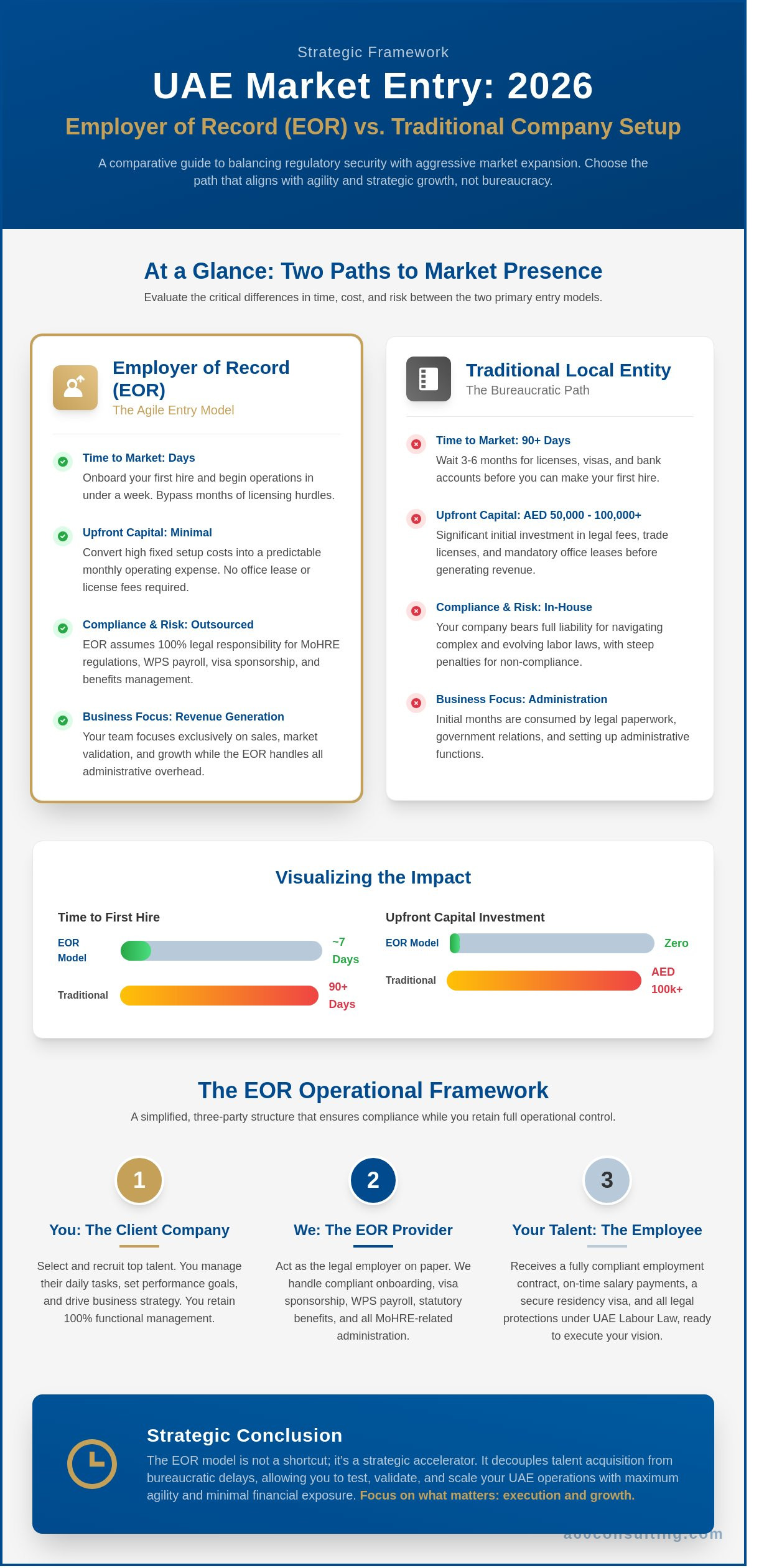
Establishing a legal entity in Dubai or Abu Dhabi requires a significant capital outlay. A standard commercial license and a basic office lease can easily exceed 50,000 د.إ to 100,000 د.إ before a single employee starts work. If a firm chooses a Free Zone that later proves restrictive for their specific client base, the cost of liquidation and relocation adds another layer of financial drain. Using an employer of record uae service eliminates these upfront capital expenditures. It converts fixed setup costs into predictable operating expenses. This ensures that capital remains focused on growth and revenue generation rather than administrative overhead during the vulnerable early stages of expansion.
Regulatory Compliance in the 2026 UAE Landscape
The Ministry of Human Resources and Emiratisation (MoHRE) has introduced increasingly sophisticated standards for employee welfare and wage protection. These standards have evolved rapidly since the landmark 2022 labor law reforms. Navigating these requirements demands localized expertise that many foreign firms don't possess internally. The EOR model provides a compliant framework where the provider assumes all legal responsibilities under national law. This includes managing the Wage Protection System (WPS), statutory benefits, and mandatory insurance. It's a structure that balances local legal demands with global operational needs. "In the UAE, an EOR acts as the legal employer on paper, while the client retains 100% functional management of the staff." This clarity allows leaders to focus on performance while the EOR manages the regulatory safety net.
Understanding the UAE Employer of Record (EOR) Model
The employer of record uae model functions as a strategic bridge between international ambitions and local compliance. It involves three distinct parties working in a synchronized framework. The EOR provider serves as the legal employer on paper. The client company retains full operational control over the employee’s daily tasks and performance. The employee receives all legal protections and benefits required by UAE Labor Law. This structure is a vital component of a successful UAE market entry strategy. It allows businesses to deploy talent without the 6 to 9 month lead time often required to establish a local legal entity.
A common misconception suggests this model only suits remote junior staff or temporary contractors. Current market data for 2025 and 2026 shows a different reality. Approximately 45% of EOR placements in the UAE now involve specialized technical roles or regional management positions. The EOR manages the Wage Protection System (WPS) requirements. This electronic salary transfer system, overseen by the Ministry of Human Resources and Emiratisation (MOHRE), ensures that 100% of employees receive their contracted pay on time. Failure to comply with WPS can lead to immediate administrative blocks and fines starting from AED 5,000 per employee.
Visa Sponsorship and Residency Permits
The EOR entity sponsors the employee's residency, managing the entire lifecycle from the initial entry permit to the final Emirates ID issuance. For 2026, the focus remains on aligning talent with specific visa categories, including standard two-year work permits and support for specialized talent pathways. The process includes mandatory health screenings and securing compliant medical insurance. This is a legal prerequisite for residency in emirates like Dubai and Abu Dhabi. The EOR ensures all documentation meets the latest MOHRE standards, preventing delays in talent deployment.
Payroll, Benefits, and Gratuity Management
Compliance extends beyond monthly pay. The employer of record uae calculates and accrues End-of-Service Benefits, commonly known as gratuity. Under Federal Decree-Law No. 33 of 2021, this is calculated based on the employee's basic salary and years of service. For UAE and GCC nationals, the EOR also manages mandatory contributions to the General Pension and Social Security Authority (GPSSA). This level of administrative precision ensures that the client remains focused on growth while the EOR handles the complex financial liabilities and statutory reporting.
If you're weighing the benefits of this model against a traditional corporate setup, exploring a tailored advisory session can clarify your specific compliance needs and financial projections.
EOR vs. Local Entity: A Comparative Framework for Strategic Growth
Choosing between establishing a local subsidiary and partnering with an employer of record uae is a fundamental strategic decision that dictates a firm's trajectory in the region. Speed defines the primary difference. A legal entity setup in Dubai or Abu Dhabi typically demands 8 to 12 weeks of administrative processing, involving physical office leases and minimum capital deposits that can often exceed AED 100,000. Conversely, an EOR model bypasses these hurdles, enabling a company to onboard talent and begin operations in as little as 48 hours.
The financial commitment varies significantly between these two paths. Entity ownership involves recurring costs for trade license renewals, corporate bank account maintenance, and mandatory local audits. For many organizations, the tipping point for transitioning from an EOR to a standalone entity occurs when the local headcount reaches 10 to 15 employees. At this scale, the cumulative service fees of an EOR may begin to exceed the fixed overhead of a dedicated corporate structure. Until that threshold is met, the EOR provides a lean, risk-mitigated vehicle for expansion.
Flexibility and Market Testing
For manufacturers of complex industrial products or specialized technology providers, the UAE represents a high-potential but nuanced environment. An EOR allows for low-stakes market testing without the long-term liability of a commercial lease. A firm can hire a single, high-level sales manager to build a regional pipeline and validate demand before committing to a full-scale regional headquarters. This agile approach is a core component of a modern 2026 GCC Market Entry Strategy, where capital efficiency and rapid pivoting are prioritized over rigid corporate structures.
Operational Control and Intellectual Property
A common concern for leadership teams involves the security of intellectual property (IP) when a third party serves as the legal employer. It's a misconception that using an employer of record uae diminishes control. Robust service agreements ensure that all work product, proprietary data, and client relationships remain the exclusive property of the client. These contracts are designed to align with UAE private sector employment regulations, providing a clear legal bridge between the EOR, the employee, and the end-user company.
Managing remote teams within the UAE regulatory environment requires a balance of digital oversight and local compliance. While the EOR handles the technicalities of the Wage Protection System (WPS) and statutory benefits, the client maintains full day-to-day functional authority. This division of labor allows the client to focus on performance and culture while the EOR manages the administrative complexities of Federal Decree Law No. 33 of 2021.
Implementing an EOR Solution: Compliance and Best Practices
Transitioning from the strategic decision of expansion to the actual implementation of an employer of record uae requires a shift in focus toward operational precision. Selecting a partner is not merely a procurement task; it is a search for a cultural bridge. In the Gulf Cooperation Council (GCC), business success is frequently built on "Wasta," a term describing the influence and networks that facilitate administrative processes. A partner with deep local roots can navigate these informal networks to resolve visa bottlenecks or labor department queries that standard digital platforms might miss.
Selecting the Right EOR Partner
Decision-makers must distinguish between global "aggregator" models and local boutique providers. Aggregators often outsource the actual employment to third parties, which can dilute the quality of support and increase response times. In contrast, a boutique provider with direct UAE licenses offers greater transparency and accountability. When vetting potential partners, use this checklist to ensure stability and compliance:
- License Validity: Verify the provider holds a specific "On-demand Labor Supply" license issued by the relevant UAE licensing authority.
- Financial Stability: Request evidence of their ability to handle payroll cycles exceeding 500,000 AED without liquidity issues.
- Regional Synergy: If your growth strategy includes neighboring markets, ensure they have a business development partner in Saudi Arabia to maintain consistency across your Middle Eastern operations.
Managing the Transition and Onboarding
The onboarding phase is where the employee’s perception of your company is solidified. From the worker’s perspective, the employer of record uae should feel like a silent facilitator rather than a distant landlord. The foreign parent company must provide specific documentation to initiate this process, including legalized Articles of Association, a Certificate of Incumbency, and a Power of Attorney for the EOR to act on their behalf. Utilizing Insta Notary Services can expedite the handling of these legal documents, which often require attestation by the UAE Ministry of Foreign Affairs (MOFA), a process that can take 5 to 10 business days.
To integrate EOR employees into your corporate culture, involve them in all internal communications and town halls. While the EOR manages the legalities of payroll and benefits, you remain responsible for daily management and performance reviews. If disciplinary actions become necessary, they must be executed through the EOR to ensure compliance with Federal Decree-Law No. 33 of 2021. This dual approach protects your legal standing while fostering a sense of belonging among your remote team.
Effective implementation requires more than just a contract; it requires a partner who understands the nuances of the Emirati market. Consult with A60 Consulting FZ-LLC to ensure your UAE expansion is built on a foundation of compliance and strategic depth.
Beyond Administration: Leveraging EOR for Rapid Sales Execution
While many organizations view the employer of record uae model as a back-office compliance solution, high-growth firms treat it as a high-performance engine room. This shift in perspective moves the EOR from a cost center to a revenue driver. By outsourcing the administrative burden of payroll, labor law compliance, and visa processing, your sales team is liberated to focus entirely on market penetration. This tactical agility ensures that your entry into the Emirates isn't stalled by bureaucratic friction, but is instead characterized by rapid, measurable execution.
The "Local Face" Advantage
UAE business culture places a premium on physical presence and long-term commitment. Clients in sectors like energy, finance, and technology often prefer dealing with representatives who are locally based and easily accessible. An EOR provides the residency status and legal framework your team needs to be on the ground permanently. This changes the dynamic of B2B negotiations from a remote transaction to a local partnership. It allows your staff to navigate the nuances of local protocol and build the rapport required for high-value contracts. "In the Gulf, business is built on trust; an EOR allows you to be present for the coffee meetings that close the deals." Having a resident visa and a local mobile number transforms a foreign representative into a credible, local participant in the UAE economy.
Scaling the Sales Pipeline
Traditional expansion typically requires a physical office lease and a long-term commercial license, which can demand significant upfront capital in AED. An EOR allows you to hire a regional sales team without these heavy overheads. This model offers several strategic benefits for scaling:
- Speed of Implementation: You can onboard a full sales team in days rather than the months required for company incorporation.
- Resource Reallocation: Capital that would be locked in office deposits or trade license fees can be redirected toward marketing and lead generation.
- Market Responsiveness: If a specific sector shows sudden growth, you can add headcount immediately to capture the momentum without renegotiating leases.
A60’s sales enablement methodology creates a powerful synergy with the EOR model. While the EOR handles the legalities of employment, our strategic framework ensures that these hires are integrated into a system designed for sustainable growth. This combination bridges the gap between a theoretical market entry plan and a functional, revenue-generating operation. EOR is the bridge from strategy to implementation. It provides the structural stability needed to turn a vision for UAE expansion into a tangible competitive advantage.
Secure Your Strategic Foothold in the UAE Market
Entering the United Arab Emirates requires more than just a legal presence; it demands a synchronization of strategy and rapid execution. Many leaders realize that immediate entity setup often creates unnecessary friction. By leveraging a professional employer of record uae model, your organization can bypass administrative bottlenecks and focus on building local alliances. This approach ensures your team is operational while maintaining full compliance with evolving 2026 labor regulations.
Success in the GCC depends on navigating complex product and software sectors with precision. A60 Consulting brings 30+ years of regional experience to bridge the gap between your global vision and local implementation. We've built a proven track record of helping companies scale through measured, fact-based transitions. Let's transform your market entry from a logistical challenge into a sustainable competitive advantage.
Partner with A60 Consulting to navigate your UAE market entry with strategic precision.
Your growth in this region is a long-term journey, and we're ready to ensure every step is grounded in excellence.
Frequently Asked Questions
Is an Employer of Record (EOR) legal in the UAE?
Yes, the use of an employer of record uae is a fully legal and regulated practice under the UAE Labor Law. The Ministry of Human Resources and Emiratisation (MOHRE) governs these arrangements through specific licensing requirements for outsourcing and recruitment entities. This framework ensures that while the EOR handles administrative and legal employment duties, your company maintains day-to-day operational control over the staff.
What is the difference between an EOR and a PEO in the UAE?
The primary distinction is that an EOR serves as the sole legal employer of your staff, while a PEO operates under a co-employment model. Using a PEO requires you to have your own legal entity registered in the UAE. In contrast, an EOR allows you to hire talent without establishing a local branch, as they take full responsibility for payroll, visas, and compliance.
How much does an Employer of Record cost in the UAE?
EOR pricing in the UAE generally consists of a fixed monthly management fee per employee added to the total cost of employment. This total includes the employee's gross salary, mandatory health insurance premiums, and statutory contributions like the End-of-Service Gratuity. You'll also need to account for government processing fees for work permits and residency visas issued by the relevant authorities.
Can an EOR in the UAE sponsor work visas for my employees?
Yes, an EOR acts as the official sponsor for your employees' work permits and residency visas. They manage the entire administrative lifecycle, from applying for the initial entry permit to coordinating the mandatory medical fitness tests and biometrics for the Emirates ID. This arrangement allows your team members to live and work legally in the UAE without your firm needing a local sponsorship license.
Does using an EOR protect my company from permanent establishment (PE) risks?
Utilizing an employer of record uae significantly reduces your risk of creating a permanent establishment, though it doesn't eliminate it entirely. Tax authorities look at the nature of the work performed; if employees conclude contracts or generate direct revenue, PE risks remain. We recommend a strategic review of your team's local activities to ensure compliance with the UAE's Corporate Tax Law introduced in June 2023.
How long does it take to onboard an employee through an EOR in the UAE?
Onboarding typically takes between 15 and 30 days from the moment the employment contract is signed. This timeline accounts for the standard processing periods for MOHRE work permits and the residency visa stamping process. If an employee is already in the UAE on a transferable visa, the transition often happens faster than for those arriving from abroad.
What happens to the End-of-Service Gratuity when using an EOR?
The EOR assumes the legal obligation to calculate and pay the End-of-Service Gratuity as mandated by the UAE Labor Law. Under Federal Decree-Law No. 33 of 2021, employees who complete one year of service are entitled to this severance pay. Most EOR providers include a monthly accrual for this liability in their billing to ensure the funds are available when the employment ends.
Can I use an EOR to hire both UAE nationals and expats?
You can hire both expatriates and UAE nationals through an EOR, provided the partner complies with Nafis program requirements. Hiring UAE nationals involves specific pension contributions through GPSSA or the Abu Dhabi Pension Fund, which differ from expat benefits. It's vital to ensure your EOR partner understands the latest Emiratisation quotas to help you contribute to local talent goals effectively. To further support these initiatives and help bridge the gap for the next generation of professionals, check out The Bedrock Program.