
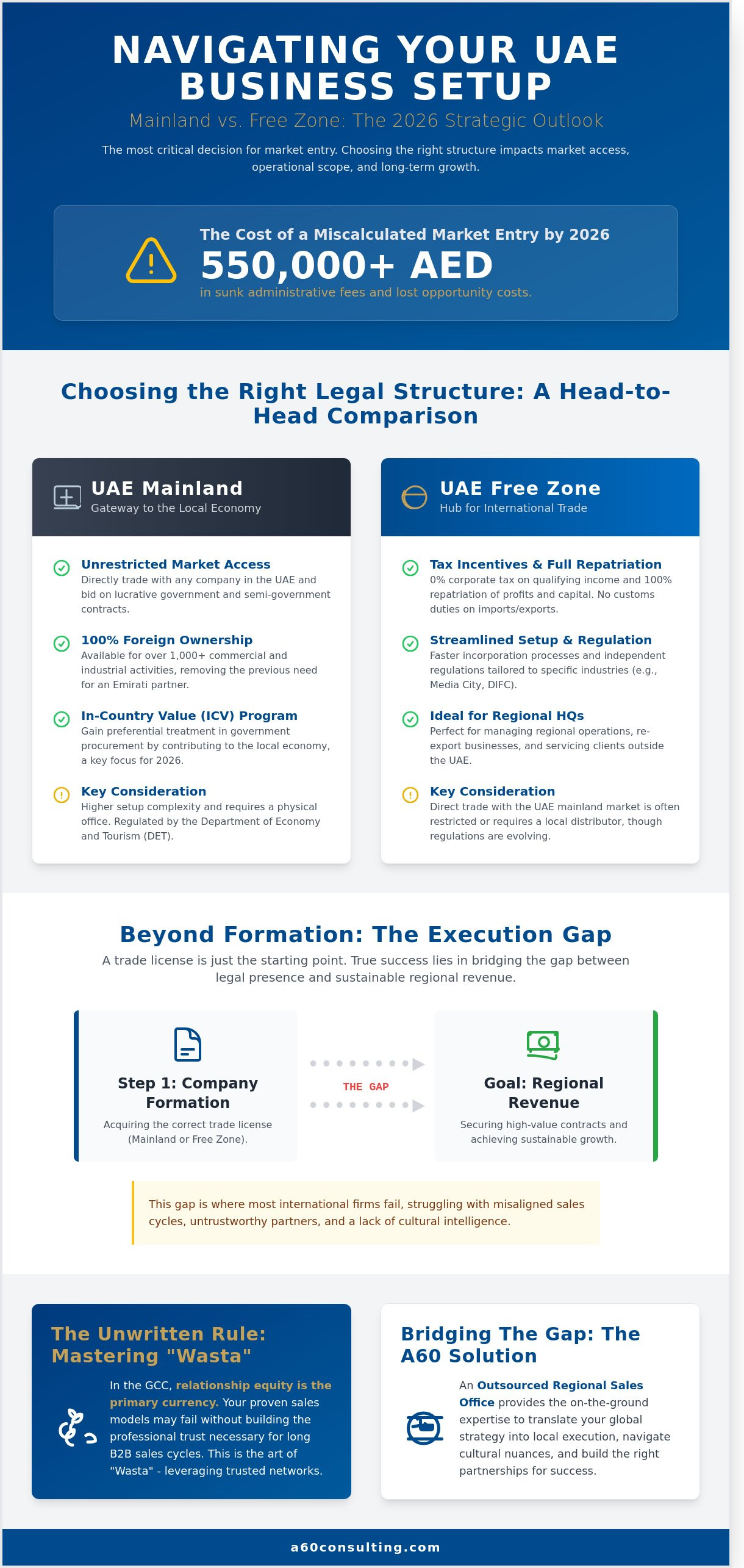
By 2026, a miscalculated market entry in the UAE can easily cost a firm upwards of 550,000 AED in sunk administrative fees and lost opportunity costs before a single contract is signed. While the Emirates remains the premier gateway to the Middle East, many European and US executives find that their proven sales models fail to translate in a market where relationship equity is the primary currency. You likely understand that a legal presence is just the starting point, yet the bridge to sustainable regional revenue often remains elusive.
This guide provides a strategic framework for doing business in dubai by aligning your global objectives with the specific cultural and regulatory nuances of the GCC. You'll learn how to transform a standard trade license into a high-performance regional hub while avoiding the common pitfalls of misaligned sales cycles and untrustworthy partnerships. We'll examine the 2026 regulatory shifts, the criteria for selecting reliable local allies, and a validated roadmap to secure high-value contracts without incurring massive overhead.
Key Takeaways
- Understand how the D33 Economic Agenda is reshaping the UAE market, moving beyond tax incentives to establish Dubai as a global commercial hub for 2026.
- Evaluate the strategic trade-offs between Mainland and Free Zone structures to ensure your legal framework supports 100% ownership while maximizing regional market access.
- Identify the critical "execution gap" that often stalls growth when doing business in dubai, ensuring your trade license translates into active regional revenue.
- Master the art of "Wasta" and relationship-based selling to build the professional trust necessary for navigating complex B2B sales cycles in the Gulf.
- Discover how an outsourced regional sales office can bridge the distance between your global strategy and local implementation through expert on-the-ground management.
Understanding the Dubai Business Landscape: More Than Just a Tax Haven
Dubai has evolved far beyond its historical reputation as a simple tax-efficient jurisdiction. By 2026, the city has solidified its position as the primary commercial nexus for the Middle East, Africa, and South Asia (MEASA) region. Success in doing business in dubai now requires a deep understanding of the emirate's strategic shift from a trade-only hub to a global center for high-value innovation and advanced manufacturing. Strategic leaders must distinguish between merely having a "presence", which often amounts to a registered entity and a local address, and achieving true "market penetration." The latter involves active participation in the local ecosystem, forming strategic partnerships, and aligning with national development goals.
The introduction of a 9% corporate tax in June 2023 marked a turning point in the city's economic maturity. This move aligned the UAE with international standards while maintaining a competitive edge. It's no longer just about capital preservation; it's about capital growth within a transparent, highly regulated, and world-class business environment. Dubai's diversified economy has moved toward a model where digital transformation and productivity gains drive over 50% of annual growth, making it a fertile ground for companies that offer measurable efficiency and technological depth.
The D33 Agenda and 2026 Economic Goals
The Dubai Economic Agenda (D33), launched in January 2023, serves as the definitive roadmap for the city's current trajectory. The agenda aims to double the size of Dubai's economy to AED 32 trillion by 2033. As we move through 2026, the focus has intensified on integrating advanced technologies into the manufacturing and logistics sectors. Government procurement priorities now heavily favor companies that contribute to the "In-Country Value" (ICV) program. This means businesses that invest in local talent and sustainable supply chains receive preferential treatment in large-scale projects. Incentives are particularly aggressive for companies specializing in green energy and sustainable industrial processes, as the UAE continues to lead regional decarbonization efforts following its COP28 commitments.
Dubai as a Regional Gateway to the GCC
Dubai acts as a sophisticated logistical and administrative launchpad for the wider GCC, particularly for firms eyeing the massive infrastructure projects in Saudi Arabia. While Riyadh is rapidly opening its doors, Dubai provides a seasoned regulatory environment and the lifestyle infrastructure that regional headquarters require to attract global talent. The UAE's Comprehensive Economic Partnership Agreements (CEPA) with India and the established trade corridors with Israel have created a unique multi-lateral trade environment. Businesses leverage these agreements to move goods and capital across borders with significantly reduced friction. By 2026, the regulatory alignment within the Gulf has improved, yet Dubai remains the most efficient point of entry for managing cross-border operations and complex regional supply chains.
Choosing the Right Legal Structure: Mainland vs. Free Zone in 2026
The decision of where to incorporate is the most significant strategic hurdle for those doing business in dubai. By 2026, the historical gap between these two structures has narrowed, yet the operational implications remain distinct. The landmark 2021 amendment to the Commercial Companies Law, which permitted 100% foreign ownership for over 1,000 commercial and industrial activities, removed the requirement for a local Emirati partner in most sectors. This shift transformed the mainland from a restricted zone into a competitive global hub, forcing leaders to weigh market access against specific regulatory benefits.
The transition from "offshore" mentalities to "onshore" operational reality is now complete. Regulators expect substance, transparency, and a clear link between a company's legal home and its actual economic activity. Choosing the wrong path doesn't just result in administrative friction; it can limit your firm's growth trajectory for years. Strategic leaders must evaluate their 2026 goals against the following frameworks.
UAE Mainland: Accessing Local and Government Contracts
A Department of Economy and Tourism (DET) license is the primary gateway for companies targeting the local UAE market or government procurement. Since the 2022 update to the In-Country Value (ICV) program, businesses aiming for federal tenders must demonstrate their contribution to the local economy. Mainland entities find this easier to achieve through local hiring and physical infrastructure. Operating onshore requires a registered physical office space, typically starting at a minimum of 200 square feet. This physical footprint isn't just a regulatory checkbox; it's a signal of long-term commitment to the regional market. For organizations focused on large-scale infrastructure or public sector consulting, the mainland structure provides the necessary legal standing to compete. You can assess your eligibility for mainland ownership with our strategic framework.
Free Zones: Specialized Hubs for Global Tech and Trade
Free Zones serve as specialized ecosystems designed for specific industries. The Dubai International Financial Centre (DIFC) and the Dubai Multi Commodities Centre (DMCC) offer regulations tailored to finance and global trade. While these zones offer 100% profit repatriation and a 0% tax rate for "Qualifying Free Zone Persons" under the June 2023 Corporate Tax Law, they come with geographic limits. A Free Zone company can't legally trade directly with the mainland without a local distributor or a mainland branch. This structure suits firms doing business in dubai that use the city as a regional headquarters for international operations. By 2026, the focus has shifted from simple tax avoidance to regulatory alignment. Choosing the right hub requires a deep dive into the specific "Implementing Regulations" of each zone to ensure long-term compliance and operational efficiency.
The "Execution Gap": Why Company Formation is Only Step One
Many executives mistakenly believe that securing a trade license marks the completion of their market entry. This mindset creates a dangerous "execution gap" where capital is drained by fixed costs without a corresponding revenue engine. Data from regional business monitors indicates that approximately 60% of foreign small-to-medium enterprises fail to achieve break-even within their first 18 months. This failure rarely stems from a poor product. Instead, it's the result of a passive presence that treats the UAE as a satellite office rather than a primary growth driver.
The hidden costs of a "wait-and-see" approach are substantial. Maintenance for a physical office, mandatory insurance, and staff visas can easily exceed AED 200,000 annually before a single contract is signed. Success in doing business in dubai requires a shift in focus from administrative milestones toward active sales enablement. Organizations must bridge the distance between having the legal right to operate and having the operational capacity to win. To learn more about overcoming these growth obstacles, visit Top7.
- Administrative Trap: Over-investing in high-end office fit-outs before validating the local value proposition.
- Underestimated Burn Rate: Failing to account for the high cost of talent acquisition and the 12-month advance rent typical in commercial real estate.
- Cultural Misalignment: Relying on digital-only outreach in a market that prioritizes face-to-face trust.
Building a Sustainable Sales Pipeline in the Middle East
Lead generation in the GCC relies on high-touch engagement. European and US firms often struggle because they attempt to export automated digital funnels that lack the personal touch required here. Technical sales management is vital in complex categories like fintech or industrial automation. You'll find that high-value contracts often involve sales cycles lasting 12 to 24 months. Managing this requires a localized CRM strategy that accounts for multiple government stakeholders and the unique rhythm of regional decision-making.
Navigating Regulatory and Trade Compliance
Compliance is a moving target. For physical goods, the Emirates Authority for Standardization and Metrology (ESMA) and the SABER platform demand rigorous documentation for every SKU. Software providers must align with the UAE Personal Data Protection Law (PDPL), specifically Federal Decree-Law No. 45 of 2021. When doing business in dubai, you must implement ongoing monitoring systems. The Ministry of Industry and Advanced Technology (MoIAT) frequently updates technical regulations, and failing to adapt can result in immediate shipment seizures or significant fines in the range of AED 50,000 to AED 1,000,000.
Effective market entry isn't a checkbox exercise. It's a continuous process of aligning your global strategy with local execution realities. Companies that survive the first 18 months are those that treat regulatory compliance and sales pipeline development as integrated functions rather than isolated tasks.
Cultural Intelligence and the Art of "Wasta" in B2B Sales
Doing business in Dubai in 2026 demands more than just a superior product or a competitive price point. It requires a mastery of Wasta. This concept isn't merely about "who you know" in a transactional sense. It's a sophisticated system of social credit and reciprocal trust. Despite the rapid digitization of the UAE economy, the human element remains the ultimate gatekeeper for high-value B2B contracts. If you treat Dubai as a remote market to be managed via video calls, you'll likely struggle against competitors who invest in physical presence. Trust is the primary currency here.
The "fly-in, fly-out" approach is a strategic failure. Data from regional market entries suggests that firms with a consistent, local executive presence see a 40% faster path to profitability compared to those operating remotely. Local partners want to see skin in the game. They're looking for a commitment to the UAE's long-term vision, specifically the D33 economic goals that aim to double the size of Dubai's economy by 2033. Success in doing business in Dubai relies on your ability to bridge the gap between Western efficiency and Middle Eastern relationship dynamics.
Relationship-Based Selling: The "Majlis" Culture in Business
Business in the UAE often happens in the "Majlis", a space where hospitality and strategy intersect. Patience is your most valuable asset. High-level negotiations rarely start with a slide deck. They begin with personal rapport. You'll likely spend the first few meetings discussing history, family, and values. This isn't wasted time; it's the most critical phase of due diligence. Etiquette dictates that you never rush to discuss commercial terms. Wait for your host to signal the transition from social to professional topics. Rushing signals that you prioritize the transaction over the partnership.
Identifying and Vetting the Right Local Distributors
The regulatory environment changed significantly with the Federal Decree-Law No. 34 of 2022. This law provides more flexibility for international brands, but the choice of a distributor remains high-stakes. You must distinguish between a "sleeping" agent and a strategic partner. A partner who doesn't offer measurable market intelligence is a bottleneck, not a bridge. Your commercial incentives must be structured to reward active market share growth rather than passive representation. Consider these vetting criteria:
- Review their G2B (Government-to-Business) track record and existing network.
- Assess their capacity for technical implementation and after-sales support in AED-denominated contracts.
- Audit their compliance with the latest UAE corporate tax regulations and ESG reporting standards.
- Verify their ability to navigate the 2023 Commercial Agencies Law during contract renewals.
Selecting the wrong partner can lead to years of litigation or market stagnation. It's better to spend six months vetting a partner than six years trying to exit a bad agreement. Professional due diligence looks beyond the balance sheet to evaluate the partner's actual influence and operational readiness.
Strategic Growth with A60 Consulting: Your Regional Sales Office
The final stage of expansion isn't found in a report; it's realized through consistent revenue and local market integration. By 2026, the complexity of doing business in Dubai has evolved beyond simple registration. Success now depends on the ability to bridge the gap between high-level strategy and daily operational execution. Many organizations utilize michelboutinstudio to refine their high-level strategies for growth, while A60 Consulting operates as your regional sales office, providing the professional calmness and strategic depth required to navigate the United Arab Emirates' competitive landscape. We don't just offer advice. We take responsibility for the implementation of your growth objectives.
Performance-Linked Sales Representation
Establishing a full local subsidiary often requires an initial capital outlay exceeding 180,000 AED for licensing, office space, and specialized staff before a single contract is signed. Our model replaces this fixed overhead with a variable, success-based structure. We act as the local face for international tech and software firms, managing everything from initial lead generation to the final contract closing. This approach aligns our incentives directly with your revenue targets. It's a partnership where our success is inseparable from yours. By utilizing our existing infrastructure, you gain an immediate physical presence in Dubai, ensuring your brand carries the weight of a local entity from day one.
Bridging the Strategy-Execution Divide
Strategic failure rarely happens during the planning phase; it occurs during the transition to the field. We've refined a methodology that ensures your Go-To-Market strategy survives the first contact with the local market. In a recent engagement, we scaled a complex manufacturer across the GCC by moving from a purely theoretical entry plan to an active sales cycle within 90 days. We secured 12 major accounts within the first 14 months, proving that a measured, fact-based approach beats aggressive, uncoordinated expansion. Our team provides ongoing market support and account management, ensuring that your doing business in Dubai remains sustainable and profitable over the long term.
We invite you to move beyond the planning phase and start building your regional footprint with a partner who understands the nuances of the Gulf market. To begin this process, schedule a market feasibility assessment with A60 Consulting today. We'll analyze your current position and define the specific steps needed to transform your strategic goals into measurable local results.
- Reduction of market entry risk through performance-linked commission models.
- Immediate access to a network of regional decision-makers and stakeholders.
- Expert management of the entire sales funnel, from prospecting to closing.
- Transformation of fixed entry costs into scalable, results-oriented investments.
Turning Dubai’s Strategic Vision into Your Commercial Reality
Success in 2026 requires more than just securing a trade license; it demands precise alignment with the Dubai Economic Agenda (D33). You've seen that the real challenge isn't the legal setup, but the execution gap that follows. Effectively doing business in dubai depends on your team's ability to navigate local B2B sales cycles and build the "Wasta" necessary for long-term growth. It's a landscape where cultural intelligence is just as valuable as your technical product specifications.
A60 Consulting provides the strategic depth needed to bridge this gap. With over 30 years of regional experience in the GCC, we specialize in scaling complex tech and industrial software firms within the UAE market. We don't believe in one-size-fits-all advice. Instead, we offer performance-linked fee structures that ensure our goals remain perfectly aligned with your measurable results. This approach transforms a standard market entry into a sustainable regional presence.
Your expansion deserves a partner who understands the nuances of the Emirates. Partner with A60 Consulting for your GCC Market Entry and start building your future in the region today.
Frequently Asked Questions
Is 100% foreign ownership available for all business types in Dubai?
You can own 100% of your company for over 1,000 commercial and industrial activities following the 2020 amendment to the Commercial Companies Law. This change removed the requirement for a UAE national to hold a 51% stake in most mainland entities. Certain strategic sectors like oil and gas, security, and defense still require local participation based on specific regulatory approvals.
What is the average time to set up a business in Dubai in 2026?
Digital transformation has reduced the setup time to as little as 15 minutes for an "Instant License" through the Invest in Dubai platform. For complex operations requiring physical premises or specialized permits, the process typically takes 5 to 10 working days. You'll need to account for additional time if your activity requires approvals from the Dubai Health Authority or the Knowledge and Human Development Authority.
Do I need a local partner (Emirati sponsor) to do business in Dubai?
You don't need a local partner for the vast majority of commercial ventures since the 2021 regulatory reforms. While professional licenses sometimes require a Local Service Agent to handle administrative tasks, they don't take equity in your firm. This legal shift has significantly lowered the cost and complexity of doing business in Dubai for international entrepreneurs.
What is the difference between a Mainland and a Free Zone company?
Mainland companies can trade directly with the local UAE market and bid for government contracts without restrictions. Free Zone companies are restricted to trading within their specific zone or internationally, though they benefit from 100% import and export tax exemptions. Dubai currently hosts over 40 specialized Free Zones, each tailored to specific industries like technology, media, or logistics.
How does corporate tax work for foreign companies in the UAE?
The UAE applies a standard corporate tax rate of 9% on taxable profits exceeding AED 375,000. Small businesses with a gross revenue below AED 3 million can apply for Small Business Relief, which stays in effect until December 2026. Free Zone entities may qualify for a 0% rate on income derived from transactions with parties outside the UAE or other Free Zone companies.
What are the most promising sectors for investment in Dubai right now?
The Dubai Economic Agenda D33 identifies digital economy, green energy, and advanced manufacturing as primary growth drivers. Fintech and sustainable technology are particularly lucrative, with the city aiming to double its economy by 2033. Doing business in Dubai within the logistics sector remains highly profitable, as the 2025 budget allocated AED 82.2 billion to improve infrastructure and social development.
Can a Dubai-based company easily expand into Saudi Arabia?
You can expand into Saudi Arabia, but you must register a separate legal entity through the Saudi Ministry of Investment (MISA). The Saudi RHQ program requires companies to establish their regional headquarters in Riyadh to bid on government contracts exceeding AED 1 million. While the GCC Unified Economic Agreement simplifies customs, legal and labor regulations remain distinct between the two nations.
What is the "Wasta" and how does it affect business development?
Wasta describes the use of social networks and personal connections to facilitate business transactions and administrative hurdles. It's a cultural pillar that prioritizes trust and long-term relationships over purely transactional interactions. Roughly 80% of successful market entries in the region involve some level of local networking to navigate the nuances of the regulatory environment and secure key partnerships.