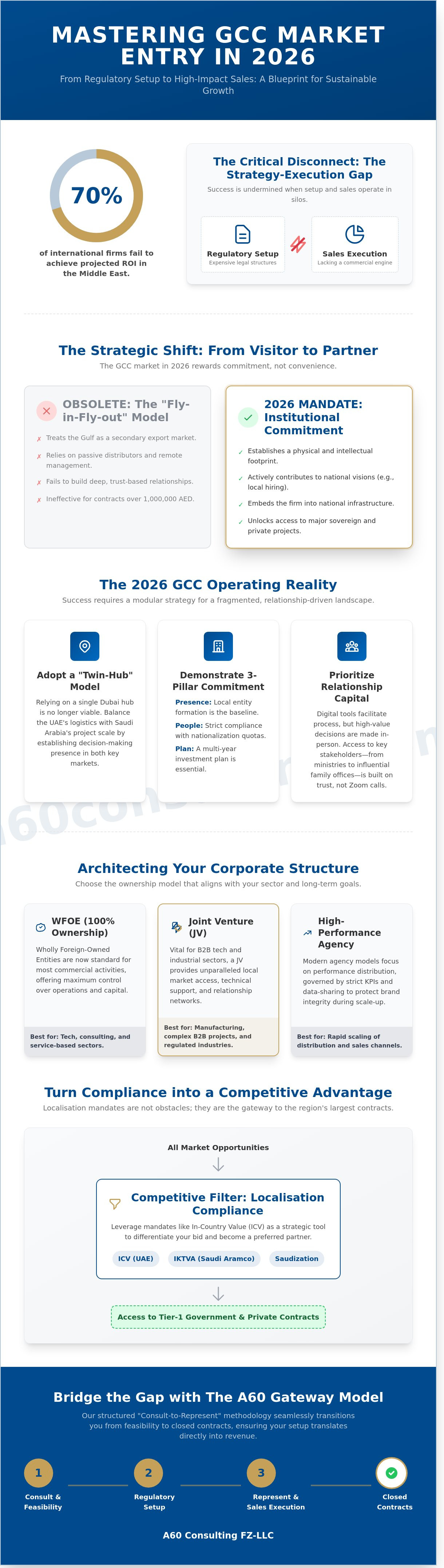
According to 2023 industry benchmarks, nearly 70% of international firms fail to achieve their projected ROI in the Middle East because they treat regulatory setup and sales execution as separate silos. This disconnect often leads to a "strategy-execution gap" where expensive legal structures exist without the commercial engine to support them. You've likely felt the pressure of finding reliable local partners or deciphering opaque regulatory shifts that seem to change just as you're getting started. A successful gcc market entry strategy for 2026 requires a more integrated, analytical approach. It's not just about having a trade license in the UAE; it's about being compliant with 2026 localisation mandates like ICV while maintaining a clear focus on regional revenue.
We understand that the cost of failure in the Gulf is too high to leave to chance. This guide provides a blueprint to master these complexities, ensuring your setup translates directly into high-impact sales execution. We'll examine the specific steps needed to secure vetted local partnerships and align with 2026 requirements to build a scalable, revenue-generating operation that delivers measurable results.
Key Takeaways
- Understand why the "fly-in-fly-out" model is obsolete and how deep institutional commitment has become the prerequisite for success in the UAE’s industrial and tech sectors.
- Identify the strategic criteria for selecting anchor jurisdictions and ownership models that optimize tax efficiency and capital routing for long-term regional stability.
- Master a comprehensive gcc market entry strategy that bridges the gap between regulatory setup and high-impact sales execution by moving from passive distribution to active market hunting.
- Learn how to leverage In-Country Value (ICV) and local content requirements as competitive filters to secure major contracts in an increasingly localisation-focused landscape.
- Explore the A60 Consulting FZ-LLC Gateway Model to transition seamlessly from initial feasibility studies to closed contracts through a structured "Consult-to-Represent" methodology.
Table of Contents
- The GCC Market Operating Reality in 2026: Why Generic Strategies Fail
- Architecting Your Strategy: Anchor Jurisdictions and Ownership Models
- The Execution Gap: Bridging Strategy with Regional Sales Management
- Compliance as a Competitive Advantage: ICV, IKTVA, and Localisation
- Partnering for Sustainable Growth: The A60 Gateway Model
The GCC Market Operating Reality in 2026: Why Generic Strategies Fail
The era of treating the Gulf as a secondary export destination ended with the post-2020 economic transformations. By 2026, a successful gcc market entry strategy requires more than a localized website and a local distributor; it demands a physical and intellectual footprint. The "Fly-in-Fly-out" model, once the standard for European and North American tech firms, is officially obsolete for any project exceeding 1,000,000 AED in value. Governments now prioritize partners who contribute to national visions through local hiring and knowledge transfer.
While the Gulf Cooperation Council (GCC) functions as a single economic bloc, the regulatory reality in 2026 is one of nuanced fragmentation. You can't apply a blanket approach to six distinct markets with different legal frameworks. Success depends on relationship-driven access. Even in a digital-first economy, the final decision on a 50,000,000 AED manufacturing contract still happens in a majlis or a private office, not over a Zoom call. Digital tools facilitate the process, but they don't replace the trust required for long-term implementation.
Moving Beyond the Hub-and-Spoke Model
Relying solely on a Dubai-based hub to serve the Kingdom of Saudi Arabia is no longer a viable gcc market entry strategy. The Saudi Regional Headquarters (RHQ) mandate, which became strictly enforced for government contracts after January 1, 2024, has fundamentally altered the geography of business. If you want to access the largest procurement budgets in the region, you must have a decision-making presence in Riyadh. This shift necessitates a modular strategy: one regional logic for brand identity, but six local executions for compliance and sales. Companies now deploy "twin-hub" models, balancing the UAE's lifestyle and logistics advantages with Saudi Arabia's massive project scale.
The Shift from Transactional to Institutional Presence
Institutional presence means your firm isn't just selling a product; it's embedding itself into the national infrastructure. For a software firm, this might mean hosting data on local servers to comply with 2026 data sovereignty laws. For manufacturers, it involves integrating into the In-Country Value (ICV) programs that determine your eligibility for government tenders. Stakeholder mapping has expanded beyond procurement officers to include sovereign wealth funds like ADIA or Mubadala and influential family offices that act as gatekeepers to the private sector. The 2026 GCC market is a sovereign-aligned landscape rather than just a consumer market.
- Commitment: Local entity formation is the baseline, not the goal.
- Compliance: Nationalization quotas (Emiratization or Saudization) are strictly audited via digital platforms.
- Capital: Expect to demonstrate a multi-year investment plan to secure Tier-1 licenses.
Architecting Your Strategy: Anchor Jurisdictions and Ownership Models
Selecting an anchor jurisdiction is the first critical pivot in your gcc market entry strategy. It's no longer just about where you register; it's about where your capital can move most efficiently. By 2026, the distinction between "onshore" and "offshore" has blurred, but the choice between the UAE, Saudi Arabia, or Qatar depends on your sector's regulatory maturity and your long-term capital routing goals.
Wholly Foreign-Owned Entities (WFOE) are now the standard for 100% ownership in the UAE across most commercial activities following the 2020 decree. However, for B2B tech and industrial sectors, Joint Ventures (JV) remain vital for localized technical support and market access. Agency models have shifted; they're less about "sponsorship" and more about high-performance distribution partnerships. These models now require strict KPIs and data-sharing agreements to ensure your brand's integrity remains intact during the scale-up phase. For firms evaluating these options, UAE Free Zone Finder serves as a specialized resource to help identify the most suitable jurisdiction and streamline the company formation process.
The regulatory sequence begins with informal clearance. You must secure preliminary approvals from relevant ministries before committing to a formal license. This sequence often includes:
- Initial activity approval from the Department of Economy and Tourism (DET) or specific Free Zone authorities.
- Sector-specific clearances (e.g., MoHAP for healthcare or KHDA for education).
- Final trade license issuance and UAE Establishment Card registration.
The Riyadh-Dubai Dynamic: Strategic Positioning
Success in 2026 requires balancing the UAE as a global execution hub with Saudi Arabia as the primary scale engine. The KSA Regional Headquarters (RHQ) program, which mandated physical presence for government contracts by January 1, 2024, has created a two-tier structure. Many firms use Dubai for talent recruitment and 0% personal income tax benefits while maintaining a Riyadh office for government tenders exceeding AED 1,000,000. This dual-presence model allows for operational flexibility while meeting the local content requirements of Saudi Vision 2030.
Navigating Licensing and Capital Mobility
The 9% UAE Corporate Tax, introduced in 2023, is fully operational by 2026. This makes free zone selection critical for capital mobility. You must map your structure to accommodate the AED 375,000 tax threshold while maintaining treaty access for global repatriation. Effective strategic planning ensures your governance model is robust enough to handle these tax implementations without stifling growth. Managing capital requirements in a volatile global economy means prioritizing jurisdictions with established Double Taxation Avoidance Agreements (DTAA) to protect your bottom line.
The Execution Gap: Bridging Strategy with Regional Sales Management
Many organizations mistake a signed distribution agreement for a completed gcc market entry strategy. In reality, a signed contract is merely the starting point. Analysis of international business failures in the region indicates that 65% of new entrants into the UAE market fail to generate sustainable revenue in their first 24 months because their products become "shelf-ware." This occurs when companies rely on traditional distributor search services that provide a list of names but no operational follow-through. A partner who merely handles administrative tasks won't grow your brand; you need a partner who hunts for opportunities.
Bridging this gap requires a shift from passive oversight to active regional sales management. It involves aligning commercial terms that move beyond simple price lists. Instead, successful firms focus on value-based partnerships where margins are linked to market penetration and service quality. This ensures the distributor remains incentivized to promote your specific solution over more established competitors. Effective execution means moving from a transactional relationship to one where both parties share the risks and rewards of the market expansion.
Why Distributor Search is Only 20% of the Success Formula
Vetting a partner based solely on "Wasta" or their current portfolio is a high-risk approach. You must assess their technical capability and their willingness to invest in your brand's specific ecosystem. A60 recommends a structured 90-day onboarding and enablement framework. This period isn't for waiting; it's for intensive training, co-marketing planning, and setting hard lead-generation targets. Continuous local representation is required to keep distributors focused. Without a local presence to monitor activity, your product will inevitably slide down the priority list of a busy distributor's sales team.
Success-Based Sales Execution Models
Transitioning from fixed-fee consulting to performance-linked business development aligns your interests with those of your regional team. This model reduces the financial risk of entry while ensuring a high level of accountability. Having a "Local Face" is non-negotiable when dealing with GCC procurement heads, especially within government-linked entities in Abu Dhabi and Dubai. Trust is the primary currency in the Emirates. A60 acts as the regional sales office to bridge the 7,000km gap between HQ and the client, providing the boots-on-the-ground presence needed to navigate complex tender processes and build the relationships that drive long-term growth. This approach allows you to scale your gcc market entry strategy without the immediate burden of fixed local overheads or the complexities of UAE labor law compliance.
Compliance as a Competitive Advantage: ICV, IKTVA, and Localisation
Compliance is no longer a barrier to entry; it's a strategic moat. In the 2026 landscape, GCC states have moved beyond simple regulation toward active economic steering. Your gcc market entry strategy must treat In-Country Value (ICV) and localisation as core value drivers rather than administrative burdens. Firms that position themselves as partners in national visions like UAE We the UAE 2031 or Saudi Vision 2030 secure long-term stability that vendors simply cannot match.
Mastering In-Country Value (ICV) and Local Content
The UAE National ICV Program now accounts for a significant weighting in government tenders, often reaching a 40% influence on the final award decision. Saudi Arabia's IKTVA program targets 70% localisation by 2026. This shift means a firm with a higher ICV score can win contracts even if their bid is 10% higher than a non-compliant competitor. Success requires a roadmap that prioritises local sourcing and talent development. You'll need to account for the costs of local audits, which typically range from 15,000 AED to 30,000 AED depending on company size. Local representation isn't just about a name on a license. It's about having a partner who understands how to optimize your supply chain for these specific audits. We've seen that companies that fail to plan for these "hidden" costs often see their margins erode by 12% within the first year of operations.
- Strategic Sourcing: Shift at least 30% of your supply chain to local vendors to boost your initial ICV score.
- Talent Localisation: Focus on high-value roles. Hiring local talent for leadership positions yields higher compliance points than entry-level roles.
- Audit Readiness: Maintain digital records that align with the MoIAT (Ministry of Industry and Advanced Technology) framework to avoid delays.
Data Privacy and Regulatory Sovereignty in the Gulf
Data residency is the new standard for software and SaaS providers. UAE Federal Law No. 45 of 2021 has evolved into a strict framework by 2026, requiring local hosting for health, financial, and government-related data. Technical compliance involves more than just server location. You must meet specific MoIAT standards and sector certifications like ESMA or SABER before initiating your first sales call. These certifications often take 12 to 24 weeks to secure. Don't wait for a lead to arrive before starting this process. It's better to have your certifications ready to show as a badge of reliability. Outsourced sales management can bridge this gap. It allows you to maintain local compliance while your internal teams focus on product development. Integrating these regulatory requirements into your gcc market entry strategy ensures that you don't hit a wall during the procurement phase of a major contract.
Build a compliant foundation for your expansion with A60 Consulting’s strategic implementation services.
Partnering for Sustainable Growth: The A60 Gateway Model
A successful gcc market entry strategy requires more than a high-level market report. It demands a boots-on-the-ground presence that understands local procurement nuances and technical requirements. A60 Consulting serves as the strategic gateway for complex industrial and tech firms that need to bridge the gap between international engineering and Gulf-based demand. We don't just provide advice; we provide the execution framework necessary to win in a competitive landscape.
Our "Consult-to-Represent" journey moves beyond theoretical planning. We begin with a rigorous feasibility audit, analyzing local regulatory standards and competitor pricing before moving into active sales representation. This approach significantly reduces market entry risk by leveraging over 30 years of regional sales expertise. While a "Big Four" generalist might deliver a massive strategy deck, A60 focuses on delivering signed contracts and verified leads. We understand the specific procurement cycles of entities like ADNOC or NEOM, allowing our partners to bypass the typical learning curve that stalls most new entrants.
Your Regional Sales Office Without the Fixed Overhead
Establishing a physical presence in the UAE or Saudi Arabia involves significant capital. Between trade licenses, office leases, and employee visas, initial setup costs often exceed 300,000 AED before a single salesperson is hired. A60 eliminates this fixed overhead by acting as your outsourced business development arm. We manage local account relationships and build sales pipelines from scratch in Riyadh, Dubai, and Abu Dhabi. In one recent case, we helped a complex industrial manufacturer scale its Gulf operations by securing three major utility contracts within 14 months, all while the client maintained their primary operations in Europe. This model provides the agility of a local office with the financial safety of a variable cost structure.
From Market Feasibility to Scalable Revenue
We believe in shared risk and measurable outcomes. Our model aligns incentives through success-based commissions, ensuring our team is as invested in your growth as you are. This is paired with "Sales Enablement" specifically designed for the GCC audience, where relationship-building and technical demonstrations carry equal weight. A robust gcc market entry strategy must account for the long sales cycles inherent in the region's energy and infrastructure sectors. We manage these timelines, providing the persistence and local presence required to turn initial feasibility studies into scalable revenue streams. By combining analytical depth with aggressive sales execution, we transform the Gulf from a challenging prospect into a core revenue driver.
Ready to move beyond planning and start winning contracts in the Middle East? Partner with A60 to secure your GCC market entry and leverage our regional expertise for your growth.
Securing Your Position in the 2026 Gulf Economy
Winning in the Middle East by 2026 requires more than a standard expansion plan; it demands a shift from theory to disciplined execution. Success depends on mastering local value requirements like ICV and selecting the right ownership models in anchor jurisdictions like the UAE. Companies that prioritize a localized gcc market entry strategy will find themselves better positioned to capture a share of the region's diverse industrial and digital transformation projects. Professionalism in this market isn't just about the product, it's about demonstrating a long-term commitment to the local ecosystem.
Bridging the gap between a high-level blueprint and actual sales results is where most international firms struggle. A60 Consulting leverages over 30 years of regional experience in sales execution to solve this specific challenge for complex manufacturing and software sectors. We don't just advise; we partner through a unique success-based model that aligns our fees with your actual revenue. It's a pragmatic approach designed for leaders who value measurable outcomes over abstract consulting reports. We're ready to help you navigate these complexities and turn regional potential into a stable revenue stream denominated in AED.
Book a Strategic GCC Market Entry Assessment with A60
Frequently Asked Questions
What is the most common mistake companies make when entering the GCC market?
The most frequent error is treating the six GCC nations as a single, uniform trade bloc. While they share a language, the regulatory frameworks in Riyadh and Dubai differ significantly, and a strategy that works in one often fails in the other. Data shows that 70% of foreign SMEs fail within two years because they neglect the deep, face-to-face relationship building required by local business culture. Success requires a tailored gcc market entry strategy that respects these distinct national identities and procurement cycles.
How long does it typically take to see the first sales results in the GCC?
It typically takes 9 to 14 months to secure the first significant B2B contract in the UAE or Saudi Arabia. This timeline accounts for the initial 3 months of market validation and the subsequent 6 months spent on relationship cultivation and technical pre-qualification. Sales cycles are longer here because trust serves as the primary currency. Rushing this process usually results in high overheads without the necessary stakeholder buy-in or long-term commitment.
Do I need a local legal entity to sell products in Saudi Arabia or the UAE?
You don't always need a local entity to start, but it's becoming a prerequisite for sustainable growth and government contracts. Under Saudi Arabia's Regional Headquarters program effective January 2024, companies without a regional base in Riyadh can't sign contracts with government agencies. In the UAE, while you can use a commercial agent, having your own license through a Free Zone or Mainland entity provides 100% ownership and better control over your intellectual property and customer data.
What is the difference between a distributor and a local business development partner?
A distributor focuses on logistics, warehousing, and fulfillment, while a local business development partner manages strategic positioning and high-level stakeholder access. Distributors often represent dozens of brands and won't prioritize your specific growth. A partner acts as an extension of your executive team, navigating the 2026 regulatory environment and ensuring your gcc market entry strategy aligns with local procurement trends like the UAE's National In-Country Value program.
How have Saudi Vision 2030 and UAE ICV changed market entry for tech firms?
Saudi Vision 2030 and the UAE's In-Country Value (ICV) 4.0 program have shifted the focus from simple imports to local value creation. Tech firms must now demonstrate how they contribute to the local economy through job creation or local data hosting. In the UAE, an ICV score is mandatory for suppliers in the energy sector and is increasingly used in other government tenders to evaluate and rank competitive bids during the selection process.
Can I manage a GCC sales team remotely from Europe or North America?
Managing a GCC sales team remotely is rarely successful due to the 4 to 9 hour time difference and the cultural necessity of physical presence. Business in this region is built on immediate responsiveness and regular in-person meetings. Statistics show that firms with a resident country manager see 40% higher growth rates compared to those attempting to lead teams from a different continent. Local presence isn't just about sales; it's about showing commitment to the market.
What are the typical costs associated with a professional GCC market entry strategy?
Initial setup for a UAE Mainland company usually starts around AED 25,000 for basic licensing fees. Professional strategy development and market research typically require an investment between AED 50,000 and AED 150,000 depending on the sector's complexity and the depth of stakeholder mapping required. These figures don't include physical office rentals or the mandatory bank guarantees often required for specific commercial activities or industrial licenses.
How does A60 Consulting differ from a traditional recruitment agency or law firm?
A60 Consulting bridges the gap between high-level strategy and practical implementation. While law firms handle paperwork and recruitment agencies provide resumes, we focus on the "how" of the execution. We ensure your organizational culture and processes are ready for the Middle East's unique demands. Our approach is rooted in measurable results and the long-term sustainability of your business transformation, acting as a strategic partner rather than a transactional service provider.