
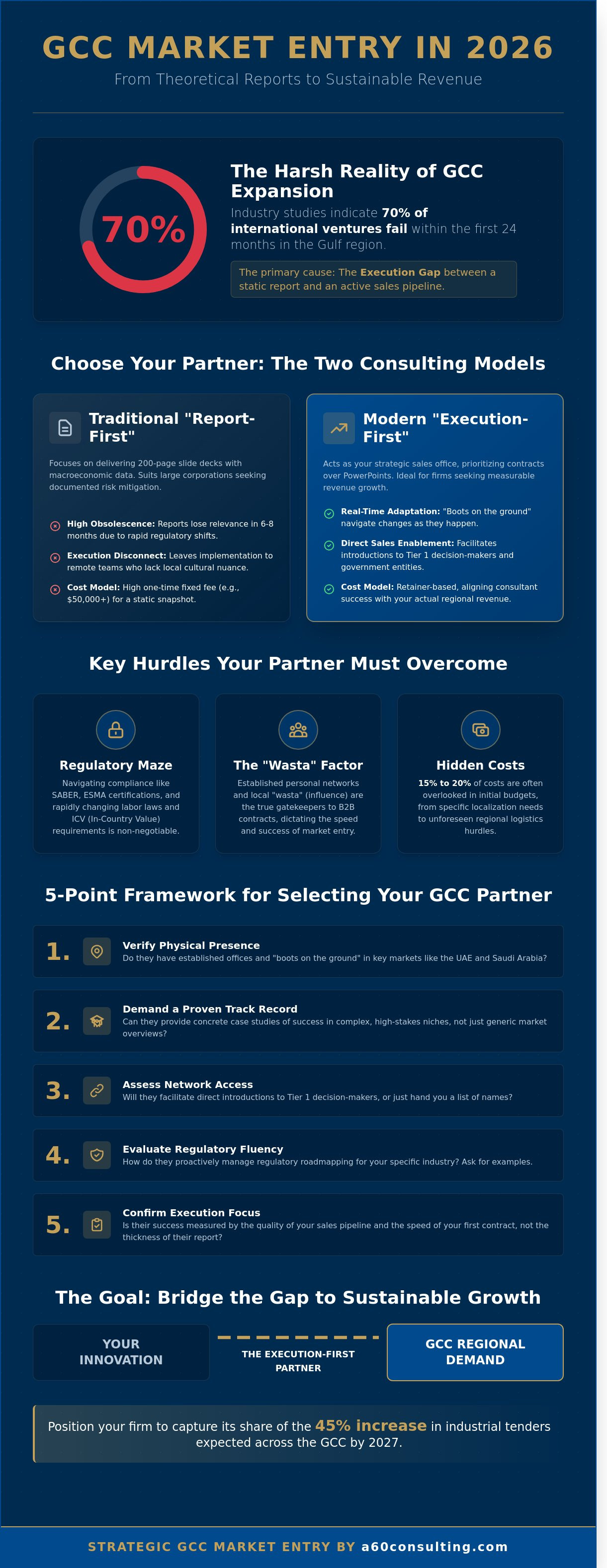
A beautiful market research report is often the most expensive paperweight a CEO will ever buy. In the Gulf region, where industry studies indicate that 70% of international business ventures fail within the first 24 months due to execution gaps, a theoretical plan simply isn't enough. You need a gcc market entry strategy consultant who prioritizes local networks and boots-on-the-ground sales over polished slide decks.
It's frustrating to watch potential momentum stall because you're thousands of miles away or stuck in the complexities of Saudi Vision 2030 and ICV requirements. You likely recognize that local "wasta" and regulatory compliance, such as SABER or ESMA certifications, are the real gatekeepers to the region. This guide promises to move you past the theory. We'll show you how to identify a strategic partner who delivers a sustainable sales pipeline and qualified distribution networks. You'll learn the 2026 benchmarks for selecting a partner who bridges the gap between a high-level strategy and actual regional implementation.
Key Takeaways
- Understand why a modern gcc market entry strategy consultant must act as a strategic bridge between your innovation and regional demand, prioritizing regulatory roadmapping over static reports.
- Evaluate the "Execution-First" boutique model against traditional research-heavy approaches to maximize the cost-to-value ratio of your consulting investment.
- Navigate the complexities of "Wasta" and local regulatory hurdles by leveraging established personal networks that dictate the speed of B2B contract acquisition.
- Utilize a specialized 5-point framework to verify a partner's physical presence and proven track record in complex niches across the UAE and Saudi Arabia.
- Learn how to bridge the gap between high-level strategy and measurable results by establishing a dedicated strategic sales office for sustainable regional growth.
What Does a GCC Market Entry Strategy Consultant Actually Do in 2026?
The role of a gcc market entry strategy consultant has shifted from providing static reports to acting as an active strategic bridge. By 2026, the Gulf Cooperation Council (GCC) has evolved into a highly competitive ecosystem where simple market presence is no longer enough for success. These experts translate foreign innovation into solutions that meet specific regional demands, such as the 2030 sustainability targets in Saudi Arabia or the digital transformation goals in Qatar. They don't just research; they build the regulatory roadmap and vet potential local partners to ensure alignment with evolving local ownership laws and cultural expectations.
In the post-2025 economy, "paper-only" strategies fail because they ignore the accelerating speed of local implementation. Entering markets like Saudi Arabia or Kuwait involves high financial stakes. A consultant reduces this risk by identifying the 15% to 20% of hidden costs often overlooked in initial budgets, such as specific localization requirements or regional logistics hurdles. They ensure that your entry is grounded in the reality of the 2026 regulatory environment, where compliance is non-negotiable and pace is everything.
The Core Pillars of a Modern Entry Strategy
Effective strategies rely on real-time regional data rather than generic assumptions. Consultants now focus on "local champions" and massive projects funded by sovereign wealth funds like PIF or ADIA. You need a tailored 2026 GCC market entry strategy that accounts for sector-specific nuances. Modern consulting pillars include:
- Feasibility studies: Using 2025 and 2026 economic forecasts to validate demand.
- Competitive landscape analysis: Mapping the influence of local conglomerates and state-backed entities.
- Regulatory roadmapping: Navigating the latest labor laws and tax treaties across the six member states.
Beyond Information: The Shift to Sales Enablement
Information is a commodity; execution is the currency of 2026. A modern gcc market entry strategy consultant acts as a direct extension of your internal sales team. They don't just hand over a strategy document. They facilitate introductions to Tier 1 decision-makers and relevant government entities. This approach bridges the gap between a high-level Go-to-Market plan and daily sales activity. Success is measured by the quality of the pipeline and the speed of the first contract, not just the thickness of the research file. They help you speak the local business language, focusing on long-term partnership and the "bölcs tanácsadó" (wise advisor) approach that prioritizes measurable results over theoretical growth.
Strategic Reports vs. Sales Execution: Which Model Fits Your Firm?
Selecting a gcc market entry strategy consultant requires a choice between two distinct archetypes: the "Research-First" big-four model and the "Execution-First" boutique approach. Traditional global firms provide 200-page slide decks filled with macroeconomic data and board-level validation. This suits massive conglomerates seeking risk mitigation through documentation. However, mid-sized firms often find more value in boutique partners who prioritize contracts over PowerPoints. While a fixed-fee research project might cost $50,000 for a one-time snapshot, a retainer-based execution partner focuses on the long-term cost-to-value ratio, aligning their success with your actual revenue growth in the region.
The "Report-Only" Trap
Static market research reports often lose their relevance within 6 to 8 months due to the rapid regulatory shifts seen in Saudi Arabia and the UAE. Relying solely on a document creates a dangerous disconnect between strategy and implementation. Internal teams sitting in Europe or North America frequently lack the cultural nuances to execute a plan from a distance; they struggle to manage local distributors or interpret subtle shifts in procurement behavior. Without local "feet on the ground," your firm risks missing the 45% increase in industrial tenders expected across the GCC by 2027.
The "Regional Sales Office" Advantage
A boutique consultant functions as your local face, building the trust necessary for Gulf business relationships. Success in this region depends on consistency and physical presence. According to the U.S. International Trade Administration's guide, establishing a local presence or working through a qualified representative is essential for navigating the legal and commercial complexities of the UAE and beyond. Retainer models ensure continuous business development, while commission-based incentives ensure the consultant shares the "success risk" alongside you.
The danger of "Genericism" is a common pitfall for manufacturers entering the Gulf. An FMCG consultant who understands retail distribution won't succeed in selling industrial software or complex machinery. These high-spec sectors require technical literacy and an understanding of regional procurement cycles that can last 18 to 24 months. If your product requires deep integration into a client's infrastructure, you need a partner who speaks the language of engineers, not just marketers. If you're ready to move beyond theory and start building a pipeline, exploring a tailored execution strategy can bridge the gap between planning and profit.
- Fixed-Fee Models: Best for initial feasibility studies and regulatory mapping.
- Retainer-Based Models: Ideal for firms requiring active lead generation and local representation.
- Technical Literacy: Essential for complex product manufacturers to avoid the "Genericism" trap.
Navigating GCC Complexity: Regulatory Hurdles and Cultural Nuance
The most common objection we encounter from international executives is the belief that a distributor can be sourced through a simple digital search and a few video calls. This approach overlooks the fundamental mechanics of the Gulf market. In the GCC, a digital presence is a prerequisite, but it's rarely the closing factor for high-value B2B contracts. Success depends on the intersection of technical compliance and deep-rooted personal networks that cannot be built from a distance.
The concept of "Wasta," often translated as "clout" or "influence," remains a critical driver of business velocity. While the regulatory environment is significantly more transparent in 2026, personal trust remains the primary currency for high-stakes decisions. A gcc market entry strategy consultant acts as a bridge, leveraging established relationships to bypass the bureaucratic inertia that often stalls new entrants. The World Bank's regional economic outlook emphasizes that regional resilience depends on structural reforms, making it vital for companies to align with national transformation goals like Saudi Vision 2030. This alignment is not just about sales; it is about proving your long-term commitment to the region's development.
Compliance as a Competitive Edge
Navigating the "Regulatory Roadmap" is no longer about simple logistics; it's about strategic positioning. The Saudi Arabian SABER platform and the UAE’s ESMA requirements demand precise technical documentation before a single unit can be shipped. Beyond product certification, winning government or energy sector tenders now requires a high In-Country Value (ICV) score. In the UAE, ADNOC's ICV program has redirected over 44 billion AED into the local economy since its inception, proving that "Glocalization" is a mandatory procurement metric. A gcc market entry strategy consultant ensures your business model meets these local content requirements, transforming compliance from a hurdle into a competitive advantage.
The Cultural Intelligence Factor
Sales pitches that focus strictly on ROI and technical specifications often falter in a Majlis setting. In the Gulf, the person is vetted before the product. Managing the timeline requires a delicate balance of patience and persistence. Decisions in 2026 still move at a pace dictated by consensus and relationship building, not just quarterly deadlines. A consultant translates your value proposition into a narrative that resonates with regional priorities, ensuring your persistence is seen as commitment rather than desperation. This cultural translation prevents the common 6 to 12-month delays caused by misunderstandings in communication styles and decision-making hierarchies.
A 5-Point Framework for Selecting Your GCC Strategy Partner
Selecting a gcc market entry strategy consultant isn't just about purchasing a market study; it's about securing an implementation partner. Most failures in the Gulf region stem from a disconnect between high-level strategy and ground-level reality. To avoid this, your selection process must prioritize evidence over promises. Your choice should reflect a balance between analytical depth and the practical ability to navigate local business cultures.
- Track Record in Your Specific Niche: Demand case studies for complex products or industrial services. If you sell specialized medical imaging equipment, a consultant who only has experience in fast-moving consumer goods won't understand your regulatory hurdles or procurement cycles.
- Physical Presence and Network: Verify if they have a dedicated team within the UAE or Saudi Arabia. A consultant operating solely from London or New York cannot capture the rapid shifts in Saudi Arabia’s Vision 2030 or the UAE’s latest industrial regulations.
- The Execution Gap: Ask specifically how they support the sales process after the report is delivered. The most valuable consultants don't stop at data; they help you hire local talent or facilitate initial meetings with key stakeholders.
- Transparency in Partner Vetting: How do they qualify distributors? Ensure they have a rigorous methodology to ensure long-term alignment, focusing on technical capability rather than just the size of the distributor's warehouse.
- Alignment of Incentives: Look for partners who offer performance-linked or success-based fee components. This ensures they're as invested in your market success as you are.
Vetting the Consultant’s Network
Don't confuse a large LinkedIn following with a functional network. A truly effective gcc market entry strategy consultant possesses deep-rooted relationships with local decision-makers and government bodies. These aren't just names on a list; they're individuals who answer the phone. Ask for "Execution References" from clients they've helped to scale revenue, not just those who received a report. This distinguishes between superficial door openers and strategic partners who understand how to navigate regional bureaucracy.
Financial and Contractual Alignment
Structure your engagement to reward results. While standard project fees cover the initial research, a success-based model often yields better long-term outcomes. This might include retainers linked to KPI-based milestones, such as securing the first three Tier-1 distributor agreements or achieving a specific revenue target within 12 months. It's better to avoid long-term lock-ins that lack clear exit points if performance stalls. A transparent fee structure reflects a consultant’s confidence in their ability to bridge the gap between strategy and measurable growth.
A60 Consulting: Your Gateway to Sustainable GCC Growth
Entering the Gulf region requires more than a high-level report; it demands a physical presence and deep-rooted networks. A60 Consulting functions as your Strategic Sales Office, bridging the gap between global manufacturing excellence and Middle Eastern market demands. With over 30 years of experience navigating the regulatory frameworks of the UAE, Saudi Arabia, and Qatar, we don't just advise on entry. We manage the entire lifecycle of your expansion. This hands-on involvement makes us a unique gcc market entry strategy consultant for firms that value execution as much as planning.
Our methodology transforms the traditional consultancy model into a partnership focused on measurable outcomes. We start with rigorous feasibility studies that analyze 2026 market projections to ensure your product has a viable niche. From there, we move into active partner management. By acting as your regional arm, we can reduce your initial overhead costs by up to 40% compared to opening a fully staffed local subsidiary. We provide the stability of a local office without the immediate administrative burden of a foreign entity.
Our Integrated Approach to Market Entry
Success in the GCC relies on the strength of your local partnerships. We don't just provide a list of names; we conduct deep-dive vetting to find distributors who actually deliver volume. Our team analyzes their historical performance and technical capabilities to ensure they're equipped to handle your specific requirements. Once partners are in place, we provide ongoing sales representation. This means you have a dedicated regional sales management team that understands the cultural nuances of closing deals in Riyadh or Dubai.
Regulatory hurdles often stall even the best products. Our advisory services ensure your products meet all local standards, such as Saudi Arabia's SFDA requirements or the UAE's MoIAT certifications, before your first shipment leaves the factory. This proactive stance prevents costly delays at the border and builds immediate trust with local authorities.
Why Industry Leaders Choose A60
The standard distributor model often fails when products are complex or require specialized technical knowledge. We specialize in these high-stakes sectors, including tech and advanced manufacturing. Industry leaders choose us because we manage the entire journey from entry to scale. We don't hand over a strategy and walk away; we stay to ensure the implementation works. As your gcc market entry strategy consultant, we focus on long-term sustainability rather than quick, unstable wins.
If you're ready to move beyond theory and start generating regional revenue, it's time to talk. Partner with A60 Consulting for your GCC expansion and leverage our three decades of expertise to secure your market position for 2026 and beyond.
Bridging the Gap Between Strategy and Middle Eastern Growth
Success in the Gulf region throughout 2026 demands a shift from static planning to active, data-driven execution. Your choice of a gcc market entry strategy consultant will determine whether your firm merely enters the market or truly leads it. Effective partnerships must bridge the gap between complex regulatory hurdles and the cultural nuances that define business in the UAE and Saudi Arabia. A60 Consulting leverages over 30 years of on-the-ground experience to navigate these waters with precision.
We've refined a specialized approach for industrial and software sectors, moving beyond theory into measurable sales growth. By offering both retainer and performance-linked fee models, we ensure our strategic depth is always tied to your tangible outcomes. It's time to move past the research phase and start building your regional legacy. Schedule a Strategic Feasibility Consultation with A60 to begin your journey today. The opportunities across the GCC are vast, and with the right perspective, your firm is ready to capture them.
Frequently Asked Questions
What is the difference between a market entry strategy and a sales representation agreement?
A market entry strategy is a comprehensive framework covering regulatory compliance, competitive positioning, and supply chain logistics for the entire GCC region. It defines how you'll operate over a 3 to 5 year period. In contrast, a sales representation agreement is a specific legal contract where a local entity sells your products for a commission, often covering just one territory like Riyadh or Dubai.
While the strategy sets the vision, the representation agreement is merely one channel for execution. You shouldn't sign a representation agreement without a strategy, as you might lock yourself into an exclusive partnership that limits your growth in other GCC states.
How long does it typically take to see ROI after hiring a GCC market entry consultant?
Most foreign enterprises achieve a positive return on investment within 12 to 18 months of engaging a gcc market entry strategy consultant. This timeline accounts for the 6 month average lead time required for product registration and initial distributor onboarding in markets like Qatar or Kuwait. Companies that skip professional consultancy often face a 40% higher failure rate in their first two years due to misaligned local partnerships.
Success requires patience and methodical execution. By the end of the first year, you'll typically have established your legal presence and secured your first round of local purchase orders. The second year is when the scale of the GCC market truly begins to reflect in your bottom line.
Why do many foreign companies fail when entering the Saudi Arabian market?
Failure often stems from a 70% mismatch between international product offerings and local cultural preferences or regulatory mandates. Many firms overlook the Saudi Vision 2030 requirements, specifically regarding the Regional Headquarters program which mandates a physical base for government contracts over a certain threshold. Neglecting the importance of building personal trust also accounts for significant delays.
Success in the Kingdom depends on adapting your business model to local bureaucratic nuances rather than imposing global standards. Firms that treat Saudi Arabia as a secondary market rather than a primary strategic hub rarely survive the first 24 months of operation.
Can a consultant help with In-Country Value (ICV) certification in the UAE?
A consultant facilitates the ICV certification process by auditing your local spend and identifying suppliers that boost your score. In the UAE, an ICV score can determine up to 40% of the weight in government procurement evaluations. We help you structure your local entity and investment records to meet the 2026 standards set by the Ministry of Industry and Advanced Technology.
This strategic preparation ensures you remain competitive against local manufacturers during the bidding process. It's not just about the paperwork; it's about optimizing your entire local supply chain to maximize your score and win more contracts.
What are the most common mistakes when selecting a Middle Eastern distributor?
The most frequent error is signing a 5 year exclusive distribution agreement without a 12 month performance review clause. Many companies partner with the first interested party they meet at a trade show like Gulfood or Arab Health. This often leads to portfolio bloating where your product sits idle among hundreds of others in a warehouse.
Proper selection requires a 360 degree audit of the distributor's logistics fleet, existing retail relationships, and financial stability. You need to ensure they can scale with your brand rather than just providing a passive shelf presence.
Is it necessary to have a physical office in the GCC to win government contracts?
Having a physical presence is becoming mandatory, particularly in Saudi Arabia where the 2024 Regional Headquarters deadline has already passed for major tenders. While some smaller consulting roles or niche supply contracts in Oman or Bahrain allow for remote fulfillment, 85% of high-value government projects require a local commercial registration. A physical office demonstrates long term commitment to the region.
It also simplifies the process of obtaining necessary local permits and managing on-site project implementation. Without a local team, you'll struggle to navigate the daily operational requirements of large scale public sector projects.
How does A60 Consulting handle the partner vetting and due diligence process?
Our process involves a 4 stage verification framework that goes beyond simple credit checks. We conduct on-site facility inspections, interview past clients, and verify legal standing through local chambers of commerce. By acting as your gcc market entry strategy consultant, we minimize risk by identifying potential conflicts of interest before any contracts are signed.
This analytical approach ensures that your chosen partner possesses the operational capacity to meet your specific 2026 growth targets. We don't rely on hearsay; we rely on verified data and direct observation of the partner's capabilities.
What industries do GCC market entry consultants typically specialise in?
Specialization usually focuses on high-growth sectors like renewable energy, med-tech, and fintech which are central to regional diversification plans. In 2023, the non-oil sector contributed over 50% to Saudi Arabia's GDP for the first time, creating massive demand for specialized expertise in these areas. Consultants also frequently work within the defense and aerospace industries.
These experts provide the necessary technical and regulatory bridges between international innovators and local sovereign wealth funds. They understand the specific procurement cycles and certification needs of each specialized vertical.