
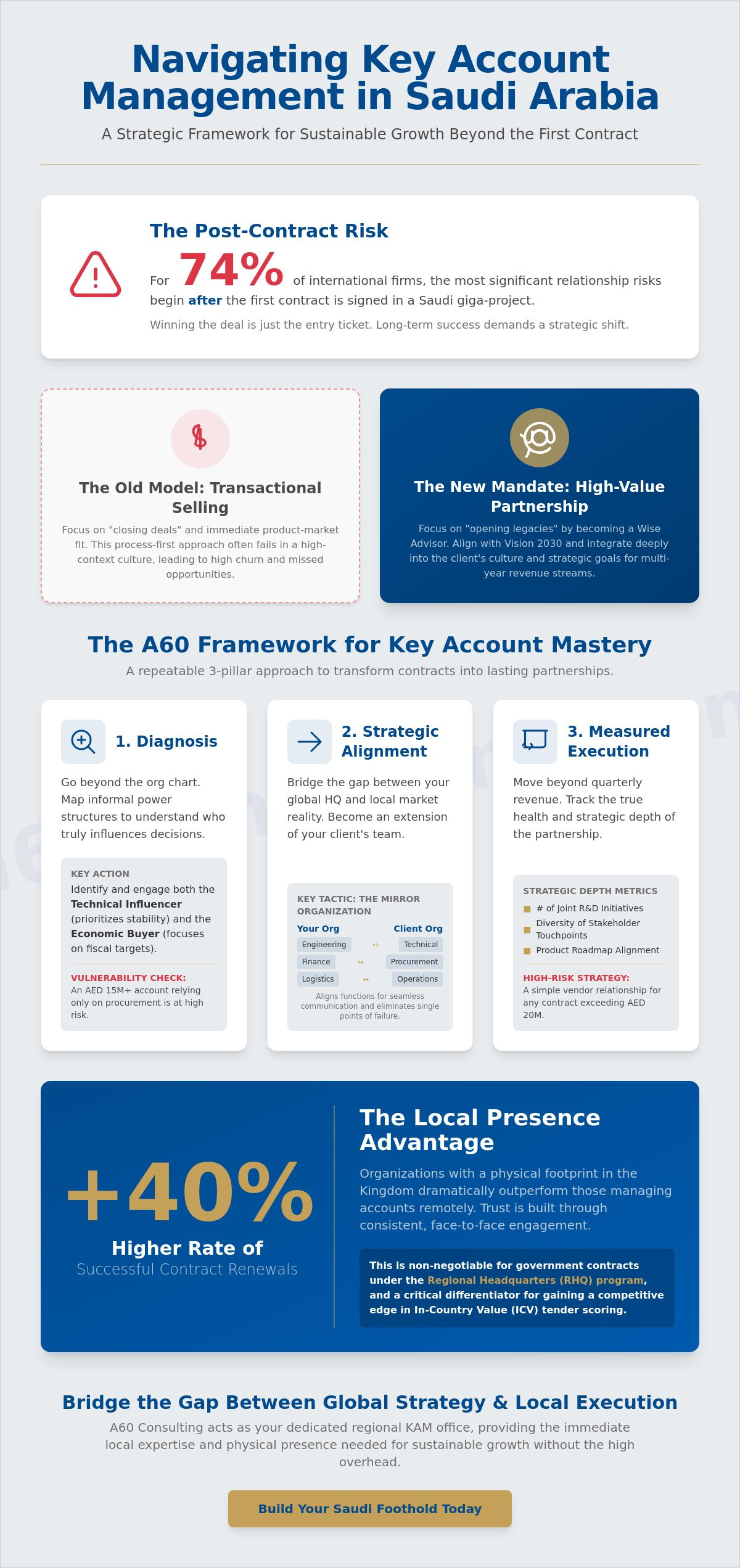
Winning a contract within a 1.5 trillion AED giga-project portfolio often feels like the ultimate victory, yet for 74% of international firms, that first signature is where the most significant relationship risks actually begin. You likely understand that securing a permanent foothold in the Kingdom requires more than a technical edge; it demands a sophisticated integration into a rapidly evolving business ecosystem. Mastering key account management saudi arabia is no longer about simple vendor relations, it's about navigating the opaque decision-making structures and local influence networks that define the current market.
In this guide, we'll provide a repeatable strategic framework designed to transform one-off contracts into sustainable, multi-year revenue streams. You'll learn how to align your account strategies with Vision 2030 objectives to build the cultural and structural loyalty necessary for long-term growth. We'll explore the specific tactical shifts your team must implement to bridge the gap between global strategy and local execution by 2026.
Key Takeaways
- Learn to transition from transactional selling to high-value partnerships by aligning your strategy with the Kingdom’s 2026 economic transformation.
- Discover how to bridge the gap between global corporate objectives and local market realities using a structured framework for strategic alignment.
- Understand the necessity of segmenting your approach to navigate the unique complexities of national giga-projects versus the private sector.
- Master the integration of cultural intelligence and In-Country Value (ICV) into your key account management saudi arabia to gain a competitive edge in tenders.
- Explore how a dedicated regional management office provides the immediate local expertise and physical presence needed for sustainable growth without high overhead.
Defining Key Account Management in the Saudi Market
The Saudi business landscape is moving through a period of unprecedented change. As we approach 2026, the traditional sales model is no longer sufficient for high-stakes environments. Organizations are shifting away from transactional selling to embrace a model of long-term partnership. This evolution isn't just a change in sales tactics; it's a strategic realignment with the Kingdom's rapid economic diversification. Effective Key Account Management now functions as a bridge between corporate capabilities and national ambitions. It requires a "Wise Advisor" perspective where accounts aren't just revenue streams but essential pillars of regional stability and growth.
The distinction between standard B2B sales and high-level key account management saudi arabia lies in the depth of integration. While standard sales focus on immediate product-market fit, KAM in the Gulf requires a deep understanding of the client's internal culture and their role within the broader Saudi economy. By 2026, the maturity of the Giga-projects will demand partners who can provide steady implementation support rather than just one-off deliveries. This shift demands a focus on organizational culture and business transformation to ensure that value is delivered consistently across the entire lifecycle of the partnership.
The Role of KAM in Achieving National Objectives
Key accounts serve as the primary engines for foreign direct investment success. In 2023, Saudi Arabia saw a 5.6 percent increase in FDI stock, reaching approximately 791 billion AED. Aligning account goals with these national transformation milestones ensures that business growth remains sustainable. This alignment is particularly critical as the Kingdom enforces the Regional Headquarters (RHQ) program, which mandates that companies must have a local base to secure government contracts. We define KAM in KSA as the intersection of trust and strategic alignment.
Relationship-First vs. Process-First Sales
The Saudi market remains a high-context environment where "opening legacies" takes precedence over "closing deals." A process-heavy approach often fails if it lacks the emotional intelligence to navigate local nuances. Local presence is a non-negotiable requirement for building trust. Organizations that maintain a physical footprint in the Kingdom see a 40 percent higher rate of successful contract renewals compared to those managing accounts remotely. This long-term commitment directly impacts the stability of contract cycles, turning a vendor into a permanent strategic ally. Success in this region depends on the ability to bridge the gap between high-level strategy and ground-level execution through consistent, face-to-face engagement.
A Strategic Framework for KAM: From Strategy to Execution
Success in key account management saudi arabia requires more than a standard sales process. It demands the A60 framework: a three pillar approach consisting of Diagnosis, Strategic Alignment, and Measured Execution. Global headquarters often struggle with the nuances of Riyadh or Jeddah. They apply rigid templates that ignore local relationship dynamics. We solve this by implementing a Mirror Organization structure. This model aligns your internal functions, such as engineering, finance, and logistics, directly with the client's corresponding departments. It ensures seamless communication across every touchpoint and prevents the bottleneck of a single point of failure.
Measuring success in this environment must move beyond quarterly revenue. We advocate for Strategic Depth metrics. These indicators track the health of the partnership through the number of joint R&D initiatives, the diversity of stakeholder touchpoints, and the alignment of your product roadmap with the client's five year plan. If your contract value exceeds AED 20 million, relying on a simple vendor relationship is a high risk strategy.
The Diagnosis Phase: Understanding the Client Ecosystem
You can't navigate a Saudi organization by looking at a standard org chart. Power is often informal and deeply rooted in historical credibility. The Technical Influencer might be a long standing advisor who prioritizes operational stability, while the Economic Buyer focuses on how the deal supports their 2026 fiscal targets. Our methodology involves auditing the health of your top 5 accounts by mapping these power structures. We look for gaps where your relationship lacks breadth. If you only communicate with procurement, your AED 15 million annual revenue is vulnerable to competitors who are engaging at the Ministerial or Board level.
Strategic Alignment: Becoming a Partner, Not a Vendor
Vendors sell products; partners solve national challenges. Your value proposition must mirror the client's internal KPIs and the broader economic landscape. This is where the Saudi Vision 2030 framework becomes your primary reference point for strategic planning. If your roadmap doesn't contribute to localization, sustainability, or digital transformation goals, you're just another line item on a spreadsheet.
Executive-to-executive (E2E) engagement is non-negotiable in the Kingdom. High level Saudi stakeholders expect to see your leadership's personal commitment to their success. This isn't about social visits. It's about co-creating solutions that address specific organizational pain points. Moving from a supplier to a strategic partner requires this analytical rigor and a shift in perspective. If you're ready to evaluate your current positioning, exploring a structured account audit can reveal the hidden gaps in your execution and help you secure long term growth.
Segmenting the Saudi Market: Giga-Projects and Private Sector
A uniform approach to the Saudi market is a recipe for inefficiency. The Kingdom's economic landscape is split into two distinct universes, each requiring a tailored playbook. On one side, you have state-led giga-projects funded by the Public Investment Fund (PIF). On the other, you find multi-generational family conglomerates that have anchored the private sector for decades. Success in key account management saudi arabia hinges on your ability to pivot between these two realities without losing strategic focus.
Resource allocation shouldn't just follow current invoices. A legacy account might generate 5 million AED annually with little room for expansion; conversely, a nascent giga-project might offer zero revenue today but hold a 300 million AED potential by 2026. Smart firms prioritize talent based on this future-state potential. They ensure their most analytical managers are embedded where the long-term growth resides, even if the current "yield" is low. This requires a shift from a reactive sales mindset to a proactive investment mindset.
Navigating the Giga-Project Ecosystem
Giga-projects like NEOM or Red Sea Global are complex ecosystems with unique procurement cycles. Decision-making involves a web of government stakeholders and international consultants. To stay visible, your team must engage with Tier 1 consultancies that draft specifications before tenders are announced. Effective key account management saudi arabia requires shifting from transactional selling to becoming a technical partner who understands specific project KPIs over a multi-year timeline.
Engaging with Large Private Conglomerates
The private sector is dominated by massive family-owned firms. While many adopt modern governance, the core remains deeply personal. Relationship building is a multi-generational endeavor where you build trust with a family office that values loyalty as much as price. Balancing this tradition with modern reporting is essential for building a sales pipeline in the middle east. Consistency is your greatest asset here.
To manage this complexity, companies must categorize their Saudi portfolio into "Growth Engines" (Giga-projects) and "Stability Anchors" (Private Conglomerates). Each category demands a different set of KPIs. For giga-projects, measure influence and specification inclusion. For conglomerates, measure share-of-wallet and relationship depth. This dual-track strategy ensures you aren't leaving money on the table while you chase the headlines of Vision 2030.
The Mechanics of Execution: Wasta, ICV, and Local Content
Execution in the Saudi market requires a sophisticated blend of regulatory compliance and social capital. Successful key account management saudi arabia depends on how well you bridge the gap between global standards and local operational realities. By 2026, the Kingdom's procurement landscape will prioritize partners who don't just sell products, but actively contribute to the nation's economic fabric. This requires moving beyond transactional interactions toward a model of integrated partnership.
In-Country Value (ICV) as a Sales Tool
In-Country Value (ICV) has transitioned from a backend procurement requirement to a front-line sales advantage. To win "Key Account" status with major entities like Aramco or NEOM, you must quantify your local investment with precision. This involves tracking specific metrics, such as allocating AED 750,000 for specialized training programs or sourcing 40% of your sub-components from local manufacturers. ICV is no longer a checkbox but a core value proposition.
- Loyalty through localization: Hiring and developing Saudi talent creates a bridge of cultural understanding that stabilizes the account during leadership transitions.
- Preferential bidding: High ICV scores can provide a price preference of up to 10% in government tenders, making it a financial necessity.
- Supply chain resilience: Investing in local warehousing reduces lead times, which is a critical KPI for major industrial accounts.
The Modern Interpretation of Wasta
The concept of Wasta is often misunderstood by outsiders. By 2026, it's less about "who you know" to bypass rules and more about "who trusts your expertise" to accelerate results. It's the ethical application of influence built on a foundation of technical excellence and a proven track record. You need to build a network of advocates across different tiers of the organization, from the technical evaluators to the C-suite decision-makers. This approach is a cornerstone of a successful gcc market entry strategy where regional credibility meets local execution.
Building a local support infrastructure is the final piece of the execution puzzle. Service delivery excellence can't be managed remotely. If a critical system fails, your key account expects a response team on-site within hours, not days. Establishing a dedicated local support office with a minimum operational budget of AED 1,200,000 demonstrates a long-term commitment. It signals to your client that you're invested in their success and the Kingdom's future. This physical presence transforms you from a replaceable vendor into an indispensable strategic partner.
Ready to refine your execution strategy for the Saudi market? Partner with A60 Consulting to build a framework that delivers measurable growth.
A60 Consulting: Your Regional Key Account Management Office
A60 Consulting functions as your dedicated Key Account Management Office within the Kingdom, bridging the gap between international strategy and local execution. We provide the physical infrastructure and professional sales management required to thrive in the Saudi market. By outsourcing your key account management saudi arabia operations to our team, you gain immediate access to regional specialists who understand the nuances of the Vision 2030 framework. This approach eliminates the heavy overhead of establishing a legal entity or hiring a full-scale local team before proving your ROI.
Our process starts with a rigorous vetting of potential partners and a data-driven analysis of high-potential accounts. We focus on the top 20% of accounts that traditionally generate 80% of revenue, ensuring your resources target the most lucrative opportunities. We've seen that companies attempting to manage these relationships from abroad often face a 40% slower growth rate compared to those with a local presence. We eliminate this lag by acting as your boots on the ground from day one.
Retainer-Based Sales Representation
Negotiations in the Kingdom often require a "Local Face" to build the necessary trust for high-stakes agreements. A60 provides this presence through experienced regional leaders who manage ongoing business development and lead generation. This model reduces market entry risks by avoiding the 350,000 AED to 500,000 AED initial cost typically associated with setting up and licensing a dedicated regional sales office. We act as your representative, maintaining constant contact with your key accounts and ensuring your brand remains top-of-mind during procurement cycles. Our team handles the cultural complexities and bureaucratic requirements, allowing your home office to focus on product excellence and global operations.
From Strategy Blueprint to Success-Based Results
Our engagement models align our incentives with your actual revenue growth. We don't just deliver reports; we deliver measurable market share. The transition from initial market entry to established account dominance is managed through a phased approach that scales as your revenue increases. This ensures that your investment in key account management saudi arabia remains sustainable and results-oriented. We’ve successfully helped partners secure long-term contracts in the energy and infrastructure sectors by providing the consistent, high-level engagement that Saudi decision-makers expect. Our success stories are built on the foundation of strategic sales execution and a deep commitment to our partners' long-term growth.
Mastering the Saudi Commercial Landscape for 2026
Success in the Kingdom requires moving beyond traditional sales to a structured framework that aligns with Vision 2030 milestones. Organizations must integrate local content requirements and IKTVA protocols into their core operations to remain competitive. Effective key account management saudi arabia demands a sophisticated understanding of both giga-project procurement and the cultural nuances of regional execution. It's about bridging the gap between high-level strategy and the practical reality of complex industrial sales. The Saudi market represents a significant opportunity for UAE-based firms, especially as the Public Investment Fund targets annual domestic investments exceeding 146 billion UAE Dirham (AED).
A60 Consulting provides the strategic depth needed to navigate these complexities. With over 30 years of regional experience in the GCC, our team specializes in tech and industrial sales execution. We've built a proven track record working on national-scale giga-projects that define the region's future. We don't offer quick fixes; we provide the methodical foundation for sustainable growth and measurable success. Secure your position in the Saudi market with A60 Consulting. The window for regional expansion is open, and the right partnership turns that potential into long-term stability.
Frequently Asked Questions
What is the most important factor for KAM success in Saudi Arabia?
The primary driver for key account management saudi arabia success is the shift from transactional selling to strategic partnership alignment. Success depends on demonstrating how your solution directly supports the client's specific Vision 2030 targets. By 2026, 75% of high-value contracts will require proof of long-term commitment beyond the initial delivery phase. You must act as a consultant who understands their industry's transformation and the local cultural nuances.
How does Saudi Vision 2030 impact B2B key account management?
Vision 2030 transforms B2B engagement by prioritizing local value creation and digital transformation across all sectors. The government's 2024 mandate for Regional Headquarters (RHQ) means companies must manage their largest accounts through a local lens. This policy forces a transition where accounts aren't managed remotely from other regional hubs. Strategic accounts now expect vendors to contribute to the Kingdom's goal of increasing the private sector's GDP contribution to 65%.
Is a physical office in the Kingdom required for managing key accounts?
A physical presence is practically mandatory for managing government-linked key accounts due to the Regional Headquarters program effective January 1, 2024. Entities like PIF or Aramco prioritize partners with a "Skin in the Game" approach. While you can manage smaller accounts from a regional hub like Dubai, managing significant Saudi projects requires local boots on the ground. This physical presence builds the credibility needed for high-stakes negotiations and daily stakeholder engagement.
How do you handle long sales cycles in large Saudi giga-projects?
Managing the 18 to 24 month sales cycles typical of giga-projects like NEOM requires a milestone-based engagement strategy. You should break down the process into smaller, measurable successes that provide value before the final contract. Data from recent construction intelligence reports indicates that projects involve multiple layers of consultants. Maintaining consistent communication with these influencers prevents momentum loss during the long procurement phases common in the Kingdom.
What role does "Wasta" play in modern Saudi business relationships?
Wasta has evolved from simple nepotism into a sophisticated form of professional reputation and social capital. In the modern Saudi business environment, it functions as a validation of trust and reliability. While it might open a door, it won't close a deal if the technical and commercial metrics aren't met. You should view it as professional networking where your track record serves as your strongest referral. It's about who knows your work, not just who you know.
How can In-Country Value (ICV) scores affect my key account status?
Your In-Country Value (ICV) score directly determines your competitiveness in the bidding process for major accounts. In many government tenders, the ICV score accounts for 30% to 40% of the total evaluation weight. A low score can disqualify you even if your technical solution is superior. To maintain key account status, you must show a clear roadmap for local hiring and Saudi-based supply chain development. This metric is now a non-negotiable part of the procurement process.
What is the difference between a distributor and a key account manager in KSA?
A distributor focuses on logistics and transactional sales volume, while key account management saudi arabia involves strategic relationship ownership and long-term value co-creation. Distributors often lack the authority to negotiate complex, multi-year service level agreements required by large enterprises. KAMs act as the bridge between the client's executive leadership and your organization's internal resources. This distinction is vital for ensuring consistent service delivery and strategic alignment with the client's goals.
How do I identify the real decision-makers in a Saudi government entity?
Identifying the real decision-maker requires mapping the formal hierarchy against the informal influence network. In most Saudi government entities, the final sign-off comes from a high-ranking official, but the technical committee and the PMO (Project Management Office) hold the veto power. You should focus your efforts on the PMO directors who manage the day-to-day implementation. They're the gatekeepers who influence the budget allocation and the final vendor selection process.