
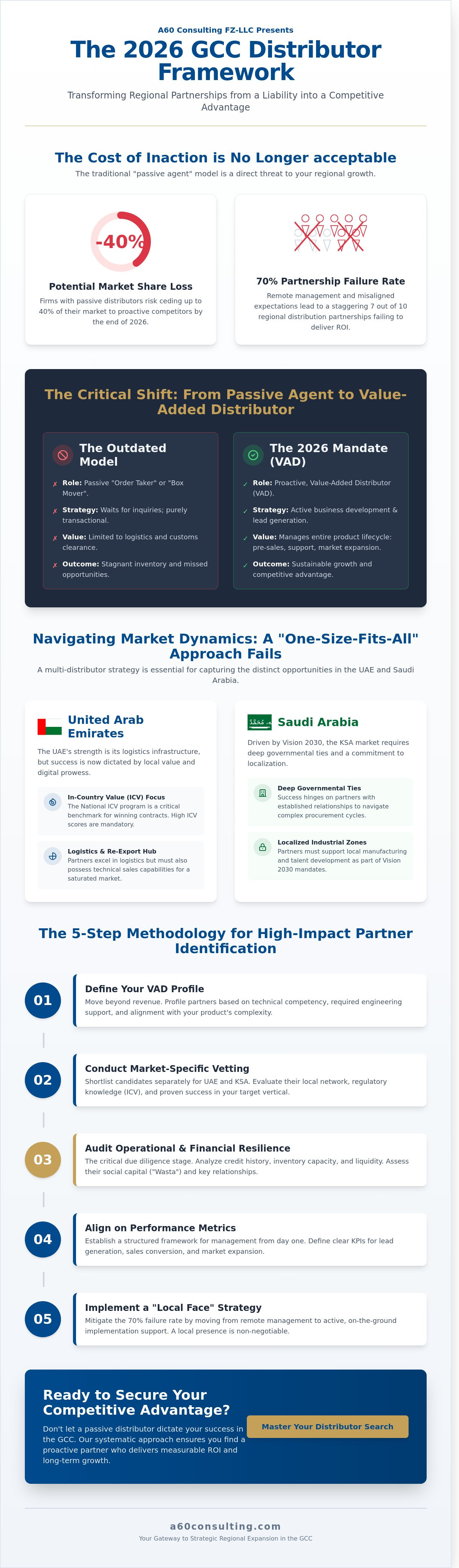
In the GCC, a passive distribution partner is no longer just a missed opportunity; it's a liability that can cost a firm upwards of 40% in potential market share by the end of 2026. You likely realize that the traditional model of signing a regional agent and hoping for the best is failing under the weight of Saudi Vision 2030 and stricter local content requirements across the Emirates. This guide provides a 2026 framework to master your distributor search middle east, ensuring you identify proactive partners who move beyond simple logistics to deliver measurable ROI.
Finding a partner who understands the nuance of the UAE and Saudi markets requires more than a standard due diligence checklist. You need a partner who acts as an extension of your own brand rather than a mere "order taker" who waits for the phone to ring while your inventory sits idle. We'll explore the current GCC landscape, provide a methodology for vetting high-performing candidates, and share a structured framework for managing these relationships to ensure long-term, sustainable growth. By the end of this article, you'll have the tools to transform your regional distribution from a logistical hurdle into a clear competitive advantage.
Key Takeaways
- Understand the critical shift from traditional trading agents to Value-Added Distributors (VADs) as regional economic frameworks like "We the UAE 2031" redefine market expectations.
- Analyze the distinct dynamics between the UAE and Saudi Arabian markets to determine why a multi-distributor strategy is essential for sustainable regional growth.
- Apply a systematic 5-step methodology for your distributor search middle east to identify partners who possess both technical depth and financial resilience.
- Mitigate the common 70% failure rate of regional partnerships by implementing a "local face" strategy and moving from remote management to active implementation support.
The Evolving Landscape of Distributor Search in the Middle East (2026)
The regional market has moved beyond simple transactional relationships. By 2026, the distributor search middle east process requires a focus on partners who integrate into your supply chain rather than just sitting on its periphery. This evolution is driven by the Economy of the Middle East shifting away from oil dependency toward high-tech, manufacturing, and specialized industrial sectors. Initiatives like Saudi Vision 2030 and We the UAE 2031 have created a regulatory environment where local presence and technical depth are now mandatory for survival.
A "one-size-fits-all" approach to the region leads to immediate market failure. In 2026, the divergence between markets is sharper than ever. A partner who excels in the UAE's logistics-heavy environment might lack the deep governmental ties required for success in Saudi Arabia's localized industrial zones. Modern procurement in the GCC is now digital-first; 82% of B2B buyers in the region conduct extensive technical research online before engaging with a sales representative. This means your distributor search middle east must prioritize partners who possess both digital maturity and high-level technical sales expertise.
The Decline of the Passive Agent Model
The era of the "order-taker" has ended. In the competitive 2026 landscape, passive agents who merely clear customs and wait for inquiries cannot sustain market share. Regional competition is too fierce for such a hands-off approach. Success now requires proactive business development and sophisticated local lead generation. A modern "Value-Added Distributor" in the Middle East is a strategic partner that manages the entire product lifecycle, from technical pre-sales and local inventory management to after-sales support and active market expansion.
Regulatory Shifts and In-Country Value (ICV)
Regulatory frameworks have become the primary filter for selecting distributors. In the UAE, the National In-Country Value (ICV) program has become a critical benchmark for contract awards in both public and private sectors. Distributors must demonstrate high ICV scores to remain competitive in major tenders. This shift means your chosen partner isn't just a sales channel; they're a key component of a comprehensive 2026 GCC market entry strategy that prioritizes local manufacturing and talent development. For instance, industrial contracts exceeding 1,500,000 د.إ often require documented evidence of local value contribution to qualify for final evaluation. Your distributor's ability to navigate these manufacturing mandates is now as important as their sales network.
Essential Criteria for Qualifying Regional Distribution Partners
A successful distributor search middle east requires moving beyond surface-level revenue projections to evaluate a partner's operational depth. In this dynamic regional market, the distinction between a "box mover" and a strategic partner often determines whether a product gains a 5% or 25% market share within its first 24 months. You must look for technical competency that matches your product's complexity. If your solution requires integration or specialized configuration, a distributor who lacks in-house engineers will likely fail to convert leads in high-stakes sectors like energy or aviation.
Financial resilience is equally critical. Given the prevailing regional economic conditions, the cost of capital can significantly impact distributor liquidity. You should audit a potential partner's credit history and their capacity to hold inventory in local currencies without relying on excessive leverage. Beyond the balance sheet, the concept of "Wasta" remains a fundamental pillar of B2B sales in this region. This isn't merely about who they know; it's about the social capital and trust they've built over decades. A partner with deep-rooted connections can often bypass the 12-month procurement cycles that stall newcomers. When expanding your reach, understanding Distribution and Sales Channels in Saudi Arabia is also vital, as many regional distributors leverage their primary operational hubs to expand into the broader market.
Evaluating Technical and Sales Synergy
A common mistake is partnering with a distributor who already represents a direct competitor. You need to audit their existing portfolio to ensure your product isn't being used as a "filler" to help them win tenders for other brands. Demand to see a dedicated product manager within their team. This individual should be your primary point of contact, ensuring your brand receives consistent focus rather than being lost in a catalog of thousands. Assess the sales force's technical literacy through a mock presentation. If they can't articulate your value proposition during the vetting stage, they won't do it effectively in front of a procurement committee in key regional markets.
Compliance, Logistics, and After-Sales Support
The regulatory environment across the region is rigorous. Verify that your partner is proficient with all relevant national and regional certification processes and industry standards. For those eyeing specific target markets, familiarity with their respective compliance platforms is mandatory. Logistics capabilities must include climate-controlled warehousing, as temperatures exceeding 45°C can compromise electronic and chemical products. Finally, a local service center is non-negotiable for hardware providers. Customers in these markets expect rapid resolution; a distributor who lacks local repair capabilities will struggle to secure long-term contracts. If you're unsure how to benchmark these capabilities against regional standards, our implementation specialists at A60 Consulting FZ-LLC can help you design a customized qualification matrix.
Market Dynamics: Navigating Saudi Arabia vs. the United Arab Emirates
Treating the GCC as a single, uniform market is a frequent strategic error. While the region shares cultural ties, the regulatory environments and operational requirements of the two largest economies differ significantly. A successful distributor search middle east requires acknowledging that a partner excelling in Dubai may lack the infrastructure or "boots on the ground" needed to penetrate the Saudi market. Saudi Arabia's sheer scale and the UAE's role as a re-export hub necessitate distinct, localized partnerships.
Secondary markets like Qatar and Kuwait have also evolved into specialized hubs. Qatar's National Vision 2030 drives demand in sports technology and green energy, while Kuwait remains a high-consumption market for luxury and healthcare. Recent data from the future of consumer goods distribution in the Middle East suggests that distributors are increasingly specializing by sector rather than geography, making your selection process more complex. Since January 1, 2024, the Saudi Regional Headquarters (RHQ) mandate has further separated these markets. Companies seeking government contracts exceeding AED 1 million must now have their regional base in the Kingdom, fundamentally changing how distribution networks are structured.
Saudi Arabia: The Transformation Giant
The Kingdom is currently an investment powerhouse, with an estimated AED 3.7 trillion pipeline of "Giga-projects" like NEOM and the Red Sea Project. Success here depends on more than just logistics; it requires a partner who understands the Nitaqat system, which governs local Saudi national employment (Saudization). High-touch sales are mandatory. Your distributor must have deep relationships within government-led procurement circles. A distributor search middle east for the Saudi market should prioritize partners who can demonstrate a physical presence in Riyadh or Jeddah rather than those managing operations remotely from abroad.
The UAE: The Regional Logistics and Trade Hub
The UAE serves as the primary gateway for wider MENA distribution, supported by world-class infrastructure like Jebel Ali Port. While the 2021 changes to the Commercial Companies Law allow 100% foreign ownership in many mainland sectors, choosing the right distributor remains vital for market penetration. You must balance Free Zone operations, which offer tax efficiencies, with mainland access for local government tenders. For a deeper dive into these nuances, consult our strategic guide to finding distributors in the UAE to understand local tactics. The UAE market is highly competitive and price-sensitive, so your partner needs a sophisticated digital supply chain to maintain margins.
- Saudi Arabia: Focus on Vision 2030 alignment and local employment compliance.
- UAE: Prioritize logistics efficiency and multi-country re-export capabilities.
- Secondary Markets: Look for specialized niches in Qatar and Kuwait to avoid direct competition with larger regional players.
The 5-Step Methodology for Identifying High-Impact Distributors
A successful distributor search middle east requires more than a casual review of LinkedIn profiles or trade show directories. In the UAE market, where relationship-based commerce meets rapid digital transformation, we apply a rigorous five-step framework to filter for quality and strategic alignment. This systematic approach ensures that the chosen partner possesses the operational infrastructure to scale your business rather than just a list of contacts.
- Step 1: Market Mapping and Long-List Generation: We identify 25 to 40 potential partners by analyzing competitors, customs data, and trade registries in key economic zones like JAFZA and KIZAD.
- Step 2: Preliminary Vetting and Interest Verification: This phase narrows the list to 8-10 candidates through initial outreach to gauge their appetite for a new principal and their current portfolio capacity.
- Step 3: Deep-Dive Due Diligence and In-Person Meetings: Physical site visits in Dubai or Abu Dhabi are non-negotiable; we assess warehouse standards, technical support capabilities, and cultural fit.
- Step 4: Commercial Alignment and Term Sheet Negotiation: We define the financial framework, including margins, credit terms, and marketing contributions in AED.
- Step 5: Structured Onboarding and Sales Enablement: The final step involves technical training and integrating the distributor into your CRM to ensure transparency from day one.
The Vetting Process: Beyond the Brochure
Distributors often present polished marketing materials that mask operational gaps. We conduct "blind" reference checks by contacting their existing principals to verify payment consistency and technical proficiency. Analyzing a distributor's marketing spend, which should ideally represent a specific percentage of their annual revenue, reveals their true commitment to brand building. Verifying a partner’s "Wasta" through third-party audits ensures their social capital provides genuine market access without compromising compliance standards.
Negotiating the Distributor Agreement
The most common error in the UAE is granting permanent exclusivity without safeguards. We recommend performance-based milestones that allow for contract re-negotiation if sales targets aren't met within the first 12 to 18 months. Clear KPIs must include lead conversion rates, market share growth, and mandatory monthly reporting. For a detailed breakdown of legal clauses and protection, refer to our guide on structuring a distributor agreement in the Middle East.
Ready to secure a partner that delivers measurable growth? Contact our UAE market entry specialists to begin your strategic search.
Beyond the Search: Ensuring Long-Term Performance and ROI
Industry data indicates that 70% of Middle East distribution partnerships fail within the first 24 months. This high attrition rate isn't usually due to a lack of product quality. It's the result of treating the distributor search middle east as a one-time transaction rather than the start of a rigorous management cycle. Remote management from a headquarters thousands of miles away carries a high risk in the UAE. Without a "Local Face" to maintain visibility, your brand is easily deprioritized when a distributor faces local market pressures or competing interests.
Success requires a Regional Sales Office (RSO) model that prioritizes active supervision. A60 Consulting FZ-LLC's approach focuses on bridging the gap between strategy and execution. We don't just find partners; we provide the persistent local presence needed to keep them accountable. This involves moving beyond quarterly reports and into the daily realities of the Emirati market, where relationships drive the speed of business.
Sales Enablement and Continuous Training
Bridging the cultural gap in technical sales presentations is vital for closing high-value deals in Dubai and Abu Dhabi. Local procurement teams often value relationship-based trust as much as technical specifications. We establish a regular cadence for pipeline reviews and joint sales calls, ensuring your brand's value proposition isn't lost in translation. This hands-on involvement allows us to identify and unblock regulatory hurdles early. Whether it's a certification delay at the Ministry of Industry and Advanced Technology or a logistics bottleneck at Jebel Ali, having local representation means these issues are resolved in days, not months.
- Bi-weekly Pipeline Audits: Moving past "optimistic" projections to verify real lead progression.
- Joint Client Visits: Supporting the distributor's team during critical negotiations to maintain brand standards.
- Regulatory Liaison: Navigating UAE-specific compliance requirements to keep the supply chain moving.
The Case for Outsourced Sales Management
The cost of establishing a full local office in the UAE is substantial. Between trade licenses, office rent in districts like DIFC or ADGM, and administrative overhead, companies can expect to spend upwards of 220,000 AED annually before paying a single salary. A strategic partnership with A60 Consulting provides the benefits of a Regional Sales Office at a fraction of that fixed cost.
We act as your local arm to drive distributor accountability and refine your distributor search middle east strategy as market conditions shift. Our team ensures that your partners aren't just "carrying" your product, but actively selling it. We monitor KPIs with analytical precision, allowing you to scale your Middle Eastern operations based on measurable success rather than guesswork. Local presence is the decisive factor that converts initial market interest into signed contracts.
Securing Your Regional Market Leadership for 2026
Success in the Gulf region now depends on a shift from traditional volume-based models to value-driven technical partnerships. By 2026, the distinction between the UAE’s logistics-led trade and Saudi Arabia’s industrial transformation will define which brands capture the largest share of the market. A successful distributor search middle east requires a methodology that prioritizes local operational capacity and cultural alignment over simple database matching. It's about bridging the gap between a high-level strategy and the daily realities of regional execution.
A60 Consulting provides the strategic depth needed to navigate these complexities. With over 30 years of regional B2B sales experience and a physical presence in both the UAE and Saudi Arabia, we specialize in the technical and industrial sectors that demand precision. We don't offer generic lists; we deliver a structured path to sustainable ROI through rigorous qualification and ongoing management. Partner with A60 Consulting to find and manage your Middle East distributors and secure your organization’s future in this high-growth corridor. Your expansion deserves the clarity that only deep regional expertise can provide.
Frequently Asked Questions
Do I need a separate distributor for each country in the Middle East?
You generally need a separate distributor for each country because legal frameworks and commercial agency laws vary significantly across borders. While the GCC shares some similarities, a partner licensed in the UAE cannot automatically provide the same legal coverage or logistics infrastructure in Oman or Kuwait. Local presence ensures compliance with specific national regulations like the Saudi Food and Drug Authority (SFDA) or the UAE Ministry of Health.
What is the standard commission or margin for distributors in the GCC?
Standard margins for distributors in the GCC typically range from 15 percent for high-volume commodities to 40 percent for specialized medical equipment or luxury goods. These figures cover logistics, marketing, and after-sales support. In the UAE, distributors often expect additional marketing contributions or "listing fees" when dealing with major retailers, which can cost between 5,000 AED and 50,000 AED per product line.
How long does a typical distributor search in the Middle East take?
A comprehensive distributor search middle east usually takes between 4 and 9 months from initial market mapping to a signed contract. This timeline accounts for identifying potential partners, conducting due diligence, and negotiating commercial terms. Rushing this process often leads to poor alignment. We've seen that 70 percent of successful partnerships involve at least two face-to-face meetings in the region before any legal commitment is made.
Is exclusivity mandatory when signing a distribution agreement in Saudi Arabia?
Exclusivity isn't legally mandatory under the 2022 Saudi Commercial Agency Law, but most local partners will demand it before investing in your brand. You can limit exclusivity to specific product categories or geographic regions within the Kingdom. It's vital to include performance-based break clauses. This ensures you aren't locked into a non-performing relationship for the standard three-year contract term common in the Saudi market.
How do I verify the reputation and "Wasta" of a potential partner?
You verify reputation through independent third-party credit reports and deep-dive reference checks with their existing international principals. Wasta, or "influence," is best measured by the distributor's track record in securing government tenders or navigating customs clearances. Look for partners who hold ISO certifications or are listed on the Abu Dhabi or Dubai stock exchanges, as these firms adhere to higher transparency standards.
What happens if my distributor fails to meet their sales targets?
If a distributor fails to meet agreed targets, your primary recourse depends on the specific performance clauses in your contract. Most UAE agreements allow for a transition from exclusive to non-exclusive status if targets aren't met for two consecutive quarters. It's essential to define these KPIs clearly in AED values and volume units to avoid ambiguity during any potential legal arbitration or termination process.
Can a UAE-based distributor legally sell products into Saudi Arabia?
A UAE-based distributor can't legally clear goods or provide after-sales support in Saudi Arabia without a local commercial registration or a Saudi partner. While the GCC Customs Union allows for the movement of goods, product registration requirements like SABER in Saudi Arabia require a locally licensed importer of record. Selling across borders without local representation often leads to shipment seizures at the Ghuwaifat border crossing.
What are the main risks of using a "Master Distributor" for the whole region?
Using a Master Distributor often leads to "margin stacking," where the final retail price becomes uncompetitive due to multiple layers of profit taking. You also risk losing direct visibility into individual markets like Bahrain or Qatar. During a distributor search middle east, we find that Master Distributors often focus 80 percent of their effort on their home market, leaving secondary territories underserved and undercapitalized.