
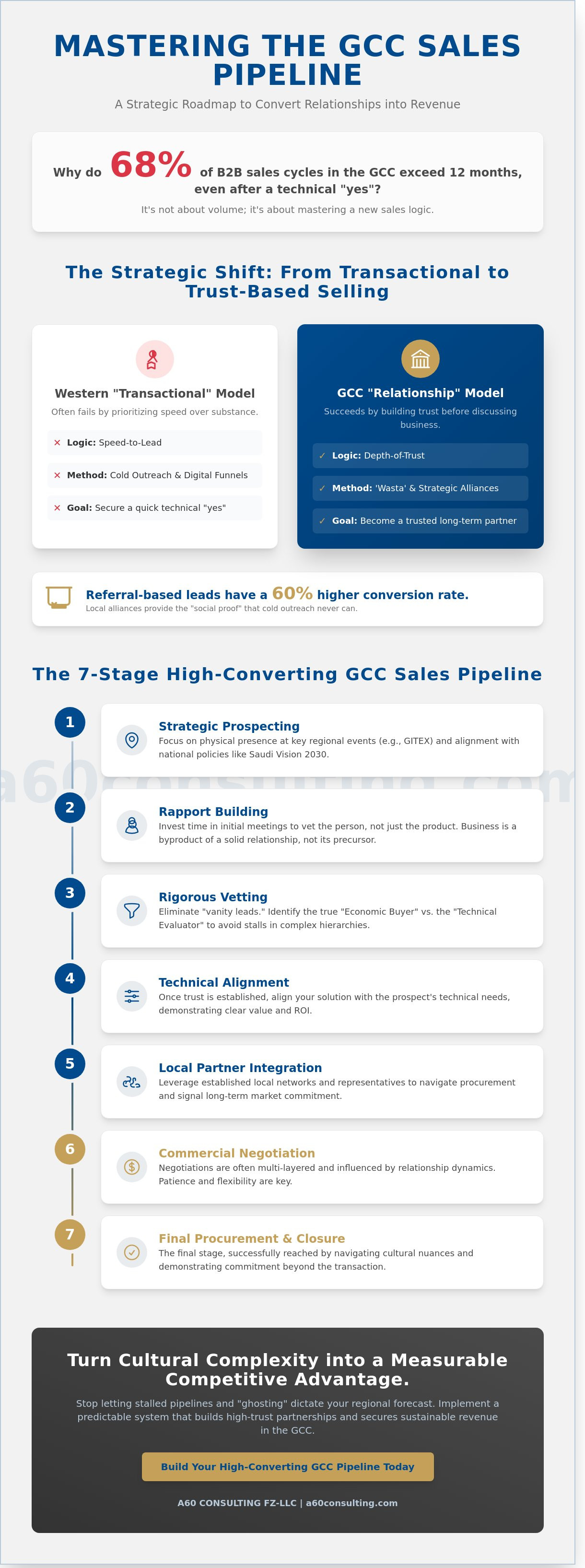
Why do 68% of B2B sales cycles in the GCC exceed the 12 month mark despite an initial "yes" from the technical team? It's a common frustration for leaders who see their projections stalled by a sudden lack of communication or "ghosting" from prospects. Building a sales pipeline in the middle east isn't about more aggressive volume; it's about mastering the nuance of the relationship-based economy. You know that the traditional Western "hard close" often backfires here, yet finding a repeatable way to reach the true decision-makers remains a significant hurdle.
We understand that you need more than just leads; you need a predictable system that converts interest into long-term partnerships. This guide provides a strategic roadmap for 2026 to transition your firm from transactional selling to a high-trust model that secures sustainable revenue. You'll discover how to align your growth with Saudi Vision 2030, map complex organizational hierarchies, and implement a process that improves your lead-to-close ratios across the Emirates and the wider region. We'll show you how to turn cultural complexity into a measurable competitive advantage.
Key Takeaways
- Shift from transactional "cold outreach" to a relationship-centric model that aligns with the trust-based business culture of the UAE and the wider GCC.
- Implement a 7-stage framework specifically adapted for regional procurement, focusing on a rigorous vetting stage to eliminate vanity leads and prioritize high-value closures.
- Navigate complex decision hierarchies in state-owned and family enterprises by accurately identifying the "Economic Buyer" versus the "Technical Evaluator."
- Learn to optimize your CRM and management cadence for building a sales pipeline in the middle east by aligning with the unique regional business calendar, including Ramadan and summer periods.
- Understand the strategic necessity of permanent regional representation to move beyond the limitations of the "fly-in, fly-out" model and secure sustainable B2B growth.
The Strategic Shift: Why Western Sales Pipeline Models Often Fail in the GCC
Many international firms enter markets within the GCC expecting their automated LinkedIn sequences and cold email funnels to scale. They often find that while their digital metrics look healthy, their actual conversion rate remains near zero. Building a sales pipeline in the middle east requires a fundamental shift in perspective. It's not a numbers game played behind a screen; it's a sequence of human interactions designed to prove reliability before a single technical specification is discussed. In the Gulf, the pipeline is a relationship-driven sequence, not a digital-only funnel.
Transactional vs. Relationship-Based Sales Logic
The Western "speed-to-lead" model prioritizes rapid response times and immediate qualification. Within the GCC, this approach often feels aggressive and impersonal. Local decision-makers value a "depth-of-trust" model where the first few meetings might not involve a formal pitch at all. These sessions serve to vet the person, not just the product. You'll find that cultural and business etiquette in the Middle East dictates a slower, social start to ensure alignment on values. If you rush the technical details, you risk appearing transactional, which is a major barrier to long-term partnerships.
The "Trust First" principle for GCC sales: Business is a byproduct of a solid relationship, never the precursor to one.
The Role of 'Wasta' and Local Alliances in Lead Generation
Many outsiders misunderstand 'Wasta' as mere nepotism. In a modern professional context, it represents the currency of credibility and social capital. It's the mechanism that allows a lead to bypass the administrative gatekeepers at prominent regional organizations. When building a sales pipeline in the middle east without a 30-year local history, you must leverage established networks. You don't need decades of presence if you have the right local representative or strategic partner. These alliances provide the "social proof" that a cold call never could.
- Local representation signals a long-term commitment to the GCC market, which is vital for government and semi-government contracts.
- Referral-based leads in the Gulf have a 60% higher conversion rate compared to cold outreach.
- Physical presence, even through a representative, removes the "flight risk" perception often associated with foreign entities.
A60 Consulting FZ-LLC acts as the bridge between global strategic ambition and local implementation. We don't just hand over a list of names; we help leaders adapt their implementation logic to match the reality of the Gulf. By combining analytical rigor with a deep understanding of regional human dynamics, we ensure your expansion isn't just a plan on paper, but a measurable success in the local market. We understand that the gap between a strategy and its execution is often filled by the strength of local alliances.
The 7 Stages of a High-Converting Middle East Sales Pipeline
Standard CRM templates often fail when building a sales pipeline in the middle east because they ignore the high-context nature of GCC business cultures. In the UAE and Saudi Arabia, a pipeline isn't a linear progression of digital touchpoints. It's a series of trust-building milestones. Success requires moving beyond "vanity leads" that show polite interest but lack the internal political capital to reach a signature. You must categorize your pipeline into seven distinct phases: Strategic Prospecting, Rapport Building, Rigorous Vetting, Technical Alignment, Local Partner Integration, Commercial Negotiation, and Final Procurement.
Prospecting and Qualification with Regional Nuance
Effective prospecting in the GCC happens where policy meets industry. In Dubai and Riyadh, this means maintaining a physical presence at anchor events. GITEX Global 2023 attracted over 180,000 visitors, providing a concentrated environment for initial discovery. When building a sales pipeline in the middle east, your qualification criteria must adapt. A "Qualified" lead in a UAE context requires more than just a budget. You need to identify if the prospect has the "Authority" to bypass complex bureaucratic layers and if the "Timing" aligns with national fiscal cycles, which often peak in Q4.
Qualification often hinges on your choice of intermediaries. Finding the right gateway to the market is a prerequisite for high-quality prospecting. You can find detailed frameworks for this in our strategic guide to distributor search in the middle east. Without a vetted partner, your pipeline will likely fill with stagnant leads that never progress past the introductory phase.
From Initial Meeting to Technical Proposal and Negotiation
The "Approach" stage in the UAE is rarely settled in a single session. It requires multiple in-person touchpoints, often involving social settings where business is discussed only tangentially. If a prospect remains silent after a proposal, it's frequently a polite "no." Conversely, aggressive questioning regarding technical specifications is a strong signal of intent. This is the "Technical Alignment" phase, where you must demonstrate compliance with local standards like the UAE’s Federal Decree-Law No. 45 of 2021 on personal data protection.
Negotiation tactics in the region require a specific type of flexibility. It's common for procurement officers to request significant concessions at the final hour. We recommend building your pricing models to accommodate these requests while protecting your core contract value. Your local partner plays a decisive role here. They understand the unspoken hierarchy within the client's organization and can navigate the final "Objection" stage by leveraging their existing social capital. If you find your current strategy isn't yielding these results, a structured pipeline audit can identify where your deals are losing momentum.
Finalizing a deal often involves a transition from the technical champion to the procurement department. This shift can be jarring. While the technical team values innovation, procurement focuses on long-term stability and local support capabilities. Ensure your documentation reflects both perspectives to avoid delays in the final AED 500,000+ approval cycles.
Lead Vetting: Navigating Regulatory and Cultural Decision Hierarchies
Many international firms find their efforts in building a sales pipeline in the middle east hindered by a common frustration: the lead that remains active for 180 days or more without moving toward a signed contract. This stagnation isn't usually a sign of disinterest. It's often a failure to distinguish between the technical evaluator and the economic buyer. While a technical lead might be enthusiastic about your solution's features, the economic buyer in a UAE family-run enterprise or state-owned entity prioritizes long-term stability, organizational impact, and risk mitigation over pure innovation.
Integrating regulatory checks early in your pipeline prevents late-stage deal collapse. A deal valued at 1,500,000 AED can easily fall apart during the final procurement review if the vendor hasn't accounted for specific local compliance standards or licensing requirements. A60 Consulting provides the local due diligence and on-the-ground verification necessary to ensure that your pipeline isn't just full of conversations; it must contain viable, high-value contracts with the actual capacity to close. We help you identify which leads possess the budgetary authority to move forward, ensuring your energy is focused on high-probability opportunities.
Understanding In-Country Value (ICV) and Local Content Requirements
In the UAE, the In-Country Value (ICV) program is a critical factor for any business targeting government or semi-government contracts, such as those with ADNOC or Mubadala. Your ICV score, which is calculated based on your local investment and procurement, measures your economic contribution to the Emirates. When building a sales pipeline in the middle east, you must prioritize leads where your current compliance levels meet their specific tender thresholds. Regulatory alignment is a competitive sales advantage that frequently outweighs a lower price point from a non-compliant competitor.
Identifying Real Decision-Makers in GCC Hierarchies
Mapping the internal Power Map of a Gulf-based client requires looking beyond standard organizational charts. In private sector B2B deals, the influence of the Board or specific family members often carries more weight than the C-suite. Research into regional procurement cycles indicates that 65% of enterprise deals stall because the vendor failed to engage the ultimate economic decision-maker during the initial discovery phase. Securing an audience with these executives requires a combination of local representation and a deep understanding of trust-based networks to establish credibility quickly.
A60 Consulting acts as your strategic partner in this process, bridging the gap between identifying a lead and securing a firm commitment. We apply an analytical lens to your pipeline, helping you navigate the complex interplay between technical requirements and the cultural nuances of Middle Eastern boardrooms. Our methodology ensures that your sales team spends their time on opportunities with a clear path to implementation and measurable ROI, rather than chasing leads that lack the internal authority to execute.
Implementation: Managing Your Pipeline with Regional Cadence and Tools
Successful execution in the UAE requires a shift from transactional efficiency to relational depth. Building a sales pipeline in the middle east isn't just about high-volume outreach; it's about aligning your internal rhythm with the local pulse. You can't force a Western Q3 timeline onto a market that operates on a distinct seasonal and religious calendar. We've seen that firms failing to respect these cycles often see a 30% drop in lead responsiveness during critical periods.
Adapting Your Sales Cadence to Middle Eastern Business Cycles
The "Peak Season" in the UAE runs from October to April. This is the window where approximately 75% of major procurement decisions are finalized. You should plan your most aggressive pipeline pushes during these months. When Ramadan occurs, you must pivot your strategy. Shorten your morning outreach and strictly avoid scheduling lunch meetings. Focus on 10:00 AM to 2:00 PM for peak productivity; it's a time for high-level updates rather than cold introductions.
During the summer months of June through August, decision-makers often travel. Don't let the pipeline go cold. Use this period for "warm maintenance" by sharing industry insights or regulatory updates. Regional events, such as GITEX Global or the Abu Dhabi International Petroleum Exhibition (ADIPEC), serve as vital acceleration points. Treat these dates as hard deadlines in your CRM to move deals from the "Proposal" stage to the "Closing" stage.
CRM Best Practices for Tracking Long-Term Regional Relationships
Your CRM shouldn't just track task completion; it needs to map the local ecosystem. We recommend customizing your CRM stages to include "Local Vetting" and "Regulatory Approval." These steps are often outside your direct control but are essential for accurate forecasting. Since the UAE Data Law (Federal Decree-Law No. 45 of 2021) established strict guidelines on personal data, ensure your CRM hosting and data entry processes remain compliant to avoid significant legal risks.
- Track "Wasta" touchpoints: Record referral sources as specific data points. A recommendation from a trusted local partner can accelerate a pipeline stage by 40% compared to cold outreach.
- Face Time Metrics: By 2026, your sales reporting should prioritize physical presence. A single 60-minute coffee meeting in DIFC or a Majlis visit carries more weight than five virtual demos.
- Deal Value in AED: Standardize all pipeline reporting in UAE Dirhams (AED) to align with local budgeting cycles and government tenders.
Managing a pipeline here is a marathon of consistency. It's about being present when the market is active and being patient when it slows down. If you're looking to refine your regional implementation strategy, our team can help you optimize your sales operations for the UAE market.
Scaling Your GCC Pipeline: The Case for Dedicated Regional Representation
Success in the United Arab Emirates often follows a predictable curve. Initial interest usually stems from global brand recognition or a specific product niche. However, sustaining that momentum requires a shift from sporadic engagement to a permanent market presence. The "Fly-in, Fly-out" model, where executives visit for a week of back-to-back meetings before returning to headquarters, has clear limitations. It creates a "stop-start" rhythm that prevents deep relationship building and leaves the pipeline vulnerable to more present competitors.
A dedicated regional representative acts as a persistent pipeline engine. They don't just manage existing leads; they uncover new opportunities through local networking and cultural alignment. In a market where trust is the primary currency, being "in the room" matters. This physical presence ensures that building a sales pipeline in the middle east becomes a repeatable, scalable process rather than a series of disconnected events. Transitioning from market entry to market leadership is impossible without this level of consistent execution.
Bridging the Gap Between Global Strategy and Local Execution
Your gcc market entry strategy provides the high-level roadmap, but tactical execution happens in the "last mile." This is where many international firms struggle. Leads often go cold because of time zone delays or a lack of real-time troubleshooting during the procurement phase. A60 Consulting fills this void by providing "feet on the ground" to manage complex B2B sales cycles. We handle the granular details, from initial lead qualification to navigating the specific regulatory requirements of UAE free zones and mainland entities. This hands-on approach transforms a theoretical strategy into measurable revenue growth by ensuring no lead is left unattended.
Partnering with A60 Consulting for Sustainable Revenue Growth
Transitioning to market leadership requires more than just a sales agent. It demands a partner who understands the strategic nuances of the region. A60 Consulting offers a comprehensive outsourced regional sales office model. We leverage 30 years of regional experience to help your business prepare for the 2026 expansion cycle. Our services focus on creating a stable foundation for your operations, ensuring that every outreach effort is backed by local intelligence and professional credibility.
We don't believe in quick fixes; we focus on the systematic work required for long-term success. Our team manages the entire sales lifecycle, allowing your core team to focus on product development while we handle the complexities of the Middle Eastern business landscape. If you're ready to move beyond intermittent sales and establish a dominant regional presence, it's time to change your perspective. Book a consultation with A60 Consulting today to discuss your roadmap for growth.
Secure Your Strategic Advantage in the 2026 GCC Market
Success in the Emirates isn't about volume; it's about the depth of your regional integration. By 2026, B2B firms must move beyond digital outreach to master the specific cultural hierarchies and regulatory frameworks defining the UAE business environment. Building a sales pipeline in the Middle East demands a shift from transactional logic to the 7-stage partnership model that respects local decision-making cadences. You've seen how local vetting and physical representation reduce the cost of customer acquisition while ensuring compliance with evolving regional standards. We bridge the gap between your global strategy and local execution. With over 30 years of regional experience and a proven record assisting complex tech and manufacturing firms, we provide the physical presence in the UAE your brand needs to thrive. We act as your local sales arm, turning strategic intent into measurable revenue growth. Partner with A60 Consulting to execute your GCC sales strategy and transform your regional potential into a sustainable market leadership position. Your growth in this high-stakes market is ready for its next chapter.
Frequently Asked Questions
How long does it typically take to build a sales pipeline in the Middle East?
Establishing a robust sales pipeline in the Middle East typically requires between 6 and 12 months of consistent market engagement. The initial 90 days focus on strategic mapping and identifying key stakeholders within your target sectors. By the 180 day mark, most firms see the first qualified opportunities entering their CRM. This timeline reflects the region's emphasis on trust based commerce, where 70% of deals require multiple face to face interactions before reaching a final decision.
Is a local partner required to build a B2B sales pipeline in Saudi Arabia?
A local partner isn't legally mandatory for every sector under current MISA regulations, but it's practically essential for 85% of government linked contracts. While 100% foreign ownership is possible, local distributors or agents provide the cultural nuance and existing networks needed to accelerate entry. These partnerships help navigate the specific regulatory landscape of Saudi Arabia. They ensure your implementation strategy aligns with local procurement norms and the high expectations of regional buyers.
How does Saudi Vision 2030 affect B2B sales pipelines for foreign firms?
Saudi Vision 2030 acts as a primary catalyst for building a sales pipeline in the Middle East by diversifying the economy away from oil. The initiative targets 65% private sector contribution to GDP by 2030, creating massive demand in technology, healthcare, and infrastructure. Foreign firms that align their value proposition with these national goals find shorter sales cycles. This strategic alignment turns a standard vendor relationship into a long term partnership focused on the Kingdom's transformation.
What is the most effective way to generate B2B leads in the GCC?
High touch networking and industry specific trade shows like GITEX Global in Dubai remain the most effective lead generation methods. Data from regional trade surveys indicates that 60% of B2B decision makers prefer introductions through a trusted mutual contact. Combining these traditional methods with targeted LinkedIn outreach allows for a structured approach. It's about bridging the gap between digital visibility and the personal rapport required to close complex, high value deals.
Can I manage a Middle East sales pipeline remotely from Europe or the US?
Managing a pipeline remotely is possible for the initial discovery phase, but it's rarely sustainable for closing high value contracts. The 4 to 8 hour time difference between the UAE and Western markets often delays critical communication during tender phases. Local presence is a signal of commitment to the market. Statistics show that firms with a physical office in the GCC achieve 40% higher conversion rates compared to those attempting to sell purely from abroad.
What are the common reasons B2B sales leads stall in the UAE or Qatar?
Leads often stall due to the consensus based decision making process where a single project might require approval from five different departments. External factors like the Ramadan period or the summer months of July and August also slow down the pace of business. During these times, decision makers are often unavailable, leading to a 30% drop in active pipeline movement. Successful firms plan their implementation cycles around these cultural and seasonal rhythms to maintain steady momentum.
How do I identify the right decision maker in a Gulf based company?
Identifying the right stakeholder requires looking beyond job titles to find the internal champion who controls the budget. In 75% of Gulf based enterprises, the Managing Director or a C suite executive retains final sign off on any expenditure exceeding 100,000 AED. Use LinkedIn to map out the organizational hierarchy, but verify these roles through direct engagement. Focus on those who are tasked with achieving the specific KPIs outlined in the company's annual transformation report.