
Would you sign a contract if you knew an underperforming partner could legally hold your brand hostage for years? Many international firms in the UAE still operate under the outdated belief that local partnerships are permanent marriages that are nearly impossible to dissolve. While the Federal Law No. 3 of 2022 modernized the landscape, a poorly drafted distributor agreement middle east can still trap your brand in legal stagnation. You likely value the high-growth potential of the GCC market, but the fear of losing control over your pricing and brand reputation often hinders decisive strategic action.
This reference guide bridges the gap between your expansion goals and the complex legal realities of the Emirates. You'll learn how to structure agreements that prioritize performance-based termination and establish clear exclusivity norms that protect your long-term interests. We'll provide a precise framework for 2026 that aligns your commercial ambitions with robust legal safeguards. By following these steps, you can ensure your regional growth remains both measurable and sustainable while maintaining the flexibility to pivot when market conditions change.
Key Takeaways
- Identify the critical legal distinctions between a Commercial Agent and a Distributor to select the framework that best secures your long-term interests in the Gulf.
- Navigate the strategic shift from mandatory to negotiable exclusivity, ensuring your distributor agreement middle east remains adaptable to changing regulations in Saudi Arabia and the UAE.
- Leverage the UAE’s unregistered agreement model to maintain operational flexibility and avoid the restrictive protections often granted to local agents under registered contracts.
- Transition from legal boilerplate to commercial execution by establishing performance-based KPIs and Minimum Purchase Obligations that are enforceable within local jurisdictions.
- Bridge the gap between strategy and implementation by adopting a "Local Face" approach to distributor management, moving beyond the contract to drive sustainable regional growth.
Understanding the Distribution Landscape in the GCC
Success in the Gulf Cooperation Council (GCC) markets requires a fundamental shift in perspective. A distributor agreement middle east serves as both a legal safeguard and a strategic roadmap for growth. By 2026, the regional landscape has matured significantly, moving away from the rigid protectionism of the past toward a more nuanced, performance-based environment. The implementation of the UAE Federal Decree-Law No. 3 of 2022 regarding Commercial Agencies has redefined how international principals interact with local partners, emphasizing contractual freedom while maintaining essential local protections.
Western legal templates often fail in Saudi Arabia or Oman because they treat the relationship as a purely private commercial matter. In these jurisdictions, local laws frequently categorize distribution as a "Commercial Agency," regardless of the title on the document. This classification triggers mandatory statutory protections that can override termination clauses, even if both parties initially agreed to them. Understanding the intersection of commercial intent and these "Public Order" provisions is the first step toward a sustainable market entry strategy.
When drafting these documents, it's helpful to reference foundational Distribution Agreements to understand basic structures, yet the Middle Eastern context demands additional layers of specificity regarding local registration and dispute resolution. The goal isn't just to sign a partner, but to build a structure that allows for an exit if performance benchmarks aren't met.
Distributor vs. Agent: Why the Label Matters
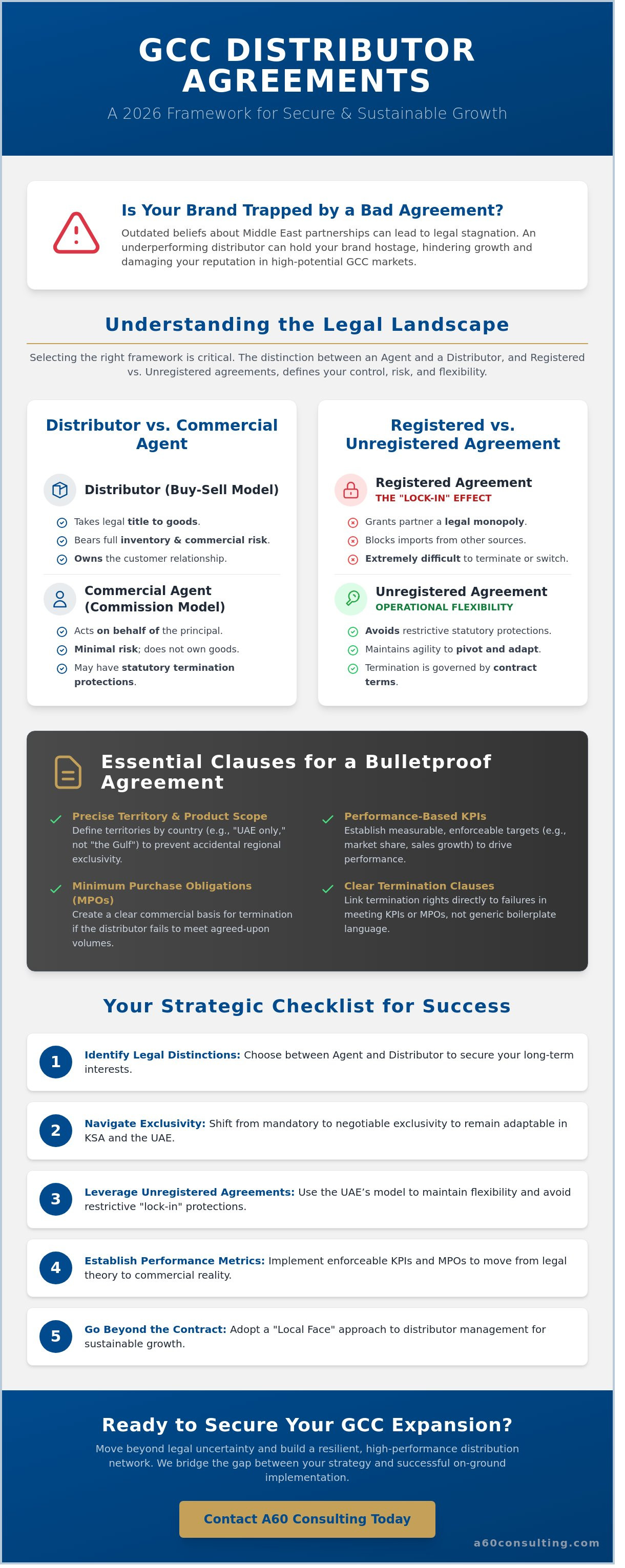
The distinction between a distributor and an agent in the GCC is a matter of risk, title, and legal leverage. A distributor typically operates on a "buy-sell" basis, taking legal title to the goods and assuming the inventory risk. They earn through a profit margin. Conversely, a commercial agent acts on behalf of the principal, often without taking ownership of the products, and earns a commission on sales.
- Risk and Title: Distributors bear the cost of unsold stock; agents do not.
- Statutory Protections: Registered agents in countries like Kuwait often enjoy "indemnity upon termination" rights that are difficult to waive.
- Operational Control: Principals often have more direct contact with the end customer in agency models, whereas distributors own the customer relationship.
The Role of the Ministry of Economy
National commercial registers maintained by the Ministry of Economy in the UAE, Qatar, and Kuwait act as a double-edged sword. Registration provides the local partner with the ability to block imports from other sources, effectively granting them a legal monopoly. This makes switching partners difficult; in many cases, a principal cannot register a new partner until the previous registration is formally canceled, which may require a court order or a significant settlement fee.
A "Commercial Agency" under GCC statutory norms is defined as the representation of a foreign principal by a local natural or legal person for the purpose of distributing, selling, or providing goods or services within a specific territory for a commission or profit.
By 2026, the UAE has introduced more flexibility for public joint-stock companies to act as agents, yet the core challenge remains the same: the "lock-in" effect of registration. Companies must weigh the benefits of a registered partner, such as assistance with government tenders, against the loss of agility in their supply chain management.
Essential Clauses for Every Middle East Distributor Agreement
A successful distributor agreement middle east strategy in 2026 hinges on precision rather than broad assumptions. The legal landscape across the GCC has matured, moving away from rigid protectionism toward more balanced, contract-based relationships. To safeguard your interests, your agreement must address specific local nuances that differ significantly from European or North American standards.
Defining the Territory and Product Scope
Vague definitions often lead to "accidental" regional exclusivity. If you grant rights for "the Gulf," you might inadvertently block yourself from appointing separate partners in Kuwait or Qatar. Be precise. Define the territory by specific national borders or even specific Emirates within the UAE. According to the UAE Distribution Channels guide, understanding whether an agent is registered under the Commercial Agencies Law is vital, as registration grants the distributor significant statutory protections that are difficult to waive. You should also clearly state whether sub-distribution is permitted. Local resellers can create complex layers of liability that you don't want to manage from a distance. For insights on identifying the right partners to fill these roles, see our Strategic Guide to Finding and Managing Distributors in the UAE.
Termination and Non-Renewal Mechanics
GCC courts, particularly in the UAE and Saudi Arabia, historically favored the local distributor. However, the 2023 UAE Commercial Agencies Law and Saudi Arabia's 2023 Civil Transactions Law have introduced more flexibility. "Good cause" remains the standard for termination, meaning you can't simply end a contract because you've found a cheaper partner. Enforceable "material breach" clauses must be specific and measurable. Effective agreements include metrics such as:
- Failure to meet 85% of annual sales targets for two consecutive years.
- Failure to maintain a minimum stock value of 500,000 AED at any given time.
- Unauthorized sales outside the agreed territory or via unapproved digital channels.
Notice periods should align with statutory minimums, which often range from 6 to 12 months. This helps mitigate "loss of profit" claims, which in some jurisdictions can reach 20% to 30% of average annual earnings if the termination is deemed unfair.
In Saudi Arabia, exclusivity is no longer a legal requirement for a valid distributor agreement middle east, allowing for more competitive, multi-channel strategies. Regarding Intellectual Property, ensure your brand is registered in each specific jurisdiction. A UAE trademark registration doesn't automatically protect you in Riyadh or Muscat. Protecting your brand in this multi-jurisdictional environment requires a proactive filing strategy before the agreement is even signed.
If you're refining your market entry strategy, our team at A60 Consulting can help align your legal framework with your operational goals to ensure sustainable growth.
Registered vs. Unregistered Agreements: Navigating Local Protections
Choosing between a registered commercial agency and a private distribution contract is the most consequential decision in a distributor agreement middle east. In the UAE, the Federal Decree-Law No. 3 of 2022, which became effective on June 15, 2023, redefined these boundaries. While registration offers the local partner intense legal safeguards, staying unregistered keeps the relationship under the Civil and Commercial Codes. This provides the principal with a clearer path to exit if performance targets aren't met. Most savvy entrants now treat registration as a reward for long-term performance rather than a starting point for market entry.
The Protections of a Registered Agent
A registered agent enjoys statutory rights that can't be contracted away. They're entitled to commission on all relevant transactions within their territory, even if they didn't personally broker the deal. Perhaps the most potent tool is the ability to record the agreement with UAE Customs. This allows an agent to request a block on any shipments of the same brand entering the country through unauthorized channels. Disputes first go to the Commercial Agency Committee, where payouts for termination often range between 5% and 15% of the average annual profit generated during the term.
Saudi Arabia and the 2026 Vision 2030 Impact
The Saudi Ministry of Commerce has moved toward a more liberalized framework to attract global investment. Since the 2023 regulatory updates, the mandatory requirement for exclusivity has diminished. Foreign manufacturers now have more room to appoint multiple distributors for different regions or product lines. For a deeper look at these shifts, consult the Saudi Arabia Distribution guidelines. The implementation of Vision 2030 has fundamentally decoupled national economic growth from rigid agency protections, allowing foreign principals to adopt multi-channel strategies that were previously legally restricted.
Deciding to register depends on your long-term commitment and the distributor's track record. If you're entering the UAE market with a new brand in 2026, keep the agreement unregistered for at least the first 24 months. This probationary period under the Commercial Code lets you assess the partner's actual implementation capabilities without the risk of a locked border or expensive deregistration fees, which can exceed AED 10,000 in administrative costs alone. Structuring a distributor agreement middle east requires a clear-eyed assessment of these protections versus the need for agility. Only move toward registration when the distributor has proven they can scale operations and hit the agreed-upon KPIs. This approach balances the need for local expertise with the necessity of maintaining strategic control over your brand's regional trajectory.
Negotiating for Performance: Aligning Incentives and KPIs
A robust distributor agreement middle east serves as a commercial engine rather than a static legal shield. In the UAE's competitive landscape, 65% of distribution partnerships fail within three years due to misaligned performance expectations. Moving beyond boilerplate clauses requires a shift toward strategic execution where every incentive mirrors a specific market reality. You must define what "success" looks like in concrete terms, ensuring the distributor's profit motives align with your brand's long-term regional health.
Transparency regarding customer data and marketing spend remains a frequent friction point. UAE Federal Decree-Law No. 45 of 2021 on the Protection of Personal Data dictates how local customer information is handled, so your agreement must explicitly define data ownership and reporting frequency. Without these provisions, you risk losing visibility into your end-users, effectively becoming a hostage to your distributor's internal CRM. Demand monthly digital sales reports and quarterly physical audits of inventory and showroom standards to maintain a clear line of sight.
Drafting Enforceable Sales Targets
Minimum Purchase Obligations (MPOs) only hold weight if they're tied to tangible consequences. In UAE courts, a breach of MPOs is a valid ground for terminating exclusivity or the entire contract, provided the targets were realistic and clearly documented. It's best to set these targets annually but review them through quarterly strategic cycles. This cadence allows for adjustments based on shifting macroeconomic factors, such as sudden shifts in real estate demand or tourism cycles in Dubai and Abu Dhabi. For a deeper look at aligning these targets with broader regional goals, refer to The 2026 GCC Market Entry Strategy.
- Exclusivity Triggers: Link the right to remain an exclusive partner to achieving 90% of the agreed annual MPO.
- Marketing Investment: Specify a fixed percentage of gross sales, often between 3% and 7%, that the distributor must reinvest into local brand building.
- Showroom Standards: If your product requires a physical presence, mandate specific AED 250,000+ investment tiers for flagship locations in premium zones like Sheikh Zayed Road.
In-Country Value (ICV) and Local Content
Strategic execution in the UAE now requires a deep understanding of the National In-Country Value (ICV) Program. If your business targets government tenders or the energy sector, your distributor's ICV score directly impacts your ability to win contracts. The distributor agreement middle east must clarify who is responsible for maintaining this certification and how local assembly or service support contributes to the score.
Negotiate the distributor's role in localizing the value chain. This might include establishing a local repair center or a spare parts hub within a free zone like JAFZA. By embedding these requirements into the contract, you ensure the distributor isn't just a logistics provider but a partner in your regional industrial footprint. This local representation is vital for monitoring commitments and ensuring that "local content" isn't just a line item, but a measurable part of your organizational growth.
Ready to build a high-performing partnership? Optimize your regional distribution network with our strategic implementation framework.
Beyond the Contract: Managing the Distributor Lifecycle with A60
Signing a distributor agreement middle east represents the start of a complex operational journey, not its conclusion. In the United Arab Emirates, data suggests that up to 65% of distribution partnerships underperform because of a "set and forget" mentality after the legal ink dries. Success depends on active, localized management that bridges the gap between high-level strategy and daily execution on the ground in Dubai or Abu Dhabi.
Remote management of GCC distributors frequently fails because it ignores the region's relationship-driven business culture. Without a consistent local presence, your brand risks becoming a secondary priority for a distributor who manages dozens of other portfolios. A60 Consulting provides the "Local Face" necessary to maintain momentum. We ensure your partner remains focused on your specific growth targets and regulatory compliance through regular face-to-face engagement, which is the primary currency of trust in the UAE.
Partner Search and Vetting Excellence
A60's methodology goes beyond reviewing trade licenses or basic financial statements. We conduct deep-dive due diligence to assess a partner's actual market influence and their existing relationships with key UAE stakeholders. Our process involves three critical stages:
- Network Verification: We confirm if the distributor has direct access to decision-makers in specific sectors like energy, healthcare, or infrastructure.
- Resource Audit: We evaluate their physical logistics capabilities and the technical proficiency of their local sales teams.
- Commercial Pre-alignment: We define performance expectations and margin structures in AED before the legal drafting begins, reducing friction during the final negotiation.
Ongoing Sales Enablement and Support
We act as your regional sales office, translating your corporate HQ expectations into actionable local plans. This hands-on approach helps mitigate cultural friction and ensures that your distributor agreement middle east remains a living, productive document. We monitor monthly KPIs, attend local client meetings, and provide the technical support your partner needs to close deals in a competitive 2026 market.
We bridge the communication gap, ensuring that regional market realities are clearly understood by your global leadership. If you want to ensure your entry into the UAE is backed by rigorous data and local expertise, you should contact A60 Consulting for a partner vetting assessment to secure your regional future. Our focus is on turning a legal document into a measurable, sustainable revenue stream.
Securing Your Competitive Advantage in the 2026 GCC Market
Building a resilient presence in the Gulf requires more than a standard template. You've seen how UAE Law 3/2022 has fundamentally shifted the balance between principals and agents, making the distinction between registered and unregistered contracts a critical strategic choice for multinational firms. Success in 2026 hinges on your ability to align local KPIs with broader regional goals like Saudi Vision 2030. A well-structured distributor agreement middle east provides the necessary legal framework, but the real value lies in the ongoing management of the partner lifecycle across the six GCC nations. With a strategic presence throughout the region, A60 Consulting brings 30+ years of GCC experience to your expansion strategy. We don't just help you sign a contract; we ensure your operational implementation matches your strategic intent. By focusing on measurable outcomes and clear governance, you'll transform a legal necessity into a sustainable growth engine. Secure your regional growth with A60’s partner search and management services. We're here to help you turn these regional complexities into your strongest competitive advantage.
Frequently Asked Questions
Is exclusivity mandatory in a Middle East distributor agreement?
Exclusivity isn't mandatory under current UAE regulations. While historical practice favored exclusive arrangements, Federal Decree-Law No. 34 of 2022 allows principals to appoint multiple agents for the same territory. This flexibility is vital for a distributor agreement middle east strategy. It enables brands to test different partners across various emirates. You should define the scope clearly in the contract to avoid overlapping territories and potential disputes.
What is the difference between a registered and an unregistered agency in the UAE?
A registered agency is recorded with the UAE Ministry of Economy, while an unregistered one is governed by general commercial law. Registered agents enjoy statutory protections under the 2022 Agency Law, which makes termination by the principal more complex. Unregistered agreements offer more flexibility for the principal. They're often preferred for initial market entries where the long term viability of the partnership isn't yet proven.
Can I terminate a distributor in Saudi Arabia for poor performance?
You can terminate a distributor in Saudi Arabia for poor performance if your contract includes specific, measurable KPIs. The Saudi Civil Transactions Law, which took effect in December 2023, emphasizes the importance of contractual terms. If a distributor fails to meet 80% of their annual sales target, this often constitutes a valid reason for non-renewal. You must document these performance gaps consistently to succeed in a potential legal challenge.
Do I need a local partner to sell products in the GCC?
You don't necessarily need a local partner to sell products in the GCC due to recent legislative shifts. The 2020 amendment to the UAE Commercial Companies Law allows 100% foreign ownership in many sectors. Similarly, Saudi Arabia’s Vision 2030 initiatives permit direct investment in retail and wholesale. However, a local distributor often provides the 100% logistical and regulatory coverage required to clear customs and manage local after-sales service.
How does the 2022 UAE Agency Law affect existing agreements in 2026?
The 2022 UAE Agency Law impacts 2026 agreements by providing clearer exit paths for principals. The law introduced a two year transition period for existing contracts that ended in mid-2025. By 2026, most principals can terminate agreements upon expiry without the restrictive material reason requirement that previously existed. This change shifts the balance of power, allowing for more performance-based renewals in your distributor agreement middle east.
What happens to my trademark if my distributor registers it locally?
Your trademark remains your property, but a distributor registering it locally can lead to a costly legal battle. Under UAE Federal Decree-Law No. 36 of 2021, the first to register usually holds the rights. If a partner registers your brand, they can block your shipments at customs. Always register your intellectual property with the Ministry of Economy before signing any deal to maintain full control of your brand's equity.
Are verbal distribution agreements enforceable in the Middle East?
Verbal distribution agreements are technically enforceable under the UAE Civil Code, but they're incredibly difficult to prove in court. Article 130 of the Civil Code requires written evidence for most commercial obligations exceeding a small value. Without a written document, you can't register the agency with the Ministry of Economy. This lack of documentation creates significant risk for both parties, especially during a transition or a performance dispute.
Who pays for marketing and promotion in a typical GCC distribution deal?
Marketing costs are typically shared, with 2% to 5% of annual turnover often allocated to a joint marketing fund. In a standard GCC deal, the principal provides the creative assets while the distributor manages the local execution. You should specify which party pays for trade shows, social media ads, and localized packaging. Clear financial splits prevent the strategic stagnation that occurs when both parties wait for the other to invest.