
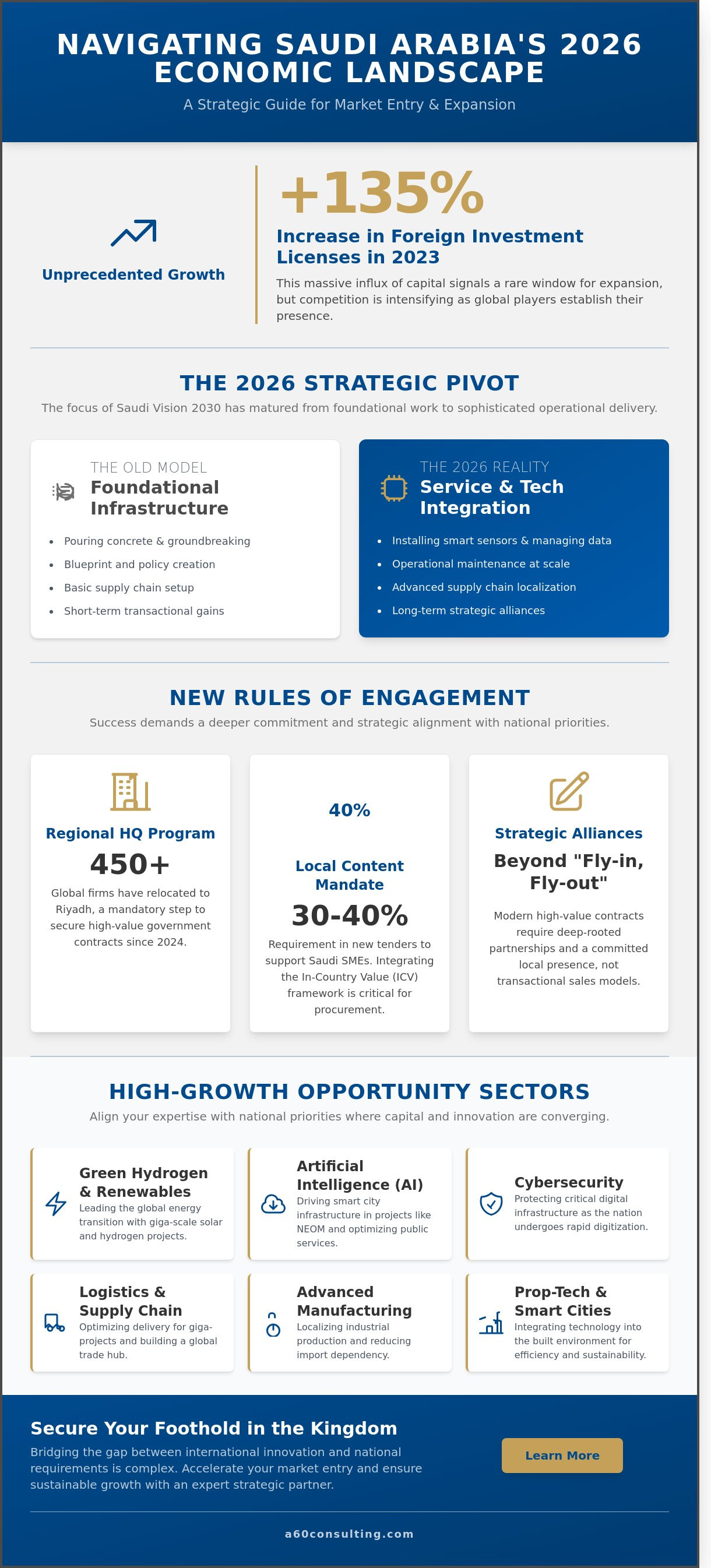
Did you know that the Saudi Ministry of Investment issued 135% more investment licenses in 2023 than in the previous year? This surge reflects a massive influx of capital, yet many UAE-based firms feel the pressure of an opaque regulatory environment and the challenge of finding vetted local partners. You're likely aware that the Kingdom's transformation represents a rare window for expansion, but the presence of established global players makes the entry point feel increasingly crowded. Identifying the right saudi vision 2030 business opportunities requires more than just ambition; it demands a precise understanding of the shifting 2026 landscape.
We've designed this guide to bridge the gap between strategic intent and successful execution. You'll discover the specific high-growth sectors poised for the next phase of development and learn the frameworks necessary to navigate the 2026 regulatory framework with confidence. We'll outline a clear, data-driven roadmap to help you secure sustainable sales growth and build a resilient presence in the region's most dynamic economy.
Key Takeaways
- Understand the strategic transition from infrastructure development to high-value service and technology delivery defining the Saudi economic landscape heading into 2026.
- Pinpoint the most lucrative saudi vision 2030 business opportunities in sectors like AI, cybersecurity, and green hydrogen to ensure your expansion is data-driven and purposeful.
- Learn why modern high-value contracts require a shift from the "fly-in, fly-out" model toward deep-rooted strategic alliances and committed local partnerships.
- Operationalize your market entry by integrating Local Content requirements and the In-Country Value (ICV) framework into your core strategy to optimize procurement scores.
- Discover how bridging the gap between international innovation and national requirements through expert guidance can accelerate a measurable and sustainable market foothold.
Evaluating the Saudi Vision 2030 Landscape in 2026: From Strategy to Execution
Saudi Vision 2030 isn't just a policy document; it's a total overhaul of the Kingdom’s economic DNA. By 2026, the landscape has moved past the initial phase of blueprints and ground-breaking ceremonies. We're now witnessing the physical and digital manifestation of the Saudi Vision 2030 strategic framework. The Public Investment Fund (PIF), managing assets exceeding 3.4 trillion AED, serves as the primary engine driving these national giga-projects. This transformation rests on three foundational pillars: a Vibrant Society, a Thriving Economy, and an Ambitious Nation. For UAE-based enterprises and international consultants, these pillars represent a structured path toward sustainable growth and cross-border partnership.
The 2026 Economic Pivot: What has Changed?
The 2026 landscape marks a definitive shift in fiscal priorities. The Kingdom’s goal to increase non-oil GDP to 50% is no longer a distant target but a measurable reality reflected in the growth of the manufacturing and tourism sectors. The Regional Headquarters (RHQ) program has fundamentally altered how foreign firms participate in the market. Since the 2024 mandate requiring companies to establish their Middle East bases in Riyadh to eligible for government contracts, over 450 global entities have relocated. This concentration of decision-making power creates a localized hub for high-value procurement. The "Delivery Phase" of giga-projects acts as the primary 2026 business driver, shifting the focus from foundational infrastructure to the integration of services and advanced technology.
Understanding the Role of Giga-projects
Giga-projects like NEOM, the Red Sea Global development, and Qiddiya have evolved into vast ecosystems. They offer diverse saudi vision 2030 business opportunities for firms specializing in logistics, prop-tech, and renewable energy. These developments act as "smart city" laboratories where international tech firms test AI-driven infrastructure at scale. Success in this environment requires a shift in executive mindset. Organizations must prioritize long-term implementation and organizational culture alignment over short-term transactional gains. Identifying high-value saudi vision 2030 business opportunities requires a presence on the ground and a deep understanding of the local supply chain regulations. 2026 is the year where strategy meets the reality of operational maintenance and service delivery.
- Infrastructure to Integration: The focus has moved from pouring concrete to installing smart sensors and managing data.
- Supply Chain Localization: There's a 30% to 40% local content requirement in many new tenders to support Saudi SMEs.
- Human Capital: Demand for specialized training and organizational transformation services has peaked as the Kingdom seeks to upskill its workforce.
For the strategic leader, 2026 is about navigating the complexity of a maturing market. It's about moving beyond the "why" of the vision and mastering the "how" of execution. The window for early-mover advantage is closing, making the precision of market entry strategies more critical than ever before.
High-Growth Sectors: Where Capital and Innovation Meet
The economic transformation of the Kingdom is no longer a future projection; it's a present reality with clear milestones set for 2026. This shift from an oil-dependent economy to a diversified global hub creates specific saudi vision 2030 business opportunities for firms that can align their operations with national priorities. Success in this market requires more than just capital. It demands an understanding of how the National Industrial Development and Logistics Program (NIDLP) and the Public Investment Fund (PIF) are directing the flow of regional investment.
By 2026, the focus will move from initial ground-breaking to the operationalization of "Giga-projects" like NEOM and the Red Sea Project. This transition opens doors for companies specializing in advanced manufacturing, supply chain optimization, and sustainable utility management. The scale is immense. For instance, the NIDLP aims to attract investments totaling approximately 1.56 trillion AED (425 billion USD) across the industrial, mining, and logistics sectors. Analyzing these market opportunities in Saudi Arabia reveals that the most resilient businesses will be those that localize their value chain rather than relying solely on exports.
The Tech Boom: Beyond Simple Software Sales
Digital transformation is the backbone of the Saudi strategy. By 2026, strict data residency requirements will be fully enforced, meaning firms must provide localized cloud solutions and on-soil data processing. This regulatory environment favors fintech and healthtech providers that invest in local infrastructure. There's a critical demand for "Industry 4.0" solutions, specifically AI-driven predictive maintenance and IoT sensors, to modernize the expanding industrial zones in Jubail and Yanbu. Edtech also remains a priority as the Kingdom seeks to upskill its workforce to meet new technical standards. Bridging the gap between a high-level strategy and operational success requires a methodical approach to market entry that accounts for these local nuances.
Infrastructure and Sustainable Energy
The Kingdom's path to net-zero by 2060 involves a massive scaling of renewable energy. By 2026, the goal is to have significantly increased the percentage of solar and wind energy integrated into the national grid. This isn't just about power generation; it's about the entire ecosystem. Opportunities exist for:
- Water Desalination: High-efficiency, low-carbon technologies to support a growing population.
- Green Building: Materials and construction methods that meet LEED Gold or Platinum standards for new urban developments.
- Waste Management: Circular economy solutions that convert municipal waste into energy or recycled raw materials.
Logistics also presents a massive frontier. The plan to turn the Kingdom into a global logistics hub involves expanding airport capacities and rail networks. Firms that provide smart logistics software or cold-chain solutions for the pharmaceutical and food sectors will find a hungry market. The focus is on measurable efficiency and sustainable growth, moving away from short-term gains toward long-term organizational health.
The Shift from Transactional Sales to Strategic Alliances
The most common mistake international firms make involves clinging to an outdated "agent" model. Many executives believe that securing a local sponsor or a passive distributor fulfills their market entry requirements. This logic doesn't hold up in 2026. The International Trade Administration market overview confirms that the Saudi economy has transitioned into a highly competitive, transparent environment where value-added partnerships take precedence over simple brokerage.
High-value contracts are no longer won by "fly-in, fly-out" sales teams. This transient approach signals a lack of long-term commitment that Saudi procurement officers now actively avoid. Reliability is measured by physical and intellectual presence. Even the concept of "Wasta," or traditional networking, has evolved. It's no longer about backroom deals; it's about building formal, professional alliances that demonstrate a clear understanding of the Kingdom's sovereign goals. To capitalize on saudi vision 2030 business opportunities, your organization must transition from being a vendor to becoming a strategic stakeholder.
Why Traditional Distribution Models are Failing
The Ministry of Investment (MISA) has simplified the path for foreign firms to obtain 100% ownership licenses, reducing the need for middle-men. In 2023, MISA issued 2,320 new investment licenses, a 39.6% increase from the previous year, signaling a move toward direct market engagement. The Kingdom now prioritizes partners who invest in local talent. Modern saudi vision 2030 business opportunities favor Value-Added Resellers (VARs) who provide technical support and localized implementation rather than just moving product boxes.
Building Trust through Local Representation
Establishing a regional office isn't just a regulatory checkbox; it's a trust-building exercise. Having a dedicated team on the ground allows you to navigate cultural nuances and respond to shifting project demands in real-time. Success requires aligning your sales pitch with the specific KPIs of national transformation programs, such as the National Industrial Development and Logistics Program (NIDLP). This level of integration is essential for any 2026 GCC Market Entry Strategy: A Blueprint for Strategic Regional Expansion. By mirroring the Kingdom's pace and ambition, you prove that your firm is a partner in their future, not just a spectator of their growth.
Operationalising Your Entry: Regulatory Compliance and Local Content
Capturing saudi vision 2030 business opportunities requires more than a competitive product; it demands a deep integration into the Kingdom's evolving regulatory framework. Success in 2026 hinges on how well a firm aligns with the Local Content and Government Procurement Authority (LCGPA) standards. As of 2024, local content weightage in government tenders can account for up to 40% of the total evaluation score. Companies that fail to account for this In-Country Value (ICV) often find themselves disqualified from major infrastructure and technology projects, regardless of their technical merit.
Your entry strategy must prioritize the Ministry of Investment (MISA) licensing process. While MISA allows for 100% foreign ownership in most sectors, it requires strict adherence to capitalization rules and operational transparency. For industrial and consumer goods, the Saudi Standards, Metrology and Quality Organization (SASO) remains the primary gatekeeper. You'll need to utilize the Saber electronic platform to obtain necessary Certificates of Conformity. Technology firms face an additional layer of oversight from the Saudi Data and AI Authority (SDAIA). The Personal Data Protection Law (PDPL), which became fully enforceable in September 2024, mandates strict data residency and processing protocols that every UAE-based tech firm must implement before launching services.
Mastering the Local Content Score
To maximize your procurement success, you must calculate and optimize your ICV score early. This score measures your contribution to the Saudi economy through the procurement of local goods, the hiring of Saudi nationals, and the development of local talent. The Nitaqat system tracks your Saudization ratios, and high-performing firms use this as a competitive advantage rather than a compliance hurdle. By 2026, moving from pure import models to local assembly or specialized service hubs in Saudi Arabia can improve your contract win rate by an estimated 25% compared to offshore competitors. Investing in national talent training programs isn't just a social goal; it's a strategic necessity for long-term contract retention.
Navigating the Regulatory Roadmap
The product certification process is often where expansion plans stall. You must identify specific HS codes and match them with SASO technical regulations through the Saber platform. Common hurdles in 2026 include the misalignment between UAE technical specifications and Saudi national requirements, which can cause delays of 90 days or more if not addressed pre-entry. A localized legal strategy is vital. This involves more than just translating documents; it requires a structural setup that accommodates Saudi labor laws and dispute resolution mechanisms. Firms that establish a robust compliance framework from day one avoid the 15% to 20% operational cost overruns typically associated with reactive regulatory fixes.
Prepare your business for a seamless transition into the Saudi market with our strategic compliance advisory.
Securing Your Foothold: How a Strategic Partner Accelerates Success
Success in the Kingdom requires more than a robust product; it demands a physical and cultural presence that matches the pace of the national transformation. By 2026, the saudi vision 2030 business opportunities that currently seem abundant will be dominated by those who secured local roots early. A60 Consulting provides the essential "boots on the ground" expertise required to navigate a regulatory and social environment that evolves weekly. We bridge the gap between your international innovation and the specific national requirements mandated by Saudi authorities.
Operating from a Dubai or Abu Dhabi hub provides a strong foundation, but the Saudi market requires localized execution. Establishing a physical entity in Riyadh can involve setup costs exceeding AED 450,000 when factoring in licensing, office space, and the mandatory recruitment of local talent. Our outsourced sales management model allows UAE-based firms to bypass these initial hurdles. We offer shared regional representation that reduces entry costs while ensuring your brand is present in every critical boardroom discussion. This isn't just about saving money; it's about deploying expert guidance to ensure your implementation mirrors your strategic intent.
Vetting the Right Partners and Distributors
Choosing a local representative is a high-stakes decision that dictates your trajectory for the next decade. Many firms fall into the "signed and forgotten" trap, where a distributor secures exclusivity but lacks the incentive to drive active growth. Effective vetting focuses on technical capability, government relations, and a shared commitment to 2026 milestones. You need a partner who views your success as a metric for their own performance. For a deeper analysis of this process, consult our How to Choose a GCC Market Entry Strategy Consultant: The 2026 Selection Guide.
Your Gateway to the Kingdom’s Vision
The year 2026 represents a definitive "now or never" moment. As projects move from the drawing board to operational reality, the window for new entrants to claim market share is narrowing. A60 Consulting acts as your regional sales office, driving impactful execution through rigorous partner management and market intelligence. We don't offer vague promises; we deliver the measurable growth required to capitalize on saudi vision 2030 business opportunities. Let us manage the complexities of the Kingdom while you focus on scaling your core business. Partner with A60 Consulting for your Saudi expansion today to secure your place in the region's future.
Securing Your Position in the 2026 Saudi Economy
By 2026, the Kingdom's transformation moves from policy creation to massive industrial execution. Success in this environment requires more than a transactional approach. It demands a deep integration into the local ecosystem through MISA licensing and ICV compliance. UAE-based firms are uniquely positioned to capture these saudi vision 2030 business opportunities by leveraging existing regional trade links and proximity. Data shows that companies prioritizing strategic alliances over simple distribution models achieve significantly more reliable market penetration in the Gulf.
Bridging the gap between a UAE headquarters and a Riyadh operation requires a partner who understands the nuances of regional scale. With over 30 years of regional experience and a proven track record in industrial and tech sales management, A60 Consulting provides the analytical depth needed to navigate complex regulatory frameworks. We help you operationalize your strategy while ensuring every step aligns with local content requirements and MISA standards.
Book a Strategic Consultation for Your Saudi Market Entry
The window for early-mover advantage is narrowing as the 2030 deadline approaches. Your expansion is a calculated step toward sustainable regional leadership.
Frequently Asked Questions
What are the most profitable business opportunities in Saudi Vision 2030 for 2026?
The most lucrative sectors for 2026 include renewable energy, specialized construction, and digital infrastructure. Saudi Arabia aims to generate 50% of its electricity from renewable sources by 2030, which creates a massive demand for solar and wind technology providers. These saudi vision 2030 business opportunities are particularly accessible to UAE firms that have already scaled sustainable energy solutions in similar desert climates.
How does the Regional Headquarters (RHQ) program affect my ability to win government contracts?
The RHQ program is now a mandatory prerequisite for any company seeking to secure government contracts valued at over 1 million AED. Since January 1, 2024, the Saudi government stopped awarding contracts to international firms that don't have their regional headquarters located within the Kingdom. If your business model relies on public sector tenders, establishing a physical headquarters in Riyadh isn't just an option; it's a strategic necessity.
What is In-Country Value (ICV) and why is it important for my business?
In-Country Value is a procurement scoring system that prioritizes companies contributing to the Saudi economy through local hiring and sourcing. It's a critical metric because a high ICV score can be the deciding factor in winning bids with major entities like Saudi Aramco or the Public Investment Fund. We've observed that businesses localizing their supply chain by at least 30% see a measurable increase in their contract win rates.
Can a foreign company own 100% of its business in Saudi Arabia?
You can legally own 100% of your business in most sectors through a license from the Ministry of Investment (MISA). While some specific activities like wholesale and retail trade require a minimum capital investment of roughly 29.3 million AED for full ownership, most service and consulting firms face no such high entry barriers. It's a significant shift from the old sponsorship model, allowing for total operational control and profit repatriation.
What are the main challenges for tech firms entering the Saudi market in 2026?
Tech firms primarily struggle with data residency regulations and intense competition for local talent. The Saudi Data and Artificial Intelligence Authority (SDAIA) mandates that specific types of data must be stored on servers within the Kingdom, which requires careful infrastructure planning. Additionally, with the tech sector growing at a rate of 13% annually, firms must offer competitive packages to attract the limited pool of skilled Saudi software engineers.
How long does it typically take to set up a business and start operations in the Kingdom?
The entire process from initial application to full operational status usually takes between 90 and 180 days. While you can often obtain a MISA investment license in less than 5 working days, opening a corporate bank account and securing employee visas takes significantly longer. We advise our partners to begin the administrative journey at least two quarters before they intend to sign their first local contract.
Do I need a local Saudi partner to sell my products or services?
You don't need a local partner for most commercial activities, but many firms choose one to accelerate market entry. While 100% foreign ownership is the legal standard, a local partner can provide immediate access to established distribution networks and existing client relationships. It's a trade-off between total equity control and the speed of market penetration that every leadership team must evaluate based on their specific goals.
What is the role of the Public Investment Fund (PIF) in business opportunities?
The PIF acts as the primary engine for economic transformation, managing assets that exceed 2.6 trillion AED. It funds the giga-projects like NEOM and the Red Sea Project, which creates a waterfall of saudi vision 2030 business opportunities for sub-contractors and service providers. Understanding the PIF's quarterly investment priorities is essential for any business leader looking to align their growth strategy with the Kingdom's largest spender.