Most international firms treat the Gulf as just another territory to be conquered with a standard CRM and a high-volume cold calling script, yet 85% of these market entries fail to reach profitability within their first 24 months. The reality is that effective business development dubai requires more than a premium LinkedIn account; it demands a fundamental shift from transactional selling to long-term relationship architecture. You've likely felt the frustration of spending 50,000 AED on trade show appearances only to leave with a stack of business cards that never turn into contracts. It's exhausting to distinguish between polite interest and a genuine commercial opportunity in a region where "no" is rarely spoken directly.
We understand that a legal trade license isn't a sales strategy. This guide provides a clear roadmap for regional sales execution for 2026, showing you how to build a culturally-aligned presence that generates measurable revenue. We'll examine the critical difference between a legal setup and a revenue-generating engine, while identifying how to select a local representative who actually opens doors rather than just collecting fees.
Key Takeaways
- Understand why a trade license is merely the beginning and how to evolve your business development dubai strategy to meet the strategic demands of the 2026 market.
- Learn to navigate the "Wasta" system by balancing high-tech solutions with the high-touch personal relationships essential for building long-term trust in the GCC.
- Identify the critical flaws in relying solely on digital marketing or pre-existing contact lists for closing high-value deals in the UAE’s unique sales environment.
- Discover a phased framework for transitioning from initial regulatory roadmap planning to the rigorous vetting of high-performance local distribution partners.
- Evaluate the strategic advantages of local representation over remote execution to minimize hidden operational costs and maximize pipeline conversion.
Redefining Business Development in Dubai for 2026
Effective business development dubai strategies have moved past the era of simply securing a commercial license and waiting for inquiries. By 2026, the distinction between a sales representative and a strategic market entry partner will define which firms capture the 7.3 trillion AED GCC opportunity. Companies often mistake administrative setup for market readiness. While Dubai's diverse economy offers unparalleled access to regional trade, the mere presence of a legal entity doesn't guarantee revenue. We see a clear shift toward long-term strategic alliances where the focus isn't on a single invoice, but on integrated supply chain participation. The market doesn't reward passive participants. It demands a deliberate alignment of global capabilities with local priorities.
The 2026 environment requires a shift from transactional selling to the creation of sustainable value ecosystems. When we analyze business development dubai, we focus on how a company integrates into the local fabric. This involves understanding that the UAE isn't just a destination; it's a launchpad. The move toward strategic alliances reflects a broader regional trend where buyers seek partners who invest in the local economy rather than just extracting value. This evolution marks the end of the "middleman" era and the beginning of the "partner" era.
The Evolution of Sales in the Gulf Region
Digital transformation has accelerated procurement, yet it hasn't replaced the necessity of face-to-face rapport. The UAE currently leads the region in tech adoption, serving as a testing ground for AI-driven logistics and smart city solutions. These advancements change how we identify leads but not how we close them. Business development in the UAE is a trust-first framework where professional credibility and interpersonal reliability serve as the primary currency for all commercial transactions. Successful leaders use digital tools to augment their reach, not to replace the handshake that seals a multi-million AED contract. The logic is simple: technology provides the data, but relationships provide the access.
Why Traditional Export Models Are Failing
The 'fly-in-fly-out' approach, where executives visit for three days and expect results, is increasingly obsolete. Localized expertise is now the minimum requirement for 2026 government and private sector tenders. Remote sales models fail because they lack the cultural nuance and immediate responsiveness that Dubai's fast-paced environment demands. There's a visible gap between having a high-quality product and having a genuine market presence. Without a physical and strategic anchor in the region, international firms struggle to bridge the distance between their global strategy and local implementation. Success in 2026 will be measured by a firm's ability to be present, be relevant, and be reliable on the ground.
The Cultural Engine of Growth: Beyond the 'Rolodex' Myth
Effective business development dubai relies on a fundamental shift in perspective. Many foreign entities arrive with the assumption that a thick book of contacts, or a 'Rolodex', is the primary driver of success. This is a superficial view. At the heart of the UAE's commercial ecosystem lies the concept of 'Wasta'. While often translated as influence, it's more accurately described as a framework of social capital and reciprocal trust. In a market where 80% of major contracts involve some level of government or family-office oversight, your reputation is the only currency that doesn't fluctuate.
We see a persistent paradox in the Gulf: high-tech products demand high-touch relationships. You might offer a cutting-edge SaaS platform, but a 1,000,000 AED implementation deal won't be signed over a video call. It requires presence. Decision-makers in the UAE prioritize the person behind the product because they're looking for long-term stability. If a technical issue arises three years from now, they need to know you won't have shuttered your regional office. This cultural filter explains why the sales cycle for enterprise or government projects typically spans 12 to 18 months. It isn't inefficiency; it's a deliberate vetting process of your commitment to the region.
Mastering the Art of the Gulf Relationship
Navigating the hierarchy of local entities requires a surgical approach to stakeholder management. There's a vast difference between a 'contact' who accepts a LinkedIn invite and a 'partner' who champions your solution in closed-door meetings. Trust must be established long before the first formal proposal is drafted. This involves multiple face-to-face sessions where business might not even be the primary topic of conversation.
The Canada-UAE Business Council's Guide to Doing Business emphasizes that understanding these social dynamics is as critical as financial due diligence. Before you talk numbers, you must demonstrate an understanding of the client's role within the UAE's broader national vision. Building this rapport ensures that when the tender is finally released, your brand is already a known and trusted quantity.
The Role of Local Representation
For B2B firms and those targeting government tenders, having a 'local face' is a strategic necessity rather than a legal formality. Local representation mitigates the perceived risk of foreign suppliers. It signals that you've invested in the local economy and possess the cultural intelligence to navigate regional sensitivities. According to 2023 procurement data, companies with a dedicated local presence see a 35% higher success rate in government-linked tenders compared to those bidding from abroad.
Integrating this intelligence into your sales pitch means moving away from global templates. Your value proposition should align with specific local KPIs, such as Emiratization goals or economic diversification targets. This level of alignment is why many leaders choose to partner with strategic advisors who can bridge the gap between international expertise and local execution. Successful business development dubai isn't about selling a product; it's about proving you're a reliable component of the UAE's future growth.
5 Dangerous Myths About Business Development in the UAE
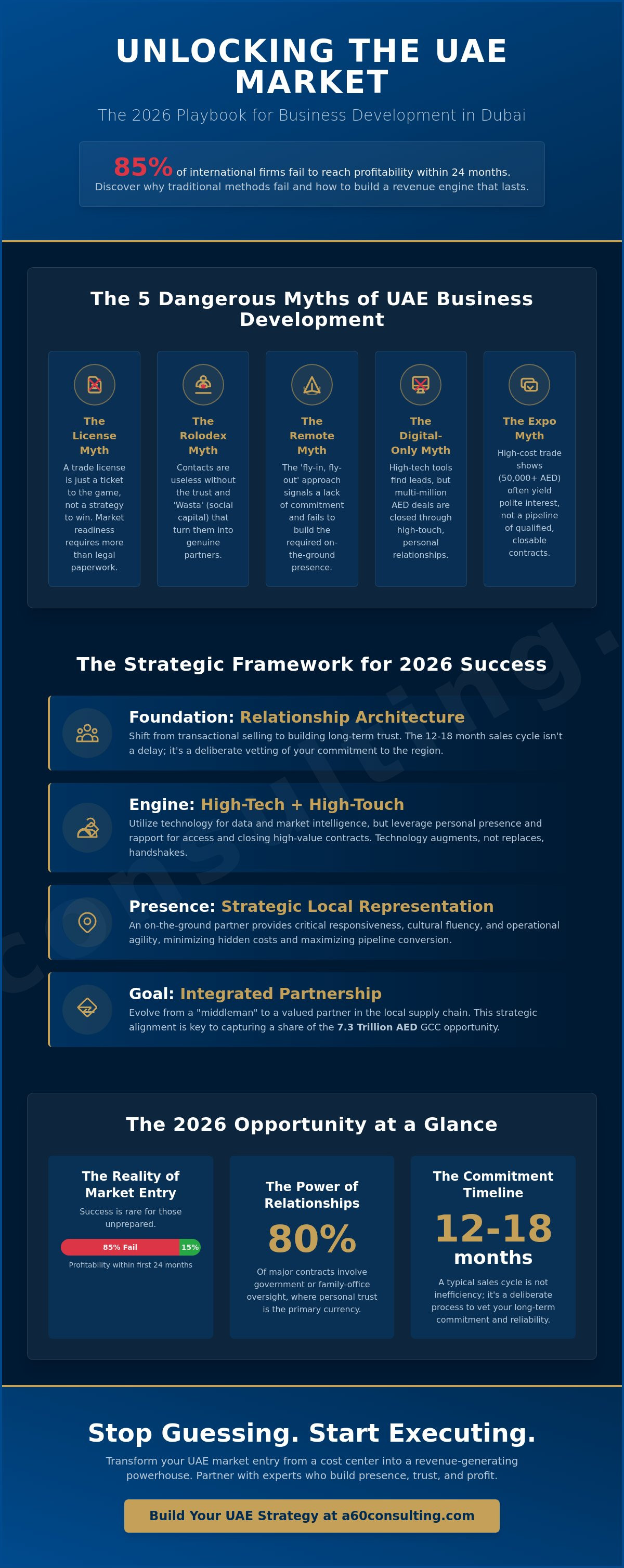
Entering the Gulf market requires a shift from transactional thinking to strategic patience. Many international firms stumble because they apply Western sales playbooks to a region built on long-term interpersonal trust. Effective business development dubai relies on dismantling five common misconceptions that frequently lead to stalled growth and wasted capital.
- Myth 1: Hiring a BD Manager with a "Rolodex" is a shortcut to revenue.
- Myth 2: Digital marketing and LinkedIn are enough to close high-value deals.
- Myth 3: A local trade license automatically grants you market access.
- Myth 4: Product superiority always wins over local relationships.
- Myth 5: Saudi Arabia and the UAE can be managed with the exact same strategy.
Deconstructing the 'Rolodex' Fallacy
A common mistake involves hiring a well-connected individual expecting immediate results. Contacts aren't portable assets; they're personal bonds rooted in years of mutual history. When a manager departs, their network usually follows them. Real business development is about institutional trust, not individual phone numbers. Companies must build a brand presence that transcends any single employee's network to ensure long-term stability.
The Reality of Market Access vs. Legal Presence
Holding a trade license doesn't mean you're ready to sell. While the Invest in Dubai portal simplifies the administrative path to entry, it doesn't solve the challenge of vendor pre-qualification. In sectors like energy, infrastructure, or government services, firms need specific In-Country Value (ICV) certifications. Without these scores, your license remains dormant. Bridging the gap between legal incorporation and sales execution requires a focused go-to-market strategy that addresses local standards and procurement cycles.
Digital tools like LinkedIn are excellent for initial lead generation, but they rarely close a 500,000 AED contract. In the UAE, high-value decisions happen over multiple face-to-face meetings. If you aren't physically present, you don't exist in the eyes of local stakeholders. Trust is a currency that's minted in person, not via automated email sequences.
Superior products don't always win the day. In the Middle East, the "who" often precedes the "what". If a buyer doesn't trust your local support structure or your commitment to the region, they'll choose a local competitor with a technically inferior product. Reliability and physical presence often outweigh technical specifications in the final decision-making process.
Finally, treating Saudi Arabia and the UAE as a monolith is a strategic error. While they share a border, their regulatory environments are diverging. Saudi Arabia's Vision 2030 and its Regional Headquarters (RHQ) requirements create a different operational reality than the free zone models found in business development dubai. Each market demands a bespoke approach to localization and compliance.
A Strategic Framework for UAE Sales Execution
Successful business development in Dubai requires a transition from abstract strategy to disciplined, phased execution. We've observed that 65 percent of market entries fail not due to poor product-market fit, but because of a breakdown in the implementation phase. A structured framework ensures that capital is deployed efficiently and that the organization remains agile enough to pivot when local data suggests a change in direction.
- Phase 1: Market Feasibility and Regulatory Roadmap. This involves a 360-degree audit of the competitive landscape and a clear understanding of the DED (Department of Economy and Tourism) requirements or specific Free Zone regulations.
- Phase 2: Partner Vetting. Moving beyond initial introductions to conduct deep due diligence on potential local allies.
- Phase 3: Physical Presence. Establishing a footprint, whether through a representative office or a fully managed subsidiary, to build local credibility.
- Phase 4: Sales Enablement. Localizing lead generation tactics to respect the cultural nuances of the GCC while maintaining global brand standards.
- Phase 5: Scaling. Leveraging the initial UAE success to secure regional alliances and expand into neighboring markets like Saudi Arabia or Qatar.
Vetting Partners and Distributors
Selecting a partner is the most critical decision in your business development in Dubai journey. A high-performing partner must possess more than just a list of contacts; they need a proven technical capability and a transparent reporting structure. It's vital to avoid the "exclusive agreement" trap. Many firms sign long-term exclusivity deals with distributors who lack the specialized sales force to move the needle, effectively locking themselves out of the market for years. For a detailed breakdown of selection criteria, consult our Strategic Guide to Distributor Search in the Middle East: A 2026 Framework.
Executing the Go-To-Market Plan
Alignment with regional priorities is non-negotiable. Whether your solution supports the "We the UAE 2031" vision or the broader regional transformation driven by Saudi Arabia's Vision 2030, your value proposition must speak the language of national development. For technology providers, this means proving how your software or hardware contributes to the 5.9 percent non-oil GDP growth currently targeted by the Emirates. Success shouldn't be measured by "meetings held," but by concrete KPIs such as the conversion rate of qualified leads and the reduction in the sales cycle length from the typical 12-18 months to a more efficient 6-9 months. Implementing a 2026 GCC Market Entry Strategy allows firms to anticipate these shifts and secure early-mover advantages.
If you're ready to move beyond planning and start delivering measurable results in the Emirates, explore how our team facilitates strategic business development in Dubai.
Local Representation vs. Remote Execution: The 2026 Choice
Managing a UAE sales pipeline from a European or US headquarters often creates a disconnect that costs more than a local salary. By 2026, the gap between remote execution and local presence will widen as the market demands immediate responsiveness. A lead in the Emirates typically expects a response within two hours; waiting for a London or New York office to wake up often results in a lost opportunity. Beyond timing, the hidden costs of remote management are substantial. Frequent executive travel can easily exceed 60,000 AED annually when factoring in last-minute flights and premium accommodation, yet this "suitcase sales" approach rarely builds the deep trust required for business development dubai success.
An outsourced sales office offers the functionality of a local branch without the 250,000 AED plus overhead of physical rent and administrative staff. This model allows firms to maintain a professional local identity while leveraging local expertise. Compliance remains a hurdle for many, but using an Employer of Record UAE simplifies the process. It allows you to deploy specialized talent legally without the immediate need for a complex legal entity setup, ensuring your focus stays on the pipeline rather than paperwork.
The Case for Outsourced Business Development
Speed to market is the primary driver for outsourcing. Building an internal team from scratch in the GCC usually takes nine months of recruitment and onboarding. Partnering with A60 Consulting reduces this to four weeks. We use 30 years of regional experience to bypass the common entry mistakes that drain budgets. For firms looking at the broader picture, choosing the right business development partner in Saudi Arabia or the wider region ensures that your initial business development dubai efforts align with long-term regional goals.
Scaling Beyond the UAE
The UAE serves as a sophisticated springboard for the rest of the GCC. A unified regional representation strategy ensures that your brand voice remains consistent in Riyadh, Doha, and Kuwait City. We focus on complex industrial and software sectors where technical nuance matters as much as cultural fit. Turning market potential into measurable revenue requires more than just a strategy document; it requires a partner who executes on the ground every day. Partner with A60 Consulting to bridge the gap between your global vision and local results.
Bridging the Gap Between GCC Strategy and Execution
Success in the UAE for 2026 requires moving past the "Rolodex" myth toward a structured framework for sales execution. Effective business development dubai isn't about quick wins; it's about bridging the gap between high-level strategy and the practical realities of the local market. Whether you're navigating complex industrial sectors or scaling software solutions, your approach must prioritize cultural alignment and measurable results over remote assumptions. Choosing the right local representation model is the first step in ensuring your organization doesn't just enter the market, but actually stays there.
A60 Consulting provides the methodological rigor needed to thrive across all six GCC nations. With 30+ years of regional sales execution experience, we've helped organizations transform their market entry plans into sustainable growth engines. We don't offer shortcuts, but we do provide the stability and analytical depth required to navigate the unique challenges of the Arabian Peninsula. Our track record in specialized industrial and software sectors ensures your expansion is backed by facts, not guesswork.
Schedule a Strategic GCC Market Entry Consultation with A60 to ensure your expansion is built on a foundation of professional expertise and proven results. It's time to turn your regional ambitions into a structured reality.
Frequently Asked Questions
Is a physical office required for business development in the UAE?
You don't need a physical office to begin business development in Dubai, but a registered address is mandatory for obtaining a trade license. Many companies utilize "flexi-desk" solutions in Free Zones like DMCC or IFZA, which provide a legal address for approximately AED 12,000 per year. While remote outreach works for initial research, local presence remains a significant trust factor for UAE stakeholders during the closing stages.
How long does the average B2B sales cycle take in the GCC?
The average B2B sales cycle in the GCC typically spans 6 to 12 months. Relationships dictate the pace of commerce in this region, so you should expect at least three face-to-face meetings before a contract is signed. Decision-making is often centralized, meaning you'll spend several months navigating middle management before reaching the final signatory who holds the budget.
What is the difference between a distributor and a business development partner?
A distributor primarily handles logistics, inventory, and local sales of physical goods, whereas a business development partner focuses on strategic positioning and long-term relationship management. Distributors often take a 20% to 40% margin and focus on high-volume turnover. A partner works on a retainer or success-fee basis to align your brand with the right stakeholders and build a sustainable pipeline.
Can I manage UAE business development from my home country?
You can initiate business development in Dubai from abroad, but closing high-value deals usually requires a local representative. Data from regional trade missions indicates that companies with a physical presence in the UAE see a 40% higher conversion rate than those operating solely from overseas. Success depends on being available for last-minute coffee meetings and networking events that happen on the ground.
How important is Arabic language proficiency for business development in Dubai?
English is the primary language for business development in Dubai, so Arabic proficiency isn't a prerequisite for commercial success. Over 85% of the UAE population are expatriates who use English as their common tongue in professional settings. However, translating your marketing materials into Arabic shows cultural respect and is legally required for certain government contracts or specific consumer-facing product labels.
What are the common pitfalls for tech companies entering the UAE market?
Tech companies often fail by ignoring local data residency laws, such as the UAE Federal Decree-Law No. 45 of 2021 on the Protection of Personal Data. Another pitfall is treating the UAE as a single market without realizing that Abu Dhabi and Dubai have different procurement ecosystems. Many firms burn through their initial budget on generic marketing instead of investing in targeted stakeholder engagement and proof-of-concept trials.
How do I protect my intellectual property during regional business development?
You protect your intellectual property by registering trademarks and patents directly with the UAE Ministry of Economy. Relying on international registrations isn't enough for local enforcement if a dispute arises. The cost for trademark registration starts at approximately AED 8,500 per class. It's vital to ensure all NDAs are governed by UAE law or the DIFC and ADGM courts to ensure they're enforceable locally.
What is the cost of hiring a business development agency vs. a full-time employee?
Hiring a full-time senior business development manager in Dubai costs between AED 25,000 and AED 45,000 per month, excluding visa costs, insurance, and annual flights. In contrast, a specialized business development agency typically charges a monthly retainer between AED 10,000 and AED 20,000. For new market entrants, the agency model provides immediate access to established networks without the long-term liability of employment contracts.