
What if the traditional "Dubai-first" model for Middle Eastern growth is actually the primary barrier to your 2026 revenue goals? With Saudi Arabia’s non-oil GDP growing by 4.4% in 2023, the regional center of gravity has shifted, demanding a more sophisticated gcc expansion strategy. You've likely realized that finding a partner who actually drives sales, rather than one who simply lists your products in a catalog, is the difference between a successful launch and a costly exit.
We understand the pressure to navigate complex local content requirements like the ICV while managing KSA, the UAE, and Qatar simultaneously. This article promises to move beyond theory, offering an execution-focused framework to master these complexities. You'll gain a clear roadmap for 2026 that balances multi-market operations and introduces a model for local representation that doesn't require immediate legal incorporation. We'll explore the specific steps to bridge the gap between market entry and sustainable revenue through a structured, fact-based approach.
Key Takeaways
- Understand how the 2026 shift toward tech diversification and the Saudi RHQ mandate redefine the requirements for a successful gcc expansion strategy.
- Learn to evaluate your product-market fit against specific regional pain points while calculating a realistic burn-to-revenue timeline for sustainable growth.
- Avoid the common "Distributor Trap" by identifying entry models that move beyond passive local partnerships toward a more controlled regional presence.
- Discover how to build a high-performance sales engine by localizing your value proposition to align with national transformation goals.
- Master the transition from market entry to sustainable revenue by bridging the gap between high-level strategy and practical, on-the-ground execution.
Navigating the 2026 GCC Economic Landscape
The economic landscape of the Gulf Cooperation Council (GCC) has undergone a fundamental structural transformation leading into 2026. We've moved past the era where oil prices dictated every business move. Today, the Vision 2030 frameworks across the region drive a surge in industrial and tech diversification. This shift isn't just a policy goal; it's a lived reality for every firm entering the market. Successful leaders recognize that a modern gcc expansion strategy requires moving beyond trade representative models toward deep local integration.
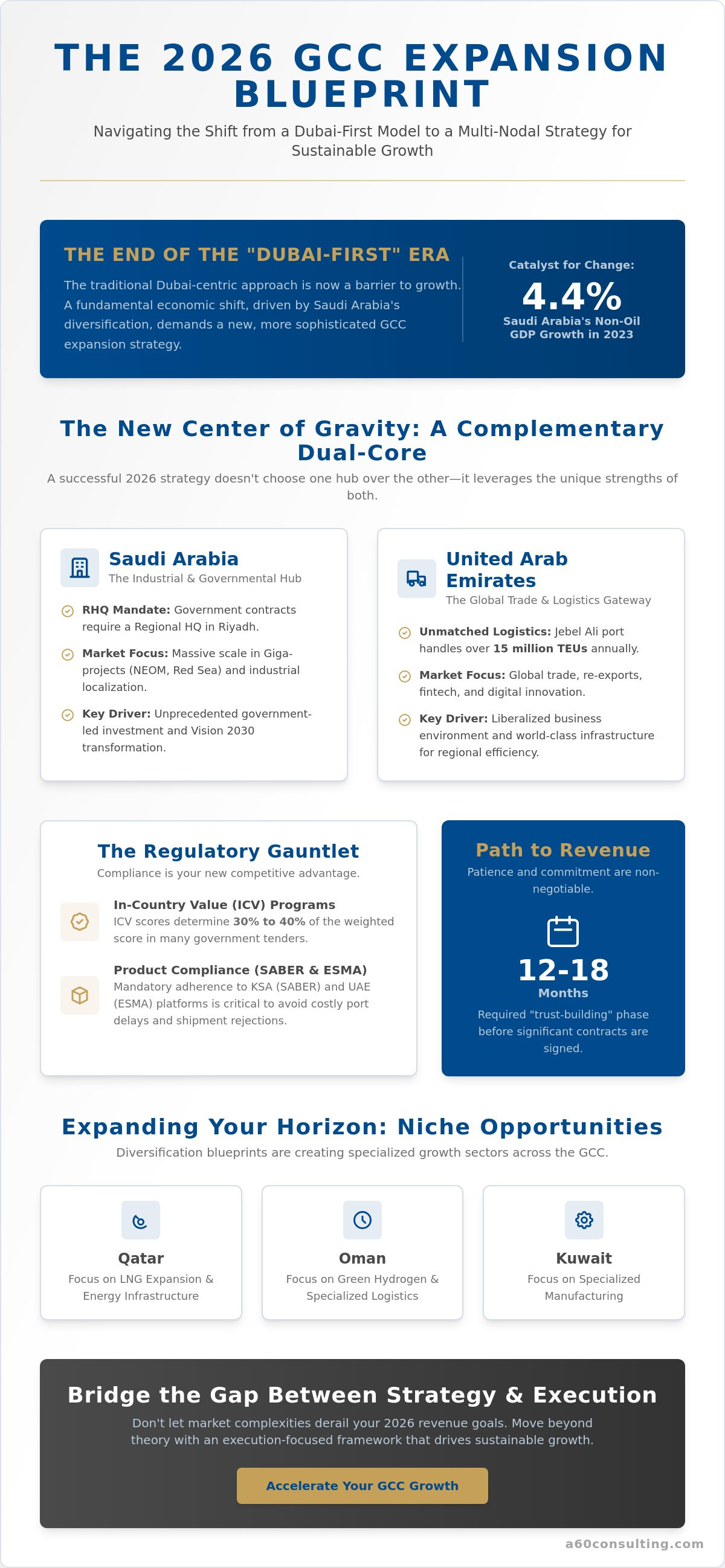
Saudi Arabia’s Regional Headquarters (RHQ) mandate has redefined the regional hierarchy. As of 2024, the government stopped signing contracts with companies that don't have their regional base in Riyadh. By 2026, this policy has matured, forcing a migration of executive talent to the Kingdom. While Riyadh captures the industrial and governmental spotlight, the UAE maintains its position as the premier gateway for global trade. Its infrastructure handles over 15 million TEUs annually at Jebel Ali, providing a logistics backbone that remains unmatched for global supply chains. Meanwhile, Qatar, Oman, and Kuwait are aggressively following the diversification blueprint, carving out niches in green hydrogen, LNG expansion, and specialized manufacturing.
The 2026 Regulatory Environment
Compliance is the new competitive advantage. In-Country Value (ICV) programs now determine 30% to 40% of the weighted score in many government tenders. It's no longer just about the lowest price; it's about how much you reinvest in the local economy. Navigating these market entry challenges middle east is vital for long-term viability. For product-based businesses, strict adherence to the SABER platform in Saudi Arabia and ESMA standards in the UAE is mandatory. These systems ensure that every imported unit meets specific technical regulations, and failure to comply leads to costly port delays or total shipment rejections.
Economic Integration vs. National Competition
The rivalry between Riyadh and Dubai creates a dynamic where a single-city approach often fails. A successful gcc expansion strategy must recognize that these markets are complementary. Riyadh offers massive scale and government-led projects, while Dubai provides a liberalized environment for fintech and global logistics. We see emerging clusters in smart manufacturing and renewable energy that span across borders. This is why a gcc market entry strategy must be multi-nodal in 2026. You don't choose one over the other. You balance a presence in KSA for market access with a UAE hub for regional efficiency. This dual-presence model allows firms to mitigate risk while capturing growth across the entire peninsula.
- Saudi Arabia: Focus on Giga-projects and industrial localization.
- UAE: Focus on global trade, re-exports, and digital innovation.
- Qatar & Oman: Focus on energy transition and specialized logistics nodes.
Assessing Your Readiness for GCC Expansion
A successful gcc expansion strategy in 2026 requires more than a robust balance sheet; it demands a fundamental shift in how your organization views time and relationships. The Gulf is no longer a "plug-and-play" market for Western or Asian solutions. We've seen that firms failing to localize their value proposition for specific 2026 regional pain points, such as ESG compliance or AI-driven logistics, struggle to gain traction. You must determine if your product solves a current problem or a legacy one. If your solution doesn't align with the rapid digitalization goals of the region, the market entry will likely stall.
Financial commitment is the most common point of failure. You should plan for a burn-to-revenue timeline of at least 12 to 18 months. This period accounts for the "trust-building" phase where no significant contracts are signed. Recent data from the World Bank in April 2026 highlights that regional economic resilience depends on a firm's ability to absorb initial shocks and adapt to local regulatory shifts. Your leadership needs the patience for relationship-based sales cycles where a "yes" often follows months of informal meetings and hospitality.
The GCC Readiness Matrix
Before committing capital, perform an internal resource audit. You'll need technical documentation that meets SASO (Saudi) or ESMA (UAE) standards from day one. Cultural competency is equally vital; your team must understand "Wasta" and the nuances of local etiquette. This isn't just about politeness; it's about understanding how influence flows through a business ecosystem. Finally, map out your regulatory roadmap. Identifying which certifications are prerequisites for your specific industry prevents costly delays at the border or during the licensing phase. If you're unsure where your gaps lie, a readiness diagnostic can provide the necessary clarity.
Identifying Your Primary Anchor Market
Choosing your first regional hub is a binary decision between the UAE and Saudi Arabia for most firms. The UAE offers a mature, international environment with high ease of doing business. For services-led firms, doing business in dubai provides a gateway to the entire region while maintaining a familiar regulatory structure. It's often the safest bet for companies testing the waters.
Conversely, the sheer scale of the Saudi market is unmatched. Tech firms and industrial players should prioritize saudi arabia business development agency for tech services to align with the Kingdom's massive infrastructure projects. Saudi Arabia isn't just a market; it's a transformation project that requires on-the-ground presence. Your choice depends on whether you seek the operational ease of a global hub or the raw growth potential of a nation in transition.
Selecting Your Optimal Market Entry and Expansion Model
Choosing the right vehicle for your gcc expansion strategy determines whether you'll scale or stagnate. Most organizations weigh three primary paths: the pure distributor model, direct incorporation, or strategic representation. Each carries distinct implications for your balance sheet and brand integrity. We see the most success when firms match their entry model to their specific risk tolerance and long-term commitment to the region.
The "Distributor Trap" remains the most common pitfall in the Gulf. Data indicates that 70% of foreign firms fail within three years when they rely solely on local partners without active oversight. These partners often manage dozens of competing brands; your product becomes just another line item in a catalog rather than a strategic priority. This lack of focus leads to misaligned pricing and poor customer support. It's a passive approach that rarely yields sustainable growth in a competitive environment.
Direct incorporation offers maximum control but requires significant capital. Beyond initial registration, you'll face ongoing costs for Public Relations Officer (PRO) services to handle visas, licensing, and labor law compliance. In markets like Saudi Arabia, the 2024 Regional Headquarters (RHQ) rules mean companies must establish a physical presence to bid on large government contracts. For many, the hybrid model provides a more efficient middle ground. By establishing a small regional sales office to manage both distributors and direct key accounts, you maintain a high-level presence while keeping operational costs lean.
The Strategic Representation Advantage
A local representative acts as your boots on the ground without the high annual overhead of a full corporate office. This model ensures you have a "local face" for high-stakes B2B and government negotiations. It's about maintaining brand control while leveraging existing networks. You don't just send emails; you participate in the local business culture through a trusted proxy who understands regional nuances and can provide real-time market intelligence.
Vetting Distribution Partners
The era of the "generalist" distributor is ending. For a successful 2026 gcc expansion strategy, you must seek specialists who demonstrate deep technical expertise in your specific niche. Evaluate potential partners based on concrete KPIs: their existing technical support infrastructure, their digital sales maturity, and their historical market penetration rates. Agreements shouldn't grant permanent exclusivity. Instead, structure your contracts around performance-based renewals to ensure the partner remains incentivized to hit your growth targets.
Building a High-Performance Regional Sales Engine
Executing a successful gcc expansion strategy requires a shift from transactional selling to a relationship-driven growth model. The transition from strategy to revenue depends on how effectively a firm integrates into the local business fabric. Success in 2026 hinges on a five-step framework designed to build trust and ensure operational agility.
- Step 1: Localizing the value proposition. You must align your offering with national transformation goals like Saudi Vision 2030 or the Oman Future Fund. Your pitch shouldn't just solve a technical problem; it needs to demonstrate how it supports the host nation's economic diversification.
- Step 2: Multi-channel lead generation. Combine digital outreach with physical presence. LinkedIn remains powerful for initial contact, but major contracts are often initiated at high-impact events like LEAP in Riyadh or GITEX in Dubai.
- Step 3: Outsourced sales management. Establishing a full legal entity can cost upwards of $150,000 in the first year. Many firms utilize outsourced sales leadership to build a physical presence and manage local pipelines before committing to a permanent office.
- Step 4: Partner enablement. Local distributors or agents require rigorous training. They need to master your technical specifications while delivering your messaging in a way that resonates with regional procurement officers.
- Step 5: GCC-specific CRM approach. Standard CRM stages don't always apply here. Your tracking must account for the social milestones and trust-building phases that precede any formal RFP.
Sales Enablement in the Gulf
Sales collateral must be bilingual. While English is the primary language of business, 45% of decision-makers in the public sector prefer reviewing technical documentation in Arabic during the final approval stages. You must also prepare for long lead times. A typical public sector procurement cycle in the GCC lasts between 14 and 22 months, requiring a sales team that values persistence over quick wins. Sales enablement in the GCC is the strategic process of equipping teams with the cultural intelligence, bilingual tools, and relationship-management frameworks necessary to navigate extended procurement cycles and close complex deals.
The Role of Local Business Development
The concept of "Wasta" is frequently misunderstood by outsiders as mere favoritism. In a professional context, it represents a sophisticated system of social capital and trust-building. It's the regional equivalent of strategic networking, where a recommendation serves as a personal guarantee of quality. Relying on local business development professionals allows you to tap into these established networks. This is particularly critical for high-value tech and industrial contracts, where 80% of successful bids involve a local representative who can navigate the nuances of regional bureaucracy. Moving from a transaction-based model to a partnership-based model ensures your gcc expansion strategy results in sustainable, multi-year revenue streams rather than one-off sales.
Building a robust sales engine is a complex undertaking that requires both patience and precision. For expert guidance on structuring your regional team, partner with A60 Consulting to accelerate your market entry.
Accelerating Your GCC Growth with A60 Consulting
Expanding into the Gulf requires more than a theoretical plan; it demands a physical and operational presence that understands the local pulse. A60 Consulting functions as your dedicated regional sales office, providing a strategic gateway into markets like Saudi Arabia, the UAE, and Qatar. With a 30-year track record in the region, we've refined the process of overcoming regulatory hurdles and cultural nuances that often stall international firms. Our team understands that local relationships are the currency of the Middle East, and we leverage our established network to open doors that remain closed to outsiders.
We don't just hand over a document. We bridge the gap between a high-level gcc expansion strategy and daily operational execution. Our model offers flexibility through project-based assignments or long-term retainer services, ensuring you have the right level of support at every stage of your journey. The A60 advantage lies in our success-based commissions. This structure aligns our goals directly with your revenue growth, ensuring our consultants are as invested in your market share as your own leadership team.
Our Market Entry Process
Our methodology moves systematically from initial feasibility studies to active sales management. We handle the heavy lifting of regional business development, which includes vetting local partners and navigating the 2024 updated Saudi Investment Law. In a recent engagement, we assisted a European cybersecurity firm in entering the Riyadh market. By managing their partner vetting process and local regulatory filings, we helped them secure their first government contract within seven months, which reduced their projected entry timeline by 40%.
- Feasibility and Analysis: We conduct deep-dive assessments to ensure your product-market fit is verified before capital is committed.
- Partner Vetting: Our team identifies and audits potential distributors or joint venture partners to ensure long-term alignment.
- Sales Management: We act as your boots on the ground, managing the entire sales cycle from lead generation to contract signing.
- Regulatory Guidance: We navigate the specific licensing requirements of each GCC member state to ensure 100% compliance.
Ready to Expand?
The window for establishing a dominant presence in the Gulf is narrowing. 2026 represents a critical milestone as Saudi Vision 2030 projects move into their final implementation phases and the UAE's "We the UAE 2031" strategy gains significant momentum. Delaying entry means facing higher competition and established incumbents who've already secured their positioning. The region's transformation is moving fast; your expansion needs to move faster.
We customize every gcc expansion strategy to fit the specific organizational culture and technical capabilities of our clients. Our consultants don't offer generic templates; they provide surgical precision in market positioning and implementation. If you're prepared to move beyond theory and start generating regional revenue, we're ready to lead the way. Schedule a consultation with A60 Consulting today to begin your transformation.
Securing Your Market Position for 2026
The 2026 economic landscape in the Gulf demands more than just a presence; it requires a precise gcc expansion strategy that bridges the gap between vision and operational reality. Success in this region hinges on two critical pillars: selecting a market entry model that respects local regulatory shifts and building a sales engine capable of navigating complex industrial cycles. With Saudi Arabia’s Vision 2030 reaching a pivotal implementation phase and the UAE’s continued diversification, the window for strategic entry is narrowing. It's no longer enough to observe from the sidelines.
A60 Consulting brings 30 plus years of regional experience to your boardroom. We maintain a physical presence in both the UAE and Saudi Arabia, ensuring our advice is grounded in current market dynamics rather than distant theory. Our team specializes in the high stakes tech and industrial sectors, where technical precision meets cultural nuance. We don't offer generic templates; we provide the methodical rigor your business needs to scale sustainably.
Partner with A60 Consulting for your GCC expansion to transform these regional complexities into your competitive advantage. The future of your growth starts with a single, well-executed step.
Frequently Asked Questions
What is the best GCC country to start an expansion in 2026?
Saudi Arabia stands as the most strategic entry point for 2026 due to the 800 billion dollar investment pipeline driven by Vision 2030. While the UAE offers a mature logistics hub for 9.5 million residents, Saudi Arabia's population of 36 million provides the scale necessary for sustainable growth. Your choice depends on whether you prioritize a regional headquarters in Riyadh or a global trading gateway in Dubai.
How much does it cost to set up a business in the GCC?
Setup costs vary based on the jurisdiction, but a basic UAE free zone license typically starts at 5,500 dollars. In Saudi Arabia, a MISA service license requires a minimum capital investment of 13,300 dollars plus additional administrative fees. These figures don't include office rent, employee visas, or legal attestation costs, which often double the initial investment during the first year of operation.
Do I need a local partner to sell products in Saudi Arabia?
You don't need a local partner for most commercial activities since the 2021 regulatory updates allowed 100% foreign ownership. Investors can obtain a MISA investment license to operate independently in sectors like retail, manufacturing, and technology. However, strategic industries like upstream oil and gas or certain consulting services still require a joint venture with a Saudi national or entity.
What is the role of In-Country Value (ICV) in GCC expansion?
In-Country Value acts as a mandatory weighting factor in public and private procurement tenders across the region. In the UAE, ADNOC's ICV program requires suppliers to certify their local economic contribution to gain a competitive edge in bidding. Saudi Arabia's Local Content Authority applies similar rules, often giving companies with high scores a 15% to 25% advantage during the technical evaluation process.
How long does a typical GCC market entry project take?
A comprehensive market entry project usually spans 6 to 9 months from the initial feasibility study to the operational launch. This timeline includes the 45 days required for document attestation and the 60 days typically needed for corporate bank account opening. A robust gcc expansion strategy ensures these administrative phases align with your commercial milestones to avoid costly delays in market activation.
Can I manage my GCC sales from my home country office?
It's possible to manage remote sales via digital channels, but this approach rarely achieves significant market share. Local regulations often require a physical office lease and a resident general manager to maintain tax residency and legal compliance. Success in this region depends on local presence, as 80% of high-value business deals are finalized through face-to-face relationship building rather than remote correspondence.
What are the main risks of expanding into the Middle East?
Regulatory volatility and labor localization quotas represent the primary operational risks for foreign firms. Frequent updates to Saudization or Emiratisation laws can increase your human resource costs by 15% annually if your gcc expansion strategy doesn't account for local hiring mandates. You must conduct quarterly compliance audits to stay ahead of the rapid legislative changes occurring across the 6 member states.
How do I find a reliable distributor in the UAE or KSA?
You should identify potential partners through the Dubai Chamber of Commerce or the Saudi Federation of Chambers and conduct a formal 3-stage vetting process. It's essential to request a due diligence report on at least 3 candidates to verify their financial liquidity and existing warehouse infrastructure. Reliable distributors usually manage a portfolio of 5 to 10 complementary brands and possess established relationships with the region's major retail or industrial buyers.