
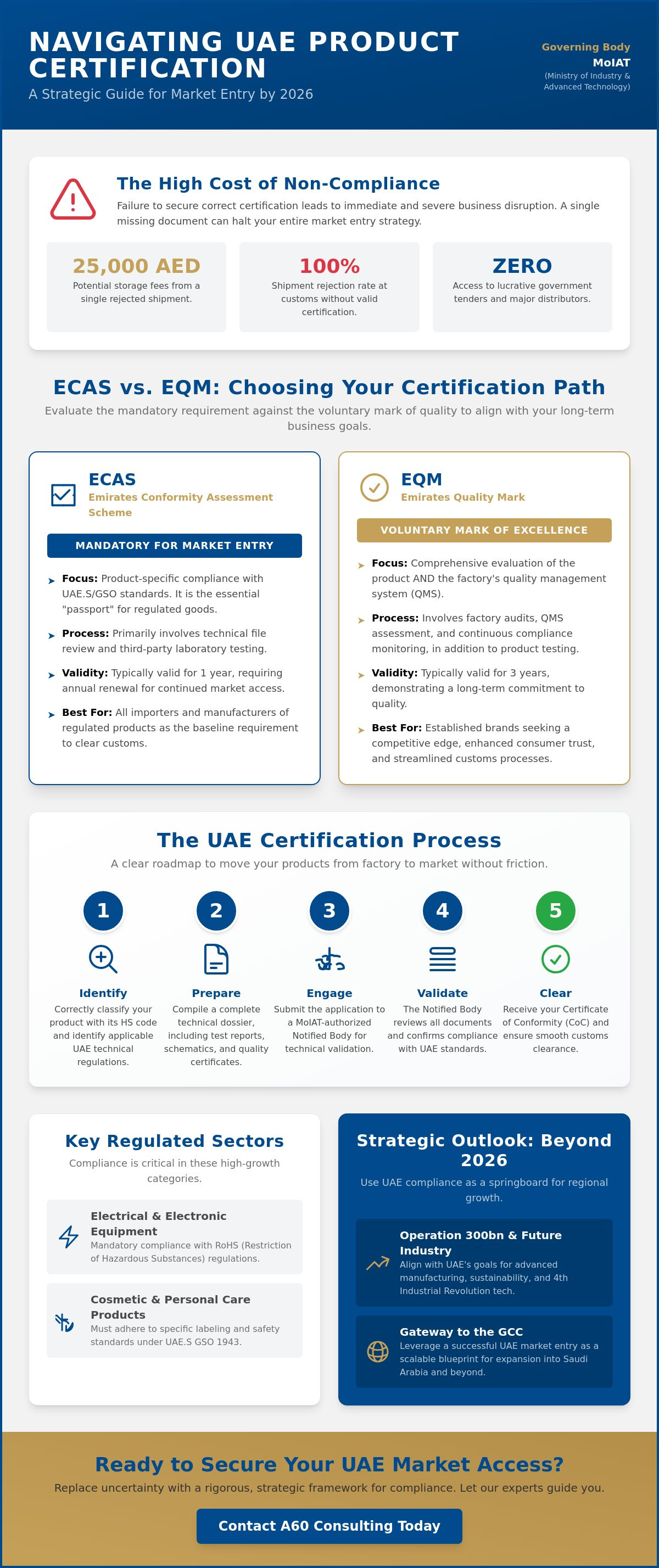
Could a single missing document really cost your business 25,000 AED in unexpected storage fees and lost market momentum? Many regional directors find that the technical barriers of product certification uae represent their greatest risk to 2026 revenue targets. You're likely familiar with the anxiety of waiting for customs clearance while wondering if a misinterpreted ECAS requirement will lead to a rejected shipment. It's a common pressure point where the complexity of MoIAT regulations meets the high stakes of international trade; a situation where professional calm is often tested by administrative ambiguity.
We've designed this guide to replace that uncertainty with a rigorous, strategic framework for compliance. You'll master the nuances of the Emirates Conformity Assessment Scheme and learn how to use voluntary marks like the EQM as a competitive differentiator rather than just a checklist item. We'll examine the specific 2026 timelines and provide a clear roadmap to ensure your products move from the factory to the UAE market without friction. This approach moves beyond simple box-ticking to create a sustainable advantage in one of the world's most dynamic economies.
Key Takeaways
- Understand the governing role of the Ministry of Industry and Advanced Technology (MoIAT) and the mandatory nature of conformity assessments for regulated goods.
- Evaluate the strategic choice between the mandatory ECAS certificate and the voluntary Emirates Quality Mark (EQM) to optimize long-term operational costs.
- Navigate the product certification uae process with precision by correctly identifying HS codes and engaging MoIAT-authorized Notified Bodies for technical validation.
- Ensure compliance for high-growth sectors by mastering specific technical regulations for electrical equipment (RoHS) and cosmetic products under UAE GSO 1943.
- Leverage UAE market entry as a scalable blueprint to streamline regulatory approvals and accelerate expansion into Saudi Arabia and the wider GCC region by 2026.
What is Product Certification in the UAE?
Product certification uae serves as a mandatory technical gatekeeper, ensuring that regulated goods entering the market meet rigorous safety, quality, and environmental benchmarks. It isn't merely a bureaucratic hurdle; it's a strategic conformity assessment process designed to protect the national economy and consumer health. The Ministry of Industry and Advanced Technology (MoIAT) oversees this ecosystem, having absorbed the functions of the former Emirates Authority for Standardization and Metrology (ESMA) to streamline industrial oversight. This structural shift reflects a broader commitment to integrating standardization with industrial growth.
As we approach 2026, the landscape of product certification uae is evolving toward "future industry" standards. This transition aligns with the UAE's Operation 300bn strategy, which prioritizes advanced manufacturing and sustainability. By 2026, manufacturers will face more stringent requirements regarding carbon footprints and the integration of 4th Industrial Revolution technologies. Organizations must distinguish between self-declaration, where a manufacturer asserts compliance for low-risk items, and third-party notified body certification. For high-risk products, an independent, MoIAT-authorized body must verify technical files and testing results before a certificate is issued.
The Legal Framework: ECAS and Beyond
The Emirates Conformity Assessment Scheme (ECAS) remains the primary regulatory umbrella for most consumer and industrial goods. The federal government utilizes this framework to enforce compliance with UAE national standards, which often mirror or build upon Gulf Standardization Organization (GSO) regional rules. While GSO standards provide a baseline for the GCC, the UAE frequently implements specific technical regulations that address local environmental conditions and safety requirements. This dual-layered approach ensures that products are resilient enough for the specific demands of the Middle Eastern market.
The Business Impact of Non-Compliance
Failure to secure the necessary certifications results in immediate operational paralysis. Customs authorities will reject shipments at the border, leading to significant storage fees and potential product destruction. Beyond these immediate costs, companies face heavy fines and mandatory product recalls that can devastate a brand's reputation. At a strategic level, non-compliant firms find themselves excluded from lucrative government tenders and lose the trust of local distributors who require valid certificates to maintain their own trade licenses.
- Regulatory Oversight: MoIAT centralizes all standardization and metrology functions.
- Market Access: Certification is a prerequisite for customs clearance in all seven emirates.
- Risk Management: Third-party verification mitigates the liability of manufacturers and importers.
- Strategic Alignment: Compliance supports the UAE's long-term goals for industrial excellence and sustainability.
ECAS vs. EQM: Choosing the Right Certification Path
Selecting the appropriate compliance route requires a deep understanding of your business's long-term objectives in the Emirates. While the Emirates Conformity Assessment Scheme (ECAS) serves as the baseline for market entry, the Emirates Quality Mark (EQM) offers a more robust framework for established players. By 2026, the distinction between these two paths will become even more critical as the Ministry of Industry and Advanced Technology (MoIAT) tightens enforcement on technical documentation and factory standards. Understanding the nuances of product certification uae protocols is no longer just a legal necessity; it's a strategic advantage.
ECAS: The Mandatory Entry Requirement
ECAS is the foundational certification that the UAE mandates for regulated goods, including electrical appliances, cosmetics, and chemical products. Both manufacturers and importers must secure this certificate before their goods reach UAE ports. Unlike voluntary marks, ECAS focuses on the product's compliance with specific UAE.S/GSO standards through technical file reviews and laboratory testing. It's the essential "passport" for products entering the market.
The process involves working with MoIAT-authorized Notified Bodies who audit technical dossiers to ensure safety and performance. For most categories, the ECAS certificate remains valid for exactly one year. This necessitates a disciplined annual renewal cycle to avoid shipment delays. Importers often find this route suitable for smaller batches or trial market entries where the initial investment must remain low and the product range is limited.
EQM: The Gold Standard for Quality
The Emirates Quality Mark represents a higher level of commitment to the UAE market. It's particularly prevalent in the construction and industrial sectors, where materials like steel, bottled water, and cement often require this certification to meet government procurement standards. The transition from ECAS to EQM shifts the focus from individual product testing to a comprehensive evaluation of the manufacturing facility itself.
The audit process for EQM includes rigorous on-site factory inspections and the implementation of a certified Quality Management System (QMS). While the initial barrier is higher, the EQM offers a three-year validity period, providing much-needed stability for long-term planning. For high-volume manufacturers, the EQM simplifies logistics significantly. It allows for multiple shipments without the need for individual consignment inspections, effectively reducing time-to-market and administrative friction at the border.
Choosing between these paths isn't just a regulatory hurdle; it's a financial decision. Organizations looking for sustainable growth often find that the higher upfront cost of an EQM is offset by the reduced administrative burden and lower per-unit compliance costs over a three-year horizon. Detailed information on these Standards for Trade helps clarify which specific technical regulations apply to your product category. In the 2026 regulatory environment, the ability to demonstrate consistent quality through the EQM can serve as a powerful competitive differentiator. If your organization is weighing these options, a strategic gap analysis can reveal which path aligns best with your operational capacity and scaling goals.
Regulated Product Categories in the UAE
The UAE regulatory framework is precise. It divides products into specific risk-based categories. For companies looking to scale, understanding these silos is the first step toward a successful product certification uae strategy. The Ministry of Industry and Advanced Technology (MoIAT) oversees most of these standards, ensuring that every item entering the market meets local safety and quality benchmarks.
Electrical and Electronic Equipment (LVE) must meet safety standards under the Emirates Conformity Assessment Scheme (ECAS). This includes the Restriction of Hazardous Substances (RoHS). RoHS limits ten specific substances, including lead, mercury, and cadmium, in electronic components. Cosmetics and personal care items follow Technical Regulation UAE GSO 1943. This regulation mandates rigorous safety reports, ingredient transparency, and strict labeling in both Arabic and English. Industrial machinery and automotive parts require compliance with safety standards to prevent workplace accidents and ensure roadworthiness. Halal certification remains a cornerstone for food, beverages, and pharmaceuticals. It's managed through MoIAT and accredited bodies to ensure every step of the supply chain meets Islamic law.
Electrical and IT Product Standards
IT products and household appliances must navigate two main paths. RoHS compliance ensures that electronic waste doesn't contaminate the environment. Meanwhile, the Energy Efficiency Standardization and Labelling (EESL) program requires appliances like air conditioners and washing machines to display star ratings. Higher ratings reflect better energy performance. For wireless tech, the Telecommunications and Digital Government Regulatory Authority (TDRA) works with MoIAT to verify radio frequency safety and interoperability.
Industrial and Construction Compliance
The construction sector faces high scrutiny. Structural steel, cement, and building materials often require the Emirates Quality Mark (EQM). This isn't just a certificate; it involves a comprehensive factory audit and continuous testing regime. For the energy sector, pressure equipment and components used in hazardous areas must obtain ECAS Ex certification to operate safely in explosive atmospheres. This is vital for oil and gas infrastructure.
- Sustainable Materials: By 2026, MoIAT will enforce stricter carbon footprint disclosures for building materials.
- Green Industries: New mandates require Environmental Product Declarations (EPDs) for steel and glass used in federal projects.
- Safety Protocols: Industrial equipment must comply with UAE.S ISO standards to ensure operator protection.
Compliance isn't a one-time hurdle. It's a continuous commitment to quality. As the UAE moves toward its 2026 sustainability goals, the integration of green standards into the product certification uae process will become mandatory for all industrial players. This shift ensures that market leaders aren't just selling products, but are contributing to the nation's long-term strategic vision.
Step-by-Step: The UAE Product Certification Process
Achieving compliance in the Emirates is a structured journey that bridges the gap between international manufacturing standards and local safety mandates. Success begins with precise classification. You must identify the correct Harmonized System (HS) code for your goods to determine which specific technical regulation applies. A mistake at this stage can lead to incorrect testing protocols and rejected shipments at Jebel Ali or Khalifa Port.
Once you've identified the regulatory path, the next phase involves engaging a Notified Body authorized by the Ministry of Industry and Advanced Technology (MoIAT). These third-party experts evaluate your technical data against UAE.S or GSO standards. After the Notified Body verifies the dossier, the application moves through the MoIAT digital portal for final review and certificate issuance. However, the process doesn't end at the border. Post-market surveillance ensures that products remain compliant throughout their lifecycle, with authorities conducting periodic spot checks on retail shelves.
Preparing Your Technical Documentation
Data integrity is the cornerstone of a successful product certification uae application. MoIAT auditors in 2026 require all laboratory test reports to originate from facilities with ILAC (International Laboratory Accreditation Cooperation) accreditation. This ensures the testing environment meets global quality benchmarks. Your technical file should include a detailed bill of materials, factory quality manuals, and a comprehensive risk assessment.
Language requirements are a frequent point of friction for international brands. While technical dossiers are typically accepted in English, UAE Cabinet Decision No. 10 of 2020 dictates that all safety warnings, instructional manuals, and product labels must be provided in Arabic. This ensures the end-user can interact with the product safely, regardless of their primary language.
Timeline and Cost Management
Strategic planning requires a clear understanding of lead times, which vary significantly based on the certification scheme. The Emirates Conformity Assessment Scheme (ECAS) generally concludes within 7 to 12 working days once a complete dossier is submitted. In contrast, the Emirates Quality Mark (EQM) requires a more rigorous 3 to 5 month window. This longer duration accounts for mandatory factory audits and the implementation of a more robust quality management system at the manufacturing site.
The most common bottlenecks involve expired test reports or inconsistencies between the trade license scope and the product category. Resolving these discrepancies early prevents the certification cycle from stalling. As you prepare your market entry, it's vital to align your regulatory milestones with your commercial partnerships. For more on this, explore our Strategic Guide to Distributor Search in the Middle East to ensure your supply chain is as ready as your paperwork.
Ready to secure your market position? Contact A60 Consulting to streamline your UAE compliance strategy today.
Strategic Compliance: Using Certification to Scale Sales
Certification isn't a bureaucratic hurdle. It's a high-value commercial asset. In the Emirates, securing your product certification uae documentation serves as the primary engine for regional market penetration. Companies that view compliance as a static requirement often fail to capture the 15% to 22% growth premium available to early movers who align with the Ministry of Industry and Advanced Technology (MoIAT) standards. This proactive approach forms the backbone of The 2026 GCC Market Entry Strategy, ensuring that technical barriers don't stall commercial momentum when opportunities arise.
By treating certification as a strategic tool, you transform a cost center into a competitive advantage. When your products carry the ECAS or EQM mark, you're not just following the law; you're signaling reliability to a market that increasingly demands transparency and safety. This signal is vital for capturing market share in the UAE's rapidly diversifying economy.
Certification as a Competitive Moat
Compliance creates a formidable barrier to entry that filters out lower-quality, uncertified competitors. In high-stakes B2B sales and government procurement, missing a single certificate can disqualify a bid worth millions of AED. By maintaining rigorous standards, you position your brand as a "Compliant Partner" for Tier-1 distributors who prioritize risk mitigation above all else. In the UAE, regulatory readiness is the first step of sales execution. This status allows you to bypass the noise of uncertified alternatives, securing your place in premium retail and infrastructure projects where quality is non-negotiable.
Partnering for Regional Success
Managing the certification lifecycle requires deep local knowledge that goes beyond simple document submission. A60 Consulting manages this regulatory roadmap as part of a broader go-to-market plan, bridging the gap between technical advisory and actual sales execution. We recognize that UAE compliance often acts as a gateway to the wider region. By synchronizing your UAE efforts with Import Regulations in Saudi Arabia, we create cross-border synergies that reduce redundant testing costs and accelerate time-to-market.
Local representation is critical for managing these cycles. Without a partner who understands the nuances of the 2026 regulatory shift, businesses risk facing sudden shipment blocks or expired permits. We provide the structural stability needed to scale. Our approach ensures that your technical foundation remains unshakeable while you focus on building regional relationships and driving revenue. We don't just help you enter the market; we help you dominate it through methodical, measured, and compliant growth.
Securing Your Competitive Advantage in the 2026 UAE Market
Success in the Emirates requires more than meeting technical requirements; it demands a strategic alignment with MoIAT and GSO standards. Choosing between ECAS and EQM isn't a simple checkbox exercise. It's a decision that dictates your speed to market and long-term scalability. As 2026 approaches, the complexity of regulated categories will continue to evolve. This makes proactive preparation essential for brands that want to avoid delays and protect their margins.
Achieving product certification uae status serves as the vital bridge between regulatory hurdles and sustainable sales growth. At A60 Consulting, we bring over 30 years of GCC regional experience to help you close the gap between strategy and execution. We don't just offer theoretical advice; we provide the expertise needed to navigate MoIAT protocols while focusing on sales execution and partner search. Our methodology ensures your compliance roadmap leads directly to measurable business transformation.
Take the next step toward a successful market entry. Contact A60 Consulting for a Regulatory Roadmap and Market Entry Strategy to turn regional complexity into your greatest asset. Your growth in the UAE starts with a clear, actionable perspective.
Frequently Asked Questions
How much does product certification in the UAE cost in 2026?
Product certification costs in 2026 are structured around the Ministry of Industry and Advanced Technology (MoIAT) fee schedule, starting with a 600 AED registration fee. Total costs for a standard conformity assessment typically range between 2,500 AED and 5,500 AED per product category. These figures don't include external laboratory testing or factory audit expenses, which vary based on the technical complexity of your specific goods.
Is ECAS certification mandatory for all products sold in the UAE?
ECAS certification isn't mandatory for every product, but it's a legal requirement for items classified under regulated categories like electronics, cosmetics, and detergents. MoIAT maintains an exhaustive list of these regulated groups that must carry the ECAS mark to enter the market. If your product doesn't fall under these specific technical regulations, you might still pursue voluntary certification to build trust with local distributors and retailers.
How long is a UAE Certificate of Conformity valid for?
A UAE Certificate of Conformity is valid for exactly one year from its date of issuance. You'll need to initiate the renewal process at least 30 days before the expiry date to ensure your supply chain remains uninterrupted. This annual renewal cycle allows the Ministry to verify that your manufacturing standards haven't deviated from the original requirements for product certification uae compliance.
Can I use my European CE marking for UAE market entry?
You can't use a CE marking as a direct replacement for UAE national certification. While test reports from ILAC-accredited laboratories used for CE marking often support your application, the UAE requires its own specific conformity marks, such as ECAS or the Emirates Quality Mark. Local customs authorities won't accept the CE mark alone as proof of compliance with UAE Cabinet Decision No. 10 of 2017.
What is the difference between MoIAT and ESMA?
MoIAT is the current federal authority responsible for standards, having absorbed all functions of the now-defunct ESMA following Federal Decree-Law No. 28 of 2020. This organizational shift centralized industrial development and standardization under the Ministry of Industry and Advanced Technology. When you're managing product certification uae today, you're dealing exclusively with MoIAT's digital platforms and their authorized notified bodies.
Do I need a local UAE trade license to apply for product certification?
You must have a valid UAE trade license to serve as the legal applicant for a certificate. International manufacturers who don't have a local branch typically appoint a licensed UAE distributor or a registered legal representative to act as the certificate holder. This local entity assumes full legal responsibility for the product's safety and serves as the primary contact for any market surveillance activities conducted by the Ministry.
What happens if my product fails the conformity assessment?
If your product fails, the notified body issues a formal non-conformity report that outlines the specific technical gaps or safety failures. You're usually granted a window of 30 to 60 days to implement corrective actions or modify the product design before applying for a re-test. It's a strategic necessity to address these points precisely, as repeated failures lead to a full rejection and the loss of all initial application fees.
How does UAE certification help with entry into Saudi Arabia?
UAE certification simplifies entry into Saudi Arabia because both countries follow the harmonized standards set by the GCC Standardization Organization (GSO). Products that earn the G-Mark in the UAE already meet the core safety requirements used by the Saudi Standards, Metrology and Quality Organization (SASO). This alignment means your technical documentation is largely transferable, which cuts your total compliance time for the wider Gulf region by roughly 40 percent.