
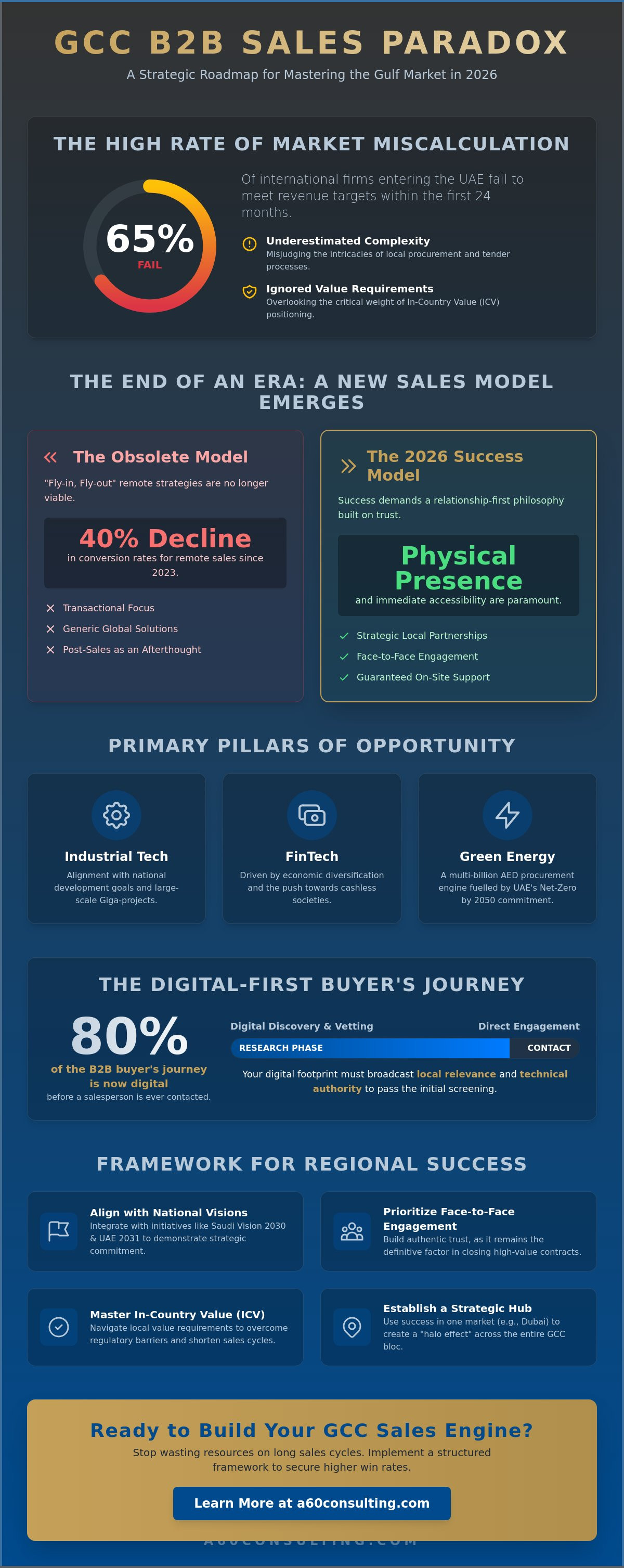
Recent data from 2024 regional trade analysis shows that 65% of international firms entering the United Arab Emirates fail to meet their projected revenue targets within the first 24 months. Most of these organizations underestimate the complexity of local procurement and the weight of regional value requirements. You probably know that driving successful b2b sales gcc isn't just about having the best technology; it's about the patient cultivation of trust and the alignment of your goals with national visions like UAE We the UAE 2031. It's draining to watch resources disappear into sales cycles that stretch beyond 12 months without a clear path to closure.
This guide offers a structured roadmap to help you master these dynamics and build a resilient sales engine for 2026. We'll show you how to blend global technical standards with the nuanced relationship-building necessary for the Gulf market. You'll learn the specific steps to improve your In-Country Value (ICV) positioning and secure higher win rates for the region's most prestigious government and enterprise tenders.
Key Takeaways
- Gain a strategic perspective on how Saudi Vision 2030 and UAE economic diversification are fundamentally altering regional procurement cycles and technical requirements.
- Explore the modern evolution of "Wasta" and why face-to-face engagement remains the definitive factor in building trust and securing high-value contracts.
- Implement a structured framework for b2b sales gcc that utilizes local enablement tools to map stakeholders and identify the real decision-makers within complex organizations.
- Overcome regional barriers by understanding In-Country Value (ICV) requirements in the UAE and learning how to navigate regulatory hurdles to shorten your sales cycle.
- Determine the optimal scaling strategy for your revenue growth by evaluating the efficiency of direct market presence versus specialized outsourced sales representation.
The Evolving B2B Sales Landscape in the GCC for 2026
Success in b2b sales gcc during 2026 demands a sophisticated blend of technical precision and cultural intelligence. It's no longer enough to offer a superior product; buyers now evaluate partners based on their ability to integrate into complex local ecosystems. This shift stems from the aggressive economic diversification strategies led by the Gulf Cooperation Council (GCC) nations. Saudi Vision 2030 and the UAE's "We the UAE 2031" vision have accelerated procurement cycles, moving from multi-year deliberations to agile, performance-based windows. By 2026, the market expects vendors to demonstrate immediate alignment with national development goals and local content requirements.
The era of "fly-in, fly-out" sales is over. Remote sales strategies managed from outside the region have seen a 40% decline in conversion rates since 2023. Local decision-makers prioritize physical presence and immediate accessibility. Growth is currently concentrated in three primary pillars: Industrial Tech, FinTech, and Green Energy. These sectors aren't just expanding, they're reinventing how business is conducted in the Gulf. For instance, the UAE's commitment to net-zero by 2050 has turned Green Energy into a multi-billion AED procurement engine that requires specialized, local technical expertise rather than generic global solutions.
The Shift from Transactional to Strategic Partnerships
B2B buyers in 2026 view one-off transactions as a liability. They seek long-term local commitment. Post-sales support has transitioned from a secondary service to the primary differentiator in the initial sales pitch. If you can't guarantee on-site support within a 4-hour window in Dubai or Riyadh, you won't make the shortlist. Digital transformation has also reshaped the "discovery" phase. Approximately 80% of the B2B buyer's journey now happens digitally before a salesperson is even contacted. This means your digital footprint must reflect your local relevance and technical authority to survive the initial vetting process.
Regional Hubs: The Interplay Between National Markets
While each nation maintains its own regulatory framework, the synergy between the UAE, Saudi Arabia, and Qatar creates a unified B2B bloc. Establishing a robust operation in Dubai often serves as the strategic gateway to the wider region. Credibility earned in the Saudi market through large-scale "Giga-projects" significantly lowers the barrier to entry in Qatar or Oman. Success in one market acts as a powerful testimonial for the others, creating a "halo effect" for your brand. The GCC B2B market is a high-trust, high-regulation environment requiring local physical presence to ensure long-term viability and compliance. Developing b2b sales gcc strategies requires understanding that while the bloc is unified, the execution must be tailored to each kingdom's specific legal and cultural nuances.
Building Trust and Authority: The Relationship-First Sales Model
Succeeding in b2b sales gcc requires a fundamental shift from transactional logic to a relationship-centric philosophy. While global markets often prioritize speed and digital efficiency, the Gulf region operates on a foundation of deep-seated trust that precedes any formal procurement. You aren't just selling a solution; you're proposing a long-term partnership that must withstand regional market fluctuations and operational challenges. This involves a commitment to physical presence that goes beyond occasional Zoom calls, especially during the final stages of a deal where face-to-face interaction remains the primary driver of closure.
Establishing authority in the United Arab Emirates means providing localized proof points. A case study from a European conglomerate rarely carries the same weight as a successful implementation for a local entity like a government department or a semi-government developer. Decision-makers look for evidence that your team understands the specific regulatory environment and cultural nuances of the GCC. For a deeper look at how these dynamics play out in practice, explore our guide on Selling to the Middle East: Strategic B2B Sales Examples and Models for 2026.
The Role of 'Wasta' in Modern Professional Sales
The concept of 'Wasta', or personal influence, is frequently misunderstood by outsiders as a way to bypass merit. In the modern professional landscape, Wasta has evolved into a sophisticated form of social capital. It's the mechanism that secures the initial high-level meeting, but it doesn't guarantee the contract. The technical and commercial evaluation remains rigorous. If your solution doesn't meet the KPIs or fails to show a clear ROI in AED, no amount of influence will save the deal.
Building a network without decades of regional history requires a strategic approach to "professional Wasta." This involves:
- Engaging with local industry bodies and Chambers of Commerce to build institutional credibility.
- Leveraging LinkedIn for high-level introductions that lead to informal coffee meetings.
- Maintaining absolute transparency to ensure that relationship-based selling never compromises ethical standards or compliance protocols.
Adapting Your Value Proposition for a GCC Audience
Technical specifications are merely the entry ticket. To win in b2b sales gcc, your value proposition must emphasize "Local Value" and "Implementation Support." Clients want to know that you have skin in the game. This means demonstrating how your service integrates with local supply chains or contributes to national economic goals. Trust in the GCC is built through consistent physical presence and responsiveness. High-touch account management is vital during the first 12 months of a contract to ensure the transition from strategy to execution is seamless. Organizations that provide on-ground support and rapid response times consistently outperform those trying to manage the region remotely. If you're looking to refine your market entry, partnering with a strategic advisor can help bridge the gap between global expertise and local execution.
Optimising the B2B Sales Cycle: From Lead Generation to Closing
The b2b sales gcc landscape requires a transition from transactional selling to a model of strategic partnership. Success in the UAE market depends on a structured five-step approach that respects local procurement logic while maintaining global efficiency standards.
- Step 1: Deep Market Mapping. Identifying the real decision-makers is the first hurdle. In 2026, data suggests that 74% of UAE enterprise deals involve at least five distinct stakeholders, ranging from technical influencers to the final financial signatory.
- Step 2: Sales Enablement. Use regional tools to track procurement cycles. Many UAE government entities and semi-government firms (GREs) announce their primary capital expenditure plans in Q1, making early-stage engagement critical.
- Step 3: Technical Evaluation. Local engineering support is a non-negotiable requirement. B2B firms that provide on-the-ground technical validation in Dubai or Abu Dhabi see a 18% faster progression through the evaluation phase.
- Step 4: Commercial Negotiation. Flexibility defines the Gulf. This doesn't mean lowering prices, but rather offering creative payment structures. Standard 60-day or 90-day terms are common, and rigid adherence to 30-day global policies often stalls promising deals.
- Step 5: The Transition. Closing the deal is only the beginning. A formal handover to a dedicated Account Management team ensures that the "Trust" built during the sales cycle isn't lost during implementation.
Building a Resilient Sales Pipeline
A robust pipeline in the UAE avoids over-reliance on a single channel. While LinkedIn remains a dominant force for initial outreach, with 82% of regional executives active on the platform, physical presence at high-value events remains the primary driver for trust. For a deeper look at lead generation, see our guide on Building a Sales Pipeline in the Middle East: A Strategic 2026 Guide for B2B Firms. Qualifying leads accurately is essential; distinguish between "Information Gathering" and a genuine "Intent to Purchase" by analyzing the involvement of procurement departments early in the conversation.
Effective Key Account Management
The "Land and Expand" strategy is the most sustainable way to grow b2b sales gcc revenue. Once a firm secures an initial contract, often valued between AED 200,000 and AED 500,000, the focus shifts to horizontal growth within the organization. This is particularly effective in large conglomerates and government bodies. You can explore these dynamics further in our analysis of Key Account Management in Saudi Arabia: A Strategic 2026 Framework for B2B Success. Using CRM data to track regional budget cycles allows your team to predict tender announcements before they're publicly released, giving you a strategic head start.
Overcoming Regional Sales Barriers: Compliance and Local Value
Many business leaders view the regulatory environment in the United Arab Emirates as a bottleneck that stretches the sales cycle. This perspective often stems from a misunderstanding of how b2b sales gcc dynamics have shifted toward localized value. While it's true that administrative steps exist, these aren't just hurdles; they're filters that reward companies invested in the region's long-term vision. In 2026, compliance is no longer a back-office task but a front-line sales advantage.
Winning Tenders with High Local Content Scores
The National In-Country Value (ICV) program, expanded by the Ministry of Industry and Advanced Technology (MoIAT) in 2021, has transformed government procurement. In many major tenders, the ICV score now accounts for 40% to 60% of the total evaluation weight. This means a firm with a higher ICV score can win a contract even if their bid is 10% more expensive than a competitor's. To improve these scores without building a full-scale factory, foreign firms should focus on strategic local sourcing and hiring Emirati talent.
Knowledge transfer has become a critical differentiator for tech and service providers. Successful sales teams include specific "Training and Development" modules in their proposals, detailing how they'll upskill local professionals. This isn't just "pro bono" work; it's a calculated move to increase the ICV contribution and align with the UAE's "Projects of the 50" initiative. When b2b sales gcc professionals lead with these metrics, they move from being a vendor to a strategic partner.
Navigating Trade Compliance as a Sales Accelerator
Customs friction is a notorious momentum killer in B2B transactions. A shipment stuck at Jebel Ali because of missing ESMA (now MoIAT) certifications can cost a company thousands of AED in daily demurrage fees and destroy client trust. Top-performing sales teams use pre-approved certifications as a closing tool. By demonstrating that products already meet SABER or MoIAT standards, you remove the "regulatory risk" objection before the prospect even raises it.
- Speed to Market: Pre-certified products can reduce delivery lead times by 15 to 20 days compared to non-compliant competitors.
- Risk Mitigation: Explicitly addressing Nitaqat (Saudization) levels in regional sales team structures ensures that cross-border operations remain stable.
- Financial Predictability: Accurate compliance prevents unexpected fines that could erode the project's margin.
Strategic sales leaders don't wait for the legal department to handle these details. They integrate compliance into the initial pitch to prove they're ready for immediate implementation. If you want to refine your market entry strategy and ensure your compliance framework supports your growth, you can partner with A60 Consulting for strategic sales alignment.
Strategic Sales Implementation: Scaling Your GCC Revenue
Scaling b2b sales gcc requires a shift from transactional thinking to long-term structural alignment. By 2026, the UAE market will demand more than just a local phone number. It requires a presence that reflects your brand’s global standards while respecting regional business etiquette. Success depends on how you structure your boots on the ground.
Choosing the Right Sales Representation Model
The "Agent" model often leads to a lack of focus. Agents frequently handle dozens of principals, meaning your product might only receive a fraction of their attention. In contrast, a "Strategic Partner" model involves deeper integration and shared KPIs, ensuring your growth is their primary objective. For mid-sized firms, establishing a Representative Office is often the most cost-effective entry point into the UAE. This structure allows you to maintain control over your intellectual property and brand narrative without the massive overhead of a full subsidiary.
You must avoid the "Distributor Trap" at all costs. This happens when a local partner rebrands your solution as their own, effectively hiding your brand from the end customer. While this might yield quick initial wins, it makes it nearly impossible to transition to a direct sales model later because you've built no direct brand equity with the local market. Maintaining visibility is a non-negotiable for sustainable b2b sales gcc expansion.
Why A60 Consulting is Your Gateway to GCC Sales
A60 Consulting provides the analytical depth and regional experience needed to master complex sales environments. With over 30 years of history in the GCC, we act as your regional sales office to accelerate your time-to-market. We don't just offer advice; we implement the structures that drive revenue. Our "Success-Based" model ensures our interests are perfectly aligned with your actual growth in the UAE market.
Effective implementation also requires the right technology. We prioritize Sales Enablement to ensure your team has the assets they need to close deals in a competitive landscape. You can explore our specific recommendations in The Definitive Guide to Sales Enablement Tools in the GCC for 2026.
Your next step for a 2026 B2B sales audit should focus on three pillars: lead quality, sales cycle length, and partner transparency. If your sales cycle in the UAE exceeds eight months for mid-market deals, your enablement process likely has gaps. Addressing these structural issues now ensures you're ready for the 2026 fiscal year. We're here to help you bridge that gap between strategy and execution.
Ready to transform your regional performance?
Partner with A60 Consulting to scale your B2B sales in the GCC.
Secure Your Strategic Position in the 2026 GCC Market
The path to sustainable growth in the United Arab Emirates and neighboring markets requires a precise blend of digital optimization and traditional trust-building. You've seen how the 2026 landscape demands rigorous compliance and a commitment to local value creation, especially as initiatives like the UAE's D33 Economic Agenda accelerate competition. Mastering b2b sales gcc isn't just about closing deals; it's about integrating your solution into the region's long-term transformation goals.
A60 Consulting provides the analytical depth and implementation support needed to bridge the gap between strategy and revenue. With 30+ years of regional B2B expertise and a proven track record in the Saudi Arabian and UAE tech sectors, we don't just offer advice. Our success-linked fee structures mean we're invested in your measurable results. It's time to transform these strategic insights into a scalable, high-performing sales operation that delivers consistent value in AED.
Book a Strategic GCC Market Entry Consultation with A60 Consulting to begin your expansion with confidence. The regional market rewards those who lead with clarity and purpose.
Frequently Asked Questions
How long is the average B2B sales cycle in the GCC?
The average B2B sales cycle in the GCC typically spans 6 to 12 months, though complex government contracts often extend to 18 months. Success requires patience and consistent follow-ups. Decision-making involves multiple stakeholders, which slows the process compared to Western markets. Companies should budget for at least three face-to-face meetings before a deal closes. This timeline reflects the region's emphasis on building trust before finalizing any significant commercial agreement.
Do I need a local office to sell to government entities in Saudi Arabia?
You must have a regional headquarters in Saudi Arabia to secure government contracts exceeding AED 1,000,000 as per the 2024 RHQ mandate. Selling to state entities without a physical presence is now restricted. While you can operate from a Dubai hub for private sector deals, the Saudi government requires local licensing and staff. This regulation ensures that international firms contribute directly to the local economy and Vision 2030 goals.
What is the role of a local distributor in the B2B sales process?
A local distributor acts as your primary bridge to market access, handling logistics and navigating specific UAE regulatory requirements like MoHAP or ESMA certifications. They provide the established networks necessary for b2b sales gcc success. Beyond delivery, they manage local credit risks and provide after-sales support in the local time zone. Choosing a partner with a proven 5-year track record in your specific niche is vital for sustainable growth.
How does In-Country Value (ICV) affect my chances of winning a contract?
In-Country Value (ICV) scores account for up to 40% of the total evaluation criteria in UAE government and energy sector tenders. A high ICV score directly improves your competitive edge against lower-priced international bidders. It measures your investment in the UAE, including local manufacturing and Emirati employment. Companies with a certified ICV score of 50% or higher find it significantly easier to win long-term procurement contracts in Abu Dhabi.
Is it possible to manage GCC B2B sales remotely from Europe or the US?
Managing high-value GCC sales remotely is inefficient because 85% of local buyers prefer in-person negotiations for deals over AED 500,000. While digital prospecting works for initial stages, closing requires physical presence. Time zone differences of 3 to 9 hours often delay critical responses. Effective strategies involve a hybrid model where a local business development manager handles daily interactions while global experts provide remote technical support.
What are the most effective sales enablement tools for the Middle East market?
LinkedIn Sales Navigator and WhatsApp Business are the most effective tools for the Middle East market in 2026. Data shows that 90% of UAE professionals use WhatsApp for business communication, making it more effective than email for quick follow-ups. Integrating these with a localized CRM like Salesforce ensures your data remains structured. These tools help bridge the gap between initial digital outreach and the essential face-to-face relationship building.
How much weight do relationships carry compared to technical specifications in 2026?
Relationships still carry approximately 60% of the weight in the decision-making process, acting as a prerequisite for technical evaluation. While your product must meet 100% of the required specifications, the buyer's trust in your long-term commitment often decides the winner. In 2026, technical excellence is expected, but the human factor ensures your proposal actually reaches the final review committee. Professional rapport remains the foundation of all successful b2b sales gcc strategies.
What are the common pitfalls for tech companies entering the GCC market?
The most common pitfall is expecting a return on investment within the first 6 months without a localized strategy. Many tech firms fail because they don't adapt their pricing to include local support costs or they ignore the 2023 UAE Corporate Tax regulations. Another error is treating the six GCC countries as a single market. Each nation has distinct procurement laws, and failing to customize your approach leads to a 30% higher failure rate.