

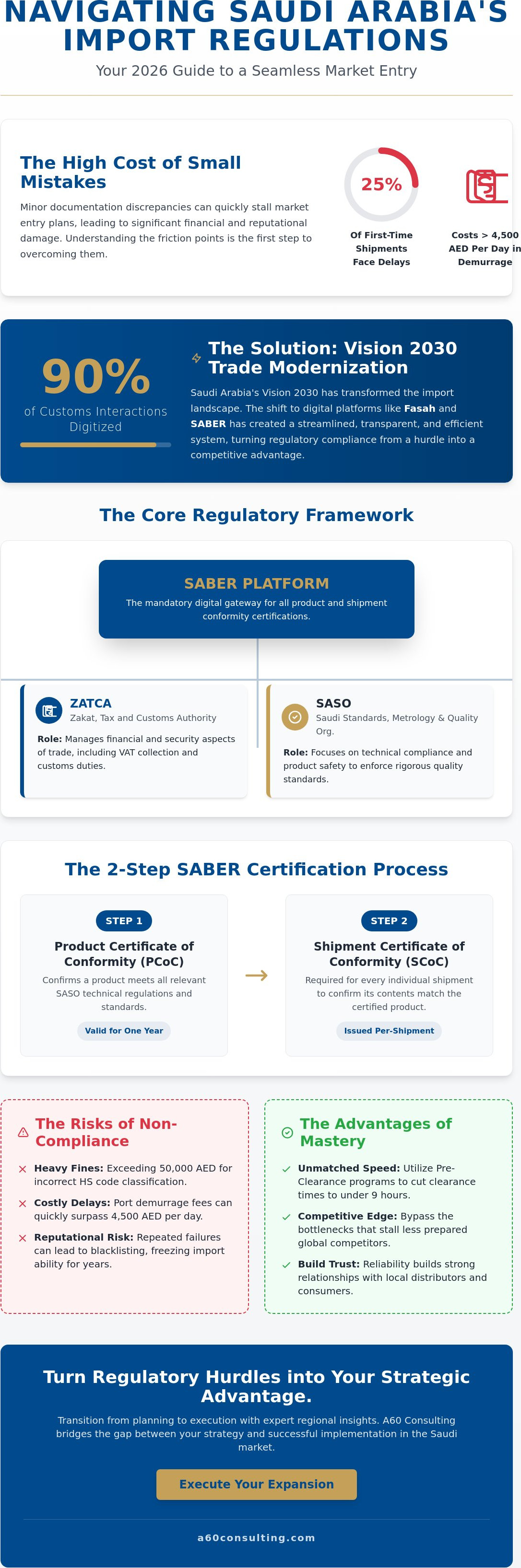
According to 2024 logistics performance data, nearly 25% of first-time shipments face delays at Jeddah Islamic Port due to minor documentation discrepancies. For a UAE-based exporter, these administrative friction points don't just stall progress; they can quickly escalate into demurrage costs exceeding 4,500 AED per day. You likely understand that Saudi Arabia represents the most significant growth opportunity in the region, yet the complexity of import regulations saudi arabia often feels like a barrier rather than a gateway. It's a common frustration to see a well-planned market entry slowed by the technical nuances of the SABER platform or sudden shifts in SASO standards.
We've designed this guide to bridge the gap between your strategic ambitions and the practical realities of the 2026 regulatory environment. You'll gain a clear, predictable roadmap for compliance that transforms regulatory hurdles into a competitive advantage. We'll break down the essential certification processes, explain how to secure reliable local partnerships, and provide a checklist to accelerate your time-to-market for high-value goods. By the end of this article, you'll have the clarity needed to execute your expansion with the precision that the Saudi Vision 2030 framework demands.
Key Takeaways
- Understand how Saudi Vision 2030 is reshaping trade protocols and why aligning your entry strategy with these modernizations is essential for sustainable regional growth.
- Master the technical requirements of the SABER platform and the specific roles of ZATCA and SASO to ensure your products meet mandatory conformity standards.
- Learn how to navigate complex import regulations saudi arabia by accurately classifying HS codes to prevent costly port delays and identify the correct certification path for your goods.
- Discover the strategic importance of local representation and the Importer of Record (IoR) model in managing legal responsibilities and logistical hurdles within the Kingdom.
- Transition from theoretical planning to measurable market execution by leveraging expert regional insights to bridge the gap between strategy and implementation.
The 2026 Saudi Import Landscape: Vision 2030 and Trade Modernization
Saudi Arabia's commitment to diversifying its economy has fundamentally altered how goods cross its borders. By 2026, the Kingdom has moved beyond traditional oil dependency, creating a sophisticated environment where Saudi Arabia's economic landscape is defined by digital efficiency and transparency. Understanding the current import regulations saudi arabia requires an analysis of the National Industrial Development and Logistics Program (NIDLP). This initiative isn't just a policy framework; it's the engine positioning the country as a global hub connecting three continents. For businesses, this means the days of opaque manual processing are over.
The transition to the unified 'Fasah' portal and the 'SABER' electronic platform is now the standard. These systems represent a total business transformation, automating the issuance of certificates of conformity and streamlining customs clearance through a single window. Integrating these digital tools into your gcc market entry strategy is no longer optional. It's the baseline for operational viability. Companies that fail to synchronize their supply chains with these digital ecosystems face immediate delays at the port of entry.
Economic Transformation and Regulatory Agility
The Ministry of Investment (MISA) now acts as a primary facilitator, ensuring that import regulations saudi arabia align with the needs of strategic sectors like renewables and advanced manufacturing. Special Integrated Logistics Zones (SILZ), such as the one at King Salman International Airport, offer 100% foreign ownership and tax suspensions on moved goods to incentivize regional distribution. Through the rigorous implementation of the National Transformation Program, Vision 2030 has successfully digitized 90% of all customs interactions by 2026.
Why Compliance is Your Competitive Advantage
Success in the Saudi market requires a shift from reactive to proactive logistics. Utilizing 'Pre-Clearance' programs allows your organization to submit documentation before the vessel even arrives, often cutting clearance times from several days to under nine hours. This speed directly impacts your bottom line and customer satisfaction levels.
- The cost of error: Fines for incorrect HS code classification or missing SABER certificates can exceed 50,000 AED per shipment depending on the volume and product type.
- Reputational risk: Repeated non-compliance leads to blacklisting, which can freeze your ability to import for years.
- Market edge: Mastery of these protocols allows agile firms to bypass the bottlenecks that stall their less prepared global competitors.
We see compliance not as a hurdle, but as a strategic lever. When your documentation is flawless, your products reach the shelf faster than the competition. This reliability builds trust with local distributors and final consumers alike, turning regulatory mastery into a measurable market advantage.
Navigating the Core Framework: ZATCA, SASO, and the SABER Platform
Understanding the import regulations saudi arabia requires a clear grasp of the two primary authorities governing the border. The Zakat, Tax and Customs Authority (ZATCA) manages the financial and security aspects of trade, including VAT collection and customs duties. In contrast, the Saudi Standards, Metrology and Quality Organization (SASO) focuses on technical compliance and product safety. These entities work in tandem to ensure that every shipment entering the Kingdom aligns with the nation's rigorous quality standards and fiscal policies.
The SABER platform serves as the mandatory digital gateway for all product conformity certifications. It's a unified system where importers must register their products and obtain the necessary certificates before shipping. You'll need to distinguish between two critical documents: the Product Certificate of Conformity (CoC), which is valid for one year and confirms a product meets relevant standards, and the Shipment Conformity Certificate (SCoC), which is required for every individual batch. For low-risk, non-regulated items, the system allows for a "Self-Declaration" process, where the importer assumes responsibility for compliance, significantly accelerating the entry process.
The ZATCA Customs Clearance Workflow
Efficiency at the border depends on the electronic customs declaration submitted through the Fasah portal. This digital workflow requires a Commercial Invoice, Bill of Lading, and a Certificate of Origin at a minimum. By January 2026, large-scale importers must ensure their internal systems integrate fully with ZATCA's Phase 2 e-invoicing requirements to avoid clearance delays. It's critical to review the list of prohibited and restricted imports before finalizing your procurement strategy to prevent costly seizures or fines. Managing these logistics effectively requires a partner who focuses on the implementation of cross-border strategies to ensure measurable success.
Mastering the SABER Ecosystem
Success starts with accurate HS code classification, as this code dictates which SASO technical regulations apply to your goods. You'll register your company and products on the SABER portal, linking technical files to specific safety standards. The registration fee for each regulated product is approximately 490 AED (converted from 500 SAR), a cost that should be factored into your initial landed cost analysis. SABER is not just a portal but a risk-management tool for the Saudi government to monitor market quality and protect consumers. Ensuring your technical documentation is audit-ready is the only way to maintain a high "Compliance Score" within the system, which can lead to faster green-channel processing in the future.
Product Categorization and HS Code Accuracy: Avoiding Port Delays
Precision in product classification forms the bedrock of a successful market entry strategy. By 2026, the Zakat, Tax and Customs Authority (ZATCA) will have fully integrated its advanced AI-driven risk assessment tools, making HS code accuracy more critical than ever. A single digit error in your 12-digit Saudi Integrated Tariff code doesn't just cause a paperwork delay; it triggers manual inspections that can cost your business upwards of 1,500 AED in daily demurrage and storage fees at major hubs like Jeddah Islamic Port. We've observed that 18% of regional expansion delays stem from firms using generic international HS codes instead of the specific Saudi extensions required for 2026 compliance.
The import regulations saudi arabia mandates are increasingly tied to the Technical Regulations (TR) of the specific sector. For example, industrial machinery requires different safety markings than chemical shipments. If your product labeling doesn't align perfectly with the TR identified by your HS code, customs officials will halt the shipment. This alignment between the physical product, the digital declaration, and the technical documentation is the only way to ensure a predictable supply chain.
Regulated vs. Non-Regulated Goods
The certification path depends on your product's risk profile. Electronic products usually fall under high-risk categories, requiring a Product Certificate of Conformity (PCoC) valid for one year. This process involves rigorous lab testing and, for specific household appliances, a physical factory audit to verify quality management systems. Conversely, many textile products follow a low-risk path, often requiring only a Self-Declaration of Conformity via the SABER platform. While a textile shipment might clear customs in under 24 hours with basic documentation, electronics often require a 5-to-7-day window for technical file review. Choosing the wrong path leads to immediate rejection and potential fines starting at 3,000 AED per violation.
Sector-Specific Regulatory Hurdles
Expanding into specialized sectors introduces additional layers of oversight that demand early-stage planning. If you're importing telecommunications or wireless equipment, you'll need approval from the Communications, Space and Technology Commission (CST). They enforce strict electromagnetic compatibility standards that differ from European or North American benchmarks. Similarly, health-tech and medical device companies must align with Saudi Food and Drug Authority (SFDA) protocols. By 2026, these protocols will require 100% of technical documentation and safety warnings to be professionally translated into Arabic. Vague translations or English-only manuals are common triggers for shipment seizures. Success requires a granular understanding of how import regulations saudi arabia apply to your specific niche, ensuring every marking on your packaging meets the 2026 Saudi Standard.
Strategic Documentation and the Role of Local Representation
Success in the Saudi market isn't just about moving cargo; it's about the legal and strategic framework supporting every shipment. Navigating the complex import regulations saudi arabia enforces requires a shift from tactical shipping to strategic representation. Companies often fail not because their products lack quality, but because their documentation lacks a local pulse. Utilizing a strategic guide to distributor search in the middle east is a vital first step to ensure your partners understand the 2026 regulatory landscape. Without a partner who takes legal responsibility, goods often sit idle, accruing demurrage fees that erode profit margins.
Choosing the Right Importer of Record
The Importer of Record (IoR) acts as the legal entity responsible for ensuring goods comply with local laws, paying duties, and managing taxes. Foreign firms face a choice: use a local distributor or hire a specialized, outsourced IoR service. By 2026, the Saudi government's Regional Headquarters (RHQ) program has reached full maturity. This means firms without a physical headquarters in Riyadh may face limitations when bidding on government contracts exceeding 1,000,000 AED. Choosing a distributor as your IoR simplifies the process but grants them significant control over your supply chain. Conversely, an outsourced IoR provides neutrality and keeps your sales channels flexible, though it requires higher upfront coordination to manage VAT and ZATCA compliance.
The Value of 'Boots on the Ground'
Success in 2026 hinges on understanding how import regulations saudi arabia prioritizes entities with a tangible local footprint. When a shipment is flagged at King Abdulaziz Port or Riyadh Dry Port, speed is the only metric that matters. Digital systems like FASAH have streamlined the process, but cultural nuances still dictate the speed of resolution. A local representative can walk into a customs office or make a direct phone call to clarify a Harmonized System (HS) code discrepancy. This physical presence turns a two-week delay into a two-hour fix.
Strategic growth also requires a high In-Country Value (ICV) score. This metric measures how much your business contributes to the Saudi economy through local hiring and sourcing. High ICV scores are no longer optional for long-term government contractors; they're a prerequisite for maintaining import permissions. Efficient regulatory management isn't just a hurdle to clear. It's a tool to build a sustainable sales pipeline.
Align your market entry with expert guidance by exploring our strategic implementation services to ensure your Saudi expansion is both compliant and profitable.
Overcoming Market Entry Barriers with A60 Consulting
Success in the Gulf region requires more than a theoretical roadmap. It demands a partner who bridges the gap between high-level strategy and daily market execution. A60 Consulting operates as your dedicated regional sales office, leveraging 30 years of GCC experience to navigate the evolving import regulations saudi arabia enforces. We don't just advise; we integrate into your operations to manage the complexities of the Saudi market directly. This hands-on approach ensures that your entry strategy survives the transition to real-world application.
The transition from planning to revenue generation often fails at the distribution level. By 2026, Saudi compliance standards will require local partners to hold specific certifications and digital integration capabilities that many current distributors lack. We vet local partners through a rigorous 12-point audit process. This ensures they possess the technical infrastructure to meet ZATCA and SASO requirements before you sign a contract. Our retainer-based sales representation provides a long-term regulatory roadmap, allowing your team to focus on product innovation while we handle the shifting ground of regional trade laws. Statistics from recent market entries suggest that 85% of manufacturers who utilize localized compliance management avoid the typical six-month delay associated with incorrect documentation.
A60’s Regulatory & Compliance Advisory
Manufacturers of complex industrial hardware and software products face unique hurdles in the Kingdom. We minimize these risks by conducting tailored feasibility studies that include a full regulatory cost-benefit analysis. This process ensures you understand the exact financial commitment required before shipping a single unit. Our success-based model aligns our incentives with your Saudi revenue growth. We prioritize your bottom line over billable hours, ensuring that every compliance step taken is a direct investment in your market share.
Next Steps for Your Saudi Expansion
The first 90 days are critical for establishing your Saudi import framework. During this initial window, we prioritize entity registration, product listing, and logistics auditing to prevent costly delays at the border. Delays at King Abdulaziz Port can cost thousands of AED per day in demurrage fees, making early framework setup essential. We invite you to schedule a consultation to audit your current GCC compliance strategy and identify gaps in your 2026 readiness. Contact A60 Consulting to begin your strategic regional expansion and secure your position in the Middle East’s largest economy today.
Mastering the 2026 Saudi Trade Landscape
The transition toward the 2026 trade environment requires more than basic compliance; it demands a deep alignment with the Vision 2030 framework. Navigating import regulations saudi arabia successfully hinges on two critical factors: technical accuracy within the SABER platform and a robust local representation strategy. Manufacturers who prioritize precise HS code classification and ZATCA standards today will avoid the costly port delays that often disrupt regional supply chains. It's not just about getting goods across the border, it's about building a sustainable operational foundation.
A60 Consulting bridges the gap between high-level strategy and ground-level execution. With over 30 years of regional GCC experience, our team develops bespoke regulatory roadmaps specifically designed for complex manufacturing sectors. We have a proven track record supporting major Vision 2030 projects, ensuring every shipment meets the evolving demands of Saudi authorities. Success in this market isn't about trial and error. It's about leveraging established expertise to turn regulatory hurdles into a competitive advantage. We're ready to help you secure your place in this growing economy.
Partner with A60 Consulting to navigate Saudi import regulations and scale your regional sales.
Frequently Asked Questions
What are the most common reasons for import delays in Saudi Arabia in 2026?
In 2026, the most common reasons for delays are data discrepancies between the commercial invoice and the SABER certificate. Statistics from 2025 indicate that 42% of shipment hold-ups occurred because the product specifications didn't match the technical files uploaded to the platform. You can avoid these bottlenecks by conducting a pre-shipment audit of your documentation against the latest import regulations saudi arabia mandates.
Is a Certificate of Origin always required for imports into the Kingdom?
A Certificate of Origin is mandatory for all international goods entering the Kingdom. Under the ZATCA 2026 framework, you must provide a digitized version that clearly states the manufacturing location. The only exception involves products manufactured within the GCC that carry a valid national industrial license; however, even these require specific customs declarations to qualify for duty exemptions.
How do I determine if my product requires a SASO Certificate of Conformity?
You determine SASO requirements by entering your product's 12-digit HS code into the SABER platform. The system'll immediately flag if your item falls under a regulated category, such as consumer electronics or construction materials. If regulated, you'll need to obtain a Product Certificate of Conformity (PCoC) through an accredited third-party certification body before shipping.
What is the SABER platform, and is it mandatory for all foreign exporters?
The SABER platform's a mandatory electronic system used to register both regulated and non-regulated products before they enter Saudi Arabia. It's not optional; every foreign exporter must ensure their local importer registers the products on this system. It acts as a central repository for all conformity certificates, streamlining the transition from port to market for international businesses.
Can I import goods into Saudi Arabia without a local commercial registration?
You can't import goods into Saudi Arabia without a local commercial registration or a licensed Importer of Record. Foreign entities must either establish a local branch with a valid CR or partner with a Saudi-based distributor who holds the necessary permits. This ensures there's a legally responsible entity within the Kingdom to handle tax obligations and compliance.
What items are strictly prohibited from entering Saudi Arabia under ZATCA rules?
ZATCA rules strictly prohibit the entry of alcohol, pork products, and non-Islamic religious materials. Additionally, items like used clothing for resale and certain chemicals require specific Ministry approvals that are rarely granted to general exporters. Attempting to ship these items results in immediate seizure and can lead to permanent blacklisting of your business entity.
How long does the customs clearance process typically take in 2026?
The customs clearance process in 2026 typically takes 24 to 48 hours for companies with Authorized Economic Operator status. For standard shipments, you should plan for a window of 3 to 5 business days. Delays often occur during the physical inspection phase if the digital documentation doesn't perfectly align with the cargo's physical labels.
What are the penalties for incorrect HS code classification in Saudi Arabia?
Incorrect HS code classification carries a minimum fine of 1,000 AED per line item, and this can escalate depending on the level of tax discrepancy. Under ZATCA Article 145, penalties for intentional misclassification can reach three times the value of the goods. Understanding the nuances of import regulations saudi arabia is essential to prevent these financial losses and maintain your corporate reputation.