
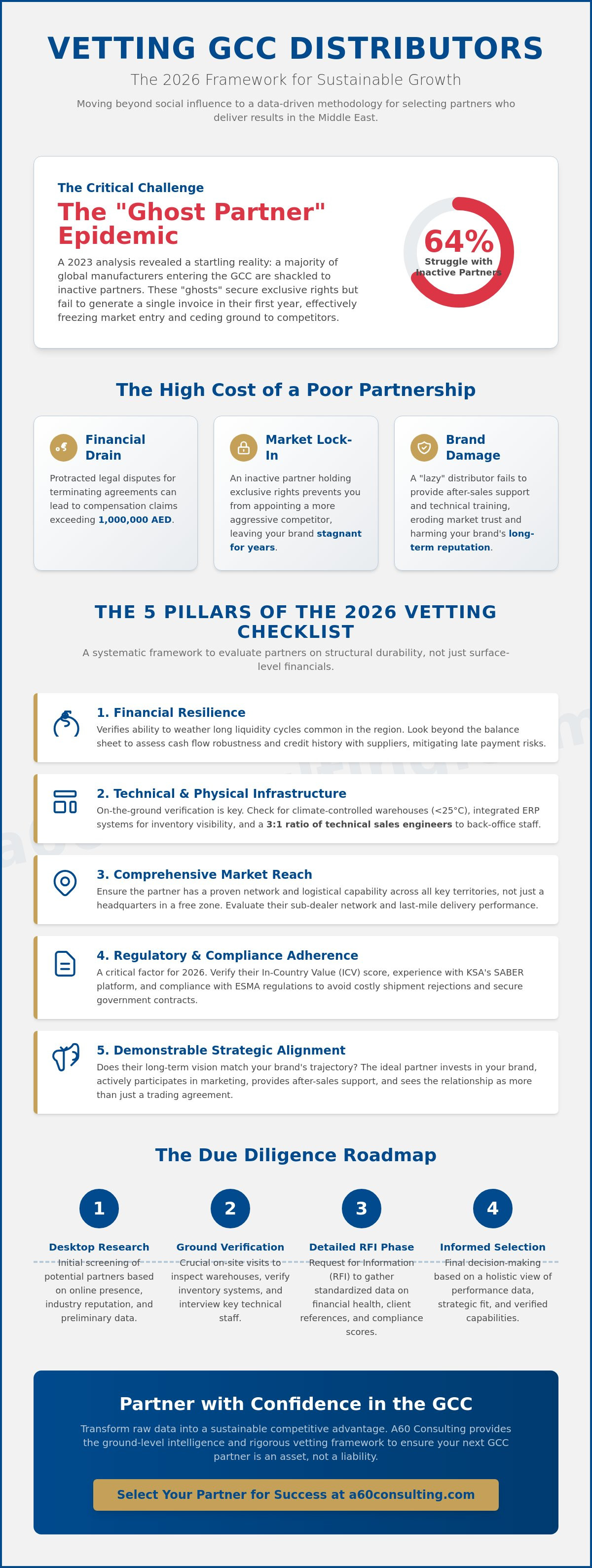
A 2023 analysis of GCC market entries revealed that 64% of global manufacturers struggle with "ghost" partners who secure exclusive rights but fail to generate a single invoice within their first 12 months. You likely recognize that a signed contract in Dubai or Riyadh is just the beginning of a high-stakes relationship where perceived influence often masks significant operational gaps. Relying on "Wasta" alone is no longer a viable strategy for companies seeking sustainable growth in the 2026 landscape.
This article provides a research-backed framework for vetting distributors middle east, helping you bridge the gap between initial strategy and successful implementation. We'll show you how to qualify partners based on measurable performance data and objective metrics rather than social standing. Our guide previews the essential steps for verifying regulatory compliance across different GCC states and offers practical methods to mitigate the late payment risks that frequently stall regional expansion. You'll gain the methodological thoroughness needed to select a partner that actually delivers results.
Key Takeaways
- Understand why strategic alignment in the UAE market outweighs simple financial solvency to prevent costly market lock-ins and brand damage.
- Apply a rigorous 2026 framework for vetting distributors middle east that balances technical infrastructure with proven financial resilience.
- Redefine the role of 'Wasta' from mere social influence to a trust-based asset, ensuring your partners possess the infrastructure required for performance.
- Execute a systematic due diligence roadmap that transitions from preliminary desktop research to detailed RFI phases for informed decision-making.
- Discover how localized market intelligence and a ground-level presence in the GCC can transform raw data into a sustainable competitive advantage.
The High Stakes of Vetting Distributors in the Middle East
In the Gulf Cooperation Council (GCC) markets, vetting is a process that extends far beyond verifying financial solvency. For a global manufacturer, vetting distributors in the Middle East requires a dual focus on technical capability and strategic alignment. A partner might show a healthy balance sheet in Dubai, yet lack the specialized infrastructure to support your 2026 growth targets. True vetting evaluates whether a distributor's long-term vision matches your brand's trajectory, particularly as regional markets move toward high-tech and sustainable industrial sectors.
The cost of a "lazy" appointment is often measured in years of lost progress. In the United Arab Emirates, terminating a poorly performing commercial agency agreement can lead to protracted legal disputes in local courts, sometimes resulting in compensation claims exceeding 1,000,000 AED. Beyond the financial drain, an inactive partner causes market lock-in, where your brand remains stagnant while competitors capture territory. Success in 2026 demands a shift from general trading partners to specialized distributors who invest in after-sales support and technical training.
To mitigate these risks, many manufacturers are adopting the "Regional Sales Office" (RSO) model. This structure allows the manufacturer to maintain a lean team in hubs like the Dubai Multi Commodities Centre (DMCC) to provide direct oversight. This team ensures that the distributor isn't just moving boxes but is actively building the brand. Understanding Middle Eastern business etiquette is essential during this oversight phase; the transition from a handshake-based agreement to a performance-metric-driven partnership requires cultural intelligence and professional patience.
Why Traditional Audits Fail in the Gulf
Standard Western audit practices often hit a wall in the Middle East due to opaque private company reporting. Many family-owned conglomerates don't publish detailed audited accounts, making it difficult to distinguish an active market player from a "paper distributor" that exists only on a trade license. The distributor trap occurs when a partner intentionally holds minimum stock levels and remains inactive solely to prevent the manufacturer from appointing a more aggressive competitor in the same territory. Identifying this requires on-the-ground verification of warehouse operations and current client references.
The 2026 Regulatory Landscape: ICV and Local Content
By 2026, the criteria for vetting distributors in the Middle East must include a partner's In-Country Value (ICV) score. In the UAE, a high ICV score is mandatory for winning government-linked contracts, as it measures the distributor's contribution to the local economy through local procurement and Emirati employment. Similarly, Saudi Vision 2030 initiatives require partners to have robust local footprints. You must verify a partner's technical proficiency in managing the SABER platform for Saudi exports and ensuring compliance with Emirates Authority for Standardization and Metrology (ESMA) regulations to avoid costly shipment rejections at Jebel Ali port.
The 5 Pillars of the 2026 Distributor Vetting Checklist
Success in the UAE market isn't accidental. It requires a methodical evaluation of a partner's ability to execute complex technical strategies while maintaining the financial stamina to bridge the gap between delivery and final payment. When vetting distributors middle east, manufacturers must look beyond surface-level sales figures and focus on structural durability. The 2026 landscape demands five core pillars: financial resilience to weather long liquidity cycles, technical infrastructure that matches global standards, comprehensive reach across the seven Emirates, strict adherence to evolving UAE Ministry of Economy regulations, and a demonstrable strategic commitment to your brand's growth.
Verifying Technical and Physical Infrastructure
A distributor's warehouse is often the most honest reflection of their operational health. During site visits, look for climate-controlled storage capable of maintaining temperatures below 25°C, as UAE summers frequently exceed 45°C, which can degrade sensitive components or packaging. Check for integrated ERP systems that provide real-time inventory visibility and automated spare parts management. A red flag is a team top-heavy with general administrative staff; instead, look for a 3:1 ratio of technical sales engineers to back-office personnel. You can verify the training certifications of the distributor's engineers by cross-referencing their credentials with the manufacturer’s internal training logs or third-party accreditation bodies like the KHDA in Dubai. This ensures that the expertise you're promised is actually present on the ground. Effective strategic implementation starts with these physical foundations.
Financial Due Diligence in a 'Late Payment' Culture
In the UAE, 60-day or 90-day payment terms are standard, but actual collection often stretches to 120 days or more, especially in the construction and energy sectors. You must analyze the distributor’s banking relationships to ensure they have sufficient facility limits for inventory financing, ideally exceeding 10,000,000 AED for mid-sized operations. Request credit references from at least three other international principals to see if the distributor maintains consistent payment schedules even when their own receivables are delayed. It's also vital to assess their history with government contract payments, as these projects offer high volume but require significant working capital reserves. Utilizing a due diligence checklist for distributors can help you uncover whether a potential partner has the liquidity to support your 2026 growth targets. Don't settle for verbal assurances; ask for audited financial statements from the last two fiscal years to confirm their resilience. This level of scrutiny is a prerequisite for vetting distributors middle east who can actually scale your business without constant credit friction.
Wasta vs. Performance: Vetting the 'Influence' Factor
In the 2026 UAE business environment, the concept of 'Wasta' has undergone a significant transformation. It's no longer synonymous with simple nepotism or "who you know" in a traditional sense. Instead, it has evolved into a measure of institutional trust and social capital. When vetting distributors middle east, you must distinguish between a partner who merely has "contacts" and one who possesses the credibility to move projects through the UAE's sophisticated regulatory and procurement systems. High-level access is a door-opener, but it isn't a substitute for operational excellence.
Influence without infrastructure is a common pitfall for global manufacturers. A distributor might claim close ties to key decision-makers in entities like DEWA or the Ministry of Industry and Advanced Technology, yet lack the technical staff to support your product. You're looking for a partner whose political reach is balanced by a robust sales execution capability. If they can't demonstrate a clear path from a high-level meeting to a signed purchase order in AED, their influence is a liability rather than an asset. True influence in 2026 is the ability to navigate compliance and technical specifications as much as it's about holding the right meetings.
Identifying 'Box-Movers' vs. Value-Added Partners
A primary red flag is the 'General Trading' license. If a distributor’s portfolio includes fifty unrelated brands across five different sectors, they're likely a box-mover. These companies rarely invest in the technical training required for complex products. To test their commitment, analyze their marketing spend. In 2025, high-performing UAE distributors allocated between 6% and 9% of their annual revenue to regional trade presence, such as dedicated stands at GITEX Global or ADIPEC. Ask for a detailed 3-Year Market Growth Plan. If they can't project market share gains with specific milestones, they're not a strategic partner; they're just waiting for orders to fall into their lap.
Verifying Sales Pipeline Transparency
Transparency is the bedrock of a successful partnership. In 2026, a professional distributor must provide real-time visibility into their sales activities. If they refuse to share access to their CRM or provide vague monthly reports, it's a sign of a fragmented pipeline. Demand to see case studies from the last 18 months that involve similar ticket sizes, specifically those exceeding 500,000 AED. For those focusing specifically on the Emirates, our Strategic Guide to Finding and Managing Distributors in the UAE provides deeper localized benchmarks for evaluating these relationships and ensuring your sales data remains accurate and actionable.
The Due Diligence Roadmap: Step-by-Step Vetting Process
Success in the UAE market isn't built on optimistic projections; it's forged through a disciplined, five-step verification cycle. Manufacturers often rush into partnerships to capture immediate demand, yet 68% of failed regional expansions stem from inadequate initial screening. A structured approach to vetting distributors middle east ensures that your brand equity remains protected while you scale operations in Dubai, Abu Dhabi, and the Northern Emirates.
The process begins with preliminary desktop research. We recommend verifying trade licenses through the Dubai Chamber of Commerce or relevant Free Zone authorities like JAFZA. Once the initial filter is complete, the Request for Information (RFI) phase must demand granular data. Don't settle for vague promises of "market coverage." Ask for 2024-2025 audited financial summaries and specific 2026 logistics capacity plans. The third step involves in-market site visits to warehouses in industrial hubs like KIZAD, followed by rigorous compliance screening against the UAE Executive Office for Control and Non-Proliferation (EOCN) lists. Finally, every partnership should initiate with a 12-month trial period governed by strict KPIs.
Conducting 'Blind' Reference Checks
Standard reference lists provided by a distributor are curated to impress. To find the truth, you must look beyond the provided names. Reach out to current customers, such as procurement managers at major UAE hospitals or retailers, without the distributor's mediation. Frame these as industry benchmarking calls rather than formal audits. Focus your inquiry on reporting accuracy. Ask if the distributor provides transparent inventory data every 30 days or if they struggle with stockouts. Verify their standing at regional trade shows like ADIPEC or Gulfood. A distributor who claims market leadership but lacks a visible, professional presence at these events is likely overstating their influence.
The Legal Vetting: Agreements and Protections
The legal framework in the Emirates is evolving. While the UAE Federal Law No. 11 of 2023 on Commercial Agencies introduced more flexibility, "termination for convenience" remains a complex hurdle for foreign principals. You must ensure your distributor agreement middle east includes clear, objective performance triggers that allow for dissolution if targets aren't met. If an agreement is registered with the Ministry of Economy, ending it becomes significantly more difficult and costly, often requiring substantial compensation payments.
- Exclusivity Limits: Define specific territories and product lines to avoid locking yourself out of future opportunities.
- Compliance Clauses: Explicitly mandate adherence to the US FCPA and UK Bribery Act, ensuring the distributor has an internal whistleblowing policy.
- Audit Rights: Secure the right to conduct unannounced financial and physical stock audits twice annually.
Effective vetting distributors middle east requires balancing legal protection with operational trust. By embedding these safeguards into your strategy, you bridge the gap between initial entry and sustainable growth.
Ready to secure your regional footprint? Partner with A60 Consulting to design a vetting framework that delivers measurable results.
Partnering for Success: How A60 Consulting Vets Your Future
A60 Consulting functions as your strategic boots on the ground across the GCC, specifically within the high-stakes markets of Dubai and Abu Dhabi. We don't rely on digital directories or superficial brochures. Instead, we act as your eyes and ears, conducting physical site visits to warehouses in JAFZA and interviewing frontline sales teams. Our proprietary methodology for vetting distributors middle east moves beyond basic financial data into the realm of deep market intelligence. We analyze a partner's true influence, their technical implementation capacity, and their cultural alignment with your brand's long-term vision.
Maintaining 'Wasta' (influence and prestige) is a critical component of doing business in the United Arab Emirates. When a manufacturer asks aggressive questions about a potential partner's debt or historical failures, it can strain the relationship before the contract is even signed. A60 Consulting serves as a necessary third-party buffer. We conduct the rigorous audits and "hard" questioning, allowing the manufacturer to maintain a position of high-level strategic partnership and mutual respect. This objective distance ensures you get the truth without burning bridges.
The value of this approach is best seen in results. In early 2024, a European medical tech firm planned to sign an exclusive agreement with a distributor claiming 90% hospital coverage in the UAE. Our vetting process revealed the distributor actually had active contracts with only 15% of the target facilities, with the rest being dormant leads. By identifying these discrepancies, we saved the client from a projected 24-month market stall and an estimated 5.2 million AED in lost opportunity costs. We don't just find partners; we protect your investment from the start.
Beyond Search: Ongoing Distributor Management
Vetting is the foundation, but sustainable growth requires active sales enablement and local representation. We transition from the vetting phase into a management role, ensuring your distributor adheres to strict KPIs and brand guidelines. We bridge the gap between your headquarters and the local market reality, providing the oversight needed to keep your partner focused on your specific product line. To understand how we identify these candidates initially, you can review our distributor search middle east framework for a complete picture of the expansion lifecycle.
Start Your GCC Expansion with Confidence
Professional vetting is a non-negotiable insurance policy for any global manufacturer entering the Emirates. The cost of an underperforming partner isn't just financial; it's a loss of reputation that can take years to rebuild. We provide the analytical depth and regional expertise to ensure your first step is a confident one. Our team focuses on measurable outcomes and organizational transformation, turning the complexity of the Middle Eastern market into a structured path for growth. Contact A60 Consulting to begin your partner vetting process today and secure a partner who truly matches your ambition.
Building Resilient Partnerships for the 2026 GCC Market
Expanding into the UAE and Saudi Arabia requires a decisive shift from traditional networking to a rigorous, data-driven approach. Success in 2026 hinges on balancing historical influence with measurable operational KPIs and transparent compliance standards. Global manufacturers often find that the process of vetting distributors middle east involves navigating complex regulatory frameworks and local market nuances that simply can't be assessed from a distance. You need a partner who effectively bridges the gap between high-level strategic intent and practical local execution.
A60 Consulting brings over 30 years of regional experience to your expansion strategy. Our permanent on-the-ground presence in the UAE and Saudi Arabia ensures that your due diligence is rooted in current market realities rather than theoretical models. We've established a proven track record with complex tech and industrial manufacturers, helping them secure sustainable growth through methodical partner selection. Your regional success depends on the quality of your local foundation; we provide the analytical depth to ensure that foundation is solid. We're ready to help you navigate these complexities with confidence.
Secure your GCC expansion with A60's expert distributor vetting services
Frequently Asked Questions
How long does it typically take to vet a distributor in the Middle East?
A thorough process for vetting distributors in the Middle East typically requires 3 to 6 months to complete properly. This timeline accounts for the initial due diligence, physical site inspections in cities like Dubai or Abu Dhabi, and the verification of local references. Rushing this phase often leads to misaligned expectations. We recommend allocating 12 weeks for the core evaluation and an additional 8 weeks for final contract negotiations.
Is it offensive to ask a potential Middle Eastern partner for a financial audit?
Requesting a financial audit isn't offensive if you frame it as a standard global compliance requirement. Most established UAE firms expect transparency during the 2026 fiscal year. You should present the request as a mutual risk management step rather than a lack of trust. Professional partners understand that sound financial health is the foundation of a sustainable partnership.
What are the most common red flags when vetting a GCC distributor?
The most critical red flag is a distributor's refusal to provide granular sales data or access to their physical warehouse facilities. Another warning sign is a high turnover rate among key account managers, which often indicates internal instability. If a partner claims to cover the entire GCC but lacks active trade licenses in specific markets, their regional reach is likely exaggerated. These indicators are essential when vetting distributors in the Middle East.
Can I appoint multiple distributors in the same country in the Middle East?
You can appoint multiple distributors in the UAE by clearly defining their scope by sector, product line, or specific emirate. However, you must ensure the contracts aren't registered under the UAE Commercial Agency Law, which often grants exclusive rights to a single agent. Non-exclusive distribution agreements provide the flexibility to work with different partners for government tenders and private retail channels simultaneously.
How do I verify a distributor's 'Wasta' or influence in a specific sector?
You verify influence by analyzing the distributor's history of winning major government tenders or their presence on high-level advisory boards. Look for a track record of successful project completions within the last 24 months. True influence manifests as a seat at the table during regulatory discussions, not just social connections. We suggest cross-referencing their project list with official UAE procurement portals to validate their claims.
What is the difference between a commercial agent and a distributor in the GCC?
A commercial agent is a local entity registered with the Ministry of Economy, enjoying significant legal protections that make contract termination challenging. In contrast, a distributor operates under a standard commercial contract, which allows for more flexible exit strategies. Understanding this distinction is vital for long-term risk management. Most modern manufacturers prefer non-registered distribution agreements to maintain control over their market presence and brand equity.
How often should I re-vet or audit my existing Middle Eastern distributors?
You should conduct a comprehensive performance and compliance audit every 18 months to ensure alignment with your strategic goals. Market conditions in the UAE change rapidly, and a partner that was effective in 2024 might lack the digital capabilities required by 2026. Annual reviews of financial stability and local market reputation help identify potential issues before they impact your revenue or brand integrity.
Does a distributor need to have an ICV certificate to work with me?
A distributor needs an In-Country Value (ICV) certificate if your business strategy involves bidding for government or semi-government contracts in the UAE. This certificate measures the company's contribution to the local economy through local procurement and employment. Having a high ICV score is a competitive advantage for partners working with entities like ADNOC. It directly impacts their likelihood of winning major tenders in the energy and infrastructure sectors.