
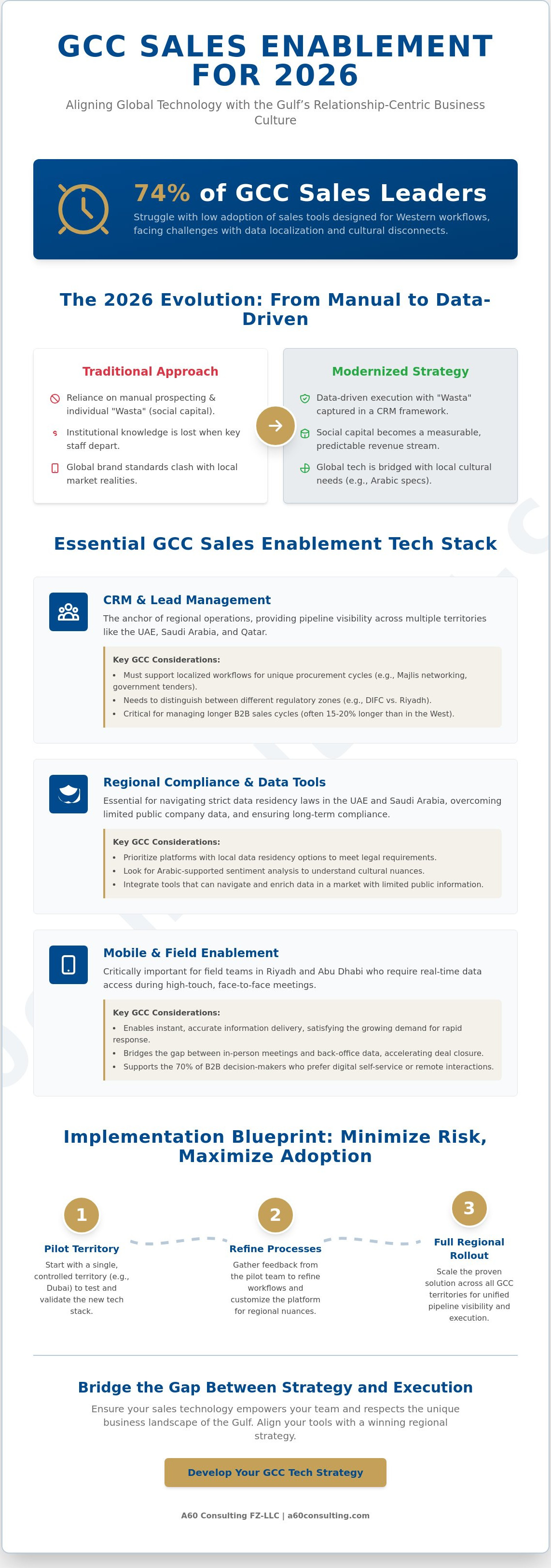
Your million-dirham tech stack is likely failing your sales team if it treats a Dubai boardroom like a Silicon Valley Zoom call. While global software markets are saturated with options, many organizations find that their investment in sales enablement tools gcc remains underutilized because the platforms don't respect the region's relationship-centric culture. A 2023 industry survey revealed that 74% of regional sales leaders struggle with data localization requirements and low adoption rates when using tools designed specifically for Western workflows.
You probably agree that technology should empower your reps, not create an administrative hurdle that slows down deal-making. It's a common challenge to balance the need for global standards with the reality of local business nuances and strict data residency laws in the UAE and Saudi Arabia. This guide explores how to align global technology with the Gulf’s unique business environment to drive measurable B2B growth. We'll examine the specific platforms and implementation strategies that ensure your tech stack supports your people, improves pipeline visibility across multiple territories, and remains fully compliant with regional regulations for 2026.
Key Takeaways
- Learn how to navigate the 2026 shift from manual prospecting to data-driven execution while maintaining the relationship-centric approach essential for success in the Gulf.
- Identify the essential sales enablement tools gcc that integrate seamlessly with regional CRM requirements and overcome the challenges of limited public company data.
- Ensure long-term compliance by prioritizing local data residency and Arabic-supported sentiment analysis to align your technology with UAE regulations and cultural nuances.
- Minimize operational risk through a phased implementation strategy, starting with a "Pilot Territory" to refine processes before a full-scale regional rollout.
- Bridge the gap between high-level market entry strategy and daily sales execution to achieve measurable growth and select the right regional distribution partners.
The Evolution of Sales Enablement in the GCC Market
Sales enablement in the Gulf Cooperation Council (GCC) has moved past the simple provision of marketing brochures to a sophisticated alignment of technology, content, and process. In the United Arab Emirates, where the B2B sector contributed significantly to a 3.7% non-oil GDP growth in 2023, the stakes for efficiency are high. By 2026, the reliance on manual prospecting has largely faded. Companies now prioritize data-driven execution to stay competitive. This transition isn't just about replacing spreadsheets; it's about institutionalizing the traditional "Wasta" system. While personal influence remains a cornerstone of regional business, modern sales enablement tools gcc allow firms to capture these relationships within a CRM-led framework. This ensures that institutional knowledge stays within the company even if a key account manager departs. It creates a measurable trail of influence that transforms social capital into predictable revenue.
Adopting these technologies is vital for a robust gcc market entry strategy. These tools provide the visibility needed to scale from a single Dubai office to a regional powerhouse. Without them, regional expansion often hits a ceiling where human memory and individual effort can't keep pace with market demands.
Beyond the Software: The Strategic Framework
Tools fail when they lack a regional blueprint. Success requires aligning marketing collateral with local cultural expectations, such as preferring high-touch communication and Arabic-language technical specs. Sales enablement bridges the gap between international headquarters and local teams, ensuring that global brand standards don't clash with regional market realities. Integrating Mobile Sales Enablement is particularly critical here. Field teams in Riyadh or Abu Dhabi require real-time access to data during face-to-face meetings to maintain the pace of modern trade. It's the difference between closing a deal in the room and waiting three days for a follow-up email.
The 2026 GCC Sales Landscape
Buyer behavior in Saudi Arabia and the UAE has shifted toward a digital-first approach. A 2024 McKinsey report highlighted that 70% of B2B decision-makers in the region prefer remote human interaction or digital self-service. There's a growing demand for transparency and rapid response times that traditional sales methods can't satisfy. Organizations are now measured by their ability to provide instant, accurate information at every touchpoint. GCC sales enablement is the fusion of local relationship management and global analytics. This combination allows businesses to respect the cultural nuances of the Gulf while operating with the precision of a global enterprise.
Essential Categories of Sales Enablement Tools for the Gulf
Selecting the right sales enablement tools gcc requires a strategic shift from global templates to regional realities. In the UAE, where B2B cycles often extend 15% to 20% longer than in Western markets, your tech stack must act as a cultural bridge rather than just a data repository. These tools should empower your team to manage the high-touch, relationship-driven nature of Gulf business while maintaining the pace required by the 2026 economic landscape.
CRM and Lead Management
The CRM remains the anchor of any regional operation. For firms operating across the UAE, Saudi Arabia, and Qatar, the challenge isn't just data entry; it's visibility across borders. High-tier options like Salesforce or HubSpot offer robust automation, but agile teams are increasingly looking at platforms that allow for localized workflows. Effective management starts with building a sales pipeline in the middle east that reflects the specific stages of regional procurement, from initial "Majlis-style" networking to formal government tenders.
A unified view is vital when managing multi-territory pipelines. Your CRM should distinguish between the regulatory requirements of the Dubai International Financial Centre (DIFC) and the evolving compliance standards in Riyadh. This clarity ensures that leadership can forecast revenue without the noise of mismatched regional data.
Intelligence and Prospecting Tools
Middle Eastern markets present a unique challenge: a significant lack of public company data. Traditional Western scrapers often fail to capture the nuances of local family-owned conglomerates or semi-government entities. To succeed, sales enablement tools gcc must include intelligence platforms that offer verified B2B data coverage specific to the Gulf. Tools like LinkedIn Sales Navigator remain essential, but they're most effective when paired with regional databases that understand the "gatekeeper" culture.
In the UAE, the receptionist or executive assistant often holds more power than their title suggests. Digital intelligence helps your team map these organizational hierarchies before the first call. This trend is part of the broader Digital Transformation in the GCC, where data-driven decision-making is replacing traditional guesswork. By 2026, firms that don't use predictive intelligence to bypass gatekeepers will find their customer acquisition costs rising by an estimated 12% annually.
Content and Coaching for a Diverse Talent Pool
Sales enablement isn't only about software; it's about the people using it. The GCC sales force is a unique blend of local Emirati talent and a vast expat population. Coaching tools must address this diversity. Content management systems should facilitate the localization of pitches, ensuring that marketing collateral respects regional etiquette while highlighting technical superiority. If you're looking to refine how your team utilizes these platforms, a strategic audit of your sales processes can identify where technology and talent are misaligned.
- CRM: Prioritize platforms with multi-currency support (AED, SAR, QAR) and regional data residency compliance.
- Intelligence: Focus on tools that provide mobile numbers and direct WhatsApp links, as these are primary communication channels in the Gulf.
- Training: Use "micro-learning" platforms to upskill teams on the fly, focusing on the 2026 regulatory shifts in the UAE.
Evaluating Tools for Regional Compliance and Culture
Selecting sales enablement tools gcc professionals rely on requires looking beyond global feature lists. Strategic alignment with local regulations and cultural norms represents the foundation of successful implementation in the UAE. Without this grounding, even the most advanced software becomes a source of friction rather than a driver of efficiency.
Regulatory Alignment: Saudi PDPL and UAE Data Law
Data sovereignty is a critical pillar of the regional digital economy. The UAE Federal Decree-Law No. 45 of 2021 on the Protection of Personal Data sets clear boundaries for how businesses handle resident information. For organizations pursuing government or semi-government contracts, "in-country" data storage isn't optional. It's a prerequisite for participation in the market. Vetting vendors for regional security certifications ensures that your sales stack doesn't become a legal liability. According to recent GCC Sales Enablement Platform Market Analysis, the demand for localized cloud infrastructure is a primary driver for software adoption as we approach 2026. Decision-makers should prioritize providers who've invested in local data centers within Dubai or Abu Dhabi to ensure seamless compliance with both UAE laws and the Saudi Personal Data Protection Law (PDPL).
Cultural Calibration of Sales Tech
Technology fails when it ignores the human element of the transaction. In the Gulf, business is built on the strength of the handshake. Arabic language support must extend beyond simple UI translation; it needs to encompass sentiment analysis that understands regional dialects and formal business etiquette. This allows sales leaders to gauge the health of a deal through the nuances of communication, not just the frequency of contact.
The UAE boasts a smartphone penetration rate exceeding 96%, making mobile-first communication the standard. Sales teams don't just use email; they utilize WhatsApp as a primary tool for closing deals. Modern sales enablement platforms must capture these mobile interactions to provide a 360-degree view of the buyer journey. If a tool doesn't integrate with mobile messaging, it misses the most vital parts of the conversation.
Addressing the common objection that "clients only buy through personal relationships" requires a shift in perspective. In the GCC, technology must empower the relationship, not replace it. Instead of using automation to send impersonal sequences, use it to track "High-Touch" activities. Platforms should be configured to prompt coffee meetings or site visits based on engagement data. This ensures that the digital strategy supports the traditional values of trust and presence, creating a hybrid model where data-driven insights enhance the personal connection rather than diluting it.
Implementation: Rolling Out Your Stack to a GCC Sales Team
Successful implementation of sales enablement tools gcc requires moving beyond software installation into the territory of organizational behavioral change. Before a single license is purchased, a rigorous audit of current workflows is essential. A 2025 survey of regional commercial leaders indicated that 38% of technology investments failed because they digitized broken processes rather than fixing them. You must map every touchpoint in your current sales cycle to identify where friction exists before introducing automation.
A "Pilot Territory" approach is the most stable path forward for firms operating across the Gulf. Instead of a multi-country launch, start with a single market like the UAE. This allows you to refine the tool's configuration and messaging in a controlled environment. Once the Dubai or Abu Dhabi team demonstrates a 15% increase in lead conversion rates, that success story acts as internal social proof for teams in Kuwait or Qatar. It's easier to scale a proven model than to fix a failing one across six different jurisdictions simultaneously.
Training and Change Management
Training sessions must account for the multicultural nature of GCC sales forces. In a typical Dubai office, you'll often find over 10 different nationalities in a single room. Standardized, one-size-fits-all webinars won't work. We recommend establishing "Power Users" within each regional office. These are high-performing reps who receive advanced training and act as first-line support for their peers. To ensure CRM data hygiene, introduce gamification. Rewards for the most accurate pipeline updates often prove more effective than top-down mandates for driving long-term adoption.
Measuring Enablement Success
Measuring ROI in the Gulf requires a balanced scorecard. While revenue is the ultimate metric, leading indicators provide the real story of adoption. Track how tool usage correlates with key account management saudi arabia outcomes, specifically focusing on the depth of relationship data captured. If your sales enablement tools gcc reduce administrative tasks by 5 hours per week per rep, that's 20 hours a month redirected toward high-value client interactions. Success is found in this continuous optimization loop where regional feedback informs the next software iteration.
A60 Consulting: Aligning Strategy with Sales Execution
Successful market entry in the UAE requires more than just a high-quality product. It demands a synchronised approach where strategy meets the front line. At A60 Consulting, we view sales enablement as the fundamental bridge between a high-level Go-To-Market (GTM) plan and the daily activities of a local sales force. Without the right sales enablement tools gcc professionals need to navigate complex local procurement cycles, even the best strategies fail at the implementation stage. We focus on ensuring that your technology stack serves the specific cultural and regulatory nuances of the Emirates.
Selecting distribution partners is a high-stakes decision. Data indicates that 65% of international firms entering the GCC struggle with partner performance within the first 18 months. Our methodology involves a rigorous vetting process that looks beyond surface-level balance sheets. We evaluate a partner's digital maturity and their ability to adopt your specific enablement workflows. We don't just recommend tools; we ensure those tools facilitate transparent communication between your headquarters and regional distributors. This transparency is vital for maintaining brand integrity across borders.
Bridging the gap between strategic consulting and a physical sales presence is where most firms stumble. It's one thing to have a slide deck explaining your value proposition; it's another to have a sales representative in Abu Dhabi using real-time data to close a deal. We eliminate this friction by integrating your CRM, content management, and training modules into a single, cohesive workflow. This ensures that every interaction a customer has with your brand is consistent, professional, and backed by the latest market intelligence.
Our Strategic Partnership Model
We act as your regional sales office to test and refine your stack before you commit to a permanent hire. This approach draws on 30 years of regional experience to identify which sales enablement tools gcc markets actually respond to. We recently helped a European SaaS provider scale their Dubai operations by automating 40% of their lead qualification, resulting in a 15 million AED pipeline growth within six months. We don't just advise; we execute alongside you.
Ready to Enable Your GCC Sales Team?
Modernising your sales operation starts with an external audit of your current GTM readiness. We provide a detailed market feasibility study that maps out the technical and human requirements for your expansion. Success isn't about buying the most expensive software; it's about building a system that your team will actually use. Consult with A60 on your GCC sales execution strategy to begin your transformation and secure your position in the 2026 market.
Mastering Sales Execution Across the Gulf
Success in the 2026 Gulf market requires a shift from simply adopting software to building a cohesive ecosystem that respects regional nuances. Companies that effectively deploy sales enablement tools gcc while aligning with local data protection standards gain a distinct competitive edge. It's not just about the technology; it's about how your team utilizes these platforms to navigate high-complexity software and manufacturing cycles. We've seen that the most resilient organizations are those that bridge the gap between strategic intent and daily execution through rigorous process design.
A60 Consulting brings 30 years of regional business development experience to your expansion. With a physical presence and established local alliances across all six GCC nations, we provide the on-the-ground support necessary for sustainable growth. We don't offer quick fixes; we deliver systematic methodologies that turn your sales stack into a measurable engine for revenue. Let's work together to ensure your regional strategy translates into tangible results on the ground. Partner with A60 Consulting for Expert GCC Sales Execution. Your path to market leadership in the UAE and beyond starts with a partner who understands the local landscape as well as you know your product.
Frequently Asked Questions
What are the most popular CRM tools used by businesses in the GCC?
Salesforce, HubSpot, and Microsoft Dynamics 365 dominate the regional landscape, representing over 60% of the enterprise market share. Large organizations in Dubai's financial district often favor Salesforce for its deep customization, while mid-sized firms in the UAE prefer HubSpot's intuitive interface. These platforms allow leaders to bridge the gap between high-level strategy and daily execution, ensuring that sales teams remain focused on measurable outcomes and sustainable growth.
Do sales enablement tools in the UAE and Saudi Arabia need to support Arabic?
Right-to-left Arabic support is a critical requirement for organizations working with the public sector or local enterprises in Saudi Arabia. While English remains the primary language for many Dubai-based multinationals, providing localized interfaces for sales enablement tools GCC significantly improves user engagement. Cultural alignment in software design isn't just a preference; it's a strategic necessity that ensures your technology stack respects the linguistic nuances of the regional business environment.
How do Saudi Arabia’s data residency laws affect sales software selection?
The Saudi Personal Data Protection Law (PDPL) and the Cloud Computing Regulatory Framework mandate that certain sensitive data must be stored on servers located within the Kingdom. Companies must prioritize vendors with local data centers, such as Oracle or Google Cloud regions in Dammam and Riyadh, to avoid legal complications. Non-compliance can result in fines reaching 5,000,000 AED for severe violations, making data residency a primary factor in any software implementation plan.
Can I use global prospecting tools like ZoomInfo or Lusha in the Middle East?
You can use these tools, but their database accuracy for Middle Eastern contacts is often 25% to 35% lower than their performance in North American markets. Successful teams often supplement global platforms with localized data providers or specialized LinkedIn Sales Navigator workflows to maintain a high-quality pipeline. This balanced approach ensures that your prospecting efforts are based on reliable data, allowing your sales representatives to act as informed advisors rather than generic callers.
What is the average cost of implementing a sales enablement stack in the region?
Implementing a comprehensive sales enablement stack typically requires a strategic investment ranging from 18,000 AED to 45,000 AED per user annually for mid-market firms. This range covers CRM licensing, content management, and the necessary training to ensure successful adoption. We view this expenditure as a vital component of business transformation, where the focus is on the long-term return on investment rather than the immediate capital outlay.
How does sales enablement differ between the UAE and Saudi Arabian markets?
The UAE market is characterized by a highly diverse, international workforce that prioritizes digital agility and rapid transaction cycles. Conversely, the Saudi Arabian market is shaped by the Vision 2030 framework, placing a heavier emphasis on localization, long-term relationship building, and government-led initiatives. These distinct environments require a shift in perspective, moving from the transactional speed of Dubai to the deep, trust-based consulting approach required in Riyadh.
Is WhatsApp integration a requirement for sales tools in the GCC?
WhatsApp integration is an essential feature because more than 80% of business professionals in the GCC use the platform for client communication and closing deals. Sales tools that fail to capture these interactions leave a significant gap in the customer journey data. Integrating these conversations into your central system ensures that every touchpoint is recorded, providing the analytical depth needed to understand what truly drives your revenue growth.
How can I improve tool adoption among my local sales representatives?
Improving adoption requires a focus on organizational culture and demonstrating the practical value of the technology to the individual user. Our experience shows that involving key sales influencers in the selection process can increase long-term tool usage by 40%. When teams see that sales enablement tools GCC actually reduce their administrative workload and provide a clear path to hitting their targets, the software stops being a burden and becomes a partner in their success.