
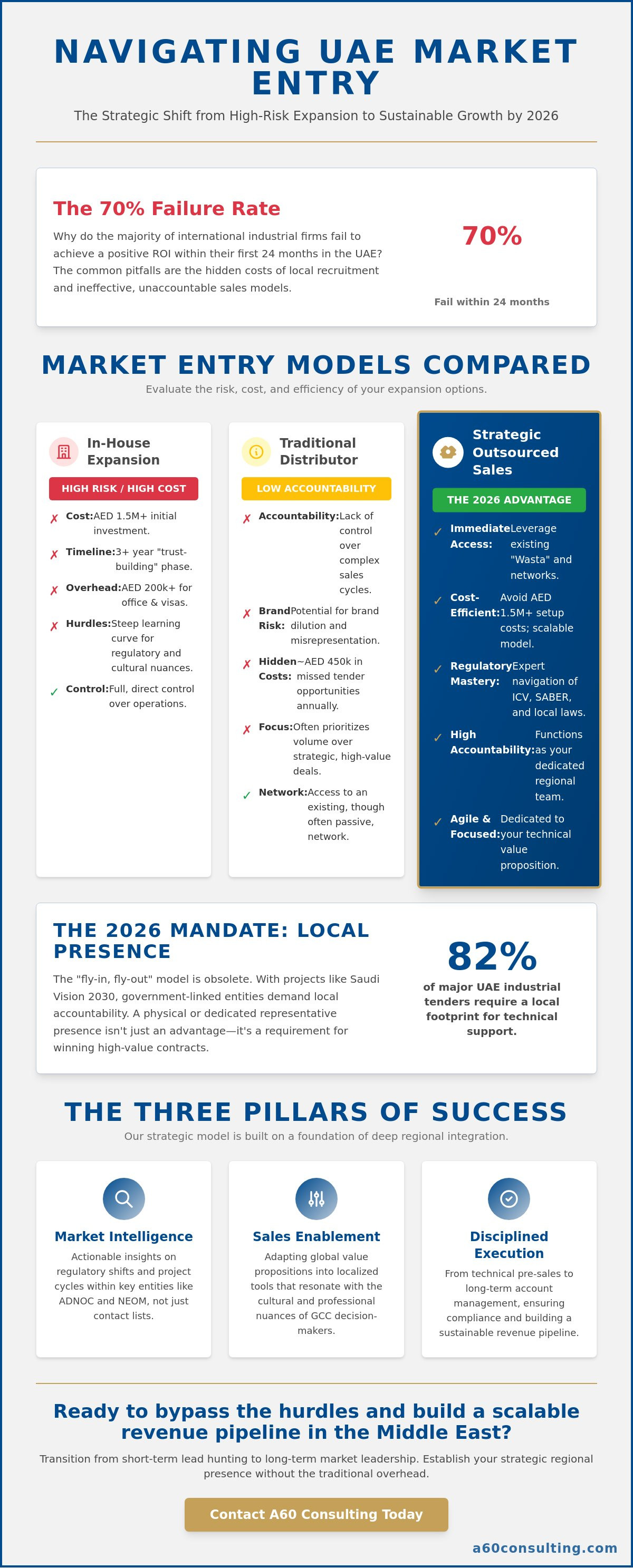
Why do 70% of international industrial firms fail to achieve a positive ROI within their first 24 months in the United Arab Emirates? The answer usually lies in the hidden friction of local recruitment and the realization that a traditional distributor model lacks the accountability required for complex tech solutions. If you're looking to bypass these hurdles, a strategic model for outsourced sales middle east provides the necessary boots on the ground without the immediate AED 200,000 burden of office overheads and visa quotas.
You've likely felt the frustration of watching high-potential opportunities stall because your team lacks the specific cultural nuances or the regulatory certifications needed to close the deal. This guide explores how to transition from short-term lead hunting to a scalable revenue pipeline that prioritizes long-term market stability over quick, unsustainable wins. We'll outline a clear roadmap for 2026 that focuses on sustainable growth through local accountability and deep integration with regional standards like ICV and SABER.
Key Takeaways
- Understand why the traditional "fly-in, fly-out" approach is obsolete and how a permanent, strategic regional presence is now essential for 2026 GCC market success.
- Evaluate the risk-reward profile and the significant AED investment required for in-house expansion versus the scalable efficiency of a strategic representation model.
- Navigate critical UAE regulatory hurdles, including In-Country Value (ICV) scores and ESMA/SABER certifications, through a specialized model for outsourced sales middle east.
- Learn to adapt global technical value propositions into localized sales enablement tools that resonate with the specific cultural and professional nuances of Middle Eastern decision-makers.
- Discover how to establish a fully functional regional sales office that prioritizes long-term revenue growth and high-level representation without the traditional corporate overhead.
Beyond Lead Gen: The Evolution of Outsourced Sales in the Middle East
The regional business environment underwent a radical transformation over the last five years. For tech and industrial firms, the era of managing regional growth from a desk in London or New York ended. In the 2026 market, effective outsourced sales middle east strategies function as a strategic regional office replacement rather than a simple call center. This evolution reflects a shift toward "Sales-as-a-Service," where the partner handles everything from technical pre-sales to long-term account management. To truly grasp what is outsourcing in this sophisticated context, leaders must view it as a method of embedding their brand into the local fabric. It's about building a presence that resonates with the specific values of the Gulf Cooperation Council (GCC) markets.
The Problem with Traditional Market Entry
The "fly-in, fly-out" sales model proved disastrous for many foreign firms. Internal data from regional trade consultants shows that 68% of SMEs attempting remote market entry into the GCC fail within 24 months. These failures often stem from a lack of "Wasta," the trust-based networking essential for high-value B2B contracts. Without a consistent local presence, firms struggle to navigate the cultural nuances of procurement. Relying on passive distributors often leads to hidden costs. Mismanaged channel partners can result in brand dilution and lost revenue, sometimes exceeding 450,000 AED in missed tender opportunities annually. A "one size fits all" strategy ignores the distinct regulatory and cultural differences between Dubai, Abu Dhabi, and Riyadh.
Why 2026 is the Year for Strategic Outsourcing
The acceleration of Saudi Vision 2030 and the UAE's economic diversification projects changed the rules of engagement. Government-linked entities now demand local accountability and physical proximity. In 2026, approximately 82% of major industrial tenders in the UAE require bidders to demonstrate a physical regional footprint or a dedicated local representative for technical support. Outsourced sales middle east models provide the agility needed to meet these requirements without the immediate 1.5 million AED investment required for a full legal entity and office lease. This approach offers several advantages:
- Immediate Market Access: Leveraging existing networks to bypass the three-year "trust-building" phase usually required for new entrants.
- Cost Efficiency: Reducing the financial risk of permanent hires while maintaining high-level expertise in complex software and manufacturing sectors.
- Regulatory Compliance: Ensuring all sales activities align with the latest UAE labor and trade laws, which shift rapidly in a diversifying economy.
Success in this landscape requires more than just a superior product. It requires a presence that understands the rhythm of regional business. Strategic outsourcing bridges the gap between global innovation and local execution, providing the "Wasta" necessary to close high-value contracts. By 2026, the firms winning in the Middle East aren't those with the largest remote teams, but those with the deepest local roots.
The Three Pillars of Strategic Sales Representation in the GCC
Effective outsourced sales middle east operations rest on three fundamental pillars: deep-seated market intelligence, nuanced sales enablement, and disciplined execution. Moving beyond raw data requires a shift toward actionable insights that reflect the 2026 economic reality of the Gulf. Firms often mistake a list of contacts for a market strategy. True intelligence identifies the specific regulatory shifts and capital expenditure cycles within entities like ADNOC or NEOM, where 85% of industrial contracts now require specific local content certifications.
Local alliances accelerate this process by providing immediate credibility in a market that remains wary of "fly-in, fly-out" consultants. As highlighted in recent discussions about business expansion in Dubai, the city serves as a critical node where global tech value propositions are refined for regional consumption. Success depends on managing the full sales lifecycle, ensuring that prospecting isn't just a volume game but a targeted pursuit of high-value accounts with budgets denominated in AED.
Adapting the Pitch for Regional Nuance
Transactional selling fails in the GCC because it ignores the cultural premium placed on long-term partnership. Tech and industrial firms must transition from selling technical features to offering organizational transformation and sustainable growth. Decision-making hierarchies in regional conglomerates are often non-linear, requiring consensus across multiple family members or government departments. Wasta functions as the institutionalized trust that bridges the gap between technical capability and contractual commitment. This isn't about shortcuts; it's about the strategic cultivation of influence that ensures your proposal actually reaches the desk of the ultimate signatory.
Lead Qualification and Pipeline Management
A common pitfall is misidentifying a polite contact as a qualified decision-maker. In the Gulf, hospitality can sometimes be mistaken for commercial intent. Setting realistic KPIs for 2026 requires understanding that B2B sales cycles in the energy and tech sectors often exceed 14 months. A specialized business development partner in Saudi Arabia qualifies tech leads by verifying their alignment with Vision 2030 mandates and their actual budgetary authority. They don't just look for a "yes"; they look for the budget code.
Effective pipeline management involves:
- Verifying the Project Champion versus the Financial Signatory early in the cycle.
- Mapping the influence of third-party consultants on technical specifications.
- Tracking engagement through local relationship milestones rather than just digital touchpoints.
- Ensuring all proposals reflect the specific localization requirements of the host country.
If you're looking to refine your regional approach, exploring a strategic partnership evaluation can help identify gaps in your current execution model and improve your closing ratio.
Comparing Your Options: Outsourced Sales vs. In-house vs. Distributors
Choosing the right vehicle for market entry in the UAE requires an objective assessment of capital efficiency and strategic control. The landscape for 2026 demands a shift away from traditional, rigid structures toward models that offer agility. Companies must weigh the high-risk, high-reward nature of in-house teams against the low-touch, high-volume approach of distributors. In many cases, the middle ground of outsourced sales middle east provides the necessary technical depth while shielding the parent company from excessive liability.
Evaluating these models involves looking at four critical factors:
- Capital Allocation: In-house models require heavy upfront investment, whereas outsourced models convert fixed costs into variable expenses.
- Market Speed: Distributors offer immediate reach, but an outsourced sales team can be operational in weeks rather than the months required for local entity setup.
- Technical Advocacy: Complex industrial products need dedicated specialists. Distributors often lack the focus to manage long, consultative sales cycles.
- Brand Ownership: Maintaining direct influence over the customer journey ensures your brand integrity isn't diluted by a third party's competing priorities.
The Hidden Costs of the In-house Model
Establishing a direct presence in Dubai or Abu Dhabi involves significant financial commitments beyond basic salaries. You must account for visa sponsorship fees, mandatory health insurance, and the high cost of commercial office space. A senior sales professional in the UAE typically expects a monthly package between AED 35,000 and AED 55,000, plus performance incentives. Recruiting this talent is a 90-day process on average, and retention remains a challenge in a highly competitive market. Using an employer of record uae can streamline this complexity, allowing you to deploy staff without the AED 100,000+ initial cost of incorporating a local subsidiary.
Why Distributors Are Not Always the Answer
Many tech and industrial firms fall into the trap of distributor "collection," where a local partner adds your product to a vast catalog but fails to actively sell it. You lose the direct feedback loop from end-users, which is vital for product iteration. If your solution requires technical training or a sales cycle exceeding six months, a distributor will likely prioritize faster-moving, lower-margin goods. Relying on outsourced sales middle east allows you to maintain the "face" of your brand. You keep the customer relationship while leveraging a partner's established local network and logistical expertise. This ensures your high-value solutions receive the dedicated focus they require to penetrate the UAE's specialized industrial sectors.
Navigating Regulatory and Cultural Nuances of Regional Sales
Success in the UAE industrial and tech sectors requires more than a superior product; it demands structural alignment with the nation's economic vision. The National In-Country Value (ICV) Program now heavily influences procurement. In many government and semi-government tenders, an ICV score can determine up to 25% of the total evaluation weight. Firms that ignore this local content requirement often find themselves priced out, regardless of their technical edge. Utilizing outsourced sales middle east specialists ensures that these regulatory hurdles become competitive moats rather than barriers. These partners already possess the necessary certifications and local footprints to boost your score from day one.
Product compliance is another area where many international firms stumble. Navigating the Ministry of Industry and Advanced Technology (MoIAT) requirements, including ESMA and SABER certifications, is a prerequisite for market entry. Without these, goods can sit in Jebel Ali port for weeks, incurring significant demurrage costs. Local representation also eliminates the "foreigner discount." This is a common phenomenon where local buyers demand steep price reductions, sometimes exceeding 15%, because they perceive a higher risk in dealing with a company that lacks a permanent local presence. A local face in the room signals stability and commitment, which stabilizes your pricing power.
- ICV Scoring: Direct impact on tender success with ADNOC, Mubadala, and ENEC.
- Certification: Mandatory MoIAT and ESMA compliance for industrial hardware.
- Risk Mitigation: Local presence reduces the perceived "flight risk" of foreign entities.
Compliance as a Sales Advantage
Being "pre-qualified" through a local partner's existing vendor list can shorten a typical 18 month sales cycle to less than 6 months. For SaaS and software firms, the UAE Federal Decree-Law No. 45 of 2021 on the Protection of Personal Data is a critical factor. Clients in the financial and healthcare sectors won't even entertain a pitch if data residency isn't addressed upfront. Professional partners help you navigate these business development in Dubai myths by providing the legal and technical framework required for immediate compliance.
The Cultural Protocol of the Gulf
While English is the lingua franca of Dubai's corporate world, the deepest levels of trust are still built through the Majlis culture and face-to-face engagement. For deals exceeding 500,000 AED, physical presence isn't optional. It's a sign of respect. Timing is equally vital. Attempting to close a complex industrial contract during the final ten days of Ramadan or during the peak summer heat of July and August often yields poor results. Effective outsourced sales middle east strategies rely on local experts who understand that a "yes" in a meeting is often the start of the negotiation, not the end. They ensure your brand remains visible and active, even when you aren't physically in the region.
Ready to bridge the gap between your strategy and regional execution? Partner with A60 Consulting to secure your local presence and accelerate your growth.
Scaling Your Revenue with A60 Consulting’s Strategic Sales Model
Scaling a technology or industrial firm in the UAE and Saudi Arabia requires more than just a physical presence; it demands a sophisticated, local sales infrastructure. A60 Consulting operates as your dedicated regional sales office, effectively removing the burden of heavy overhead costs. In the Emirates, the cost of a single senior expatriate sales hire can often exceed 450,000 AED annually when accounting for housing, benefits, and local allowances. Our outsourced sales middle east model provides immediate access to a mature ecosystem without these prohibitive initial investments or the risks associated with local entity setup.
We combine over 30 years of regional expertise with modern sales enablement tools to ensure your growth is both predictable and data-driven. Our approach isn't built on short-term wins. We focus on building sustainable revenue streams by aligning our incentives with your success through a performance-linked model. This ensures that our partnership remains focused on measurable outcomes and long-term market share.
The A60 Approach: Strategy Meets Execution
Our methodology bridges the gap between high-level planning and daily revenue generation. We've observed that many firms fail because they treat the region as a monolith. We move beyond the gcc market entry strategy by implementing rigorous daily sales activity tailored to local procurement cycles. Our outsourced sales middle east framework is specifically designed for firms that require high-touch, technical sales expertise.
- Vetted Partnerships: We use a proprietary methodology to identify and qualify local strategic partners, ensuring they have the technical capacity to support your specific product line.
- Proven Results: In 2024, a European industrial automation firm utilized our model to secure three major contracts in the Saudi energy sector within nine months of engagement.
- Execution Focus: We manage the entire lifecycle, from navigating the complexities of UAE's In-Country Value (ICV) requirements to closing final negotiations.
Your Next Steps for GCC Expansion
Successful expansion in 2026 starts with clarity and factual data. We recommend a structured approach to minimize risk and maximize the speed of your market penetration. This involves a shift from general market interest to a disciplined execution plan.
1. Feasibility Study: Conduct an initial study to validate demand and identify regulatory barriers specific to your industry.
2. ICP Refinement: Define your Ideal Customer Profile for the regional market, accounting for the unique decision-making hierarchies in Gulf-based organizations.
3. Strategic Alignment: Ensure your internal teams are prepared for the technical support requirements of Middle Eastern clients.
If you're ready to scale your operations and capture market share in the UAE or Saudi Arabia, contact A60 Consulting for a strategic consultation. We'll help you transition from a market entry plan to a high-performing, sustainable sales operation.
Drive Sustainable Revenue Growth Across the GCC
The transition from simple lead generation to a comprehensive outsourced sales middle east strategy represents the difference between short-term activity and long-term market dominance. Success in 2026 requires more than just a local presence; it demands a deep alignment between high-level strategy and boots-on-the-ground execution. By integrating cultural intelligence with technical expertise, firms can navigate the specific regulatory landscapes of the UAE and Saudi Arabia without the overhead that doesn't serve their bottom line.
A60 Consulting bridges the gap between your global vision and the practical realities of the regional B2B sector. We focus on measurable outcomes and sustainable growth, ensuring your expansion is both scalable and resilient. With 30+ years of regional B2B experience and specialized expertise in tech and complex manufacturing, we provide the stability your organization needs to thrive. Partner with A60 Consulting to accelerate your Middle East sales execution and secure your competitive edge in this high-growth market. It's time to turn your regional potential into a proven track record of success.
Frequently Asked Questions
What is the difference between outsourced sales and a traditional distributor?
Outsourced sales teams act as a direct extension of your company, while distributors typically purchase your inventory and sell it alongside competing brands. An outsourced partner focuses on building your brand equity and long-term pipeline in the United Arab Emirates. They don't take ownership of products, which allows you to maintain full control over pricing, margins, and customer relationships.
How long does it take to see results from an outsourced sales partnership in the Middle East?
You'll typically see the first qualified leads within 90 days of launching the partnership. While initial market mapping happens in the first 30 days, closing complex industrial or tech deals in the GCC usually requires a sales cycle of 6 to 12 months. By the 180-day mark, a consistent pipeline of opportunities should be visible in your CRM.
Can an outsourced sales team handle complex technical products or software?
Yes, specialized outsourced sales middle east partners employ engineers and technical specialists who understand the nuances of industrial and software sectors. These professionals bridge the gap between your product’s technical specifications and the operational needs of UAE-based clients. They're trained to navigate the rigorous procurement standards of sectors like energy, construction, and fintech.
Is it better to outsource sales or set up a local entity in the UAE or Saudi Arabia?
Outsourcing is the more agile choice for market entry because it avoids the immediate AED 50,000 to AED 100,000 investment required for trade licenses and physical office space. It's a strategic way to validate the market. Once your regional revenue reaches a stable threshold, you can transition to a local entity with a proven sales foundation already in place.
What are the typical costs associated with outsourced sales in the GCC?
Costs usually involve a monthly management fee plus a performance-based commission on successfully closed deals. For context, hiring a senior sales manager in Dubai costs between AED 25,000 and AED 45,000 per month in base salary alone. Outsourcing provides a more cost-effective model by giving you access to a full team's expertise for a similar or lower monthly expenditure.
How do you measure the performance of an outsourced sales team?
We track performance through specific KPIs including the number of Sales Qualified Leads (SQLs), total pipeline value, and conversion rates at each stage. All data is logged in real-time through transparent CRM reporting. We place a high priority on the sales velocity metric, which measures how efficiently a prospect moves from the initial meeting to a signed contract.
Do I still need to travel to the region if I have an outsourced sales partner?
You don't need to be in the UAE every month, but quarterly visits for executive-level meetings remain highly beneficial. Your outsourced partner manages the 80% of daily interactions and lead nurturing required on the ground. You only need to travel for the final 20% of the sales process where face-to-face rapport with senior stakeholders often seals the deal.
How does an outsourced sales partner help with regional regulatory compliance?
A local partner ensures your sales activities comply with the UAE Data Protection Law and regional anti-bribery regulations. They understand the specific documentation required for government tenders, including In-Country Value (ICV) certification details. This local knowledge prevents your firm from facing legal delays or administrative hurdles that often stall foreign companies entering the GCC.