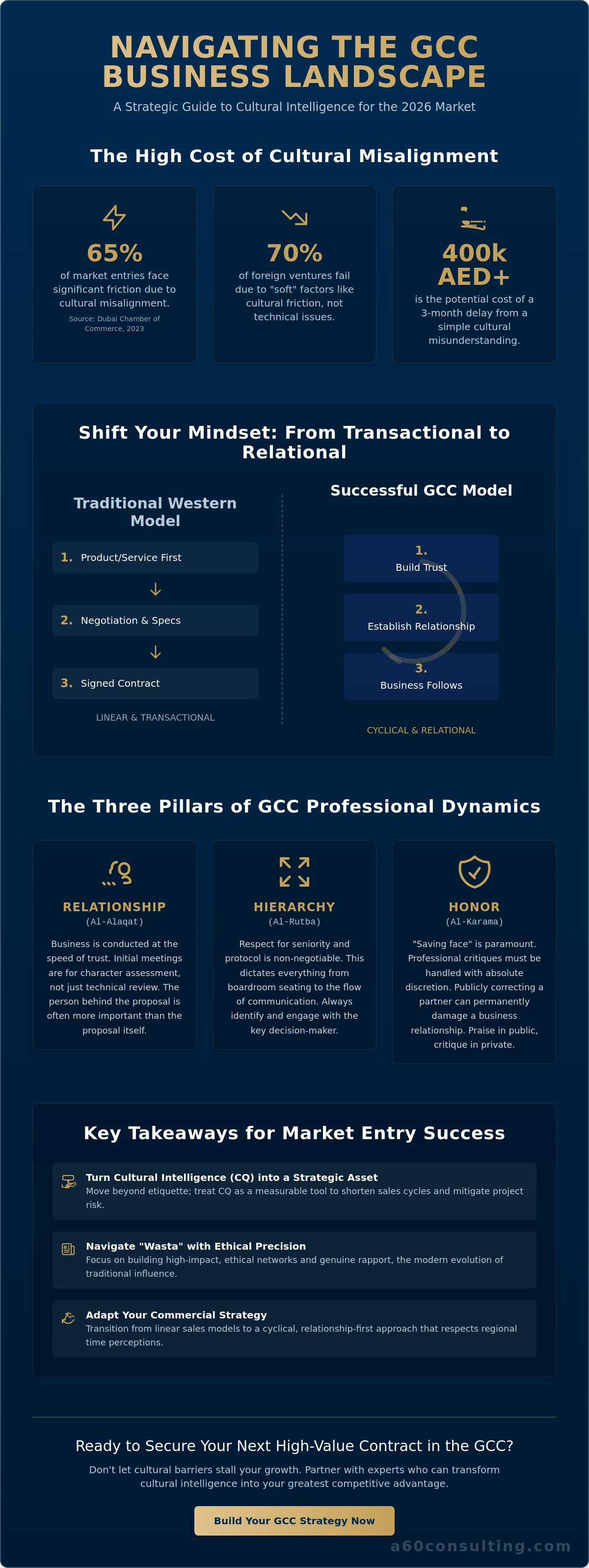
What if the biggest barrier to your next 10 million AED contract isn't your pricing structure, but the sequence in which you served coffee? According to a 2023 analysis by the Dubai Chamber of Commerce, nearly 65% of international market entries into the UAE encounter significant friction because of a misalignment with the business culture middle east requires for long-term success.
You likely already feel the frustration of sales cycles that stretch for months without a clear "yes" or "no"; you're often left wondering if your potential partner is a genuine decision-maker or simply a gatekeeper. We understand that across the GCC, the distance between a handshake and a signed agreement is measured in trust, not just technical specifications. This guide provides a strategic framework to transform cultural intelligence into a measurable competitive advantage, helping you shorten your time-to-market and secure high-trust alliances. We will examine how to navigate the "wasta" system with ethical precision and identify the specific behavioral shifts needed to win in the 2026 Gulf economy.
Key Takeaways
- Transform Cultural Intelligence (CQ) from a soft skill into a measurable strategic asset to navigate the complexities of the 2026 GCC market with precision.
- Master the foundational pillars of business culture middle east—relationship, hierarchy, and honor—to align your professional conduct with regional expectations.
- Navigate the modern evolution of "Wasta" to build ethical, high-impact networks that bridge the gap between initial market entry and sustainable B2B partnerships.
- Adapt your commercial strategy by transitioning from linear Western sales models to a cyclical approach that respects regional time perceptions and relationship-building milestones.
- Evaluate the strategic necessity of a physical presence versus remote management to ensure your UAE operations achieve long-term growth and operational sustainability.
Beyond Etiquette: Why Business Culture in the Middle East is Your Strategy
In the 2026 GCC market, Cultural Intelligence (CQ) has evolved from a social grace into a measurable business asset. It's no longer enough to simply show up with a superior product or a competitive price point. Success in this region depends on your ability to decode the complex layers of business culture middle east, where the person behind the proposal carries more weight than the proposal itself. Companies that treat cultural alignment as a strategic pillar see faster approvals and more resilient partnerships. Those that view it as an afterthought often find themselves stuck in endless cycles of "maybe" that never materialize into signed contracts.
A common misconception among Western executives is that a "good product" can bypass local norms. This transactional mindset often clashes with the relationship-driven commerce of the Gulf. In the UAE and Saudi Arabia, business is conducted at the speed of trust. This means the initial stages of a partnership are focused on character assessment rather than technical specifications. Understanding Middle Eastern etiquette is the first step, but the real advantage lies in mastering high-context communication. In these B2B negotiations, what's left unsaid, the pauses in conversation, and the non-verbal cues are just as significant as the clauses in a contract. If you can't read between the lines, you're essentially flying blind in the boardroom.
The ROI of Cultural Alignment
Cultural mastery serves as a risk mitigation tool that prevents project stalls and communication breakdowns. When teams lack CQ, they misinterpret feedback, leading to friction that can derail even the most promising ventures. The cost of this misalignment is high. Data shows that 70% of foreign entries into the GCC fail due to "soft" factors like cultural friction rather than technical or financial hurdles. In a market like Dubai, where operational costs are high, a three-month delay caused by a cultural misunderstanding can easily cost a firm upwards of 400,000 AED in wasted resources.
The Trust Premium is the measurable reduction in transaction costs and time-to-contract achieved through established personal rapport before formalizing a deal. By investing in relationships, you aren't just being polite; you're streamlining your path to revenue.
The GCC Landscape in 2026
The business climate across the UAE, Saudi Arabia, and Qatar is undergoing a massive transformation. Regional diversification projects, such as Saudi Vision 2030 and the UAE’s focus on the "NextGen" economy, are changing professional expectations. There's a new blend of traditional values and hyper-modern efficiency. Local partners now expect international firms to demonstrate a long-term commitment to the region's growth, rather than a "fly-in, fly-out" mentality. To succeed, your entry plan must be as sophisticated as the market itself. You can find a detailed breakdown of these dynamics in our guide on The 2026 GCC Market Entry Strategy: A Blueprint for Strategic Regional Expansion.
The Three Pillars of Middle Eastern Professional Dynamics
Success in the UAE's commercial sector requires more than technical expertise; it demands a deep alignment with the foundational values that govern every interaction. We categorize these into three specific pillars: Relationship (Al-Alaqat), Hierarchy (Al-Rutba), and Honor (Al-Karama). These concepts aren't abstract theories. They dictate the seating arrangements in a Dubai boardroom, the formal tone of a high-stakes email, and the pace of a multi-million AED procurement process. Understanding these cultural differences in Middle Eastern business is the first step toward building a sustainable presence in the region.
The concept of "Saving Face" or Al-Karama is perhaps the most critical for Western partners to master. Professional critiques must be handled with extreme discretion. Publicly correcting a senior executive or even a peer can permanently damage a partnership. Negotiations often involve the "Majlis," a traditional assembly space that has evolved into a sophisticated decision-making environment. While the Majlis may appear informal, it's where the real consensus is built before any official papers are signed. If you're invited to such a space, you've moved beyond being a vendor to becoming a potential partner.
Relationship-First, Business-Second
In the UAE, trust is the primary currency. It's common for the first three meetings to revolve entirely around personal history, family, and shared values without a single mention of a contract or product specifications. This isn't a waste of time; it's a rigorous vetting process. Your Emirati counterpart is assessing your character and reliability. You'll likely be offered Gahwa (Arabic coffee) and dates. Refusing this hospitality is seen as a rejection of the relationship itself. Always accept with your right hand and take at least one cup to signal your respect for the host's generosity.
To engage effectively without being intrusive, focus on topics like local developments, history, or the UAE's Vision 2031 goals. Avoid sensitive political or religious discussions. A60 Consulting often helps leaders bridge this gap by facilitating strategic cultural alignment during the early stages of market entry.
Navigating Hierarchy and Seniority
The business culture middle east relies on a clear, top-down structure known as Al-Rutba. Decisions are rarely made by committee; they're made by the person at the top. While you might spend 80% of your time with a "Technical Evaluator," they're often there to filter information for the "Real Decision Maker," who may only appear at the final stage. Recognizing this distinction prevents the frustration of stalled timelines.
- Protocol: When addressing members of Royal Families or high-ranking government officials, use "Your Excellency" or "Your Highness" unless specifically told otherwise.
- Seniority: Always greet the most senior person in the room first. Age and title carry significant weight in UAE corporate circles.
- Communication: Keep written communication formal and respectful of titles, ensuring all senior stakeholders are correctly copied on relevant correspondence.
For a more granular breakdown of these interactions, consult our Mastering Business Etiquette in the Middle East: A Strategic Checklist for 2026 to ensure your team is prepared for every face-to-face encounter.
Decoding Wasta: Networking and Influence in the Gulf
Wasta is a term often misunderstood by Western executives as simple nepotism or "connections." In the context of business culture middle east, it represents a sophisticated system of social capital and reciprocal trust. Originally rooted in tribal mediation where a respected elder would settle disputes, Wasta has evolved into a modern professional framework. By 2026, this concept functions as a vital lubricant for the regional economy, helping firms navigate the 1.2 trillion AED non-oil sector in the UAE. It isn't about bypassing rules; it's about gaining the trust required to be heard within a crowded marketplace.
Western networking often feels transactional, focusing on immediate ROI or "lobbying" for specific policy changes. Wasta is different. It's a multi-generational social contract based on honor and long-term commitment. While a LinkedIn connection might get you a meeting, Wasta ensures that your proposal is actually read by the decision-maker. It acts as a catalyst for regulatory hurdles, such as accelerating complex licensing through the Dubai International Financial Centre (DIFC) or identifying the right local partner who shares your strategic vision.
Leveraging Wasta Ethically
International firms must operate within the strict anti-corruption frameworks that have been strengthened leading up to 2026. Building influence ethically means focusing on "Intercessory Wasta," where a respected third party vouches for your competence and integrity. This approach ensures compliance with the UAE’s Federal Decree-Law No. 31 of 2021 regarding the Crimes and Penalties Law. Success depends on building a network of influence through genuine engagement rather than shortcuts. To master this balance, refer to our detailed analysis on Understanding Wasta in Business: A Strategic Guide to GCC Networking in 2026.
The Power of Local Representation
In the UAE and Saudi Arabia, having a "local face" is a non-negotiable requirement for long-term credibility. There's a fundamental distinction between a distributor, who merely moves product, and a strategic local representative who manages your reputation. A distributor focuses on volume; a representative focuses on your brand's integration into the business culture middle east. Local presence signals to stakeholders that you're invested in the region's 2030 and 2050 national visions. A60 Consulting serves as this critical professional proxy for foreign tech firms. We provide the cultural bridge and the high-level access necessary to turn a market entry strategy into a sustainable, revenue-generating operation. We don't just open doors; we ensure you're invited to stay in the room.
Adapting the B2B Sales Cycle for GCC Cultural Norms
Western sales models typically follow a linear trajectory: lead generation, qualification, proposal, and close. In the United Arab Emirates and the wider GCC, this process is cyclical and deeply rooted in relationship equity. Success requires a fundamental shift in how you perceive time and progress. While a European manager might view a three-week silence as a lost lead, an experienced professional in the business culture middle east recognizes this as a period of internal consensus-building. You aren't just selling a product; you're auditioning for a permanent seat at their table.
Managing timelines involves understanding linguistic nuances like "Inshallah" (God willing) and "Bukra" (tomorrow). These aren't excuses for inefficiency. They reflect a cultural acknowledgment that human plans are secondary to divine will and social priorities. To maintain momentum without appearing desperate, pivot from "checking in" on a contract to providing value-added insights. If a prospect goes quiet, send a relevant market report or an invitation to an exclusive networking event in Dubai. This keeps your brand visible while respecting their internal rhythm.
- Linear Model: Focuses on transaction speed and quarterly targets.
- Cyclical Model: Prioritizes trust-building, social validation, and long-term loyalty.
- Momentum Strategy: Use "polite persistence" through social touchpoints rather than aggressive email follow-ups.
The Art of the GCC Sales Pitch
Your pitch must evolve from "Feature-Benefit" to "Partner-Outcome" messaging. UAE decision-makers are less interested in the technical specifications of your software and more concerned with how your firm will support their 2026 growth targets. Technical demos are secondary. Your primary goal is demonstrating a 10-year commitment to the region. This is particularly vital when aligning with large-scale initiatives. For instance, understanding the broader regional shifts is essential, so review our analysis on Saudi Vision 2030 Business Opportunities: A Strategic Guide for 2026 Expansion to see how localized outcomes drive B2B interest.
Negotiation and Contract Finalization
The signed contract isn't the finish line. It's often the starting point for the real partnership. In the UAE, verbal agreements made over coffee carry immense weight. Your word is your bond; breaking a verbal commitment can damage your reputation more than a legal breach. Expect last-minute requests for concessions, even after the price seems settled. This is a "face-saving" mechanism for the buyer. Smart negotiators build a 10% to 15% buffer into their initial AED pricing to allow for these final gestures of goodwill without sacrificing the project's viability.
Ready to refine your regional approach? Partner with A60 Consulting to bridge the gap between strategy and local execution.
Building a Sustainable Presence: Implementation and Local Alliances
Transitioning from market entry to long-term sustainability requires moving beyond transactional interactions. In 2026, the business culture middle east mandates a shift toward deep cultural integration. Success isn't measured by the first contract, but by the third and fourth. Companies that treat the UAE as a satellite office often struggle. High-growth firms now allocate specific budgets for cultural onboarding to ensure their global strategy aligns with local expectations.
Decision-makers in the UAE value the ability to meet face-to-face on short notice. While digital tools assist, a local trade license and a physical office in hubs like Dubai or Abu Dhabi signal commitment. The Abu Dhabi Department of Economic Development (ADDED) continues to emphasize the importance of local substance for firms bidding on government tenders. Managing operations remotely from a headquarters thousands of miles away creates a disconnect that competitors with local offices will exploit.
In-Country Value (ICV) scores are no longer optional for those targeting the energy, manufacturing, or infrastructure sectors. By 2026, a high ICV score, which measures your contribution to the local economy through Emirati hiring and local sourcing, will be the primary filter for procurement. This is where culture meets the balance sheet. It's a measurable way to prove your brand isn't just taking value from the market, but actively building it.
Vetting and Managing Local Distributors
Many international brands fail because they adopt a "fire and forget" distribution model. They sign a contract and expect the partner to handle everything. This ignores the nuance of the business culture middle east, where consistent relationship maintenance is required. You must vet partners for more than just their logistics capability; you need cultural alignment. This ensures they represent your brand's core values while adapting the delivery to local sensibilities. For a deeper dive, review our Strategic Guide to Distributor Search in the Middle East: A 2026 Framework.
Conclusion: Partnering for Cultural Success
Cultural intelligence is the ultimate differentiator in a crowded market. As we approach 2026, the ability to decode social cues and institutional requirements like ICV will separate market leaders from those who merely survive. Navigating these complexities requires a partner who understands both the boardroom and the local majlis. If you're ready to solidify your position in the GCC, consider how a tailored entry plan can mitigate risk. We invite you to explore our How to Choose a GCC Market Entry Strategy Consultant: The 2026 Selection Guide to find the right expertise for your journey.
Navigating the 2026 GCC Landscape with Strategic Precision
Success in the Gulf region requires a shift from viewing local customs as mere etiquette to treating them as a core competitive advantage. Integrating the business culture middle east into your operational framework ensures that your B2B sales cycles align with the high-trust requirements of the UAE and Saudi Arabian markets. By mastering the dynamics of Wasta and securing local alliances, your organization moves beyond market entry and toward long-term sustainability. It's about bridging the gap between a high-level vision and the reality of industrial execution.
A60 Consulting provides the measured, fact-based guidance necessary for this transition. With 30+ years of regional expertise and a strategic presence in the UAE and Saudi Arabia, we're specialists in complex tech and industrial sales execution. We don't believe in quick fixes, focusing instead on the systematic work that leads to measurable success. Download our 2026 GCC Market Entry Blueprint to start building a presence that's both resilient and profitable. Your expansion deserves the clarity that only deep regional experience can provide.
Frequently Asked Questions
Is it necessary to learn Arabic for business in the Middle East?
You don't need to be fluent in Arabic to succeed in the UAE, as English is the primary language for 90% of commercial transactions. Most professional environments in Dubai and Abu Dhabi operate entirely in English. Learning basic greetings like "As-salamu alaykum" demonstrates cultural respect. This small effort builds the trust necessary for a healthy partnership.
What is the standard dress code for business meetings in Riyadh vs. Dubai?
Business attire in Dubai is generally professional and modern, while Riyadh requires more conservative choices. In Dubai’s DIFC, men typically wear lightweight suits and women wear professional dresses or trouser suits. When visiting Riyadh, men should stick to dark suits and women should opt for loose-fitting clothing that covers the arms and legs. Following these standards ensures you respect the local business culture middle east expectations.
How should I handle business meetings during the month of Ramadan?
You should schedule meetings in the early morning during Ramadan because energy levels are higher before the afternoon heat. Business hours in the UAE are legally reduced by two hours per day according to Federal Decree-Law No. 33 of 2021. Avoid offering food or water during meetings, as your partners are likely fasting from dawn until sunset. It's better to host business dinners, or Iftars, to build deeper relationships.
Is it appropriate to give gifts to business partners in the GCC?
Giving gifts is a common way to strengthen partnerships, but you should wait until a solid relationship is established. Choose high-quality items like Bateel dates or luxury office accessories, and always present them with your right hand. Avoid giving alcohol or products made from pigskin, as these are prohibited in Islamic culture. If you receive a gift, it's polite to open it later rather than in front of the giver.
How do gender roles affect business culture in the Middle East?
Women play a significant and growing role in the UAE economy, holding 15% of board positions in listed companies as of 2023. Female executives should expect to be treated with professional respect, though they might encounter more traditional attitudes in older family businesses. It's best to wait for a male counterpart to initiate a handshake. This nuanced approach helps navigate the evolving business culture middle east effectively.
What does "Inshallah" really mean in a business negotiation context?
"Inshallah" translates to "if God wills," and in a negotiation, it signifies a positive intent rather than a binding commitment. It doesn't mean a "no," but it suggests that the outcome is subject to factors beyond the speaker's immediate control. You should view it as a sign that the discussion is moving forward. Don't press for a definitive "yes" or "no" immediately after hearing it, as patience is a strategic asset.
How do I know if a business lead is serious or just being polite?
You can distinguish a serious lead from a polite contact by the level of follow-up detail they request. Middle Eastern hospitality means almost everyone will be welcoming and offer tea. A lead is serious if they introduce you to senior decision-makers or ask for specific implementation timelines. If the conversation remains focused on generalities after three meetings, the lead might just be practicing traditional courtesy.
Can I do business in the Middle East without a local representative?
You can now own 100% of a mainland business in the UAE in many sectors without a local partner, following changes to the Commercial Companies Law in 2021. However, having a local representative or "PRO" remains vital for navigating government bureaucracy and licensing. A local partner provides the "wasta," or social influence, that accelerates regulatory approvals. While not always legally required, local expertise significantly reduces your time to market.