
The combined GDP of the GCC bloc has surpassed $2.2 trillion, yet many foreign innovators find their market entry stalled by an invisible barrier. You've likely realized that having a world-class product isn't enough when faced with SAR 62,000 annual license renewals in Saudi Arabia or the complex 9% corporate tax thresholds in the UAE. Effective local representation gcc is no longer a legal formality; it's the strategic sales engine that converts regional potential into measurable revenue by bridging the gap between global innovation and local cultural nuances.
We understand the frustration of balancing the potential for 4.5% economic growth against the risk of high overhead costs when regulatory clarity remains elusive. This article demonstrates how a targeted representation model offers a low-risk, high-impact alternative to traditional entity setup. You'll learn the critical distinctions between a distributor and a representative, while gaining a clear roadmap for sales execution in Saudi Arabia and the UAE. We'll also address the looming September 2026 ESG reporting deadlines to ensure your regional presence is both profitable and compliant.
Key Takeaways
- Understand why active local representation gcc acts as a strategic sales engine rather than just a legal formality or a passive distribution channel.
- Learn how to leverage the modern application of 'Wasta' to navigate high-context business cultures and build the trust necessary for high-value B2B contracts.
- Evaluate the total cost of ownership for regional expansion and discover how outsourced representation provides immediate market access without the overhead of full incorporation.
- Identify specific criteria for selecting a representative who offers both technical alignment and deep industry connections to ensure long-term implementation success.
- Discover a roadmap for establishing a regional sales office that bridges the gap between global innovation and the unique demands of the Gulf market.
What is Local Representation in the GCC and Why Does It Matter?
The economic landscape of the Gulf Cooperation Council (GCC) has undergone a fundamental transformation. As we move through 2026, the region is no longer a simple export destination; it's a sophisticated market with a combined GDP exceeding $2.2 trillion. For foreign companies, the traditional model of remote selling or relying on a passive distributor is failing. Success now requires a nuanced approach to local representation gcc that goes far beyond ticking a legal box or hiring a Public Relations Officer (PRO).
True local representation is a commercial strategy rather than a legal formality. While a distributor typically manages logistics and inventory for multiple brands, a dedicated representative acts as your internal sales arm. They don't just wait for orders; they actively shape the market, build brand equity, and align your global innovation with local cultural expectations. This distinction is critical because regional governments, driven by initiatives like Saudi Vision 2030 and the UAE's various diversification programs, now prioritize partners who demonstrate long-term commitment through a tangible regional footprint.
The Legal vs. Commercial Distinction
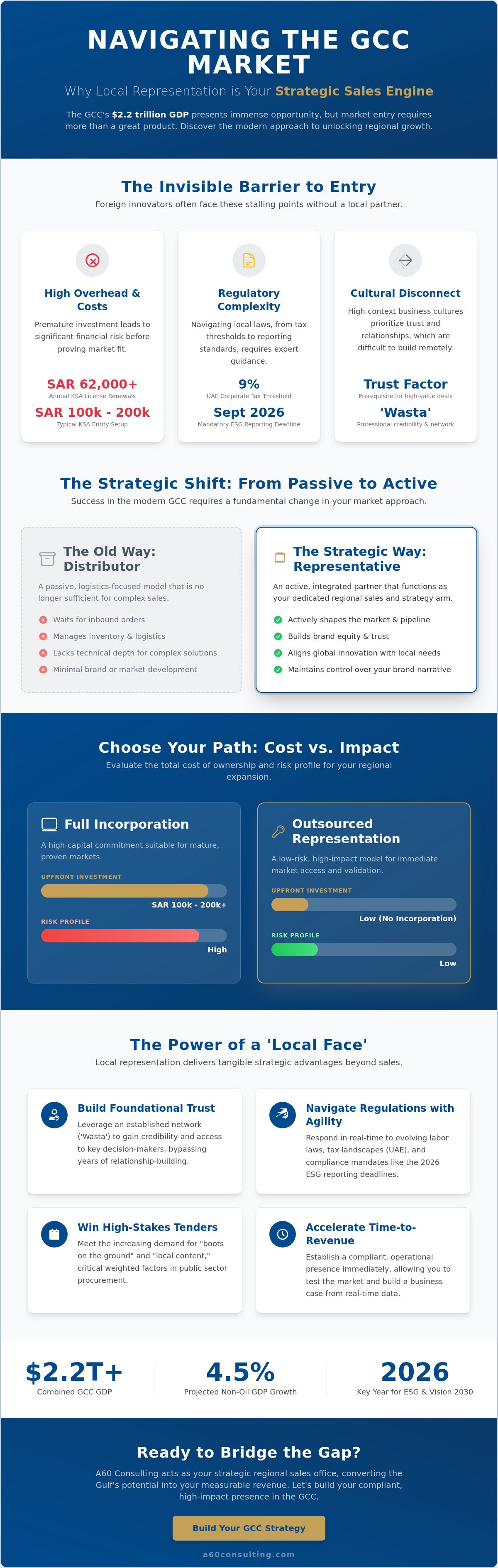
It's easy to confuse a commercial agent with a strategic sales representative. A commercial agent is often a legal necessity for customs and local licensing, but they rarely possess the technical depth to sell complex solutions. In contrast, strategic local representation gcc allows you to maintain control over your brand narrative and sales pipeline without the immediate overhead of full incorporation. This is particularly valuable for market testing. Before committing to the SAR 100,000 to 200,000 setup costs of a medium-sized firm in Saudi Arabia, representation provides a compliant way to navigate regulatory hurdles and build a business case based on real-time data.
The Regional Necessity for a Physical Presence
Procurement departments in the Gulf, especially within the public sector and large semi-government entities, increasingly demand "boots on the ground." They aren't just buying a product; they're investing in a relationship. A physical presence signals that you're available for face-to-face consultations, site visits, and immediate troubleshooting. Local representation serves as the strategic bridge between foreign technology and regional procurement needs, ensuring that innovation translates into localized value.
- Government Relations: Representatives manage the long-term dialogue with ministries and regulatory bodies, which is essential as mandatory ESG reporting becomes the standard across all six member states by late 2026.
- Contractual Trust: Having a local face allows your firm to participate in high-stakes tenders where "local content" requirements are a weighted factor in the decision-making process.
- Agility: A representative can react to regulatory shifts in real-time, such as the new labor laws in Oman or the evolving corporate tax landscape in the UAE.
By 2026, the gap between those who sell *to* the region and those who operate *within* it has widened. Choosing an active representation model ensures your business stays on the right side of that divide, leveraging the projected 4.5% non-oil GDP growth without the risks of premature, heavy-capital expansion.
The Trust Factor: Building Relationships through a 'Local Face'
Trust isn't a byproduct of a good product; it's the prerequisite for any transaction in the Gulf. While digital transformation has streamlined many processes, the high-context business culture of the Middle East still relies heavily on personal rapport. This is where the concept of 'Wasta', often oversimplified as "influence", plays a vital role. In 2026, Wasta has evolved into a professional endorsement of credibility. When you utilize local representation gcc, you're essentially borrowing the established reputation of a regional partner to bypass the years of relationship-building normally required to enter the inner circles of procurement.
Localisation involves more than linguistic accuracy. It requires an understanding of the unwritten rules that govern professional interactions in Riyadh or Dubai. A local representative knows that a deal isn't closed when the contract is signed, but when the personal connection is solidified. They bridge the gap between your technical innovation and the client's need for a partner who understands their specific organizational culture. If you're looking to refine your approach, we can help you build a resilient regional strategy that prioritizes these human connections.
Navigating the Trust-Based Business Culture
High-value contracts in the GCC are rarely won through cold emails or remote pitches. Face-to-face engagement is the standard for establishing legitimacy. A local presence signals a commitment to the region's long-term goals, such as Saudi Vision 2030. It proves you aren't just seeking a quick win. This physical proximity allows for the frequent, informal touchpoints that build the "Trust Factor." You can explore this further in our strategic guide on Mastering Business Culture in the Middle East.
Addressing In-Country Value (ICV) and Localisation
By May 2026, the UAE and Saudi Arabia have fully integrated In-Country Value (ICV) scores into their procurement cycles. These scores measure your contribution to the local economy. Foreign firms often struggle to meet these targets without a full-scale factory. However, a local representative provides a strategic workaround. They help you leverage local alliances and talent pools to improve your bidding score in government tenders. This ensures your innovation meets the "local content" requirements mandated by state-owned enterprises, which often account for a significant portion of the region's $588 billion quarterly GDP. This tactical alignment allows you to maintain a lean operation while appearing deeply rooted in the local market.
Outsourced Sales Representation vs. Full Incorporation
Choosing between a full subsidiary and outsourced sales representation is a decision that defines your fiscal health for the next three years. While the trend toward 100% foreign ownership across the region makes incorporation legally simpler, it doesn't necessarily make it the most efficient commercial path. For many firms, the heavy lifting of a full setup creates a "sunk cost" trap that forces a focus on administrative survival rather than market growth. By contrast, local representation gcc allows you to remain lean, shifting your capital from office leases and licensing fees toward active business development.
The total cost of ownership for a local entity often surprises foreign executives. In Saudi Arabia, even a small consultancy can expect first-year costs between SAR 30,000 and SAR 60,000, while a medium-sized trading firm might face SAR 200,000 before a single sale is made. These figures don't include the SAR 62,000 annual MISA renewal fees or the complexities of the 20% corporate tax rate. Representation mitigates these risks by providing a "sandbox" environment where you can validate your product-market fit before committing to permanent infrastructure.
Cost and Time-to-Market Analysis
Speed is a competitive advantage in the Gulf's fast-moving non-oil sectors. Setting up a mainland license in the UAE starts at roughly AED 18,500, but the lead time for bank account opening and residency visas can stretch into months. Outsourced representation reduces your "time-to-first-sale" by utilizing the representative's existing legal and commercial framework. You can begin bidding on contracts within weeks rather than quarters. This agile approach is essential for debunking common misconceptions, as we detail in our analysis of Business Development in Dubai: Beyond the Myths.
The Role of an Employer of Record (EOR)
Maintaining a high-impact presence often requires specific technical talent on the ground. However, the residency visa fees in Dubai (ranging from AED 3,000 to AED 6,000 per person) and the mandatory work injury insurance contributions in Oman add layers of HR complexity. An Employer of Record (EOR) works in tandem with local representation gcc to manage your staffing needs without the need for a local HR department. This hybrid model ensures you stay compliant with the latest labor laws while keeping your operational footprint minimal. For a deeper dive into these structures, see our Employer of Record UAE: Strategic Guide 2026. This allows for a seamless transition; as your revenue grows, you can move from a represented model to a full regional office with a proven pipeline already in place.
How to Select and Manage a Local Representative
Selecting the right partner for local representation gcc is a decision that moves beyond simple background checks. While many competitors focus solely on legal due diligence, the real risk often lies in a lack of technical and commercial alignment. A representative with "generalist" connections might get you into a room, but without deep industry expertise, they won't be able to articulate the value of your innovation to a specialized procurement committee. You need a partner who understands the specific technical standards of the region, such as the IFRS S1/S2 reporting requirements that became mandatory for financial firms in Qatar on January 1, 2026.
Effective management requires a shift in how you measure success. Don't settle for "introductions" as a primary KPI. Instead, focus on qualified pipeline growth and measurable milestones within the tender process. A balanced agreement typically includes a retainer to ensure dedicated bandwidth and success fees to align incentives with your revenue goals. Exclusivity should be earned through performance rather than granted as a default. If you're ready to find a partner who matches your technical depth, you can consult with our regional experts to evaluate your strategic options.
Vetting for Strategic Alignment
Vetting starts with asking the hard questions about a representative's existing network and their ability to handle rapid regulatory shifts. For instance, they should be well-versed in the updated Saudi Investment Law, effective since February 2025, which replaced traditional licenses with a streamlined registration process. A high-quality partner doesn't just sell; they act as your local compliance advisor. For specific insights on the Kingdom, see our guide on Choosing the Right Business Development Partner in Saudi Arabia.
Managing the Regional Sales Pipeline
Remote management of a local office doesn't have to be a blind exercise. Transparency is achieved through integrated sales enablement tools that provide real-time reporting on lead progression. Regular, structured reviews ensure that your brand consistency is maintained across different GCC territories, whether you're navigating the 15% VAT environment in Saudi Arabia or the 5% rate in the UAE. By treating your representative as an extension of your own team, you create a feedback loop that allows you to adapt your global strategy to local market realities. This systematic approach ensures that your regional presence isn't just a placeholder, but a high-impact sales engine that delivers a measurable return on investment.
A60 Consulting: Your Strategic Regional Sales Office
Entering the Gulf market requires more than a tactical plan; it demands a partner who can execute that strategy with surgical precision. A60 Consulting FZ-LLC functions as your dedicated regional sales office, providing the high-impact presence you need without the immediate administrative weight of a local subsidiary. We don't just offer advice from the sidelines. Instead, we act as your 'Regional Face,' leveraging 30 years of deep-rooted experience in the Gulf to bridge the gap between your global innovation and local procurement requirements.
Our hybrid model is designed for companies that value both strategic depth and measurable results. By providing local representation gcc, we allow your organization to scale sustainably, testing the waters with a proven sales engine before committing to heavy legal infrastructure. This approach ensures your market entry is driven by revenue and implementation rather than administrative survival.
The A60 Representation Framework
We act as an extension of your global sales team, ensuring that your brand voice remains consistent while adapting your pitch to the high-context business cultures of Riyadh and Dubai. A60 Consulting FZ-LLC focuses on long-term account management rather than one-off introductions. We integrate with your existing CRM and reporting structures to provide total transparency, ensuring you maintain control over your pipeline while we handle the day-to-day complexities of regional business development. This commitment to measurable success allows us to drive growth that's both rapid and resilient.
Getting Started with GCC Expansion
The first 90 days of our partnership are focused on moving from strategy development to active lead generation. We begin by identifying high-value targets within your specific sector, whether you're navigating the new ESG reporting deadlines in Kuwait or seeking to capitalize on the expansion of non-oil sectors. Our success-based commission model ensures our incentives are perfectly aligned with your own. We don't just open doors; we manage the entire sales cycle, from initial technical alignment to the final contract signature. A60 Consulting FZ-LLC provides the strategic vantage point and operational excellence you need to turn regional potential into a permanent success story in the Gulf.
Capitalizing on the Gulf's Non-Oil Expansion
The path to regional success in 2026 requires a fundamental shift from transactional selling to strategic partnership. As we've explored, the complexities of the current regulatory environment and the nuances of trust-based business cultures demand more than a remote approach. Effective local representation gcc serves as the critical bridge, allowing your organization to remain agile while building the long-term credibility required for high-value contracts. This model ensures you don't just enter the market, but actually integrate into the regional economic fabric.
A60 Consulting FZ-LLC brings over 30 years of regional sales experience to this process, acting as your dedicated local office. We specialize in the unique requirements of the technology and manufacturing sectors, where technical alignment is as vital as market access. Our performance-linked fee structures ensure that our goals are perfectly synchronized with your revenue targets. If you're ready to bridge the gap between strategy and execution, schedule a strategic consultation for your GCC expansion today. A60 Consulting FZ-LLC provides the measured, fact-based approach needed to turn regional potential into a sustainable business transformation.
Frequently Asked Questions
What is the difference between a local representative and a distributor in the GCC?
A local representative acts as a strategic extension of your own sales team, whereas a distributor primarily functions as a logistics and fulfillment partner. While a distributor often manages multiple competing brands, a representative focuses exclusively on your technical alignment and long-term brand equity. This distinction is vital for complex products that require deep relationship management and consistent market positioning.
Do I need a local partner to sell to the government in Saudi Arabia?
Selling to the Saudi government generally requires a local presence to satisfy In-Country Value (ICV) and "local content" requirements. Since January 1, 2024, the Regional Headquarters (RHQ) program has mandated that foreign companies must have a regional base in the Kingdom to qualify for government contracts exceeding SAR 1 million. A local representative provides a compliant way to navigate these high-stakes procurement cycles.
Can a foreign company have local representation without a legal entity?
Foreign firms can establish local representation gcc through a service-level agreement with a regional partner without the need for immediate legal incorporation. This model provides a low-risk environment to test the market and build a sales pipeline. It allows you to avoid the SAR 100,000 setup costs often associated with medium-sized trading firms while maintaining an active commercial presence.
How much does local representation typically cost in the UAE?
The cost of establishing a presence varies depending on the license type, with Free Zone licenses starting at AED 5,500 and Mainland licenses beginning at AED 18,500. A typical first-year investment for a new entity in a Dubai free zone ranges between AED 18,000 and AED 34,000. Outsourced representation allows you to bypass these fixed overheads by utilizing a partner's existing commercial infrastructure.
What are the benefits of outsourcing sales representation in the Middle East?
Outsourcing reduces your "time-to-first-sale" by leveraging an established partner's network and cultural expertise. It mitigates the financial risk of full incorporation while providing immediate access to the relationship-based "Wasta" network. This approach is particularly effective for navigating the projected 4.5% non-oil GDP growth in 2026 without committing to long-term office leases or residency visa fees.
How do I ensure my local representative is compliant with regional laws?
Compliance is maintained through rigorous vetting and contracts that align with the latest regional shifts, such as the UAE's 9% corporate tax threshold. You should ensure your partner is prepared for the mandatory ESG disclosure requirements being enforced across the GCC by late 2026. Regular audits and performance-linked KPIs help ensure that your representative operates within the legal frameworks of each member state.
What is the role of a local representative in managing In-Country Value (ICV)?
A representative helps foreign firms improve their ICV scores by leveraging local alliances and regional talent pools. In markets like the UAE and Saudi Arabia, procurement departments use these scores to prioritize vendors who contribute to the local economy. Your representative acts as the bridge that ensures your global technology meets these specific, localized procurement mandates.
How long does it take to establish a local presence through a representative?
Establishing a presence through a representative typically takes 4 to 8 weeks, which is significantly faster than the 3 to 6 months often required for full incorporation and bank account opening. This speed-to-market is a critical advantage in the Gulf's fast-moving non-oil sectors. It allows your business to begin lead generation and tender participation within the first quarter of engagement.