

Did you know that UAE digital infrastructure now faces up to 600,000 breach attempts every single day? In this high-stakes environment, mastering data privacy laws gcc has shifted from a back-office legal task to a core strategic requirement for any firm entering the Gulf. You're likely feeling the pressure of fragmented regulations across six different countries, where the distinction between onshore rules and free zone requirements like those in the DIFC or ADGM can feel like a moving target.
It's understandable to feel overwhelmed when a single unauthorized data disclosure in Saudi Arabia now carries a SAR 5 million fine and potential criminal penalties under the fully enforced PDPL. We've designed this guide to help you replace that uncertainty with a clear, actionable roadmap for regional compliance in 2026. You'll gain a deep understanding of the current regulatory landscape, the actual cost of market entry, and the specific criteria for selecting local partners who meet these rigorous new standards for data sovereignty and child digital safety.
Key Takeaways
- Understand the "GDPR-plus" framework driving digital trust across the region and its alignment with Saudi Vision 2030 and UAE Centennial 2071.
- Navigate the critical differences between UAE Federal Law and the Saudi PDPL to ensure your global operations align with the latest data privacy laws gcc updates.
- Clarify the jurisdictional complexities between onshore regulations and the GDPR-equivalent standards of financial free zones like the DIFC and ADGM.
- Implement a robust compliance framework by integrating Data Protection Impact Assessments (DPIAs) directly into your distributor search and market entry strategy.
- Leverage strategic compliance as a competitive advantage to fast-track government procurement and meet the rising standards of regional enterprise buyers.
The Evolving Landscape of Data Privacy Laws in the GCC
The transition from sector-specific guidelines to comprehensive national federal frameworks is now complete across the Gulf. For years, regional privacy was a patchwork of banking or healthcare rules; today, robust data privacy laws gcc define the baseline for all commercial activity. This evolution isn't merely a legal update. It's a strategic pillar of Saudi Vision 2030 and UAE Centennial 2071. These nations recognize that digital trust is the primary currency of a modern economy. By aligning with international data privacy principles while adding specific regional safeguards, the GCC has created what many experts call a "GDPR-plus" model.
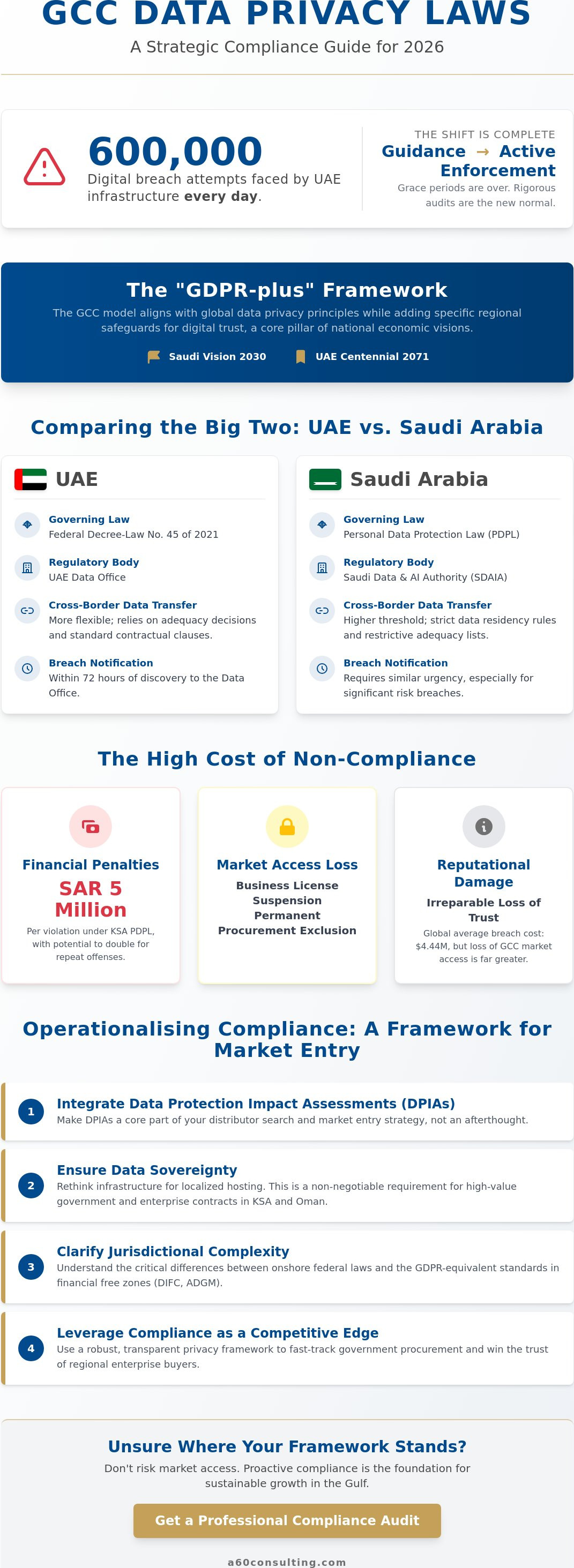
April 2026 represents a critical milestone for every organization operating in the region. We've moved past the grace periods of 2024 and 2025 into a phase of active, systematic enforcement. The Saudi Data & AI Authority (SDAIA) is now conducting rigorous audits, following the 48 enforcement decisions issued in the year following their grace period. In the UAE, the Data Office is fully operational, managing a landscape where breach attempts have spiked to nearly 600,000 per day. This shift from guidance to audits means that cross-border data flow governance is no longer optional; it's a prerequisite for market survival.
Why Data Sovereignty Matters in the Gulf
Data sovereignty is no longer a theoretical preference. It's a hard requirement. Saudi Arabia and Oman, whose PDPL became fully enforceable on February 5, 2026, have implemented strict residency rules that require sensitive personal data to remain within national borders. For SaaS providers and cloud-based business models, this necessitates a fundamental rethink of infrastructure. You can't simply rely on global hubs. Localized hosting isn't just a technical hurdle. It's a statement of commitment to national security and data integrity that regional partners demand before signing high-value contracts.
The Cost of Non-Compliance
The financial penalties are designed to be deterrents, not just administrative fees. In Saudi Arabia, serious breaches can trigger fines up to SAR 5 million, and repeat offenses can double that amount. Beyond the balance sheet, the reputational damage is often irreparable. If you're seeking to partner with sovereign wealth funds or government entities, a single data breach can lead to business license suspension or permanent exclusion from procurement lists. The global average cost of a data breach reached $4.44 million in 2025, but in the GCC, the loss of market access is often the far greater expense.
Comparing the Big Two: UAE Federal Law vs. Saudi PDPL
While both nations aim for rapid digital transformation, their legal architectures for data privacy laws gcc compliance reflect distinct national priorities. The UAE Federal Decree-Law No. 45 of 2021 provides a broad framework that mirrors international standards, whereas the Saudi PDPL, fully enforceable since September 14, 2024, introduces more stringent controls over data residency. These two frameworks form the bedrock of the region's regulatory environment, yet they require different operational approaches for businesses seeking to scale across both markets.
Both laws share a core DNA. They require explicit consent from users, guarantee data subject rights such as the right to access and the right to be forgotten, and mandate strict breach reporting timelines. In the UAE, notifications should reach the Data Office within 72 hours of discovery. Saudi Arabia's PDPL demands similar urgency, particularly when the breach poses a significant risk to the data subject. The critical divergence lies in cross-border transfers. Saudi Arabia maintains a higher threshold for legal and governance safeguards when data leaves the Kingdom, often requiring specific approvals or adherence to strict adequacy lists that are more restrictive than the UAE's federal guidelines.
Navigating the Saudi PDPL Implementation
The Saudi Data and AI Authority (SDAIA) acts as the primary regulator, overseeing the transition from the grace period to active enforcement. Controllers must now register through the National Data Governance Platform to ensure their data processing activities are transparent to the authority. As of 2026, the PDPL grace period has officially concluded, meaning full compliance is the only viable path for businesses. Strategic alignment with these rules isn't just about avoiding SAR 5 million fines; it's about building a foundation for sustainable growth. If you're unsure where your current framework stands, a professional compliance audit can identify gaps before they become legal liabilities.
The UAE Data Office and Federal Oversight
The UAE Data Office serves as the central federal regulator, providing much-needed clarity on how Law No. 45 of 2021 interacts with existing sector-specific rules, such as those governing health data. For many organizations, appointing a Data Protection Officer (DPO) is now a mandatory operational step, particularly when processing large volumes of sensitive personal information. This DPO must act as the bridge between the company and the regulator, ensuring that privacy by design is integrated into every new product launch or marketing campaign. Understanding these nuances is essential for any firm that treats data as a strategic asset rather than just a byproduct of business.
Onshore vs. Offshore: The Jurisdictional Complexity
Operating in the Gulf requires a sophisticated understanding of legal geography. Unlike many global regions where a single national law suffices, the data privacy laws gcc landscape is defined by the coexistence of onshore federal laws and offshore financial free zone regulations. This layer cake of jurisdiction means a firm based in Dubai or Abu Dhabi might be subject to entirely different sets of rules depending on whether they sit within a financial free zone or on the mainland. For strategic leaders, this isn't just a legal nuance; it's a structural decision that dictates your entire data architecture.
The Dubai International Financial Centre (DIFC) and the Abu Dhabi Global Market (ADGM) operate as independent, common law jurisdictions. Their data protection regimes, such as the DIFC Data Protection Law No. 5 of 2020, are the closest regional equivalents to the EU's GDPR. They emphasize individual rights and cross-border adequacy with a level of granularity that often exceeds federal requirements. Qatar follows a similar model with the Qatar Financial Centre (QFC), which maintains its own data protection rules separate from the national Law No. 13 of 2016. This creates a "dual compliance" challenge. If your firm is headquartered in the DIFC but processes the data of onshore UAE residents, you'll likely need to align your operations with both the free zone's GDPR-style requirements and the UAE Federal Law No. 45 of 2021.
When to Follow DIFC/ADGM vs. Federal Law
Determining your primary jurisdiction depends on the nexus of your processing activities. If your legal entity is registered in a free zone, that zone's regulator is your first point of contact. However, the moment you collect data from "onshore" consumers, federal mandates like the UAE's Child Digital Safety Law of 2025 come into play. Many tech firms now use free zone standards as their regional baseline. It's a pragmatic choice. By meeting the higher DIFC or ADGM standards, you often satisfy the core requirements of federal laws, though you must still account for specific national localized storage rules.
Regional Variations: Qatar, Kuwait, Oman, and Bahrain
The broader GCC continues to tighten its oversight. Oman's Personal Data Protection Law (PDPL) became fully enforceable on February 5, 2026, marking the end of its two year transition. Organizations in Oman must now appoint a DPO who is ideally located within the country and ensure all privacy notices are available in Arabic. Kuwait has followed suit with CITRA Regulation No. 26 of 2024, which became effective on February 19, 2024, replacing older rules. In Qatar, the National Cyber Security Agency (NCSA) issued fresh guidelines in April 2026 to clarify individual rights under their existing 2016 law. These updates prove that compliance is a moving target that requires constant monitoring of local ministerial resolutions.
Operationalising Compliance: A Framework for Market Entry
Transforming legal requirements into operational reality requires a fundamental shift in perspective. You shouldn't view data privacy laws gcc as a hurdle to clear; instead, treat them as a framework for building a high-trust sales engine. Before your first regional transaction, conducting a GCC-specific Data Protection Impact Assessment (DPIA) is essential. This assessment identifies where sensitive data flows across borders and highlights potential friction points with local residency requirements, particularly in jurisdictions where enforcement has become more aggressive in 2026.
Operational success also hinges on localization that goes beyond simple translation. In Oman, since the conclusion of the transition period on February 5, 2026, privacy notices must be provided in Arabic by law. Kuwait’s CITRA Regulation No. 26 of 2024 similarly mandates that information be delivered in both English and Arabic. Beyond the paperwork, your regional sales teams need specific training on compliant lead generation and CRM management. Using a database that isn't configured for regional opt-in requirements can lead to significant penalties, especially as regulators move toward active audits of marketing practices.
Vetting Local Partners and Distributors
Your local partner is often your biggest data liability in the region. When conducting a distributor search middle east, you must audit their internal data handling capabilities with the same rigour as their sales performance. It's not enough to have a signed agreement. You need specific clauses that define their role as a data processor and mandate breach notifications within the 72-hour window required by most GCC authorities. If your distributor's security standards are lax, your brand carries the primary reputational and legal risk under data privacy laws gcc frameworks.
Aligning Privacy with Other Regulatory Hurdles
Data compliance doesn't exist in a vacuum. It intersects directly with import regulations saudi arabia, where customs processes may require the disclosure of specific data types for security clearance. Similarly, product certification uae often involves software reviews that must align with Child Digital Safety mandates. Integrating these requirements into a unified "Regulatory Roadmap" early in your GTM strategy prevents costly delays during the launch phase. If you're ready to move from planning to execution, A60 Consulting FZ-LLC can help you build a compliant regional infrastructure that supports your long-term growth goals.
Strategic Compliance as a Competitive Edge in the GCC
In the current market, viewing regulatory adherence as a mere cost center is a tactical error. By 2026, enterprise buyers and government entities across the Gulf have moved toward a "compliance-first" procurement model. A 2026 report indicates that 91% of individuals now demand stricter oversight of their personal data, and this sentiment has trickled up into the B2B world. When you demonstrate a mastery of data privacy laws gcc, you aren't just avoiding fines; you're removing a significant barrier to entry for high-value contracts. Compliance has become a signal of organizational maturity that separates serious market players from transient vendors.
Strategic alignment with these laws also provides a direct path to improving your In-Country Value (ICV) scores and success in government tenders. In Saudi Arabia and the UAE, procurement officers increasingly prioritize partners who can prove localized data residency and robust governance. This isn't just about technical settings. It's about demonstrating a commitment to the region's digital sovereignty goals. Firms that can articulate their data protection framework during the bidding process often find they can fast-track approvals that stall their less-prepared competitors.
Moving Beyond the Legal Checkbox
We believe the most successful expansions treat compliance as a trust-building asset rather than a defensive posture. Our "Wise Advisor" approach focuses on identifying local partners who already maintain high data standards, ensuring your reputation remains protected from day one. By integrating privacy into your broader gcc market entry strategy, you create a seamless transition from legal setup to active sales. This foresight prevents the common mistake of building a sales pipeline only to have it blocked by a failed data audit during the final stages of a deal.
Partnering with A60 Consulting FZ-LLC for Regional Growth
Navigating the jurisdictional complexities of the Gulf requires more than just a legal opinion; it requires a partner who understands the friction of implementation. At A60 Consulting FZ-LLC, we bridge the gap between complex legal theory and practical sales execution. We handle the heavy lifting of local representation and regulatory vetting, allowing your leadership team to focus on sustainable growth. If you're ready to audit your regional data readiness and secure your position in the market, you should schedule a strategic consultation for your GCC expansion. We'll help you turn regulatory hurdles into a measurable competitive advantage.
Securing Your Future in the Gulf's Digital Economy
The transition from legal preparation to active enforcement is now a reality across the region. Success in 2026 requires more than a checklist; it demands a fundamental integration of data privacy laws gcc into your core operational strategy. We've explored how the nuances between UAE federal mandates and Saudi Arabia's strict residency rules can either block your progress or serve as a powerful differentiator during government procurement. By bridging the gap between offshore free zone standards and onshore requirements, your organization builds the trust necessary for sustainable growth.
At A60 Consulting FZ-LLC, we bring 30+ years of regional expertise to help you navigate these complexities. We specialize in supporting tech and complex product manufacturing firms through our strategic presence in both the UAE and Saudi Arabia. Our role is to handle the analytical and regulatory heavy lifting so you can focus on your business transformation. When you're ready to move from planning to implementation, Partner with A60 Consulting FZ-LLC for your GCC Market Entry. Together, we'll turn regulatory compliance into a measurable engine for market success.
Frequently Asked Questions
Are GCC data privacy laws the same as GDPR?
No, they aren't identical, though they share foundational principles such as consent and transparency. While the data privacy laws gcc framework adopts GDPR-style rights for data subjects, it places a much heavier emphasis on national data sovereignty and localization. You must account for specific regional nuances, such as the UAE’s child digital safety rules or Saudi Arabia’s strict cross-border transfer approvals, which go beyond standard European requirements.
Do I need to store all my data locally in Saudi Arabia?
Yes, for sensitive personal data and specific government-related information, local residency is generally required under the PDPL. The Saudi Data & AI Authority (SDAIA) mandates that data controllers maintain a high level of sovereignty over citizen data. While some transfers are permitted under strict governance frameworks, the default expectation for 2026 is that infrastructure for sensitive processing should be hosted within the Kingdom’s borders.
What are the penalties for violating the UAE Data Protection Law?
Penalties under UAE Federal Decree-Law No. 45 of 2021 are determined by the UAE Data Office and include significant administrative fines. For specific violations under the 2025 Child Digital Safety Law, platforms face strict enforcement actions. Beyond financial costs, the regulator has the authority to suspend business licenses or issue public warnings, which can be devastating for a firm's reputation among regional enterprise clients.
Do free zone companies have to follow UAE federal data laws?
Yes, free zone companies must navigate both sets of regulations. While the DIFC and ADGM have their own independent data protection regimes, federal laws like the UAE's Child Digital Safety Law of 2025 apply to all entities operating within the country. If your free zone firm collects data from onshore residents, you must ensure your compliance framework accounts for federal mandates to avoid jurisdictional gaps.
Who is the regulator for data privacy in Saudi Arabia?
The Saudi Data & AI Authority (SDAIA) is the primary regulator responsible for the enforcement of the Personal Data Protection Law (PDPL). Since the grace period ended on September 14, 2024, SDAIA has moved to an active auditing phase. They oversee the National Data Governance Platform, where all data controllers are required to register their activities to ensure transparency and compliance with national standards.
Is a Data Protection Officer (DPO) mandatory for foreign firms in the GCC?
It depends on the specific country and the volume of data you process. In Oman, appointing a Data Protection Officer became mandatory for organizations processing citizen data as of February 5, 2026. In the UAE, a DPO is required if you process large volumes of sensitive data or engage in high-risk processing. Even when not strictly mandatory, having a regional DPO is a strategic asset for navigating data privacy laws gcc.
How do data privacy laws affect B2B sales and lead generation in the Gulf?
These laws mandate a shift from passive data collection to active, informed consent. You can't rely on pre-checked boxes or purchased lead lists without verifying that the data was collected in compliance with local opt-in rules. In 2026, regional enterprise buyers use compliance as a vetting tool; demonstrating a secure, transparent CRM process can actually shorten your sales cycle by building immediate trust with procurement officers.
Can I transfer personal data from the GCC to my home country?
Transfers are permitted only if the destination country provides an adequate level of protection or if you have specific regulatory approval. Bahrain, for example, maintains a whitelist of approved jurisdictions. In Saudi Arabia, you must implement specific legal and governance safeguards, such as standard contractual clauses; in some cases, you must obtain SDAIA approval before moving sensitive personal data outside the Kingdom’s borders.