
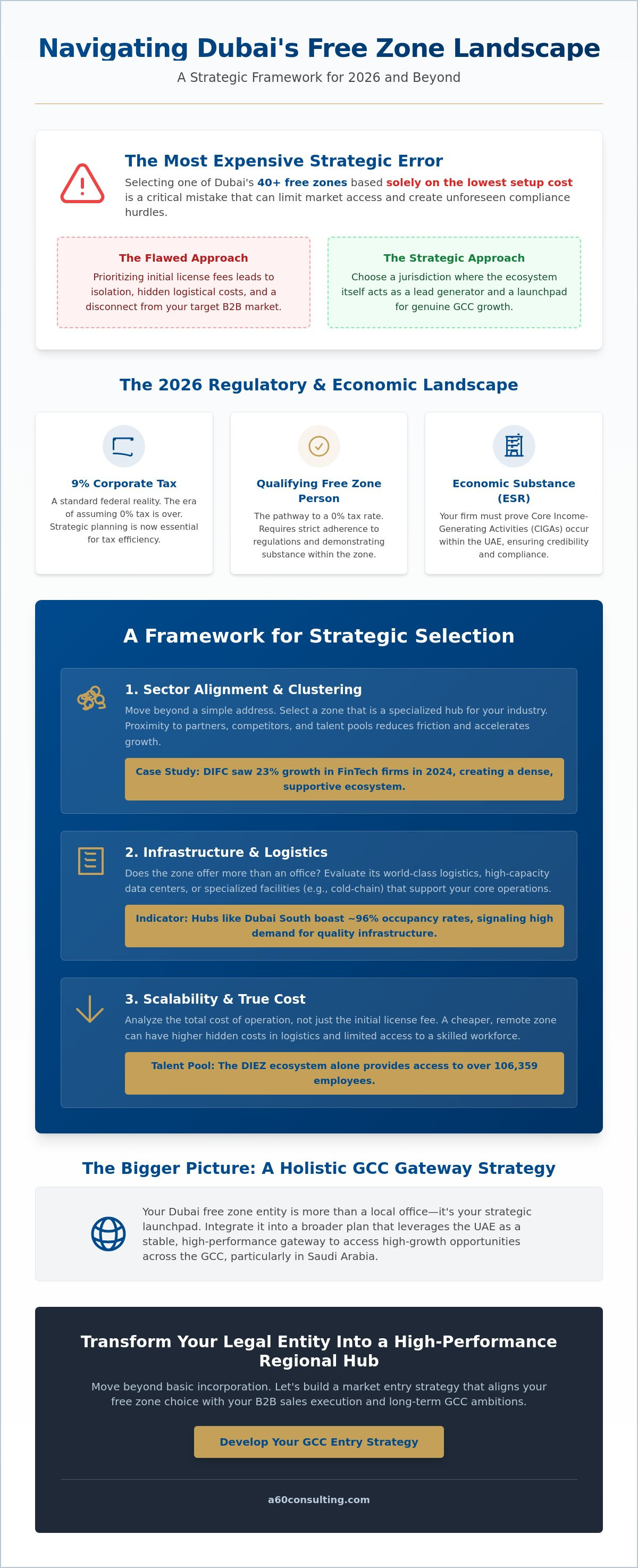
Selecting one of the 40 plus free trade zones dubai offers based solely on the lowest setup cost is often the most expensive strategic error a global firm can make in 2026. You're likely aware that Dubai serves as a critical gateway to 2.5 billion consumers, yet the complexity of the 9% corporate tax regime and the specific requirements for Qualifying Free Zone Person status can turn a simple expansion into a regulatory hurdle. It's natural to feel concerned about choosing a jurisdiction that might inadvertently limit your access to the lucrative mainland market or create unforeseen compliance costs.
This guide provides a strategic framework to help you identify the specific zones aligned with your sector, ensuring you balance tax efficiency with genuine market reach. We'll move beyond basic incorporation to focus on a roadmap for scaling your sales execution after your license is issued. By examining current data, such as the 96% occupancy rates in hubs like Dubai South, we'll explore how to transform your regional presence from a mere administrative checkbox into a high performing engine for GCC growth.
Key Takeaways
- Learn to navigate the 2026 landscape of free trade zones dubai by selecting a jurisdiction that aligns with the D33 Agenda’s sector-specific innovation clusters.
- Identify the critical infrastructure and clustering requirements that differentiate a mere administrative address from a strategic launchpad for B2B growth.
- Evaluate the shifting boundaries between free zone and mainland operations to maintain maximum flexibility for your future regional business activities.
- Discover a framework for scaling sales execution and local representation that transforms your legal entity into a high-performance regional hub.
- Integrate your Dubai presence into a broader GCC strategy that leverages the UAE as a strategic gateway to the high-growth opportunities in Saudi Arabia.
Understanding the 2026 Landscape of Free Trade Zones in Dubai
Historically, free trade zones dubai provided a straightforward path for international firms to secure 100% foreign ownership and customs exemptions. By 2026, this landscape has matured into a complex network of sector-specific innovation hubs. These zones aren't merely administrative jurisdictions; they're sophisticated ecosystems where tax efficiency meets world-class logistics and digital infrastructure. The evolution of the model has shifted from providing simple warehouses to fostering high-tech sales and tech environments that support sustainable growth.
The core benefits remain foundational for any GCC entry strategy. Companies enjoy 100% capital repatriation and a business-friendly environment that facilitates rapid scaling. However, the modern entrant must look beyond these surface-level perks. Success now depends on how well a firm integrates into the specialized clusters that Dubai has carefully cultivated over the last decade.
The Role of Free Zones in UAE’s Diversification
Dubai's Economic Agenda, D33, aims to double the emirate's economy by 2033 through a focus on digital transformation and high-tech manufacturing. Free zones are the primary vehicles for this transition, moving away from traditional trade toward knowledge-based sectors. This shift ensures that companies aren't just operating in a tax haven but are part of a broader business transformation. In 2026, the strategic value of an FTZ lies in its ability to serve as a specialized launchpad that integrates administrative efficiency with immediate access to sector-specific talent and innovation.
Regulatory Framework and Governance
Each jurisdiction is managed by its own Free Zone Authority (FZA), which operates under independent regulations tailored to specific industries. Understanding this list of Dubai's free trade zones is essential for identifying which governance structure aligns with your operational needs. Compliance has become more rigorous in 2026. The 9% federal corporate tax is now a standard reality, though many free trade zones dubai offers allow for a 0% rate if the entity qualifies as a "Qualifying Free Zone Person."
Maintaining this tax advantage requires strict adherence to Economic Substance Regulations (ESR). Your organization must demonstrate that core income-generating activities actually take place within the zone. This regulatory depth ensures the UAE remains a credible, transparent partner for global firms while providing the stability needed for long-term implementation of market entry strategies.
Strategic Selection: A Framework for Choosing the Right Zone
Choosing between the various free trade zones dubai provides requires a shift from administrative thinking to strategic analysis. A common mistake is prioritizing the lowest initial license fee without considering the long-term cost of isolation from your target market. Clustering is the primary driver of B2B growth in the UAE; being physically close to your partners and competitors reduces the friction of implementation and accelerates trust building in the Gulf. Successful firms select a jurisdiction where the ecosystem itself acts as a lead generator.
Operational costs should be viewed through the lens of scalability rather than just the first year's investment. While a remote zone might offer a cheaper license, the hidden costs of logistics or limited access to the 106,359 employees currently working within the DIEZ ecosystem can quickly erode those savings. Efficiency in 2026 is measured by the "Ease of Doing Business" metric, which includes digital visa processing speeds and the availability of specialized infrastructure like high-capacity data centers or cold-chain logistics. Developing a robust market entry strategy ensures that your choice of zone supports your sales execution rather than hindering it.
Top Tier Zones for Technology and Software
For fintech and software firms, jurisdictions like Dubai Internet City and the Dubai International Financial Centre (DIFC) remain the gold standard. DIFC recorded a 23% growth in fintech firms in 2024, creating a dense network of venture capital and regulatory support. These hubs aren't just office spaces; they're accelerators where regional R&D thrives due to proximity to the region's largest financial institutions. If your goal is to tap into the UAE's online retail market, which is projected to exceed $8 billion by 2026, being situated within these tech-centric environments is essential for partnership identification.
Industrial and Manufacturing Powerhouses
If your business involves physical goods, the multi-modal transport advantages of Jebel Ali Free Zone (JAFZA) and Dubai South are unmatched. By early 2026, occupancy rates in Dubai South reached 96%, reflecting the high demand for proximity to Dubai World Central. JAFZA continues to lead for complex manufacturing, providing specialized power and waste management infrastructure that smaller zones lack. Warehouse rental rates saw a 22% year-on-year increase in JAFZA during the second half of 2025, signaling the intense competition for strategic logistics space that offers direct access to global shipping lanes.
Free Zone vs. Mainland: Resolving the Market Access Dilemma
The decision between free trade zones dubai and a mainland license is no longer a simple binary choice based on ownership. Since the landmark 2021 amendments to the Commercial Companies Law, mainland entities also offer 100% foreign ownership for over 1,000 commercial and industrial activities. This shift has forced a more nuanced analysis of jurisdictional reach. The fundamental difference now lies in operational flexibility; mainland companies can trade freely with any entity in the UAE and bid for government contracts, whereas free zone entities are technically restricted to their specific zone or international markets.
A common concern for global firms is whether they can effectively sell to the mainland from a free zone base. While direct sales are restricted, strategic workarounds remain standard practice. Many firms utilize local distributors or commercial agents to bridge this gap. Others adopt a dual-licensing framework, which allows them to maintain their specialized free zone infrastructure while obtaining a branch license from the mainland authorities to handle local transactions. This hybrid approach ensures you don't have to choose between specialized logistics and domestic market penetration.
Dual-Licensing and Hybrid Models
In 2026, the Department of Economy and Tourism (DET) has streamlined the process for free zone companies to operate on the mainland. This regulatory evolution is particularly beneficial for firms that view Dubai as a gateway to broader GCC distribution. If your primary objective involves high-volume sales in Saudi Arabia while maintaining a management hub in the UAE, a mainland branch often provides the smoothest path for customs clearance and regional logistics. These hybrid models allow for a seamless transition as your organization moves from initial market entry to full scale implementation.
Tax Implications and Economic Substance
The introduction of the 9% federal corporate tax on taxable income exceeding AED 375,000 has redefined the value proposition of free zones. To maintain a 0% tax rate, a firm must qualify as a "Qualifying Free Zone Person" and ensure their revenue is classified as "Qualifying Income." In 2026, free zone exporters who derive their income from international trade and maintain adequate operational substance within their zone continue to benefit from the 0% corporate tax rate on that specific revenue. However, income derived from mainland trade is generally subject to the standard 9% rate, making regulatory and compliance advisory a critical component of your ongoing strategy to avoid unexpected tax liabilities.
Beyond Incorporation: Leveraging Free Zones for B2B Sales Execution
Registration is merely a prerequisite for success. The real challenge for global firms lies in transforming a legal entity within free trade zones dubai provides into a high performance sales engine. By 2026, the most successful organizations have moved past simple compliance to focus on sales execution. This involves establishing a physical presence that acts as more than just a mailing address. It's about creating a regional hub for technical support and customer engagement. The workforce across DIEZ companies increased by 26.2% to 106,359 employees by the end of 2025; this highlights the growing importance of free zones as centers for human capital and operational depth. Recruiting specialized talent within these ecosystems allows you to build a team that understands the local regulatory environment from day one.
Trust remains the primary currency in the Middle East. You can't effectively manage a sales pipeline from a headquarters thousands of miles away. Genuine market penetration requires local representation in the Gulf to navigate cultural nuances and build face-to-face relationships with key decision makers. Your free zone office should serve as a showroom where potential clients can interact with your technology or receive localized technical support. This physical touchpoint is often the deciding factor in B2B sales where long term reliability is a prerequisite for any contract.
Building a Regional Sales Pipeline
Lead generation in the UAE requires a tailored approach that respects local business etiquette while maintaining professional rigor. Integrating your office into a broader GCC market entry strategy ensures your sales team isn't working in a vacuum. Success in 2026 depends on your ability to adapt your value proposition for a corporate audience that prioritizes long term partnership over short term gains. A Dubai based hub allows you to test these pitches before scaling them across the wider region.
Partner and Distributor Management
Being on the ground simplifies the process of distributor search in the Middle East. It allows for rigorous vetting and real time management of regional logistics from a central location. Data from 2025 shows that companies with a local presence in free trade zones dubai experience significantly fewer supply chain disruptions. This proximity enables you to monitor compliance and performance more effectively than through remote oversight, ensuring your partners remain aligned with your global standards.
If you're looking to optimize your regional growth, our team can assist with sales execution and management to ensure your entity delivers measurable results.
Integrating Free Zones into a Holistic GCC Entry Strategy
Establishing a presence in one of the free trade zones dubai provides shouldn't be the final destination of your regional plan. It's a calculated first step in a broader GCC expansion. While the UAE offers the most mature regulatory environment for international firms, Saudi Arabia represents the primary growth engine for the coming decade. Successful market entry requires synchronizing these two jurisdictions so that your Dubai hub supports your Saudi Vision 2030 objectives. Stagnation often occurs when leadership treats incorporation as a success metric rather than an operational starting point.
The UAE-Saudi Nexus
The relationship between Dubai and Riyadh is complementary rather than competitive for global firms. Saudi Arabia's Regional Headquarters (RHQ) program has introduced new requirements for government procurement, yet many companies continue to utilize Dubai's infrastructure for their regional logistics and technical support. This nexus allows you to maintain the operational stability of the UAE while capturing high-value opportunities in the Kingdom. Deciding when to establish a physical presence in both locations depends on your specific sales volume and the nature of your regional contracts.
The A60 Consulting FZ-LLC Strategic Partnership
A60 Consulting FZ-LLC bridges the gap between administrative setup and sustainable revenue generation. We understand that a trade license doesn't identify partners or close sales; only a disciplined execution strategy can achieve those results. Our team focuses on the implementation phase, providing partner vetting and local representation that ensures your regional hub remains a profit center. By moving beyond the mechanics of incorporation, A60 Consulting FZ-LLC helps you navigate the cultural and regulatory nuances of the Gulf with a focus on measurable outcomes. You can scale your regional sales with A60 Consulting FZ-LLC's market entry expertise.
Mastering Your Regional Expansion
Success in the Gulf requires a shift from administrative compliance to strategic implementation. While free trade zones dubai provides the necessary legal foundation, your long term growth depends on how effectively you bridge the gap between setup and sustainable revenue. You've seen that choosing a zone is about more than just costs; it's about positioning your organization within the right innovation clusters to capture D33 Agenda opportunities. True market penetration demands a commitment to local representation and a disciplined approach to sales execution across the wider GCC.
A60 Consulting brings 30 plus years of regional expertise to your expansion, specializing in the complexities of B2B sales execution. We don't just offer theory; we provide end to end partner search and vetting to ensure your regional presence delivers measurable results. It's time to transform your Dubai entity from a legal requirement into a high performing sales engine. Partner with A60 Consulting for your GCC Market Entry Strategy and build a foundation for lasting success in the Middle East.
Frequently Asked Questions
What are the most popular free trade zones in Dubai for tech companies in 2026?
Dubai Internet City and the Dubai International Financial Centre (DIFC) remain the leading hubs for technology and software firms. DIFC reported a 23% growth in fintech companies in 2024, providing a dense ecosystem of venture capital and specialized regulatory support. These zones are designed to foster innovation through proximity to the region's largest financial institutions and tech talent pools.
Can a free zone company sell products directly to customers in the UAE mainland?
Direct sales to the mainland are generally restricted for free zone entities. To access the domestic market, firms typically utilize a local distributor or obtain a branch license from the Dubai Department of Economy and Tourism (DET). This dual-licensing framework allows you to maintain your free trade zones dubai base while legally conducting transactions with mainland customers.
How much does it cost to set up a business in a Dubai free zone in 2026?
Initial setup costs typically range from AED 12,000 to AED 50,000 depending on the zone and license type. For example, DMCC registration fees start at AED 9,000, while annual license fees range from AED 10,000 to AED 50,000. In DAFZA, the total first year investment often falls between AED 40,000 and AED 150,000 including office requirements.
Do free zone companies have to pay the 9% UAE Corporate Tax?
All entities must register for corporate tax, but a 0% rate applies to "Qualifying Income" for those with "Qualifying Free Zone Person" status. Income that doesn't meet these specific criteria is subject to the standard 9% tax on profits exceeding AED 375,000. Registration with the Federal Tax Authority (FTA) is mandatory regardless of whether the company expects to pay tax.
What is the difference between a Free Zone Enterprise (FZE) and a Free Zone Company (FZCO)?
The primary difference lies in the number of shareholders. An FZE is a limited liability company incorporated with a single shareholder, which can be an individual or a corporate entity. An FZCO requires two or more shareholders. Both structures provide the benefits of a free zone, but the choice depends on your specific ownership and capital requirements.
Can I use a Dubai free zone entity to trade with Saudi Arabia and Qatar?
Yes, a Dubai entity serves as a strategic gateway for trade across the GCC. The Dubai Integrated Economic Zones Authority (DIEZ) reported a 19.4% increase in revenue in 2025, driven largely by regional trade expansion. Using Dubai as a central hub allows you to manage logistics and sales execution for the Saudi and Qatari markets efficiently.
How long does the incorporation process take for a free zone license?
The incorporation process usually takes between 1 and 4 weeks. Most authorities have streamlined their digital platforms to allow for rapid document submission and visa processing. While basic commercial licenses are issued quickly, industrial or specialized tech licenses requiring third party regulatory approvals may take longer to finalize.
Is a physical office mandatory for all free trade zones in Dubai?
Most zones require a physical address, though many offer "flexi-desk" solutions for smaller operations. A JAFZA flexi-desk costs between AED 12,000 and AED 20,000 annually. However, for companies seeking "Qualifying Free Zone Person" tax status, maintaining adequate physical substance, including a proper office and local staff, is a critical regulatory requirement in 2026.