
Why do transactions in the Middle East rise by 35% in a single year while so many international brands still struggle to see a tangible return on their regional investments? The 2026 GCC market demands a shift in perspective; a distributor is no longer just a logistics provider, but a strategic extension of your organization that requires rigorous vetting for both regulatory compliance and sales execution. You've likely experienced the high cost of partner turnover or the frustration of verifying market reach claims in a landscape that often lacks transparency. It's a challenge that requires a move from hope to a fact-based methodology.
This guide provides a strategic framework to identify and secure high-performance partners who share your commitment to sustainable growth. We'll examine how professional distributor search services middle east navigate the latest complexities, including the June 30, 2026, UAE Maritime Pre-Load Cargo Information deadline and Saudi Arabia's SR30 million capital requirement for retail ownership. You'll gain a clear roadmap for building a vetted shortlist of partners who don't just collect brochures, but actively drive sales execution in an economy projected to grow by 4.4% this year.
Key Takeaways
- Modern distribution in the GCC has evolved from simple product movement to a strategic, solution-based partnership that requires a multi-layered vetting process.
- A robust evaluation framework for 2026 must balance technical competence with financial stability to ensure your partner can withstand global economic volatility.
- Effective distributor search services middle east now integrate regulatory pre-audits and In-Country Value (ICV) scores to mitigate risk before the first contract is signed.
- Strategic success depends on aligning your regional footprint with specific local dynamics, such as the Saudi-First RHQ mandate or Dubai’s re-export advantages.
- Transitioning from a search-only approach to a sales-enablement model ensures that your chosen partner delivers measurable execution rather than just market presence.
Why Distributor Search Services in the Middle East Have Changed in 2026
The GCC market has undergone a fundamental transformation that makes traditional market entry tactics obsolete. By May 2026, the era of "moving boxes" through a single regional hub has ended. It's replaced by a demand for solution-based distribution where partners must provide technical integration, local maintenance, and regulatory mastery. Utilizing professional distributor search services middle east is no longer just about finding a name; it's a multi-layered strategic vetting process designed to align a partner's operational reality with your corporate values. The GCC is a fragmented landscape where a "one size fits all" approach fails. To succeed, you must understand the broader Economic landscape of the Middle East, which currently prioritizes localized manufacturing and digital transparency over simple re-export models.
One of the most significant risks in 2026 is the "dormant distributor." These are established regional players who aggressively sign exclusive contracts to keep competitors out, only to let the brand sit idle without marketing spend or sales execution. They collect brochures, not purchase orders. A strategic search identifies these patterns before you're locked into a stagnant relationship. This requires looking past the surface-level trading volume and examining a partner's actual capacity to handle new 2026 requirements, such as the UAE’s MPCI filing deadline on June 30 or Saudi Arabia’s SR30 million capital requirement for 100% foreign-owned retail entities.
The Cost of the Wrong Partner in the GCC
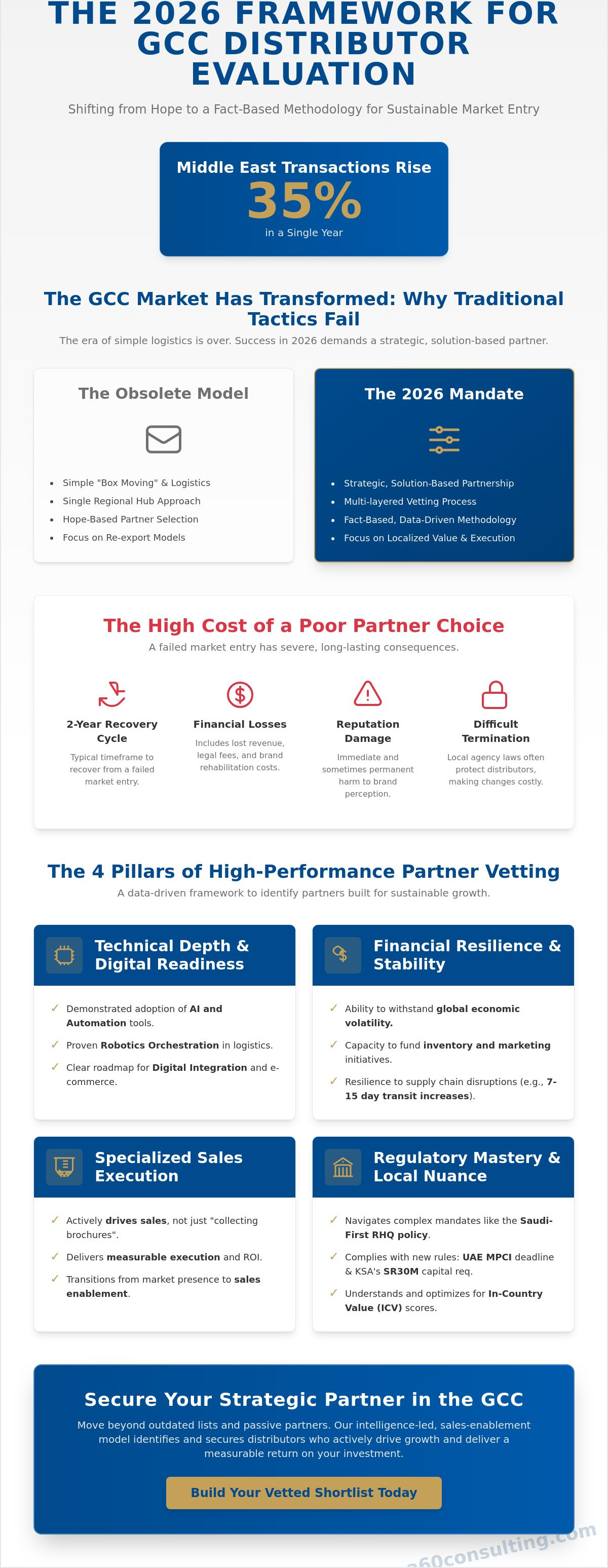
A failed market entry in the Middle East typically results in a two-year recovery cycle. The financial impact isn't just lost revenue; it's the cost of legal fees and the high price of brand rehabilitation. Terminating an exclusive distributor agreement in this region remains notoriously difficult. Local commercial agency laws often provide significant protection to the distributor, making it expensive and time-consuming to switch partners once a contract is registered. If your first choice is poor, your brand reputation with key regional buyers suffers immediate, sometimes permanent, damage.
Beyond the 'LinkedIn List': The Value of Local Intelligence
Standard database-driven lists are insufficient for the 2026 business environment. Professional distributor search services middle east rely on intelligence-led identification that verifies a distributor's "Wasta," or their true level of influence and access within government and private procurement circles. You can't verify a partner's market reach from a London or New York office. Physical presence in the region is non-negotiable for vetting. It allows for the inspection of warehouses, the interviewing of existing sales staff, and the verification of local claims regarding logistics and compliance capabilities.
The 2026 Framework for Evaluating Distribution Partners
Market entry in the GCC has evolved beyond simple match-making. In 2026, professional distributor search services middle east must employ a rigorous, data-driven framework to move beyond basic contact lists. We focus on four specific pillars: technical depth, financial resilience, specialized sales teams, and shared long-term objectives. A partner's ability to navigate the current e-commerce expansion in the Middle East is just as critical as their traditional retail footprint. With GCC economies projected to grow by 4.4% in 2026, the financial health of a partner isn't just about their current balance sheet; it's about their capacity to fund inventory and marketing in a landscape where transit times have increased by 7 to 15 days due to regional shipping disruptions.
Technical competence is non-negotiable for 2026. As the region adopts AI and automation at a standard level, your partner must possess the digital infrastructure to support these tools. This includes robotics orchestration in logistics and coordinated automation ecosystems. If a potential partner can't demonstrate a clear roadmap for digital integration, they'll likely struggle to maintain efficiency as regionalization of supply chains becomes the norm. We look for partners who treat technology as a core competency rather than an afterthought.
Assessing Sales Execution Capacity
Sales execution is the bridge between market entry and revenue. We recommend a physical audit of a partner's CRM systems during the vetting process. Does their pipeline show active, verified leads, or is it a collection of cold contacts? In 2026, "generalist" sales teams are a significant liability. You need specialized units capable of providing in-country technical support, especially as distribution hubs become smaller and smarter. Ensuring your partner has a dedicated team for your specific product category is a prerequisite for success. If you're unsure how to benchmark these internal capabilities, evaluating your current regional strategy can reveal hidden gaps in your partner's performance.
Strategic Alignment vs. Volume Focus
The distinction between "box-movers" and "value-added" distributors has never been sharper. A box-mover focuses on volume at the expense of brand integrity; a value-added partner invests in your organizational story. Vetting must include a deep dive into their existing portfolio. If they carry a direct competitor, your brand will likely be deprioritized during peak seasons. We suggest requesting a joint marketing plan during the final vetting stage. This document serves as a litmus test for their commitment. It shows whether they view your brand as a long-term strategic asset or just another SKU in an overcrowded warehouse.
Regional Nuances: Navigating the UAE, Saudi Arabia, and Qatar
Success in the Gulf depends on dismantling the myth of the "Pan-GCC" distributor. While a single partner covering six nations sounds efficient, it rarely delivers results for complex products or regulated industries. Localized expertise is essential because each market operates under distinct legal and economic frameworks. Professional distributor search services middle east now focus on granular, country-specific identification to avoid the pitfalls of a fragmented strategy. This shift is reflected in the changing distribution landscape in the Middle East, where brand owners are increasingly establishing direct footprints to support their local partners and ensure brand consistency across borders.
Saudi Vision 2030 and Partner Selection
Saudi Arabia's "Saudi-First" strategy has redefined regional operations. As of 2026, the Regional Headquarters (RHQ) requirement is a primary driver for government procurement. If your partner doesn't have a clear path to supporting your RHQ status, you'll find yourself excluded from massive GIGA projects. Additionally, foreign companies in wholesale and retail with 100% ownership are required to have a minimum capital of SR30 million. This high threshold makes it vital to identify partners who possess the financial depth to scale alongside the Kingdom's rapid transformation. We focus on partners who don't just trade, but invest in local assembly or manufacturing capabilities to meet increasing localization requirements.
The UAE's Multi-Tiered Distribution Landscape
The UAE remains the region's premier re-export hub, with the logistics industry contributing 14% to Dubai's GDP. It serves as a vital gateway to Africa and Central Asia, but choosing between a Mainland and a Free Zone partner is a critical decision. Mainland distributors offer broader access to local government contracts and the domestic market, while Free Zone entities provide specialized logistical advantages for international trade. Navigating these options requires a clear understanding of your long-term regional goals. For a deeper dive into these specifics, see our Strategic Guide to Finding and Managing Distributors in the UAE.
Qatar and Kuwait represent specialized opportunities, particularly in energy and infrastructure. Qatar's 5% standard customs duty and its de minimis threshold of 1,000 QAR for personal imports create a specific environment for consumer and industrial goods alike. In these markets, distributor search services middle east prioritize partners with deep-rooted connections in the oil and gas sectors. These relationships are the only way to navigate procurement cycles that are notoriously long and relationship-driven. Relying on a Dubai-based partner to manage a Doha-based project often leads to communication gaps and lost opportunities.
A Strategic Checklist for Vetting Regional Partners
A successful market entry in the GCC requires a transition from high-level strategy to granular operational verification. In 2026, professional distributor search services middle east don't just provide a list of names; they facilitate a rigorous five-step audit process to ensure your partner can actually perform. This methodology moves beyond the initial chemistry of a meeting to verify the technical and regulatory foundations of the business. It's about ensuring that your strategic intent translates into measurable in-country results without the friction of unforeseen compliance hurdles.
- Step 1: Regulatory and Compliance Pre-Audit. Verify the partner's ability to navigate SABER in Saudi Arabia or ESMA in the UAE. This includes checking their track record with the Ministry of Health (MoH) for specialized sectors.
- Step 2: In-Country Value (ICV) Score Assessment. In both the UAE and KSA, a high ICV score is often a prerequisite for winning government contracts. You must verify if your partner’s local investment and employment levels align with these national priorities.
- Step 3: Reference Checks with Existing Principals. Don't rely on testimonials. Speak directly to other international brands in their portfolio to verify payment punctuality and marketing commitment.
- Step 4: Commercial Term Stress-Testing. Evaluate margins, credit facilities, and dedicated marketing spend. Ensure the partner can absorb the 7 to 15-day transit delays currently affecting regional shipping routes without compromising inventory levels.
- Step 5: Cultural Fit and 'Wasta' Verification. Assess the partner's genuine influence within local procurement circles. This qualitative assessment determines if they have the access required to move your brand past the initial gatekeepers.
Compliance and Regulatory Roadmaps
Navigating the regulatory landscape has become more complex as of January 2026. For example, the Federal Decree-Law No. 26 of 2025 now mandates strict parental controls for children's data, which significantly impacts digital product distribution. Your partner must demonstrate a clear roadmap for complying with these evolving data privacy laws and product-specific certifications like SABER. To ensure you haven't missed a critical step, consult our Vetting Distributors in the Middle East: The 2026 Strategic Checklist.
Negotiating the Agreement
The 2026 regional trend is shifting away from indefinite exclusivity. Modern agreements prioritize performance-based exclusivity with clear KPIs and "Sunset Clauses" that allow for termination if sales targets aren't met within a specific timeframe. This protects your brand from the "dormant distributor" risk mentioned earlier. Structuring these legal safeguards requires deep local knowledge of commercial agency laws. You can find a detailed breakdown in our guide on Structuring a Distributor Agreement in the Middle East. If you're ready to move from planning to execution, schedule a strategic consultation to audit your proposed partnership terms.
Why A60 Consulting FZ-LLC is the Choice for Strategic Partner Search
Selecting a partner in the GCC requires more than a directory; it demands an advocate who understands the nuances of local execution. A60 Consulting FZ-LLC doesn't operate as a detached advisor. We function as your regional sales office. This distinction is vital in a market where transaction volume is accelerating and regulatory landscapes are shifting. We bridge the gap between high-level strategy and the practical reality of securing your first contract. Our approach is designed for leaders who value measurable results over theoretical reports. By utilizing professional distributor search services middle east, you gain access to an ecosystem of high-performance players who have already been vetted for financial resilience and technical depth.
A60 Consulting FZ-LLC brings over 30 years of deep networking across the Middle East. We specialize in complex industrial, software, and technology sectors where simple "box-moving" models inevitably fail. Our performance-linked model ensures our success is directly tied to your revenue, creating a true partnership based on shared risk and reward. We don't just find a partner; we help you implement a sustainable business transformation in the region. This involves navigating the latest 2026 requirements, from the UAE's MPCI filing deadlines to Saudi Arabia's data localization mandates, ensuring your entry is both compliant and competitive.
From Strategy to Execution
Finding a shortlist is only the beginning of the journey. A60 Consulting FZ-LLC moves from the identification phase to the "First Sale" by providing local representation during the most critical negotiations. Our role doesn't end when the ink dries. We provide the oversight necessary to ensure your partner remains active and aligned with your corporate values. We monitor their marketing spend and sales pipeline, acting as the bridge that prevents the "dormant distributor" risk discussed earlier. For a deeper look at our methodology, read our Strategic Guide to Distributor Search in the Middle East: A 2026 Framework.
Your Gateway to the GCC
The "A60 Advantage" combines a local face with global standards. Consider our success in scaling a specialized tech firm across three GCC markets within just 12 months. By leveraging our existing network, we bypassed the typical two-year market entry struggle that often plagues international brands. We manage the complexities of 2026 regulations while you focus on product innovation. This level of integration provides the stability and intellectual edge needed to thrive in an increasingly crowded landscape. Ready to begin your expansion? Contact A60 Consulting FZ-LLC for a customized partner search strategy.
Transitioning from Strategic Intent to Regional Market Leadership
The 2026 GCC landscape offers a unique window of opportunity for organizations that move from theoretical planning to disciplined implementation. It's clear that securing a high-performance partner is the single most critical factor in determining your long-term success. By utilizing specialized distributor search services middle east, you move past the risks of "box-moving" and enter the realm of value-added partnership. This isn't just about market entry; it's about establishing a resilient, compliant, and profitable presence in a region that rewards methodological thoroughness and local intelligence.
A60 Consulting FZ-LLC provides the strategic depth and execution focus required to navigate this journey. With our 30-year history and deep immersion in Saudi Vision 2030 projects, we don't just offer advice; we provide a bridge between your global standards and local market realities. We understand that every choice has a measurable impact on your brand’s reputation. Our success-based models ensure that our commitment to your results is as deep as your own, providing the stability needed to scale effectively across fragmented markets.
Partner with A60 Consulting FZ-LLC to find your next high-growth Middle East distributor and secure your brand's future in the GCC with a partner who understands the value of measurable execution. We're ready to help you turn your strategic vision into a regional commercial reality.
Frequently Asked Questions
How much do distributor search services in the Middle East typically cost?
Basic distributor search services middle east in the UAE start from 10,500 AED per month according to 2026 data from Accurate Middle East Consulting. Total costs fluctuate based on the technical depth of the audit and whether you require on-the-ground sales representation after the search. Investing in professional vetting prevents the much higher financial burden of a failed market entry, which can cost a brand two years of lost revenue.
How long does it take to find and sign a vetted distributor in the GCC?
Identifying and signing a high-performance partner typically takes between four and six months. This timeframe is necessary to complete a multi-layered vetting process, including warehouse inspections, compliance audits, and reference checks with existing principals. Rushing this strategic phase often results in the "dormant distributor" risk, where a partner signs an agreement but lacks the capacity or intent to execute sales.
Can one distributor cover the entire Middle East region?
It's rare for a single entity to effectively manage the entire region for complex or regulated products. While large groups have offices across the GCC, their influence and technical capacity vary significantly between cities like Riyadh, Dubai, and Doha. We recommend country-specific partners to navigate local requirements, such as Saudi Arabia’s SR30 million capital mandate for 100% foreign-owned retail firms.
What is the difference between a commercial agent and a distributor in the UAE?
A commercial agent is typically a local entity registered with the Ministry of Economy, granting them significant statutory protections and exclusivity rights. A distributor usually operates under a standard commercial contract without these specific legal safeguards. Choosing the right structure is vital because terminating a registered agency agreement is notoriously difficult and expensive within the UAE's legal framework.
Do I need a local partner to sell software in Saudi Arabia in 2026?
You don't strictly require a local partner for software, but regional data localization laws and RHQ requirements make local representation essential for public sector contracts. Federal Decree-Law No. 26 of 2025 mandates strict data processing standards that are far easier to manage with an in-country partner. Most successful software firms now utilize a hybrid model that blends digital innovation with local technical support.
What happens if my Middle Eastern distributor underperforms?
Your recourse depends entirely on the "Sunset Clauses" and KPIs established in your agreement. Without these performance-linked safeguards, terminating an underperforming partner in the GCC can lead to protracted legal disputes. We recommend including clear milestones for marketing spend and sales volume. This allows you to transition to a new partner if the current one fails to meet the agreed-upon benchmarks.
How does In-Country Value (ICV) affect my choice of distributor?
In-Country Value (ICV) scores are a critical factor for winning government procurement contracts in both the UAE and Saudi Arabia. A distributor with a high ICV score demonstrates a verified commitment to local investment and employment. Selecting a partner with a low score can effectively exclude your brand from major GIGA projects, regardless of your product's quality or technical advantages.
Is exclusivity mandatory in Middle East distribution agreements?
Exclusivity isn't a legal requirement, but it remains the standard expectation for most regional partners. However, professional distributor search services middle east now frequently negotiate performance-based exclusivity. This ensures that a partner only maintains their protected status as long as they hit specific sales targets. This shift toward flexibility allows brands to maintain better control over their regional growth and market representation.