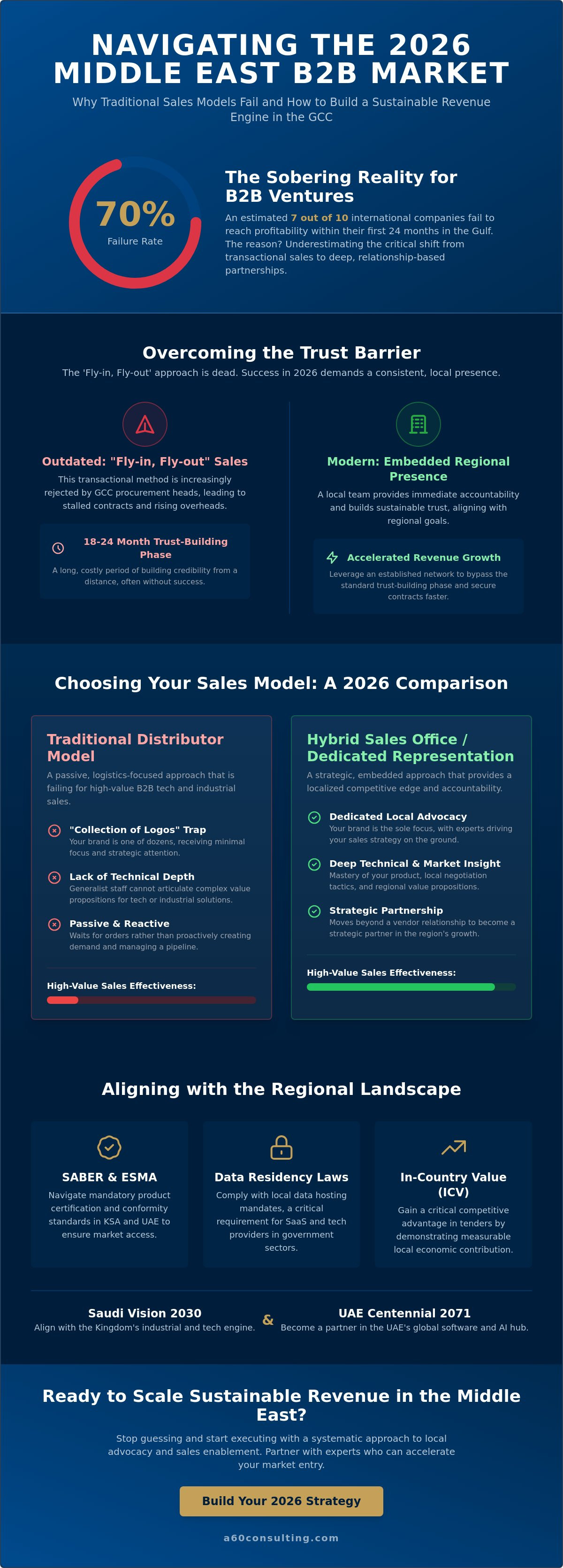
Why do 70% of international B2B ventures in the Gulf fail to reach profitability within their first 24 months? Most organizations underestimate the shift from transactional selling to the relationship-heavy reality of selling to the middle east. You probably recognize that technical superiority isn't enough when local procurement mandates like SABER or the ICV program prioritize regional integration over global prestige. It's often draining to watch potentially lucrative contracts stall in the trust-building phase while overhead costs in Dubai or Abu Dhabi continue to climb.
We understand that mastering these regulatory frameworks and identifying qualified distributors requires more than a standard export strategy; it demands a systematic approach to local advocacy. This article provides a strategic roadmap for your 2026 execution, focusing on high-impact B2B sales models and the actual ROI of professional local representation. We'll analyze concrete examples of successful market entries and provide a rigorous framework for vetting regional partners to ensure your expansion is both sustainable and measurable.
Key Takeaways
- Align your B2B strategy with the UAE Centennial 2071 and Saudi Vision 2030 to transition from a simple vendor to a strategic partner in the region's tech-enabled economies.
- Discover why the traditional passive distributor model is failing and how a Hybrid Sales Office provides a localized competitive edge when selling to the Middle East in 2026.
- Navigate the modern 'Wasta' by building sustainable trust and moving beyond the 'Fly-in, Fly-out' sales approach that GCC procurement heads increasingly reject.
- Master regionalized value propositions and negotiation tactics to protect your margins while pricing high-value industrial and tech contracts in UAE Dirham (AED).
- Learn how to bypass the standard 18-month trust-building phase by leveraging an embedded regional presence to accelerate your sustainable revenue growth.
Understanding the 2026 B2B Landscape when Selling to the Middle East
By 2026, selling to the middle east has evolved from a traditional export model into a sophisticated exercise in strategic alignment. Success no longer depends on merely shipping products; it requires a deep integration with the national economic diversification goals of the Gulf Cooperation Council (GCC). The Economic landscape of the Middle East is currently defined by a decisive transition from oil-reliant revenues to tech-enabled, knowledge-based growth. This shift is codified in frameworks like Saudi Vision 2030 and the UAE Centennial 2071, which prioritize local industrialization and digital sovereignty.
The year 2026 represents the critical "execution phase" for regional mega-projects. Most initiatives that were conceptualized in the early 2020s are now reaching peak construction or operational maturity. This maturity creates a specific demand for suppliers who can provide immediate, scalable implementation rather than just pilot programs. With an estimated AED 3.7 trillion in active infrastructure and development projects across the region, procurement teams are prioritizing reliability and local presence over low-cost, offshore bidding.
Suppliers must recognize that the regional market is increasingly protective of its economic future. This has led to the rise of localized requirements that dictate who wins government and semi-government contracts. To remain competitive, B2B entities must demonstrate a measurable commitment to the host nation’s long-term stability and technological advancement.
The GCC as a Unified yet Diverse Market
While the six GCC nations (UAE, Saudi Arabia, Qatar, Oman, Kuwait, and Bahrain) share cultural similarities and a common customs union, they operate as distinct markets with varying degrees of maturity. By 2026, the UAE has solidified its position as a global hub for software and AI integration, while Saudi Arabia has become the region's industrial engine. A "one-size-fits-all" strategy fails because it ignores these nuances. For instance, selling industrial hardware in 2026 requires a focus on Saudi's manufacturing zones, whereas high-end fintech solutions find their most fertile ground in the DIFC or Abu Dhabi Global Market.
Regulatory Trends Impacting Sales in 2026
Compliance is the primary barrier to entry in the current market. In Saudi Arabia, the SABER platform has become the mandatory gateway for product certification, while the UAE's ESMA standards have tightened around sustainability and energy efficiency. Software providers face even stricter hurdles. Data sovereignty laws, such as UAE Federal Law No. 45 of 2021, now mandate local hosting for sensitive datasets, making regional cloud partnerships essential for B2B SaaS success. In 2026, In-Country Value (ICV) serves as a critical competitive advantage by directly linking a supplier's local economic contribution to their probability of winning government tenders.
- SABER System: Mandatory for all regulated products entering the Saudi market to ensure conformity.
- Data Residency: Requirement for local data storage for government and healthcare sectors.
- Execution Readiness: Shift from planning to delivery in Neom, Etihad Rail, and Dubai Urban Plan 2040.
Choosing Your Sales Model: Distributor vs. Dedicated Representation
The landscape of selling to the middle east has shifted from simple transactional trade to complex, relationship-driven partnerships. By 2026, the traditional passive distributor model, where a local partner merely stocks products and waits for orders, is largely failing for high-value B2B services. UAE buyers now demand technical depth and immediate accountability that a generalist distributor cannot provide. Success in the current market requires a choice between logistical reach and strategic intimacy.
The Distributor Model: Pros, Cons, and Hidden Costs
Distributors offer the fastest route to market, typically taking 60 to 90 days to begin operations. They handle logistics, customs, and local compliance, which is vital for high-volume commodity products. However, many firms fall into the "Collection of Logos" trap. A distributor in Dubai might represent 40 different brands, meaning your complex solution receives only a fraction of their sales team's attention. This lack of focus often results in stagnant growth despite a physical presence. To avoid these pitfalls, companies should align their choice with a 2026 blueprint for strategic regional expansion to ensure the model matches their long-term growth targets.
Dedicated Sales Representation: The Professional Gateway
For contracts exceeding 750,000 AED, the "trust gap" is the primary barrier to closing deals. Dedicated representation bridges this by providing a consistent local face. The Hybrid Sales Office has emerged as a dominant strategy for 2026. This model allows you to deploy a Regional Sales Manager through a specialized consultancy, avoiding the 150,000 AED annual overhead of a full physical office and legal incorporation in a Free Zone. This representative manages government relations and builds the deep alliances necessary for the UAE's G2B sector. If you're weighing these options, you can assess your organizational readiness with our strategic framework.
The data shows a clear trend in speed-to-market and effectiveness:
- Passive Distributor: 1-3 months setup; high risk of brand dilution.
- Hybrid Sales Office: 3-4 months setup; high control over brand narrative and 100% focus.
- Full Subsidiary: 9-12 months setup; maximum control but highest capital expenditure.
Consider the case of a European software firm that spent 2024 struggling with a generic distributor in Dubai. They saw zero pipeline growth for 14 months because the distributor's staff didn't understand the software's API integration capabilities. After transitioning to a dedicated regional sales office model in early 2025, they secured three pilot projects with UAE-based logistics firms within 7 months. Each contract was valued at over 450,000 AED. The difference wasn't the product; it was the ability to provide on-the-ground technical consultations and build rapport with C-suite executives who value local commitment over a catalog entry.
Overcoming the 'Trust Barrier' in High-Value Tech and Industrial Sales
The definition of 'Wasta' has evolved significantly as we approach 2026. While it traditionally referred to "who you know," the modern UAE business environment now defines it through the lens of delivery and reliability. In high-value B2B sectors, Wasta is the trust you've earned to ensure a project doesn't stall. It's no longer about getting a foot in the door through a cousin; it's about being the partner who guarantees that an AED 2 million industrial automation system won't face three days of downtime due to lack of local parts. Selling to the middle east requires shifting from a "transactional" mindset to a "stewardship" mindset.
Procurement heads in the GCC, particularly within the ADNOC or DEWA ecosystems, increasingly reject the "Fly-in, Fly-out" (FIFO) sales model. Parachute sales teams who arrive for a week of meetings and then disappear back to Europe or the US are viewed as a high-risk liability. A 2024 regional procurement survey indicated that 78% of decision-makers prioritize vendors with on-the-ground technical support. You don't need a 50-person office immediately, but you must demonstrate a "soft landing" through local service level agreements (SLAs) or dedicated regional representatives who reside in the UAE.
The Psychology of the GCC Buyer
Face-to-face interaction remains the "final mile" of any major deal. While initial discovery calls happen over Zoom, the closing stages require a physical presence. The buyer needs to see the person who'll be accountable if things go wrong. This accountability is why sales cycles often span 12 to 18 months. Momentum is maintained through consistent, low-pressure touchpoints rather than aggressive closing tactics. For those operating across borders, implementing a robust framework for key account management in Saudi Arabia is essential for managing the multi-year contracts that define the region's industrial landscape.
Leveraging Local Alliances
Success in selling to the middle east often depends on your proximity to "Influence Hubs" like the Dubai International Financial Centre (DIFC) or the Abu Dhabi Global Market (ADGM). These aren't just office clusters; they're ecosystems where credibility is traded. Trade shows like GITEX Global or LEAP shouldn't be treated as simple lead-generation events. They're trust-building milestones where you demonstrate your long-term commitment to the region's Vision 2030 and "We the UAE 2031" goals.
- Identify partners who offer "Value-Added" distribution rather than just logistics.
- Use regional exhibitions to host private, high-level technical briefings for existing prospects.
- Ensure your local partner has a proven track record with the specific government entity you're targeting.
In the GCC, the contract follows the relationship, not vice versa. If the personal trust isn't established during the pre-tender phase, even the most competitive technical bid will likely fail during the final evaluation. Professional persistence, backed by local technical availability, is the only way to bridge this gap.
Adapting Your Sales Execution: Pitching, Pricing, and Pipeline Management
Successful execution when selling to the Middle East requires a departure from the "one size fits all" global playbook. By 2026, the UAE market will reward firms that transition from being a "Global Best Practice" provider to a "Regional Problem Solver." This shift means your value proposition must address specific local constraints, such as extreme climate impact on hardware or the rapid digital transformation mandates of the UAE government. If your solution doesn't solve a problem unique to the GCC's 2026 economic climate, it's just another commodity.
Pricing in the UAE is a delicate balance between protecting margins and respecting the deeply rooted negotiation culture. Buyers often view the initial quote as a starting point for dialogue rather than a final figure. To maintain profitability, sales teams should build "negotiation buffers" into their initial proposals. For instance, if a software implementation is valued at 350,000 AED, focus on bundling additional value, such as extended local support or specialized training, rather than simply slashing the price. This approach preserves the perceived value of the core product while satisfying the buyer's need for a bespoke deal.
Technical sales enablement is no longer optional. In the UAE's B2B sector, decision-makers are increasingly technically proficient and have little patience for high-level sales talk. Your regional team needs deep product knowledge that allows them to answer granular implementation questions on the spot. If a sales representative has to "get back to the technical team" for every query, the momentum of the deal often dies. This expertise is vital for distinguishing between "polite interest" and "qualified intent." In Middle Eastern business culture, hospitality and kindness are standard, which can lead inexperienced sales teams to overstate their pipeline. A prospect's willingness to share coffee doesn't always equal a signed contract; true intent is measured by their willingness to involve technical stakeholders and discuss specific integration timelines.
Adapting the Pitch for a GCC Audience
Your pitch must align with the "We the UAE 2031" vision or Saudi Vision 2030 to resonate at the highest levels. ROI shouldn't just be about internal savings; it's about how your firm helps the client contribute to national digital and sustainability goals. Using case studies from similar emerging markets, like Singapore or Saudi Arabia, provides the social proof required to build trust. For more on this, see our guide on building a sales pipeline in the Middle East.
Sales Enablement Tools for 2026
By 2026, LinkedIn will remain the dominant B2B tool in the UAE, with over 80% of regional decision-makers using it for vendor research. Efficiently managing these leads requires integrated sales enablement tools in the GCC that support multilingual documentation. Even when business is conducted in English, providing technical specifications or executive summaries in Arabic demonstrates a level of commitment that sets your firm apart from distant competitors.
Ready to refine your regional execution? Optimize your regional sales strategy with our expert advisory team.
Scaling Sustainable Revenue with A60 Consulting’s Sales Enablement
A60 Consulting doesn't just offer advice; it functions as your embedded regional sales office. This structural integration allows international firms to maintain a robust local presence without the immediate overhead of establishing a physical entity in Dubai or Abu Dhabi. When selling to the middle east, the most significant barrier isn't usually product quality. Instead, it's the 18-month "trust-building" window typically required before a major contract is signed. A60 leverages a 30-year network to bypass this delay, providing immediate access to decision-makers across the GCC.
Our engagement models are built for flexibility and measurable impact. We offer project-based structures for specific market entry goals and retainer-based models for companies seeking long-term growth. This ensures that your expansion is supported by a team that understands the nuances of local procurement cycles and technical pre-qualification requirements.
Case Study: Industrial Growth in the UAE
A European manufacturer of complex industrial components struggled with stagnant growth for 24 months despite having a superior product. By outsourcing their local representation to A60, they transitioned from a "cold" foreign entity to an "active" local player. Within 12 months, the manufacturer secured three Tier-1 utility contracts, resulting in 3x revenue growth. A60 handled the intricate technical pre-qualification process that usually stalls international bidders for years.
Why a Strategic Partner Beats a Traditional Consultant
Traditional consultants often deliver a thick report and leave the execution to your internal team. A60 bridges the gap between strategy and implementation. We manage the regulatory roadmap, ensuring compliance with UAE Ministry of Industry and Advanced Technology (MoIAT) standards, while your team focuses on core product innovation. We reduce market entry risk by utilizing performance-linked success fees, which aligns our financial incentives with your actual sales volume in the region. This approach transforms a consultant-client relationship into a true partnership focused on the bottom line.
Next Steps: Your 90-Day GCC Sales Roadmap
Expanding your footprint in the Emirates requires a structured approach rather than a scattergun method. Our 90-day framework is designed for clarity and speed:
- Phase 1: Market feasibility and regulatory audit to identify high-margin opportunities and compliance hurdles.
- Phase 2: Partner vetting and local representation setup to establish a credible, professional presence.
- Phase 3: Sales execution and pipeline acceleration through our existing network of regional stakeholders.
Effective expansion is a marathon, but the right partner helps you sprint the first few miles. Contact A60 Consulting to start your GCC expansion today. Success in selling to the middle east comes down to who you know and how quickly you can prove your commitment to the local market.
Mastering Your Regional Sales Strategy for 2026
Success in the upcoming business cycle requires more than a high-quality product. It demands a deliberate choice between distributor-led reach and the depth of dedicated representation. As the UAE pursues its D33 economic agenda, the trust barrier remains the most significant hurdle for high-value industrial and tech firms. Overcoming this requires a physical presence and a deep understanding of local procurement cycles. Selling to the middle east isn't a transactional exercise; it's a long-term commitment to relationship building and strategic alignment.
A60 Consulting bridges the gap between global strategy and local execution. With 30+ years of regional experience and a physical presence in both the UAE and Saudi Arabia, we're experts in tech and industrial sales enablement. We don't offer shortcuts. We provide the methodology and regional insight needed to scale sustainable revenue. Partner with A60 Consulting for your Middle East sales execution to transform your regional potential into a structured, high-performing pipeline. We're ready to help you navigate the complexities of the 2026 landscape.
Frequently Asked Questions
Is it possible to sell to the Middle East without a local office?
Yes, you can sell to the region without a local presence by leveraging a registered commercial agent or distributor. This approach is common for companies testing the market before committing to the 100% foreign ownership structures available in UAE free zones. However, 70% of high-value B2B contracts in the GCC still require a local partner to manage after-sales support and maintain relationship proximity.
How long does the typical B2B sales cycle take in the GCC?
A typical B2B sales cycle in the GCC spans between 9 and 14 months. This duration reflects the region's emphasis on building interpersonal trust before discussing technical specifications. You'll spend the first 4 months establishing credibility through face-to-face meetings. Decisions often involve multiple stakeholders; this extends the procurement timeline compared to Western markets where digital vetting is more prevalent.
What are the biggest mistakes Western companies make when selling to Saudi Arabia?
The most frequent error is treating Saudi Arabia as a secondary market to the UAE. Many firms fail because they don't align their proposals with the Vision 2030 framework or ignore Saudization requirements. Success in selling to the middle east requires a dedicated strategy for the Kingdom. Companies that attempt to manage Saudi operations remotely often lose out to competitors who invest in local talent.
How do I find a reliable distributor in the UAE?
You should start by vetting potential partners through the Dubai Chamber of Commerce or the Abu Dhabi Chamber databases. Don't rely solely on online profiles. Visit major trade exhibitions like GITEX or Big 5 to observe how a distributor represents existing brands. A reliable partner must demonstrate a proven track record of managing logistics and navigating the specific regulatory standards of the Emirates.
What is In-Country Value (ICV) and does it apply to my business?
ICV is a procurement program that scores companies based on their contribution to the UAE economy. It applies to you if you intend to bid on government tenders or work with state-owned enterprises like ADNOC. Your score depends on factors like local manufacturing, investment, and hiring UAE nationals. The National ICV Program redirected 53 billion AED back into the local economy in 2023 alone.
What is the role of "Wasta" in modern 2026 business transactions?
In 2026, "Wasta" has evolved into a sophisticated form of professional networking and social capital. It's not about bypassing laws but about having a trusted intermediary to validate your reputation. While digital procurement systems have increased transparency, a strong network remains vital for gaining access to key decision-makers. It's the catalyst that ensures your proposal actually reaches the right desk for a technical review.
Should I focus on the UAE or Saudi Arabia first for market entry?
You should choose the UAE if you need a low-friction entry point with world-class logistics and a diverse international talent pool. It's an ideal testing ground for selling to the middle east due to its mature regulatory environment. Conversely, Saudi Arabia is the priority if your product requires massive scale. The Kingdom's current infrastructure projects offer larger contract volumes but require a more significant long-term commitment.
How do I protect my intellectual property when selling in the GCC?
You must register your trademarks and patents directly with the UAE Ministry of Economy before starting operations. International registrations aren't always sufficient for local enforcement. Ensure your contracts include specific dispute resolution clauses that favor DIFC or ADGM courts. These jurisdictions operate under common law frameworks; they provide a familiar and predictable environment for protecting your proprietary technology and brand assets against infringement.