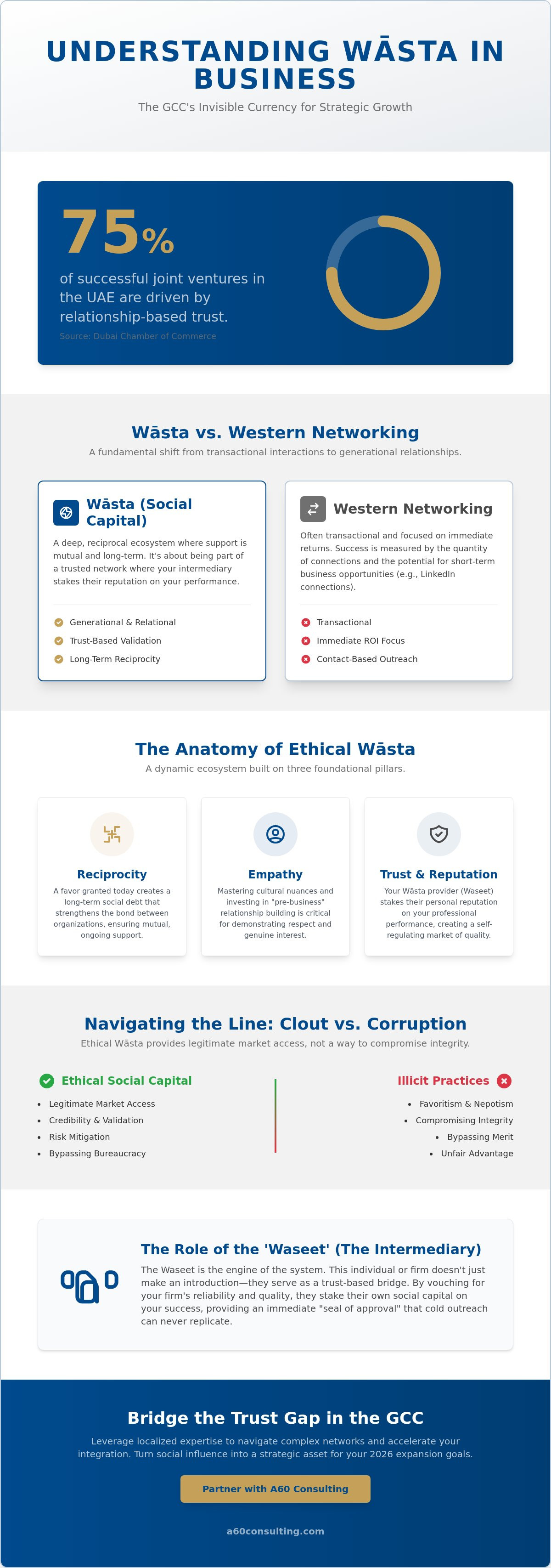
In the UAE’s commercial ecosystem, your balance sheet often carries less weight than the depth of your social equity. Many international executives view wasta in business as an opaque barrier to entry or a synonym for favoritism, yet this perspective overlooks its role as a sophisticated mechanism for trust-building and risk mitigation. You likely feel that without a local lineage, the doors to key decision-makers in Dubai or Abu Dhabi remain firmly closed. It's a valid concern, especially since data from the Dubai Chamber of Commerce indicates that relationship-based trust remains the primary driver for over 75% of successful joint ventures in the region.
We agree that the line between cultural networking and ethical compromise can seem thin when you're observing from a distance. However, mastering these nuances is the only way to build authentic, high-impact business relationships that drive measurable growth in the Gulf. This guide provides a clear framework for building local social capital and shows you how to leverage connections ethically. We'll explore the practical steps required to navigate the "who you know" culture and turn social influence into a strategic asset for your 2026 expansion goals.
Key Takeaways
- Learn how Wasta functions as the Gulf's invisible currency, moving beyond simple networking to act as a vital social mechanism for achieving strategic business objectives.
- Master the three cultural pillars—reciprocity, empathy, and trust—that form the essential foundation for building sustainable, high-impact partnerships across the UAE.
- Distinguish between ethical wasta in business and illicit practices by understanding how social capital provides legitimate market access and credibility without compromising integrity.
- Discover why investing in "pre-business" relationship building through traditional venues like the Majlis is a critical prerequisite for foreign firms entering the regional market.
- Understand how to bridge the trust gap by leveraging localized expertise to navigate complex networks and accelerate your organization’s integration into the GCC’s industrial and tech sectors.
What is Wasta in Business? Defining the GCC’s Invisible Currency
Wasta isn't just a buzzword; it's the structural backbone of Gulf commerce. In the United Arab Emirates, where business moves at the speed of the 2030 vision, understanding What is Wasta remains a prerequisite for any executive. The term originates from the Arabic root for "middle" or "mediation." It historically referred to a tribal leader intervening to resolve disputes or facilitate agreements. Today, wasta in business has evolved into a sophisticated form of social capital that functions as the primary lubricant for high-stakes transactions across the region.
While critics sometimes misinterpret it as mere nepotism, strategic leaders recognize it as a mechanism for risk mitigation. In a market where legal frameworks are rapidly evolving, trust acts as a secondary layer of security. Wasta represents the "clout" or "connections" required to bypass bureaucratic friction. It ensures that a proposal reaches the right decision-maker's desk at the right time. It's the invisible currency that converts potential into implementation.
The 2026 Context: Wasta and Regional Modernisation
The UAE's digital transformation hasn't replaced Wasta; it's formalised it. Government portals and automated tender systems now handle the technical execution of contracts, yet the human element dictates the speed of adoption. Even as Saudi Vision 2030 pushes for 100% digital procurement, a high percentage of successful regional partnerships still rely on pre-existing relationships to navigate the final stages of approval. Building this rapport requires a deep understanding of business etiquette middle east to ensure your entry into these circles is respectful and culturally aligned. Modern wasta in business is less about "skipping the line" and more about "verifying the quality" of the person standing in it.
Wasta vs. Professional Networking
Western networking is often transactional, focused on immediate ROI or LinkedIn connections. Wasta is generational and deeply reciprocal. It's not about asking for a favor; it's about being part of an ecosystem where support is mutual and long-term. In the UAE, where project values often exceed 10,000,000 AED, the stakes are too high for cold introductions.
- Reciprocity: A favor granted today creates a long-term social debt that strengthens the bond between organizations.
- Warm Introductions: Entering a meeting through a trusted intermediary provides an immediate "seal of approval" that cold outreach cannot replicate.
- Validation: Your Wasta provider stakes their personal reputation on your professional performance, creating a self-regulating market of quality.
Wasta serves as a trust-based bridge between formal institutions and informal social capital.
The Anatomy of Wasta: Reciprocity, Empathy, and Trust
Wasta in business isn't a static concept. It's a dynamic ecosystem built on three foundational pillars: Mojamala (Reciprocity), Hamola (Empathy), and Somah (Reputation). These elements don't function in isolation; they create a virtuous cycle where social capital translates directly into operational efficiency. In the UAE market, where a single partnership agreement can exceed 50,000,000 AED, these cultural nuances act as the primary risk-mitigation framework. This academic analysis of wasta demonstrates how these traditional structures remain relevant even as regional economies modernize under initiatives like Vision 2030 and We the UAE 2031.
The "Waseet," or intermediary, serves as the engine of this system. This person doesn't just make introductions. They stake their own social capital on the success of the connection. If a Waseet introduces a foreign firm to a local procurement head, they're essentially guaranteeing the firm's reliability. It's a high-stakes role that requires deep cultural intelligence and an understanding of how to balance the three pillars to ensure mutual benefit for all parties involved.
Mojamala: The Art of Reciprocal Obligations
Business in Dubai or Abu Dhabi is rarely a sprint. It's a long-term commitment to mutual support. Mojamala represents the social debt you accumulate through meaningful interactions. It's not about immediate returns. You might provide technical insights to a local partner or attend a family Majlis without expecting a contract the next day. These actions build a reservoir of goodwill. Avoid the transactional trap of asking for a favor during your first meeting. Local executives often spend months vetting a partner's willingness to contribute to the relationship before discussing specific 2026 project timelines. Genuine Mojamala involves being present at industry events and offering value before you ever request access to a decision-maker.
Somah: Why Your Reputation is Your Best Asset
Somah is the ultimate filter for local partners. Before any formal due diligence begins, UAE business leaders vet foreign firms through their private networks. They'll ask: "Does this company deliver on its promises?" or "Are they committed to the region for the next decade?" Your track record in other markets matters, but your local Somah is what determines your "Wasta potential." When developing a gcc market entry strategy, you must prioritize transparency. A single ethical lapse or a failed implementation can damage your Somah permanently, making it nearly impossible to secure future government tenders or private equity backing. Protecting this asset requires consistent, high-quality execution and a visible commitment to the local business community.
Building this level of trust takes time and a disciplined approach to networking. If you're looking to map your influence and build a sustainable presence in the Emirates, our strategic advisors can help you navigate these complex social dynamics with precision.
Ethical Wasta: Navigating the Line Between Clout and Corruption
Western executives often mistake wasta in business for simple bribery. This is a strategic error that overlooks the cultural nuance of the GCC. While corruption involves illegal financial gain or the subversion of law, wasta functions as social capital. It's a system built on trust and mediated access. The Concept of “Wasta” emphasizes that this practice relies on reciprocity and empathy rather than illicit transactions. By 2026, the UAE's regulatory environment has become significantly more sophisticated, making the distinction between a "favor" and a "bribe" critical for any foreign entity.
Intermediary wasta focuses on bypassing administrative "red tape" by identifying the correct stakeholder. It ensures your documentation reaches the right office without sitting in a digital queue for months. It's about getting a hearing, not necessarily getting a "yes." In the modern Emirati market, this influence is used to accelerate processes that are already legal and compliant, rather than to circumvent the law itself.
Compliance and the Foreign Corrupt Practices Act (FCPA)
Operating in the UAE requires strict adherence to international frameworks like the FCPA and the UK Bribery Act. Ethical wasta serves as a tool for connection. It helps you find the right decision-maker, but it doesn't buy the decision. Red flags appear when a local partner demands "success fees" without a clear scope of work or claims they can bypass mandatory safety inspections for a fee. These are not wasta; they're legal liabilities.
To mitigate these risks, firms should rely on a transparent distributor search middle east process. This ensures partners are vetted through due diligence rather than just personal ties. During 2025, the UAE Ministry of Justice reported a 15% increase in compliance audits for joint ventures, highlighting the need for documented, merit-based selection processes. You can't rely on "who you know" to cover for a lack of "what you know" regarding local regulations.
The "Wasta-Free" Management Trend
Large-scale entities like NEOM or ADNOC have shifted toward meritocratic systems. In 2026, having "pure wasta" without a high-quality product is a failing strategy. These organizations now use Key Performance Indicators (KPIs) and digital procurement portals to ensure fairness. Influence can get your proposal onto the desk of a C-suite executive, but the data must justify the contract. If your product doesn't meet the technical specs, no amount of social clout will save the deal.
We're seeing a "Merit-based Wasta" emerging in the region. In this framework, your reputation for delivery and operational excellence is what actually opens the doors. Balancing traditional relationship-building with modern performance metrics is the only way to achieve sustainable growth. Consider the following shifts in the 2026 landscape:
- Digital Transparency: Most government tenders in Abu Dhabi and Dubai now require submission through encrypted portals, reducing the opportunity for manual interference.
- Performance Tracking: Contracts often include clauses that allow for termination if specific 2026 sustainability or Emiratization targets aren't met, regardless of who brokered the deal.
- Verification Culture: Third-party audits are now standard for any contract exceeding 5,000,000 د.إ.
The goal isn't to avoid wasta in business, but to use it as a bridge to showcase your firm's genuine value and professional integrity.
Building Social Capital: A Blueprint for Foreign Firms
Developing social capital in the UAE requires a shift from transactional efficiency to relational depth. Success isn't measured by the speed of the first contract; it's defined by the strength of the foundation laid before business is even discussed. To leverage wasta in business effectively, foreign firms must follow a disciplined blueprint that respects local customs while meeting modern strategic demands.
The process follows five critical steps:
- Invest in Pre-Business Relationships: The Majlis culture remains the cornerstone of Emirati networking. Expect to spend the first several meetings discussing history, family, and values without mentioning a pitch. This isn't wasted time; it's the period where your character is assessed.
- Vet Intermediaries with Precision: Not all connections are equal. You must choose a gcc market entry strategy consultant who possesses a verified network and understands the nuances of local protocol.
- Align with National Agendas: Your business must solve a problem for the nation. Whether it's sustainability or technology transfer, your goals should mirror the UAE's "We the UAE 2031" vision.
- Maintain a Local Face: Trust is built through presence. A regional office in Dubai or Abu Dhabi signals a long-term commitment that a fly-in, fly-out model cannot match.
- Protect Your Somah: Reputation, or Somah, is your most valuable asset. Delivering on a small project with excellence builds more social capital than a large project that misses its milestones.
The Importance of Physical Presence
You cannot build wasta in business via Zoom. In the UAE, trust is a sensory experience that requires face-to-face interaction. Digital communication is for logistics; physical meetings are for partnership. For firms entering the market in 2026, local representation acts as "Wasta-as-a-Service." Having a representative who can attend a last-minute coffee or a formal dinner ensures your firm remains top-of-mind when decisions are made. This physical consistency proves you're a partner, not just a vendor seeking a quick exit.
Aligning with National Visions
Institutional Wasta is earned by contributing to In-Country Value (ICV) programs. By hiring local talent and sourcing from UAE-based suppliers, firms transition from outsiders to "partners in progress." This strategic alignment is essential across the GCC. For instance, companies that link their growth to saudi vision 2030 business opportunities while maintaining a strong UAE base find that their reputation precedes them across borders. It demonstrates that your firm is invested in the region's collective future, not just its own balance sheet.
Building this level of influence requires a methodical approach that balances tradition with modern KPIs. If you're ready to establish a meaningful presence in the Emirates, we invite you to partner with our strategic advisors to navigate these complex social dynamics.
How A60 Consulting Bridges the Trust Gap in the GCC
A60 Consulting leverages 32 years of regional experience to provide what we define as "Instant Wasta." For foreign tech and industrial firms entering the UAE, the primary barrier to entry isn't usually technical capability. It's the absence of established, multi-generational credibility. We act as the local face for our clients, bridging the gap between international operational standards and Middle Eastern business traditions. Our methodology combines rigorous strategic analysis with deep cultural clout. This ensures your value proposition resonates with local decision-makers who prioritize long-term stability over transactional gains.
Success in the Emirates relies on the intersection of data and relationships. We don't believe in the outdated middleman model. Instead, we provide a structured framework where your firm’s technical excellence is validated by our local reputation. This dual-layered approach allows you to engage with stakeholders at the highest levels of government and industry, effectively demystifying the role of wasta in business for your leadership team.
Strategic Partner Vetting
Identifying the right partner is the most critical decision a firm makes in the GCC. We focus on identifying partners who possess "Good Wasta," which is influence built on a track record of respect, ethics, and tangible results. Our vetting process involves a three-stage alignment check:
- Cultural Alignment: Ensuring the partner’s internal values match your corporate governance standards.
- Commercial Synergy: Verifying that their existing infrastructure can support your specific scaling needs.
- Strategic Influence: Confirming they have the "ear" of relevant industry regulators.
By leveraging our established networks, clients typically reduce their time-to-market by 50%. In a recent 2024 project, a European industrial firm faced a regulatory deadlock that threatened to delay an AED 18.5 million facility launch. A60 facilitated technical workshops with local authorities, aligning the firm’s global standards with UAE-specific requirements. The facility opened exactly on schedule, turning a potential loss into a landmark success.
Your Gateway to Sustainable GCC Growth
Transitioning from market entry to market mastery requires a partner who understands that wasta in business is an asset to be managed, not a shortcut to be exploited. Our "Wise Advisor" approach focuses on building a permanent, respected footprint. We help you move beyond short-term contracts toward sustainable, long-term growth that contributes to the UAE's broader economic goals. If you're ready to secure your position in the 2026 Gulf market, Book a consultation with A60 to discuss your expansion strategy.
Mastering the Nuances of Gulf Networking for 2026
Success in the United Arab Emirates and Saudi Arabia doesn't happen in a vacuum. It's built on a foundation of trust and long-term reciprocity. Understanding the role of wasta in business is no longer just about gaining access; it's about demonstrating cultural fluency and professional integrity. As we look toward 2026, the transition from traditional networking to a transparent, value-driven model is accelerating. Firms that prioritize deep social capital over transactional gains will find the most sustainable growth. This evolution requires a shift in perspective, moving from simple introductions to strategic partnerships that respect local heritage while meeting global compliance standards.
Navigating these complex social structures requires more than a theoretical framework. It demands an on-the-ground presence and a nuanced understanding of local regulations. A60 Consulting brings 30+ years of regional experience across the UAE and Saudi Arabia to your expansion strategy. We've a proven track record helping complex tech and software firms bridge the gap between global standards and local expectations. Partner with A60 Consulting to navigate GCC business culture with 30+ years of local expertise.
Your journey into the GCC market is a marathon, not a sprint. With the right cultural compass, your organization can turn these invisible networks into measurable business success.
Frequently Asked Questions
Is Wasta illegal in the GCC?
Wasta isn't illegal by itself, but its application can violate specific anti-corruption laws if it involves bribery or illicit influence. In the UAE, Federal Decree-Law No. 31 of 2021 provides a clear framework that distinguishes between social mediation and criminal nepotism. Most government entities now use digital platforms to ensure that 100% of procurement processes remain transparent and auditable.
How can a foreign company build Wasta from scratch?
Foreign firms build legitimate Wasta by investing in long-term relationships with local partners and participating in industry councils. It usually takes 18 to 24 months of consistent presence to establish the necessary trust. Joining the Dubai Chamber of Commerce, which recorded a 20% increase in new memberships recently, offers a structured environment to develop these vital strategic connections.
What is the difference between Wasta and networking?
Networking focuses on the broad exchange of information, while wasta in business involves using personal influence to achieve specific operational goals. Networking builds the pool of contacts, but Wasta is the active application of those bonds to bypass bureaucratic delays. Research indicates that 75% of regional leaders view this as a form of social capital that facilitates smoother implementation.
Does Wasta still matter in 2026 with all the new regulations?
Wasta remains a critical factor in 2026 because it provides a layer of human trust that digital systems cannot replicate. Even though 90% of UAE government services are now fully automated, personal endorsements still validate a company's reputation before a contract is signed. It's a tool for navigating the cultural nuances that exist alongside modern regulatory frameworks.
Can I win a government tender in Saudi Arabia without Wasta?
You can certainly win a government tender in Saudi Arabia without Wasta by following the Government Tenders and Procurement Law strictly. The Etimad portal has standardized bidding, ensuring that technical merit and pricing are the primary selection criteria. In 2025, over 85% of awarded contracts were decided based on these transparent, data-driven metrics rather than personal connections.
What should I do if a partner asks for a "Wasta-based" favour that feels unethical?
You should decline the request immediately by referencing your company's compliance policy and the UAE's anti-bribery regulations. Propose a legal alternative that achieves the objective through official channels or authorized mediation services. Maintaining your professional integrity is essential, as the local legal system now imposes significant penalties for any actions that compromise fair market competition.
How does Wasta affect recruitment and hiring in the Middle East?
Wasta in business continues to influence recruitment by creating a "hidden" job market where roughly 60% of senior roles are filled through referrals. While candidates must still meet 100% of the technical requirements, a personal recommendation acts as a guarantee of cultural fit. This practice reduces the perceived risk for the employer during the intensive organizational transformation processes common in the region.
Is Wasta more important in the UAE or Saudi Arabia?
Wasta holds equal importance in both markets, though the application varies based on local economic goals and Vision 2030 milestones. In the UAE, it's often used to navigate the competitive international landscape of Dubai and Abu Dhabi. In Saudi Arabia, it's more focused on aligning with national development priorities. Both countries rely on personal trust to underpin 95% of their most significant business partnerships.