
The most expensive mistake a foreign executive can make in 2026 isn't overpaying for a MISA license; it's underestimating the price of strategic silence once that license is in hand. You likely recognize that Saudi Arabia's Vision 2030 offers unparalleled growth, yet the ambiguity of the total capital requirement remains a significant barrier. It's difficult to build a reliable 12 month budget when the visible fees, such as the SAR 12,000 initial MISA license cost, represent only the tip of the iceberg.
We've designed this guide to provide clarity on the actual cost of entering the saudi arabia market for foreign companies by bridging the gap between regulatory compliance and commercial reality. You'll gain a realistic framework that accounts for the SAR 800 monthly expat levies, the 100% Saudization mandates for administrative roles effective April 5, 2026, and the essential costs of local sales execution. We'll move from basic setup fees to a comprehensive growth strategy, ensuring you don't waste capital on a physical presence that lacks a path to measurable ROI.
Key Takeaways
- Learn why the visible MISA fees are only the starting point and how to account for the strategic "iceberg" costs that determine long-term market success.
- Gain a clear budgetary framework for the 2026 regulatory landscape to accurately forecast the total cost of entering the saudi arabia market for foreign companies.
- Understand the financial trade-offs between rigorous partner vetting and the substantial risks of misaligned local distribution channels.
- Navigate the complexities of the 2026 Nitaqat mandates to build a sustainable and compliant hiring roadmap for your first twelve months of operation.
- Explore how shifting from immediate full-time local hiring to strategic sales management can optimize your capital allocation during the critical launch phase.
The Saudi Entry Cost Iceberg: Visible vs. Invisible Expenses
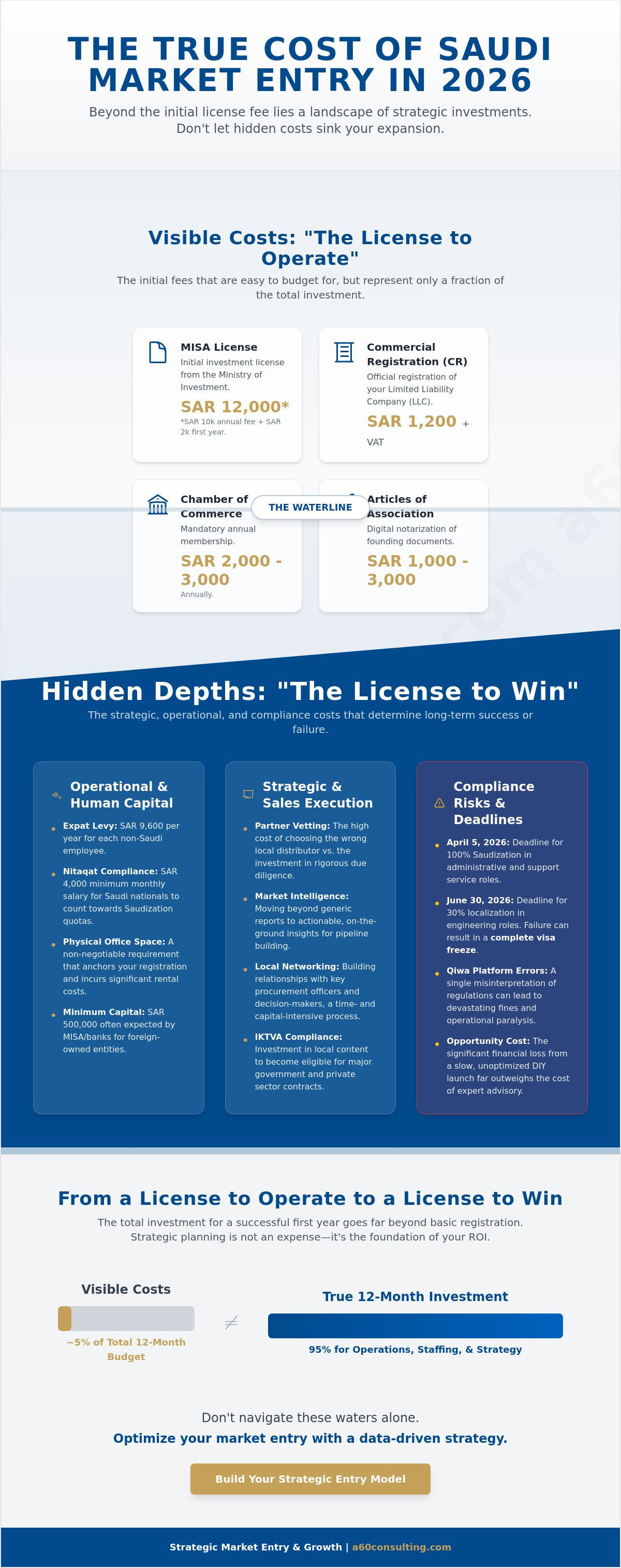
Many international firms approach the Kingdom with a simple checklist of registration fees. They see the SAR 12,000 MISA license cost and assume the primary financial hurdle is cleared. In reality, that figure represents only the tip of a much larger iceberg. To calculate the true cost of entering the saudi arabia market for foreign companies, you have to look beneath the surface at the operational and strategic investments required for long term viability.
The ongoing transformation of Saudi Arabia's economic landscape under Vision 2030 has shifted the cost structure for foreign firms. It's no longer just about paying a fee to exist; it's about investing in a local presence that creates value. We distinguish between a "License to Operate," which is the legal right to be in the country, and a "License to Win," which is the strategic positioning required to capture market share. In 2026, regulatory updates emphasize local content and In-Kingdom Total Value Add (IKTVA). This means companies that don't budget for local integration will find themselves locked out of major government and private sector contracts.
The Three Pillars of Market Entry Budgeting
A realistic 12 month budget must be built on three distinct pillars. The first is Regulatory and Legal, covering the mandatory "entry ticket" costs like Chamber of Commerce subscriptions and Notary fees. The second is Operational and Human Capital. This includes the SAR 800 monthly expat levy and ensuring Saudi employees meet the SAR 4,000 minimum salary required for Nitaqat compliance. The third, and most often ignored, is Strategic and Sales Execution. This covers the cost of building a pipeline, vetting partners, and establishing a brand that resonates with local procurement officers.
Why DIY Entry Often Costs More in the Long Run
Trying to navigate the Saudi market without local expertise often leads to invisible financial leaks. The financial impact of misinterpreting a single regulation on the Qiwa platform can be devastating. For instance, missing the June 30, 2026, deadline for 30% localization in engineering roles doesn't just result in a fine; it can freeze your ability to issue work visas entirely. The opportunity cost of a slow, unoptimized launch far outweighs the initial investment in professional advisory. Building relationships and understanding the nuances of local networking requires a presence that a generic, remote market study simply cannot provide.
Breaking Down the Mandatory Legal and Registration Fees
Securing your legal right to operate is the first tangible milestone in your expansion. While the process has become significantly more streamlined through digital transformation, the cost of entering the saudi arabia market for foreign companies remains a multi-layered financial commitment. In 2026, the primary expense begins with the Ministry of Investment (MISA) license. For most service activities, you'll face an annual service fee of SAR 10,000, plus a SAR 2,000 fee for the first year of issuance. It's vital to recognize that these figures can scale quickly depending on your sector; some specialized licenses reach upwards of SAR 80,000.
Once your MISA license is secured, the Commercial Registration (CR) follows. The standard issuance fee for a Limited Liability Company (LLC) is approximately SAR 1,200, which is subject to a 15% VAT. You'll also need to budget for the Chamber of Commerce membership, which typically ranges between SAR 2,000 and SAR 3,000 annually. According to the U.S. Department of State's investment climate report, the Kingdom's focus on transparency has improved these processes, yet the requirement for a physical office remains a non-negotiable expense that anchors your registration.
A common point of confusion for foreign executives is the minimum capital requirement. While not always legally mandated for every LLC type, MISA and local banks often expect a minimum capital of SAR 500,000 for foreign-owned entities. You don't always need to deposit this entire amount immediately at the SBC stage, but it must be reflected in your Articles of Association. Digital notarization of these articles adds another SAR 1,000 to SAR 3,000 to your initial setup budget.
The 2026 Registration Roadmap
The Saudi Business Center (SBC) now acts as the central hub for your journey. After securing the MISA license, you'll move to Step 2: drafting and notarizing your Articles of Association. This leads to Step 3, where you must address Municipality (Baladiya) and Civil Defence (Wasel) requirements. These aren't just administrative hurdles; they require a physical lease and specific safety upgrades to your office space, which can cost between SAR 50,000 and SAR 100,000 depending on the city and building grade.
Hidden Regulatory Compliance Costs
Compliance doesn't end with registration. Manufacturers must account for the SABER system registration for product certifications, while tech firms need to budget for data privacy and cybersecurity standards set by SDAIA. Additionally, annual professional audits are mandatory for maintaining your license. While these fees are fixed, the efficiency of your setup depends on a regulatory and compliance strategy that avoids unnecessary delays and keeps your operations in good standing from day one.
Strategic Costs: Market Intelligence and Partner Vetting
Legal registration provides the framework to exist, but strategic intelligence determines the capacity to compete. Many organizations falter because they treat the cost of entering the saudi arabia market for foreign companies as a purely administrative line item. They rely on surface level market data that fails to account for the ground level nuances of the Kingdom's 2026 competitive landscape. A comprehensive go-to-market strategy requires a deep dive into sector specific dynamics, which the official Invest Saudi portal identifies as a cornerstone for sustainable investment. Professional fees for specialized feasibility studies typically range from SAR 20,000 to SAR 50,000, reflecting the depth of analysis required to navigate this evolving market.
The financial impact of distributor misalignment is one of the most significant "hidden" costs in the Middle East. Selecting an incompatible partner can lead to years of stagnated growth and complex legal entanglements that are difficult to unwind. At A60 Consulting FZ-LLC, we focus on mitigating this risk by implementing a rigorous vetting process that evaluates potential partners beyond their financial statements. We assess their actual access to B2B decision makers and their alignment with your long term objectives. For a detailed breakdown of this methodology, our Strategic Guide to Distributor Search in the Middle East provides a 2026 framework for identifying partners who can deliver measurable results.
Market Feasibility and Competitive Analysis
Market Feasibility in the context of Saudi Vision 2030 is the analytical process of aligning a company's unique value proposition with the Kingdom's specific economic diversification goals and localized regulatory requirements to ensure long term commercial viability. You need a territory specific roadmap that accounts for regional differences between the industrial hubs of the Eastern Province and the commercial center of Riyadh. Identifying the actual decision makers in large Saudi conglomerates isn't a matter of simple database searching; it requires established local networks. Investing in this intelligence upfront prevents the wasted capital associated with pursuing the wrong market segments or mispricing your offerings against local competitors.
The Financial Value of Local Representation
While establishing a full physical sales office is a significant capital commitment, outsourced local representation offers a more agile alternative. This model allows you to maintain a professional presence and build local trust without the immediate overhead of a large scale facility. Local alliances accelerate the sales cycle by providing immediate credibility and reducing the friction often associated with foreign market entry. Understanding the strategic importance of local representation in the GCC is essential for firms that want to remain competitive while optimizing their initial launch budget.
Operational Reality: Visas, Office Space, and Saudization
Transitioning from legal setup to active operations reveals the recurring cost of entering the saudi arabia market for foreign companies. The Nitaqat system is often the most misunderstood element of this phase. It's not merely a compliance quota; it's a strategic payroll commitment that requires precise calculation. For example, to be counted as a full Saudi employee under Nitaqat purposes, the individual's salary registered with GOSI must be at least SAR 4,000. For international firms, the second employee hired after the General Manager must be a Saudi national, which fundamentally changes your initial hiring budget and organizational structure.
Visa expenses also scale quickly and include several layers of government fees. While the Qiwa platform fee is SAR 2,000 and the annual Iqama residency permit is SAR 650, the real weight lies in the monthly Work Permit Levy, also known as the Expat Levy. You'll pay SAR 700 per month for every foreign employee if their number doesn't exceed your Saudi headcount, rising to SAR 800 if it does. These costs, combined with the SAR 400 monthly dependent levy for expat families, make the Employer of Record (EOR) model an attractive, cost-effective alternative for testing the market before committing to a full scale local entity.
Office space remains a mandatory anchor for your MISA license, as virtual addresses aren't widely accepted for most license types. While virtual office subscriptions range from SAR 8,000 to SAR 15,000, they are often insufficient for long term growth or specific sector requirements. A dedicated commercial office in a business hub like Riyadh typically starts at SAR 50,000 annually and can exceed SAR 100,000. For many, starting with co-working spaces at SAR 20,000 to SAR 30,000 provides the necessary physical footprint while managing initial capital outflow during the first twelve months.
The Human Capital Budget
Beyond base salaries, you must account for GOSI social insurance contributions and mandatory private health insurance for all staff. Bilingual talent and managers with local GCC experience command a significant premium in the current competitive landscape. You should also budget for specific training programs to meet the 100% localization requirement for 69 administrative support roles, which became effective on April 5, 2026. This investment in local talent isn't just a regulatory hurdle; it's a prerequisite for building a sustainable organizational culture in the Kingdom.
Physical Presence and Logistics
Physical product manufacturers must factor in the cost of warehousing and the ongoing SABER system registration fees. Even for service firms, localized marketing collateral is a critical investment. Translating your sales pitch isn't just about language; it's about cultural alignment and professional presentation. If you're looking to optimize these operational expenses while maintaining a high impact presence, our local representation and sales management services provide the strategic depth needed to scale without the traditional overhead of a full local team from day one.
Optimizing Your ROI: A60 Consulting FZ-LLC’s Strategic Entry Model
The transition from calculating expenses to generating revenue defines the success of any expansion. While the cost of entering the saudi arabia market for foreign companies is often viewed through the lens of mandatory fees, the most significant financial gains are found in strategic optimization. A60 Consulting FZ-LLC bridges the gap between high level strategy and ground level execution. We provide a structured roadmap where project based fees replace the ambiguity of a DIY approach. This ensures you aren't just paying for a license, but for a measured path toward measurable commercial results.
Our model prioritizes capital efficiency by offering retainer based sales representation as an alternative to immediate, full time local hiring. This approach allows you to bypass the immediate pressure of Nitaqat quotas and the associated recruitment overhead during your initial market testing phase. By aligning our incentives through success based commissions, we ensure that our growth is inextricably linked to yours. We leverage 30 years of regional experience to help you avoid the financial mistakes that often come from a lack of local context, such as misjudging the length of the Saudi procurement cycle or overcommitting to fixed assets too early.
Case Study: Strategic Savings
In a recent engagement, a mid sized tech firm achieved 35% savings in their first year setup costs by utilizing our local representation model instead of immediate full scale incorporation. By delaying the commitment of a dedicated commercial lease and utilizing our established networks, they reduced their time to first contract by four months. This efficiency was made possible through professional partner vetting, which eliminated the risk of a costly distributor misalignment. For a deeper look at this methodology, you can explore The 2026 GCC Market Entry Strategy: A Blueprint for strategic regional expansion.
Next Steps for Your Saudi Expansion
Successful market entry requires moving beyond generic data to industry specific intelligence. The first step in minimizing the cost of entering the saudi arabia market for foreign companies is a comprehensive market feasibility study tailored to your specific sector and service offering. A dedicated sales management presence in the Kingdom provides the stability and cultural nuance needed to build long term trust with Saudi B2B decision makers. We invite you to move from theory to implementation by taking the next step in your journey. You can schedule a strategy call with A60 Consulting FZ-LLC today to define your roadmap and secure your place in the Kingdom's future.
Building a Capital-Efficient Roadmap for 2026
Entering the Saudi market in 2026 is no longer a matter of simply paying for a license; it's a strategic commitment to the Kingdom's long term vision. We've explored how the cost of entering the saudi arabia market for foreign companies is shaped by both visible regulatory fees and the invisible operational weight of Saudization and local presence. Success belongs to those who view these requirements as an investment in local integration rather than a mere administrative hurdle. By prioritizing rigorous partner vetting and agile sales management, you can protect your capital while building a foundation for scalable growth.
A60 Consulting FZ-LLC offers the strategic depth needed to bridge the gap between registration and ROI. With 30+ years of regional experience, we're experts in tech and industrial market entry, providing a performance-linked sales execution model that aligns our success with yours. Don't leave your expansion to chance or generic market studies. Partner with A60 Consulting FZ-LLC to scale your business in Saudi Arabia and turn the complexities of the 2026 landscape into your competitive advantage. The opportunities within the Kingdom are vast, and the right strategic partnership is the key to unlocking them.
Frequently Asked Questions
What is the minimum capital required to start a company in Saudi Arabia in 2026?
Minimum capital for a foreign owned LLC is typically SAR 500,000. While some service activities allow for capital as low as SAR 25,000, MISA and local banks often expect the higher threshold to ensure financial stability. You don't always need to deposit the full amount upfront, but it must be declared in your Articles of Association. This requirement ensures that companies entering the Kingdom possess the necessary liquidity to sustain their initial operational phase.
How much does a MISA investment license cost for a foreign tech company?
A MISA investment license for a tech company carries a standard annual service fee of SAR 10,000. You'll also pay an additional SAR 2,000 for the first year of issuance. These fees are fixed for most service activities, though specialized sectors might see higher rates. It's essential to budget for these as recurring annual costs rather than one time setup expenses to maintain your legal right to operate within the Kingdom.
Can a foreigner own 100% of a company in Saudi Arabia?
Foreign investors can own 100% of their company in the vast majority of Saudi business sectors. This policy, driven by Vision 2030, eliminated the previous requirement for a local partner in most industries. While a few restricted sectors still require a Saudi majority, the tech and industrial landscapes are fully open. This level of control allows international firms to implement their global corporate culture and strategic objectives without local interference.
What are the ongoing compliance costs for foreign firms in the Kingdom?
Ongoing compliance involves corporate income tax at 20% of net adjusted profits and a standard VAT rate of 15%. You must also account for the monthly Work Permit Levy of SAR 700 to SAR 800 per foreign employee. These recurring expenses represent a significant portion of the total cost of entering the saudi arabia market for foreign companies. Annual professional audits and Chamber of Commerce renewals at SAR 2,000 are also mandatory.
Is it cheaper to use a distributor or set up a local entity in Saudi Arabia?
Using a distributor is often cheaper initially, but a local entity offers a higher ROI through direct market control. A distributor eliminates the SAR 50,000 office rental cost and immediate Saudization requirements. However, the long term cost of entering the saudi arabia market for foreign companies via a distributor includes lost margin and reduced brand visibility. A local entity is the superior choice for firms planning a multi year strategic presence and high volume sales.
How does Saudization (Nitaqat) affect the cost of doing business?
Saudization increases your payroll budget by requiring a minimum salary of SAR 4,000 for any Saudi national to count toward your Nitaqat quota. If you fail to meet these ratios, the government may freeze your ability to issue or renew expat work visas. This system forces companies to invest in local talent development. It's a strategic cost that requires careful headcount planning to avoid operational bottlenecks and sudden increases in labor expenses.
What is the cost of an office space requirement for a MISA license?
Office space typically costs between SAR 50,000 and SAR 100,000 annually in major business districts like Riyadh or Jeddah. A physical office is a mandatory requirement for obtaining a MISA license and Commercial Registration. While virtual offices exist for SAR 8,000 to SAR 15,000, they often don't meet the criteria for specific business activities. You'll also need to budget for Civil Defence safety upgrades and municipal service charges attached to the property.
How long does the Saudi market entry process typically take?
The setup process generally takes between 3 and 6 months to reach full operational readiness. While digital platforms like the Saudi Business Center can issue a Commercial Registration in just a few days, opening a corporate bank account and securing visas takes longer. You should plan for a multi stage timeline that includes document attestation, physical office setup, and the initial recruitment of your Saudi and expat staff to ensure a smooth launch.