

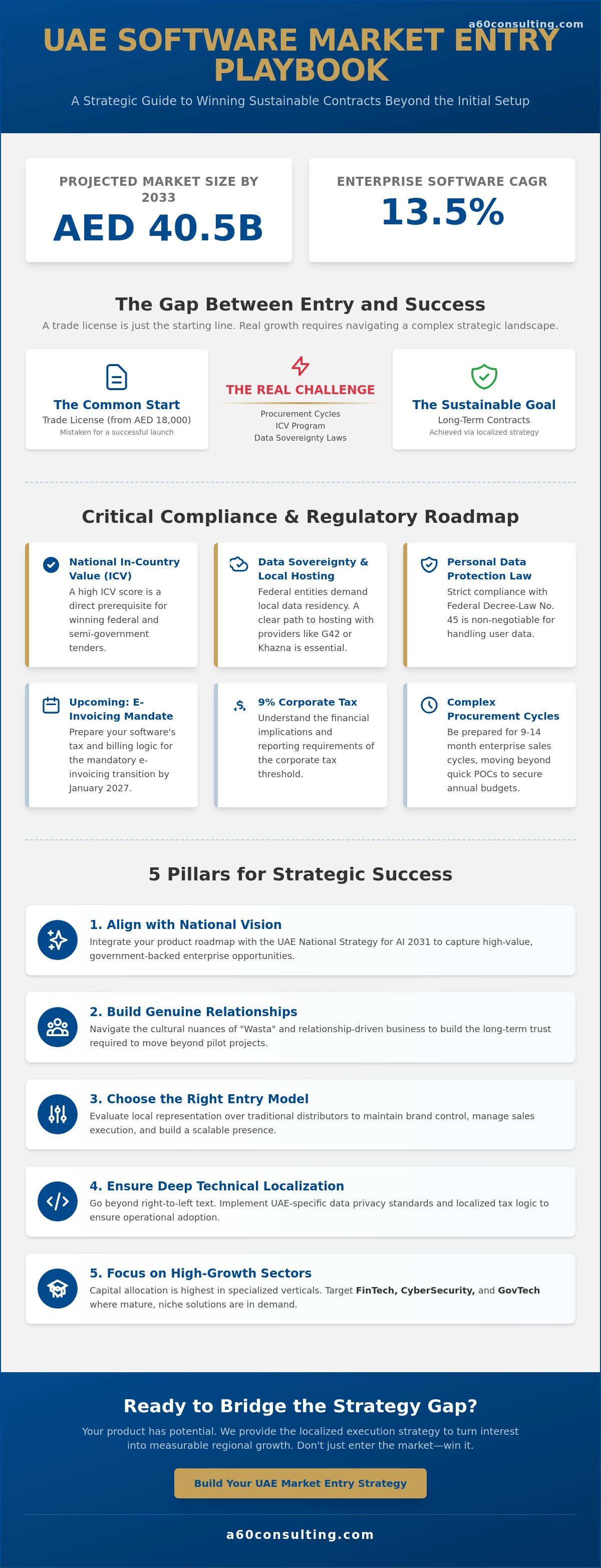
Obtaining a trade license for as little as AED 18,000 is often mistaken for a successful launch, but a legal permit is merely a ticket to the starting line. For many leaders, the real challenge of uae market entry for software companies begins when they encounter the rigid barriers of government procurement and the 9% corporate tax threshold. It’s natural to feel frustrated by the shifting requirements of the National In-Country Value (ICV) Program or the complexities of Federal Decree-Law No. 45 regarding personal data protection. You know your product solves a critical problem; however, without a localized execution strategy, it's easy to stall in a market projected to exceed AED 40.5 billion by 2033.
This article provides the strategic depth required to bridge the gap between initial setup and winning sustainable regional contracts. You'll gain a clear roadmap for navigating the 2026 regulatory environment, from child digital safety laws to the upcoming January 2027 e-invoicing mandates. We'll explore how to identify performance-linked partners and build a scalable presence that delivers measurable growth instead of just overhead.
Key Takeaways
- Understand why successful expansion requires aligning your product roadmap with the UAE National Strategy for AI 2031 to capture high-value enterprise opportunities.
- Learn to bridge the gap between initial technical interest and full-scale implementation by mastering uae market entry for software companies within complex procurement cycles.
- Identify the critical role of the National In-Country Value (ICV) program and how a high score directly impacts your ability to win federal and semi-government tenders.
- Evaluate the strategic benefits of local representation over traditional distributor models to maintain control over your brand and sales execution.
- Navigate the cultural nuances of "Wasta" and relationship-driven business to move beyond temporary pilots toward sustainable, long-term regional growth.
The UAE Software Market in 2026: A Strategic Overview
The UAE software market in 2026 exists in a state of high-velocity transformation, driven largely by the National Strategy for AI 2031. This federal vision aims to position the country as a global leader in artificial intelligence, creating a demand for sophisticated solutions that can automate the non-oil Economy of the United Arab Emirates. However, many founders misinterpret this enthusiasm for easy sales. The "hype" of the market often masks the reality of enterprise sales cycles that typically span 9 to 14 months for significant contracts. Successful uae market entry for software companies requires a shift in perspective: you aren't just selling a tool; you're participating in a national digital transformation.
A broad gcc market entry strategy often fails because it ignores the UAE's specific sovereign data requirements. In 2026, the shift toward local cloud hosting is absolute. Federal entities and large enterprises now prioritize vendors who can demonstrate compliance with localized data residency through providers like G42 or Khazna. If your software doesn't have a clear path to local hosting, you'll find the most lucrative procurement doors remain closed.
The Digital UAE Initiative and Software Adoption
Federal digital projects are the primary engine of demand. The Telecommunications and Digital Government Regulatory Authority (TDRA) acts as the gatekeeper, ensuring that digital services meet strict interoperability and security standards. High-growth sectors aren't limited to generic business tools. FinTech, CyberSecurity, and GovTech are seeing the highest capital allocation. By 2026, the UAE enterprise software market is projected to grow at a CAGR of 13.5%, but this capital is reserved for those who can integrate with the existing federal digital infrastructure.
Market Maturity vs. Competitive Density
The UAE market has matured beyond the need for generic SaaS products. While the competitive density for standard CRM or ERP systems is high, there's a significant gap in specialized industrial software and AI-powered niche solutions. Decision-makers in 2026 are highly analytical. They prioritize "provenance" and international case studies that demonstrate a track record of stability. A "wait and see" approach isn't viable anymore. With the enterprise software market expected to reach AED 40.5 billion by 2033, the window for establishing a foundational presence is closing for those who don't act with strategic precision today.
Evaluating Product-Market Fit: Why Adoption Trumps Interest
Achieving a successful Proof of Concept (POC) is a common milestone for international firms, yet it rarely guarantees a purchase order. In the UAE, the gap between technical interest and operational adoption is where many initiatives fail. For a robust uae market entry for software companies, you must recognize that interest is often a social currency, while adoption is a financial commitment. Moving from a pilot to a multi-year contract requires more than a functional demo; it demands an alignment with the client's internal risk assessment and long-term digital roadmap. Developing a tailored market entry strategy ensures your product is positioned correctly from the first meeting.
Localization in 2026 extends far beyond right-to-left text alignment. It involves deep integration with the UAE's data privacy regulations and ensuring your software can handle localized tax logic, such as the upcoming January 2027 e-invoicing mandate. Without these technical foundations, your product remains a foreign entity that's difficult for local teams to support. Mastering the nuances of b2b sales gcc is essential to bridge these gaps and turn initial curiosity into a scalable regional presence.
Procurement Nuances for Software and SaaS
The decision-making unit (DMU) in UAE federal entities is multifaceted. While the IT department provides the technical "buy-in," the financial "budget allocation" is controlled by separate committees that operate on rigid annual cycles. These committees often prioritize "tried and tested" solutions with local references over disruptive startups. If you don't have a localized case study, your software may be perceived as a high-risk investment, regardless of its technical superiority.
Technical Integration and Local Support Expectations
Government and sensitive enterprise sectors frequently demand "on-premise" or private cloud deployments due to sovereignty concerns. This preference can significantly impact your margins if you haven't accounted for the cost of 24/7 local technical support. In 2026, clients expect immediate responsiveness and a physical presence to manage implementation hurdles. Your ability to integrate seamlessly with existing legacy systems determines whether you'll achieve long-term contract retention or be replaced during the next budget cycle.
Selecting Your Entry Model: Direct Sales vs. Local Partnerships
Many organizations treat the acquisition of a trade license as the finish line, but for software firms, the real work begins with selecting a sustainable vehicle for revenue growth. In the UAE, you generally face a choice between direct legal incorporation or leveraging a strategic partnership. While a basic free zone setup might cost between AED 18,000 and AED 35,000, the true expense lies in the high-caliber sales talent required to navigate the 14-month procurement cycles mentioned earlier. A misplaced hire or a passive partner at this stage can lead to a failed uae market entry for software companies before the first renewal date.
Direct entry offers total control, yet it carries the highest risk and upfront capital requirement. Conversely, the right partnership model allows for rapid testing of the market without committing to the full overhead of a mainland office. The decision shouldn't be based on administrative ease; it must be based on which model provides the most direct path to the decision-makers in your specific sector.
The Limitations of Traditional Distribution
Generic distributors often treat software as a line item in a catalog rather than a solution requiring active advocacy. This leads to "brand collection," where a local partner holds your rights but lacks the technical depth to drive implementation. To avoid this, a rigorous distributor search middle east must focus on partners who possess existing relationships within your specific vertical, whether that's FinTech or GovTech. Software isn't a commodity. It requires active selling and technical vetting that generic distributors simply don't provide.
Outsourced Sales Representation: The Agile Alternative
For companies seeking agility without the immediate overhead of a full mainland subsidiary, outsourced sales representation offers a compelling alternative. This model functions as a "Regional Sales Office as a Service," providing immediate access to consultants with 30 or more years of local experience. By utilizing local representation gcc experts, you ensure that your interests are defended in every meeting. Interests remain aligned through performance-linked structures, ensuring that growth is measured by actual contracts signed rather than just activities logged.
Navigating UAE Compliance: ICV and Data Sovereignty
While establishing a legal presence is a foundational step, compliance is the mechanism that converts a trade license into a contract-winning asset. A common misconception among international firms is that holding global certifications like GDPR or SOC2 is sufficient for the local market. While these standards are respected, they don't replace the specific requirements of Federal Decree-Law No. 45 of 2021 on the Protection of Personal Data. For a successful uae market entry for software companies, you must treat local regulatory alignment as a strategic differentiator rather than a mere administrative checkbox.
Ignoring the nuances of the UAE Cyber Security Council’s regulations can lead to immediate disqualification from government tenders. These frameworks prioritize the security of "critical infrastructure" and demand a level of transparency that standard international agreements often lack. If your compliance posture is not localized, you risk losing momentum during the final stages of procurement when technical audits become most rigorous.
The In-Country Value (ICV) Factor
The National In-Country Value (ICV) Program is a government initiative that gives preference in tenders to companies that contribute to the local economy. For software firms, your ICV score is a decisive factor in competitive rankings for federal and semi-government contracts. Since ICV certificates are valid for 14 months from the date of your audited financial statements, maintaining a high score requires consistent local investment. You can improve this score by hiring Emirati nationals, utilizing local procurement for your operations, and establishing a clear regional spend footprint. If you need assistance navigating these requirements, our regulatory and compliance advisory services provide the necessary local expertise.
Data Privacy and Sovereignty Laws
The Federal Decree-Law on the Protection of Personal Data (PDPL) aligns the UAE with international standards while introducing specific local oversight through the UAE Data Office. For software providers, particularly those in the cloud space, data residency is a non-negotiable requirement for sensitive sectors. Federal Decree-Law No. 26 of 2025 on Child Digital Safety further complicates this by imposing strict obligations on platforms used by those under 18. To remain compliant, most software vendors must establish local cloud partnerships with providers like G42, Khazna, or Etisalat Cloud to ensure all personal data remains within the country’s borders.
To ensure your software meets 2026 residency standards, follow this checklist:
- Verify that all personal data processing complies with the PDPL and the UAE Data Office guidelines.
- Audit your hosting architecture to ensure data residency within UAE-based data centers for sensitive government workloads.
- Implement the specific digital safety protocols mandated by Federal Decree-Law No. 26 of 2025 if your software serves younger users.
- Secure an ICV certificate to participate in government procurement and maximize your competitive weighting.
Scaling Your Software Presence: Implementation and Sales Management
Strategy serves as the blueprint, but disciplined execution is what ultimately constructs a sustainable business. For many international firms, the transition from a market entry plan to actual revenue generation is where the most significant friction occurs. Successful uae market entry for software companies relies on a calculated 5-step transition: validating specific localization needs, selecting a high-caliber representation model, initiating trust-based lead generation, navigating the "Wasta" network, and managing the long-term implementation cycle. This process ensures that your presence isn't just a legal formality but a functional sales engine.
In the context of business culture middle east, "Wasta" represents the social capital and trust required to navigate complex organizational hierarchies. It isn't merely about "influence"; it's about the professional credibility your representative carries into the boardroom. For a software manufacturer, this credibility often determines whether a proposal reaches the technical committee or remains stalled at the administrative gate. A60 Consulting FZ-LLC acts as this strategic bridge, providing the localized authority needed to move high-value software solutions through the procurement pipeline.
Building and Managing a Local Sales Pipeline
Software negotiations in the UAE are rarely concluded through digital channels alone. High-stakes contracts, particularly those exceeding AED 500,000, require a consistent physical presence to address technical concerns in real-time. Lead generation strategies must blend digital precision with traditional networking, focusing on sector-specific events and direct outreach to C-suite decision-makers. Sales enablement tools should be adapted to track these long-cycle interactions, ensuring that every touchpoint reinforces the reliability of your brand during the 14-month procurement windows common in 2026.
Measurable Success: Transitioning to Sustainable Growth
A successful first year in the UAE isn't solely defined by immediate revenue. It's measured by the quality of the pipeline and the depth of your integration within the local ecosystem. Key performance indicators (KPIs) should include the number of qualified leads in government sectors and the successful completion of initial localized pilots. Our approach at A60 Consulting FZ-LLC emphasizes accountability through a model that combines strategic oversight with performance-linked outcomes. This structure ensures that our goals are perfectly aligned with your regional expansion. Partner with A60 Consulting FZ-LLC for your UAE sales execution to transform your strategic vision into a measurable, scalable market share.
Building a Sustainable Legacy in the UAE Software Ecosystem
The transition from a market observer to a regional leader requires more than technical excellence; it demands a deep integration with the UAE’s strategic vision. We've explored how navigating the National Strategy for AI 2031 and mastering the nuances of ICV scores can transform regulatory hurdles into competitive advantages. Success in 2026 isn't found in the trade license itself, but in the disciplined execution of a localized sales strategy that respects the 14-month procurement cycle. A successful uae market entry for software companies depends on bridging the gap between having a superior product and establishing the professional trust required to win federal contracts.
A60 Consulting serves as your dedicated partner in this journey, bringing more than 30 years of regional expertise to the table. As specialists in complex software and industrial technology, we don't just offer advice; we provide a performance-linked sales management model that ensures our success is tied directly to your growth. This systematic approach allows you to scale with confidence while maintaining full control over your brand’s regional narrative. Secure your UAE software market entry strategy with A60 Consulting and move beyond initial interest toward measurable, long-term impact.
Frequently Asked Questions
Do software companies need a physical office to sell to the UAE government?
Federal procurement and semi-government entities effectively require a physical presence, either through a mainland office or a certified local partner. While you can sell to private firms remotely, government contracts prioritize vendors with "boots on the ground" to ensure accountability and technical support. This physical proximity is a cornerstone of successful uae market entry for software companies targeting the public sector.
What is the In-Country Value (ICV) certificate and is it mandatory for software?
The ICV certificate is a score reflecting your economic contribution to the UAE and is essential for winning government tenders. It isn't mandatory for basic business operations, but it provides a critical competitive weighting in the procurement process. Your score is calculated based on factors like local procurement, investment in the country, and the employment of Emirati nationals.
Can I sell SaaS in the UAE using international cloud servers like AWS or Azure?
You can use international servers for general commercial data, but personal data must comply with Federal Decree-Law No. 45 of 2021 (PDPL). Sensitive government data or information related to critical infrastructure must reside on local servers such as G42, Khazna, or Etisalat Cloud. Meeting these residency requirements is non-negotiable for vendors seeking long-term federal contracts.
How long is the average enterprise software sales cycle in the UAE?
The average enterprise sales cycle typically spans 9 to 14 months for significant contracts. This timeline reflects the multi-stage nature of UAE procurement, which includes technical vetting, financial budget allocation, and the essential relationship-building phase. Companies must plan their cash flow to accommodate these extended windows rather than expecting immediate returns.
What is the best legal structure for a software firm entering the UAE?
The optimal structure depends on your primary client base. Free zones like DIFC or ADGM offer 100% foreign ownership and are excellent for regional hubs and private sector sales. However, for direct government work, a mainland license or a strategic local representation model is often more effective. This allows for a deeper uae market entry for software companies without the immediate overhead of a full mainland subsidiary.
How does the UAE Cyber Security Council regulate foreign software products?
The UAE Cyber Security Council enforces strict technical standards for software used in critical sectors like finance, energy, and government. Foreign products must undergo rigorous audits to ensure they align with the National Cyber Security Strategy and don't compromise sovereign data. Compliance with these localized security frameworks is a prerequisite for any vendor aiming for high-level enterprise integration.
Is a local distributor enough to manage my UAE market entry?
A generic distributor is rarely sufficient for complex software that requires active advocacy and technical expertise. Most distributors manage broad catalogs and lack the specialized focus needed to navigate 14-month sales cycles or build the necessary "Wasta" with C-suite decision-makers. Successful entry usually requires a dedicated sales execution partner who provides localized representation and active pipeline management.