
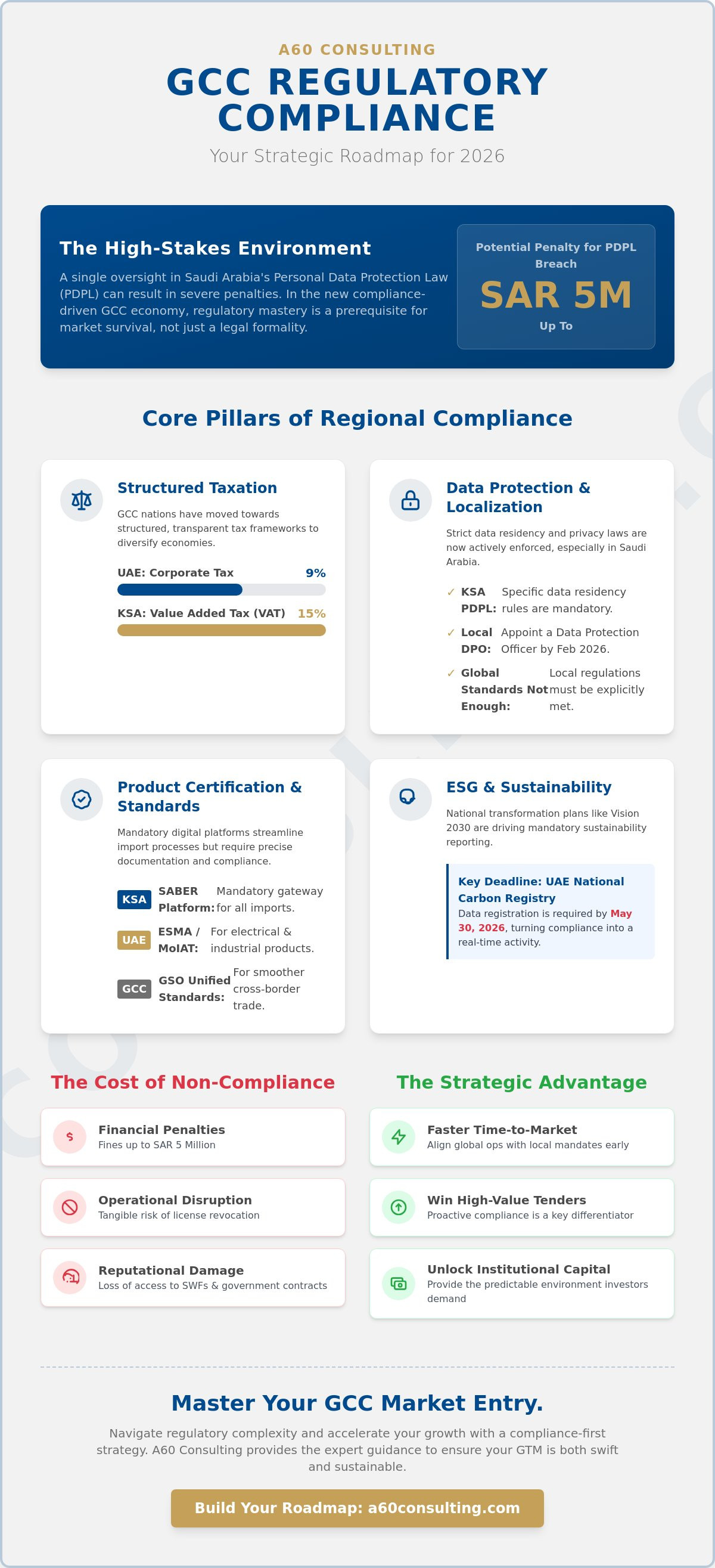
In 2026, a single oversight in Saudi Arabia's Personal Data Protection Law can cost your business up to SAR 5 million in penalties. It's a sobering figure that highlights why gcc regulatory compliance has evolved from a back-office administrative task into a core pillar of market survival. You likely recognize that the Gulf region represents a critical frontier for growth, yet the fragmentation between six different nations often creates a paralyzing level of complexity for international leadership teams.
We've designed this strategic guide to help you master these shifting frameworks, ensuring your market entry is both swift and sustainable. You'll gain a clear understanding of the transition toward structured taxation, such as the 15% VAT in Saudi Arabia and the 9% corporate tax in the UAE. We'll also provide a roadmap for mandatory ESG disclosures and data localization requirements, allowing you to align global operations with local mandates while reducing your overall time-to-market.
Key Takeaways
- Understand why the shift toward compliance-driven economies makes regulatory mastery a prerequisite for market longevity rather than a mere legal hurdle.
- Learn how to navigate the jurisdictional overlap between mainland authorities and specialized free zones to prevent operational delays.
- Discover a phased roadmap for gcc regulatory compliance that prioritizes rigorous due diligence and product certification before your official launch.
- Identify how a proactive compliance posture serves as a strategic differentiator when bidding for high-value tenders with sovereign wealth funds.
- Align your global operations with specific UAE and Saudi Arabian mandates early in the GTM phase to significantly reduce your time-to-market.
The Evolving GCC Regulatory Landscape in 2026
The Gulf Cooperation Council (GCC) is no longer a region where business is conducted through informal agreements or loosely defined protocols. By 2026, gcc regulatory compliance has matured into a multi-layered framework of national and regional mandates that demand high levels of operational discipline. We're witnessing a historic shift from "oil-reliant" to "compliance-driven" economies. This transition isn't merely a change in administrative policy; it represents a fundamental restructuring of the Gulf's value proposition to the world. Regulators have moved beyond basic oversight to focus on sophisticated transparency, anti-money laundering (AML) initiatives, and mandatory sustainability reporting. GCC regulatory compliance serves as a strategic enabler for foreign direct investment in 2026, providing the predictable environment that institutional capital demands.
The Drivers of Change: Vision 2030 and Beyond
National transformation plans, led by Saudi Arabia’s Vision 2030, act as the primary engine for this regulatory acceleration. These initiatives have catalyzed a move toward regional standardization, making it easier for compliant firms to scale across borders. Digital transformation plays a central role here. Systems like Saudi Arabia’s "Fatoora" for e-invoicing and the UAE’s national carbon registry, which requires data registration by May 30, 2026, have turned enforcement into a real-time activity. This year marks a turning point where gcc regulatory compliance is no longer a periodic audit but a continuous, digital-first operational requirement for any firm engaged in cross-border trade.
The Consequences of Non-Compliance
The cost of oversight has never been higher. Regulatory bodies have moved from the framework implementation phase into proactive enforcement. In Saudi Arabia, breaches of the Personal Data Protection Law (PDPL) can now result in fines reaching SAR 5 million. Beyond financial penalties, the risk of license revocation is a tangible threat for entities that fail to align with local mandates. We often see that the "reputational cost" is even more damaging. In a region where business is built on long-term trust and partnership, a compliance failure can permanently close doors to sovereign wealth funds and large-scale government contracts.
International firms entering the Saudi market frequently stumble by assuming that global standards automatically satisfy local requirements. A common pitfall involves ignoring specific data residency rules or failing to appoint a local Data Protection Officer (DPO) as required by the updated Executive Regulations effective February 2026. These mistakes don't just delay market entry; they signal a lack of commitment to the host nation’s strategic goals, making future sales execution significantly more difficult.
Core Pillars of Regional Compliance: UAE, Saudi Arabia, and Beyond
Success in the Gulf requires a deep understanding of the specific agencies governing your sector. In the United Arab Emirates, the Ministry of Industry and Advanced Technology (MoIAT) oversees industrial standards, while the Saudi Standards, Metrology and Quality Organization (SASO) dictates the rules for the Kingdom. Central to these efforts is the GCC Standardization Organization (GSO), which works to unify technical regulations across the member states. Trade agreements between these nations increasingly favor products that meet unified GSO standards, allowing for smoother cross-border movement once the initial entry point is secured. Aligning your product specifications with these regional standards shouldn't be an afterthought. It's a foundational step in your Go-To-Market (GTM) phase. If you're planning a launch, securing product certification in the UAE is a strategic necessity that prevents costly customs delays and ensures your gcc regulatory compliance remains intact from day one.
Product Certification and Standards (ESMA & SABER)
The SABER platform is the mandatory gateway for all Saudi Arabian imports. It's where you'll register products and obtain the required conformity certificates. It's a digital system designed to speed up clearance, but it requires precise documentation and technical data. Similarly, electrical and industrial products in the UAE must meet ESMA requirements to enter the market. Understanding these Import regulations in Saudi Arabia and the UAE helps you avoid the common trap of localizing your product only after it reaches the border.
Data Privacy and Cybersecurity Mandates
Digital sovereignty is a non-negotiable priority in 2026. The UAE Federal Decree-Law No. 45 of 2021 and the Saudi Personal Data Protection Law (PDPL) represent the gold standard for regional data governance. Software firms and cloud providers must now navigate strict data residency requirements, as localizing sensitive data within the host country is often mandatory. For instance, the full implementation of Oman's PDPL on February 5, 2026, requires organizations processing citizen data to appoint a Data Protection Officer. You can find more detail on these shifting requirements in our guide to data privacy laws in the GCC. If you're unsure how these mandates affect your specific tech stack, our team can help you design a compliant operational architecture that supports long-term growth.
Managing Regulatory Fragmentation Across the Gulf
Navigating the Gulf requires recognizing that while the bloc is unified in its long-term vision, the regulatory execution remains deeply national. The GCC economic outlook highlights a period of intense diversification, but this has led to a surge in country-specific mandates that often overlap or conflict. We see this most clearly in the tension between regional integration and national sovereignty. A "one-size-fits-all" approach to gcc regulatory compliance fails in the Middle East because it ignores the specific legal nuances that distinguish a Riyadh-based operation from one in Dubai or Muscat. Success depends on your ability to harmonize these differing requirements into a single, cohesive operational strategy.
The Regional Headquarters (RHQ) mandate in Saudi Arabia is perhaps the most significant example of this fragmentation. Since the start of 2024, and with even more proactive enforcement in 2026, international firms seeking to bid on government contracts exceeding SAR 1 million must establish their regional base within the Kingdom. This isn't just a physical relocation; it's a fundamental shift in how you manage gcc regulatory compliance across your entire portfolio. It forces leadership teams to make a strategic choice between established hubs and the rapidly growing Saudi market, often requiring a total redesign of corporate governance structures.
Free Zones vs. Onshore Compliance
Free zones in the UAE offer attractive benefits, such as 100% foreign ownership and specialized legal frameworks like those found in the DIFC or ADGM. However, these benefits often come with a trade-off. While these zones are ideal for international tech firms, they limit your ability to trade directly with the "onshore" mainland or participate in government procurement. If your business model relies on public sector tenders, an onshore license is usually necessary. We help our partners conduct a strategic analysis to determine which jurisdiction best fits their specific goals, ensuring that their legal structure doesn't become a bottleneck for sales execution.
Local Content and In-Country Value (ICV)
By 2026, local content requirements have become a mandatory pillar of compliance rather than a voluntary preference. The UAE’s In-Country Value (ICV) program and Saudi Arabia’s IKTVA (In-Kingdom Total Value Add) framework are now decisive factors in contract bidding. These programs measure your economic contribution through local hiring, regional procurement, and domestic manufacturing. If your ICV score is low, your chances of winning a B2B tender with a sovereign entity are virtually zero. We provide strategic compliance advisory to help you optimize these scores, turning local content requirements into a competitive advantage during the sales process.
Building a Compliance-First Market Entry Roadmap
A successful market entry isn't about speed. It's about structural integrity. We advocate for a phased approach where gcc regulatory compliance is integrated into the earliest stages of planning rather than treated as a final administrative hurdle. Phase 1 begins with rigorous due diligence to assess the feasibility of your business model against local laws. Feasibility isn't just about market size; it's about the cost of alignment. If a product requires a complete technical redesign to meet GSO requirements, that must be known before capital is committed. Phase 2 focuses on product localization and certification, while Phase 3 involves vetting partners through a strict compliance audit. By Phase 4, you've established a system for ongoing monitoring to catch regulatory shifts. Finally, Phase 5 involves leveraging local representation in the GCC to manage direct engagement with authorities, ensuring your interests are protected on the ground.
Vetting Partners for Regulatory Alignment
Your distributor’s compliance record is often your biggest hidden liability. If a local partner bypasses a certification requirement to save time, the legal and reputational fallout lands squarely on your brand. We recommend a distributor search in the Middle East that prioritizes regulatory vetting over mere sales volume. Agreements must include specific trade compliance clauses that allow for immediate termination in the event of a breach. This proactive stance ensures that your gcc regulatory compliance remains consistent, even when operations are handled by third parties. It's about building a partnership where both sides understand the high stakes of non-compliance.
Documentation and Audit Readiness
Authorities in the UAE and Saudi Arabia have streamlined their digital audit processes, meaning they can verify your records in real-time. Preparing for unannounced inspections is now a routine part of doing business. You need a "Golden Record" of all compliance documentation, accessible instantly to local authorities. For firms processing personal data, this includes having your Data Protection Officer (DPO) records finalized by the February 5, 2026 deadline set by Oman's regulations. Local sales offices play a vital role here, maintaining daily regulatory hygiene and ensuring every transaction mirrors the strategic standards set at the global level. This level of readiness transforms an audit from a crisis into a routine validation of your operational excellence.
If you're ready to bridge the gap between strategy and execution, our team can help you build a customized compliance roadmap for your 2026 expansion.
Strategic Compliance as a Competitive Advantage
Viewing gcc regulatory compliance solely as a defensive measure is a tactical error that limits your market potential. In a region where sovereign wealth funds and massive state-owned enterprises drive the majority of high-value contracts, compliance is your most potent tool for building trust. These entities don't just look for vendors; they seek long-term partners who demonstrate a sophisticated understanding of the local regulatory environment. A robust compliance posture acts as a powerful differentiator in competitive B2B sales tenders, often outweighing price considerations. When you prove that your operations are fully aligned with national goals like Saudi Vision 2030 or the UAE’s sustainability mandates, you're not just following rules; you're signaling your commitment to the region’s future.
The A60 Consulting approach focuses on bridging the gap between high-level strategy and the granular realities of daily execution. We believe that compliance shouldn't slow you down. Instead, it should provide the structural discipline needed for sustainable growth. By integrating regulatory requirements into your sales and operational workflows, we help you avoid the "compliance drag" that often hampers international firms. This proactive alignment ensures that your business remains agile, allowing you to pivot quickly as new mandates emerge in the 2026 landscape. Ultimately, local expertise is the only tool capable of turning these complex frameworks into a measurable business advantage.
The A60 Advantage: 30 Years of Regional Experience
Our methodology is built on three decades of navigating the specific nuances of the Gulf markets. We understand that gcc regulatory compliance often involves "grey areas" where the written law meets local administrative practice. We don't just offer theoretical advice; we act as your regional sales office to manage the implementation of these standards on the ground. This hands-on involvement allows us to integrate regulatory advisory into a broader GCC market entry strategy, ensuring that your compliance posture supports your revenue targets rather than contradicting them.
Next Steps for Your GCC Expansion
Success in 2026 requires an honest assessment of your current readiness. Are your data processing protocols ready for the proactive enforcement phases in Saudi Arabia and Oman? Does your product certification strategy account for the latest GSO standards? We invite you to schedule a strategic consultation with our regional experts to diagnose potential bottlenecks before they impact your bottom line. Our team will help you build a roadmap that prioritizes both speed-to-market and operational excellence. Partner with A60 Consulting for your GCC market entry and transform regulatory complexity into your greatest competitive strength.
Securing Your Future in the Gulf Market
The 2026 landscape demands a fundamental shift from reactive legal management to proactive strategic alignment. We've seen how gcc regulatory compliance has evolved into a core differentiator for firms seeking to win high-value contracts and build lasting trust with regional sovereign entities. Success in this environment depends on your ability to bridge the gap between global operational standards and the specific, shifting mandates of the UAE and Saudi Arabia. It's about turning a perceived barrier into a measurable business advantage.
With 30 years of regional expertise and a strategic presence across both the UAE and Saudi Arabia, A60 Consulting understands the nuances of sales execution within these frameworks. We've built a proven track record helping complex product manufacturers navigate these waters with professional calm and methodological rigor. It's time to move beyond the logistical hurdles and start viewing these regulations as a roadmap for sustainable growth. Navigate GCC compliance with A60 Consulting’s strategic entry blueprint and ensure your market entry is built on a foundation of operational excellence.
Frequently Asked Questions
What are the main regulatory bodies in the GCC?
The primary bodies include the Ministry of Industry and Advanced Technology (MoIAT) in the UAE and the Saudi Standards, Metrology and Quality Organization (SASO) in Saudi Arabia. At a regional level, the GCC Standardization Organization (GSO) coordinates technical regulations across all member states. Financial sectors are overseen by national entities like the Securities and Commodities Authority (SCA) in the UAE and the Capital Market Authority (CMA) in Saudi Arabia.
Do I need a local partner to be compliant in Saudi Arabia?
You don't always need a local shareholder for 100% ownership, but local representation is often a practical necessity for gcc regulatory compliance. For instance, specific activities or government procurement require a physical presence or a Regional Headquarters. We help identify where a local partner or representative is strategically required to manage authority engagement and ensure your operations mirror local legal expectations.
How long does it typically take to achieve product certification in the UAE?
Product certification through MoIAT or ESMA in the UAE typically takes between 10 to 20 working days. This timeline assumes your technical files and test reports are already aligned with regional standards before submission. Delays usually occur when documentation is incomplete or test reports don't meet specific GSO requirements, which can extend the process by several weeks.
Are GCC regulatory requirements the same for all six member states?
No, they aren't identical. While the GSO harmonizes technical standards, national laws for taxation and data protection vary significantly. For instance, Saudi Arabia maintains a 15% VAT rate while Oman's rate is 5%. Each country also has its own timeline for mandatory ESG reporting, such as the UAE’s May 30, 2026, deadline for carbon data registration in the national registry.
What is the SABER system and how does it affect my exports to Saudi Arabia?
SABER is the mandatory electronic platform used to issue conformity certificates for products entering Saudi Arabia. It links directly with the FASAH customs system to automate the clearance process. If your products aren't registered and certified on SABER, they won't pass through Saudi customs, regardless of their compliance status or certifications in other GCC member states.
What happens if my company fails a regulatory audit in the UAE?
Failing an audit can lead to immediate financial penalties and, in severe cases, the suspension of your commercial license. In the UAE, non-compliance with Economic Substance Regulations (ESR) or AML laws can result in fines starting from AED 20,000 and reaching up to AED 1 million for repeat offenses. Proactive monitoring is the only way to avoid these operational disruptions and protect your reputation.
How has the Saudi Regional Headquarters (RHQ) mandate changed for 2026?
By 2026, the RHQ mandate is a non-negotiable requirement for any firm targeting government-linked projects. International companies without a registered regional headquarters in Riyadh are ineligible for government contracts exceeding SAR 1 million. This rule has centralized decision-making within the Kingdom and changed how global firms structure their regional leadership to maintain their bidding eligibility.
Can a foreign software firm comply with GCC data privacy laws without local servers?
It's difficult because local residency is increasingly mandatory for sensitive data. Under the Saudi PDPL and UAE Federal Law No. 45, certain categories of personal or government-related data must be stored on servers located within the country. Software firms often need to adopt a localized cloud approach to maintain gcc regulatory compliance while serving regional clients in 2026.