
Obtaining a commercial license within the Kingdom no longer guarantees a seat at the table. In fact, as of early 2026, tech and industrial firms without a functional Regional Headquarters are legally excluded from government contracts exceeding SAR 1 million, which is approximately AED 979,000. Most executives recognize that a legal presence doesn't automatically translate to market share. To bridge this gap, you need a rigorous saudi arabia market entry checklist 2026 that prioritizes sales execution over mere administrative filing.
At A60 Consulting FZ-LLC, we understand the pressure of meeting the 90% Qiwa documentation target by June 2026 while trying to identify local partners who actually deliver results. This guide offers a clear roadmap to navigate the third phase of Vision 2030, an era where non-oil activities already contribute 55% of the total GDP. You'll learn how to manage the 20% corporate income tax environment, meet the 60% localization requirement for marketing roles, and transform your strategic approach into a measurable success story. We'll move beyond the theory of licensing to focus on the practical milestones that drive revenue in the Kingdom's current fiscal reality.
Key Takeaways
- Understand the operational thresholds for government contract eligibility to ensure your investment aligns with the latest Regional Headquarters mandates.
- Follow our saudi arabia market entry checklist 2026 to move beyond legal incorporation and establish a high-performing commercial presence.
- Master the nuances of the Nitaqat program and digital compliance platforms to maintain a stable and legally sound workforce in the Kingdom.
- Develop an Ideal Partner Profile that prioritizes technical execution and sales performance over mere legal representation.
- Identify the strategic steps needed to transition from a localized entity to a market-leading firm through structured regional sales management.
Strategic Readiness: Aligning with Vision 2030 and the RHQ Mandate
Entering the Saudi market in 2026 requires a shift in perspective from opportunistic sales to long-term strategic alignment. The Kingdom has moved beyond the initial reform phase and is now focused on maximizing the impact of its massive capital deployments. For tech and industrial firms, the first item on any saudi arabia market entry checklist 2026 must be a rigorous audit of how their business model fits into the current regulatory landscape. This isn't merely about compliance; it's about securing the "Permission to Play" in an economy where non-oil activities now contribute 55% of the total GDP.
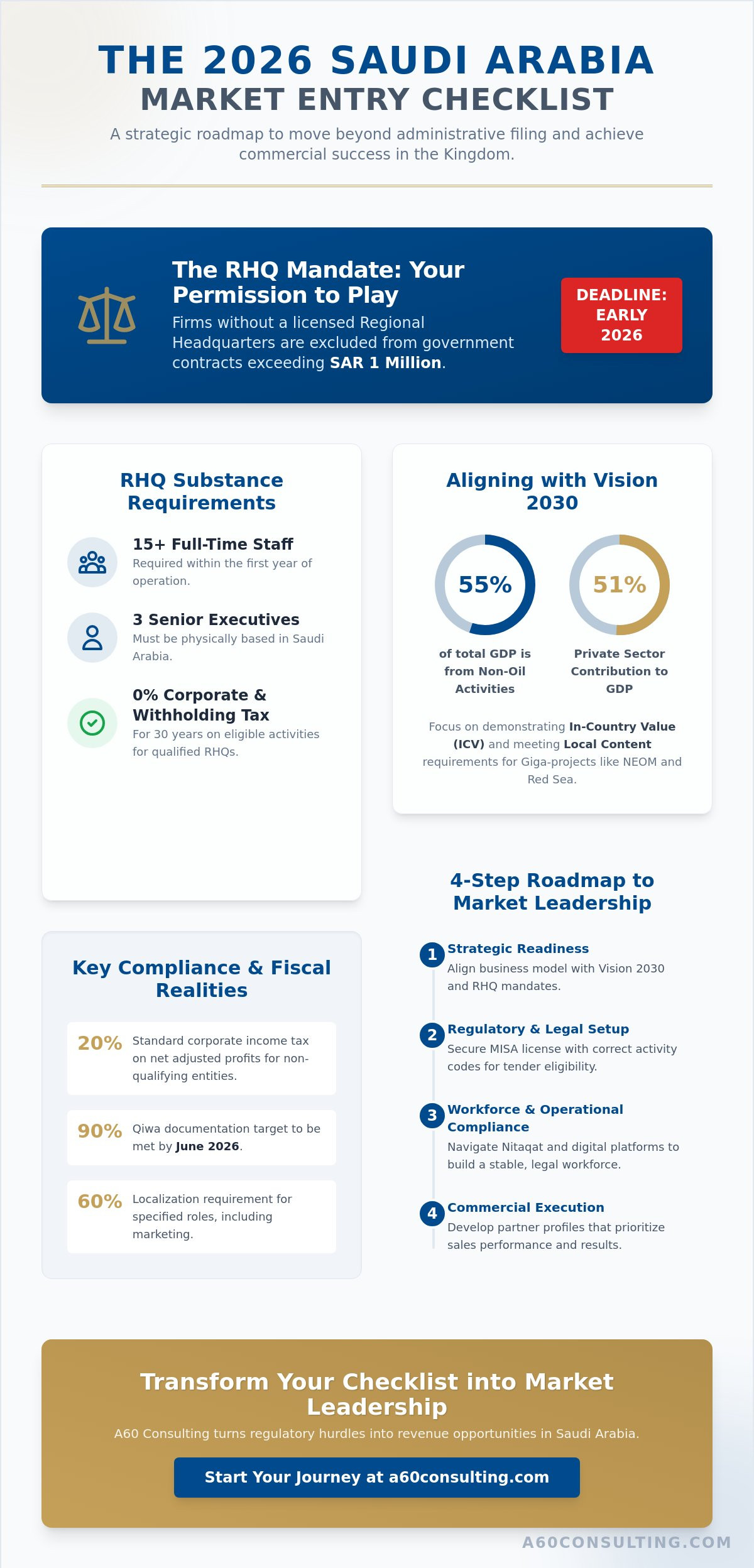
Your readiness assessment should start with the 30-year tax incentive package. Qualified Regional Headquarters (RHQ) currently enjoy a 0% corporate income tax rate and 0% withholding tax on eligible activities. However, these benefits are tied to strict operational substance. You must evaluate your "In-Country Value" (ICV) potential, specifically how your supply chain contributes to local job creation and technology transfer. With the private sector's contribution to GDP reaching 51% in 2025, the government prioritizes partners who demonstrate a commitment to the local ecosystem rather than those seeking simple transactional relationships.
The 2026 Regional Headquarters (RHQ) Requirement
The RHQ mandate is now a strictly enforced reality. As of early 2026, foreign companies lacking a licensed Regional Headquarters are excluded from bidding on government contracts exceeding SAR 1 million, which is approximately AED 979,000. To maintain this license, your organization must employ at least 15 full-time staff within the first year, including three senior executives based physically in Saudi Arabia. By 2026, the RHQ mandate has transformed from a policy guideline into a binary filter for procurement, effectively barring any multinational without a physical, executive presence in Riyadh from the Kingdom's largest public spending pools.
Vision 2030 Strategic Fit Analysis
Success depends on mapping your industrial or tech solutions to specific programs like the National Industrial Development and Logistics Program (NIDLP). Whether you are targeting Giga-projects like NEOM, the Red Sea, or Qiddiya, you must identify the specific "Local Content" requirements for these infrastructure bids. This alignment is the cornerstone of Saudi Vision 2030, which seeks to localize the majority of military and industrial spending by the end of the decade.
Understanding these milestones is essential for a broader The 2026 GCC Market Entry Strategy: A Blueprint for Strategic Regional Expansion. Your saudi arabia market entry checklist 2026 should reflect a deep understanding of these localized quotas, ensuring that your go-to-market strategy is both compliant and commercially competitive.
Regulatory & Legal Setup: The 2026 Permission to Play
The shift from strategic planning to legal execution is where many firms encounter their first real friction. In the current 2026 landscape, a legal license is no longer a standalone achievement; it's a integrated component of your broader commercial viability. As you refine your saudi arabia market entry checklist 2026, you must view the regulatory setup as a foundation for revenue generation rather than a mere administrative hurdle. The Kingdom's systems are now highly digitized, requiring a level of data accuracy and transparency that leaves no room for "letterbox" entities.
Securing a Ministry of Investment (MISA) license is the pivot point for your entry. This document dictates your operational boundaries and capital requirements. While 100% foreign ownership is standard for most tech and industrial sectors, the specific activity code you choose will determine your future eligibility for government tenders and private sector partnerships. Utilizing the Investor Service Centre can significantly reduce lead times, but success depends on having your corporate documentation correctly attested and translated into Arabic before the first submission. For firms based in Dubai or Abu Dhabi, it's vital to note that while the UAE corporate tax rate is 9%, your Saudi entity will be subject to a 20% corporate income tax on net adjusted profits, necessitating a distinct fiscal strategy.
MISA Licensing and Activity Codes
Choosing between Service, Industrial, or Trading licenses requires a deep understanding of your 2026 capital deployment. Industrial licenses often provide better access to specialized economic zones, while Service licenses are the preferred route for B2B tech firms. The 2026 regulations have further streamlined the process for high-tech ventures, though you must still prove economic substance to qualify for the full suite of incentives offered under the Regional Headquarters (RHQ) Program. Ensuring your setup remains agile is a core part of our regulatory and compliance advisory services.
Taxation and Zakat Compliance (ZATCA)
Registration with the Zakat, Tax and Customs Authority (ZATCA) is mandatory once your Commercial Registration (CR) is issued. For 2026, the standard VAT rate remains at 15%, with a mandatory registration threshold of SAR 375,000, which is approximately AED 367,250. Beyond simple registration, you must implement E-invoicing (Fatoora) Phase 2. This requires your accounting software to be technically integrated with ZATCA's systems for real-time transaction clearance. This level of transparency is a significant shift from previous years and is explored further in our guide on GCC Regulatory Compliance: A Strategic Guide for 2026 Market Entry. Compliance isn't just about avoiding penalties; it's about building the institutional trust required to win in a competitive market.
Workforce & Operational Compliance: Navigating Nitaqat
Building a physical presence in Riyadh or Jeddah requires more than just an office lease. Your saudi arabia market entry checklist 2026 must account for the sophisticated digital labor ecosystem that now governs every hire. On April 26, 2026, the Nitaqat program entered a new three-year phase, significantly raising the bar for localization. The "Yellow" category has been eliminated, meaning underperforming firms are immediately pushed into the "Red" zone, losing their ability to renew work permits or hire new staff. This shift demands a proactive approach to human capital management from day one.
Maintaining "Platinum" or "High Green" status is the only way to ensure operational continuity. For tech and industrial firms, this involves balancing high-level expat expertise with local talent. A Saudi national only counts as a full unit toward your quota if they earn a minimum monthly wage of SAR 4,000, which is approximately AED 3,916. Marketing roles require a higher threshold of SAR 5,500 (AED 5,385), while engineering positions must reach SAR 8,000 (AED 7,832). Gaining Credibility in the Saudi Market often starts with your commitment to the Human Resources Development Fund (HRDF), which provides subsidies for training local engineers and technicians to meet these specific requirements.
Mastering the Nitaqat System in 2026
Success in 2026 requires a deep dive into your specific industry "cell." Ratios vary wildly between a software development house and a heavy manufacturing plant. To ease visa processing, you should utilize the HRDF programs that offset the costs of hiring and training Saudi youth. Furthermore, ensure all technical staff meet the 2026 professional accreditation standards set by the Saudi Council of Engineers. Without these certifications, even a highly skilled foreign expert won't be able to secure a work permit, stalling your technical implementation.
Qiwa and the Mudaraba Contract Framework
Qiwa is now the central nervous system for labor compliance. By June 30, 2026, all employers must have 90% of their Saudi employee contracts authenticated on the platform to be counted toward Saudization targets. This digital integration extends to the Wage Protection System (WPS), which monitors salary payments to ensure they match the authenticated contracts exactly. Qiwa has effectively automated labor compliance for foreign investors by linking contract authentication directly to visa issuance and GOSI registration. Failing to hit the June 30 deadline can result in immediate fines and a downgrade in your Nitaqat status, highlighting why workforce management is a critical pillar of any saudi arabia market entry checklist 2026.
Commercial Execution: Partner Search & Sales Management
The most common pitfall for tech and industrial firms is the assumption that a commercial license naturally leads to a sales pipeline. In reality, your saudi arabia market entry checklist 2026 remains incomplete until you've established a robust commercial execution engine. By 2026, the market is no longer impressed by global credentials alone. Success now depends on your ability to find local partners who possess the technical depth to support your solution and the reputational capital to navigate complex procurement cycles.
Defining an Ideal Partner Profile (IPP) is the first step in this transition. Don't simply default to the largest conglomerates. These "big names" often carry massive portfolios where your product might get lost. Instead, look for specialized, mid-sized firms that are hungry for growth and already have high In-Country Value (ICV) scores. A partner's ICV score is a critical metric in 2026, as it directly influences their success rate in government and Giga-project tenders.
Distributor Search and Vetting Framework
Vetting must go beyond a simple credit check. You need a multi-stage process that includes reputational due diligence and a deep dive into their existing technical support capabilities. When negotiating, prioritize sales performance over blanket exclusivity. In the 2026 Saudi market, an exclusive agreement without clear, time-bound KPIs is a strategic liability. This approach ensures your partner remains motivated to actively pursue market share rather than merely acting as a passive gatekeeper. You can find more details on this selection process in our Strategic Guide to Distributor Search in the Middle East: A 2026 Framework.
B2B Sales Execution and Pipeline Management
Sales in the Kingdom remain deeply rooted in trust and personal relationships, often referred to as 'Wasta.' However, the 2026 version of Wasta is highly professionalized. It's about having the right representation in the 'Majlis' where strategic decisions are often discussed before they reach a formal tender. Your sales pitch must pivot from technical features to how your solution accelerates specific Vision 2030 goals. Local representation is non-negotiable for managing this pipeline effectively and ensuring your brand stays top-of-mind during long decision cycles. For a deeper look at these dynamics, see our guide on Mastering B2B Sales in the GCC: A Strategic Guide for 2026.
If you need to identify and manage the right local partners to complete your saudi arabia market entry checklist 2026, our sales execution and management team can act as your regional office to bridge the gap between strategy and revenue.
The A60 Advantage: From Checklist to Market Leadership
Completing a saudi arabia market entry checklist 2026 is a significant milestone, but it doesn't represent the finish line. It's merely the starting block for sustainable growth. At A60 Consulting FZ-LLC, we understand that the gap between a legal license and a signed contract is often filled with cultural nuances and execution risks that a spreadsheet cannot account for. Our role is to act as your strategic partner, transforming these regulatory requirements into a measurable commercial advantage.
We provide a regional sales office model that allows tech and industrial firms to establish a physical presence in Riyadh without the immediate overhead of a full local entity. By leveraging our 30 years of GCC experience, we help you bypass the common entry pitfalls that often drain resources before the first sale is even secured. Our success-based model ensures that our incentives are perfectly aligned with your revenue growth. We don't just offer advice; we share the journey toward market leadership, focusing on implementation rather than just theory.
Strategic Sales Representation in Riyadh
Managing lead generation and key account management from afar is rarely effective in the Kingdom's current high-stakes environment. Our team provides the local representation necessary to maintain consistent touchpoints with decision-makers in the public and private sectors. We manage the local pipeline on your behalf, ensuring that your technical value proposition isn't lost in translation during the procurement process. This boots-on-the-ground approach is explored further in our analysis of The Strategic Importance of Local Representation in the GCC for 2026.
Bridging the Cultural Gap in 2026
The 2026 Saudi market has evolved into a more transparent, data-driven environment, but the underlying cultural dynamics of trust remain paramount. We help you navigate the modern evolution of 'Wasta,' which is now less about unearned favors and more about institutional credibility and long-term reliability. Our team translates international value propositions into a local context that resonates with the strategic goals of Vision 2030. Understanding these subtle shifts is critical for any firm looking to master Mastering Business Culture in the Middle East: A Strategic Guide for 2026.
Market entry shouldn't be a gamble. By integrating our sales execution and management expertise into your saudi arabia market entry checklist 2026, you gain the stability and intellectual depth required to win. We focus on both the numbers and the people, ensuring that your transformation into a Saudi market leader is both systematic and sustainable.
Securing Your Future in the Kingdom
The roadmap to success in Riyadh has fundamentally changed. By 2026, the distinction between a company that merely exists on paper and one that leads the market is defined by its ability to execute. Navigating the RHQ mandate and the 90% Qiwa documentation targets requires more than administrative diligence; it requires a presence that commands trust. Your saudi arabia market entry checklist 2026 is the starting point for this transformation.
Bridging the gap between a MISA license and consistent revenue growth is where strategic depth becomes a competitive advantage. With over 30 years of regional experience, we specialize in tech and industrial GTM execution through a success-based sales commission model that aligns our results with your expansion. We don't just provide a list of steps; we provide the local representation and expertise needed to convert regulatory compliance into measurable market share.
It's time to move beyond the checklist and begin your implementation. Book a Strategic Market Entry Consultation with A60 Consulting today to secure your position in the third phase of Vision 2030. The Kingdom's growth is accelerating, and the right partnership is the surest way to ensure you don't just enter the market, but lead it.
Frequently Asked Questions
Do I need a Regional Headquarters (RHQ) in Saudi Arabia by 2026?
Yes, establishing an RHQ is mandatory if your firm intends to bid on government contracts exceeding SAR 1 million, which is approximately AED 979,000. This regulation is strictly enforced in 2026 to ensure that multinational corporations have a genuine operational substance and executive presence within the Kingdom rather than managing operations from neighboring hubs.
What is the minimum capital requirement for a MISA license in 2026?
Capital requirements vary significantly based on your specific activity code. Industrial licenses generally require a minimum capital of SAR 1 million (AED 979,000), whereas service licenses for tech firms often have no fixed minimum capital but require a detailed investment plan. Trading licenses remain the most capital-intensive, often requiring SAR 30 million (AED 29.3 million) with a commitment to invest SAR 20 million over three years.
How does the Saudization (Nitaqat) system affect tech companies?
The Nitaqat system mandates specific hiring quotas for Saudi nationals based on your industry "cell." For tech firms, maintaining a high status depends on meeting minimum wage thresholds, such as AED 7,832 for engineering roles and AED 5,385 for marketing positions. Failing to meet these targets through the Qiwa platform can result in the suspension of work permits and a downgrade to the "Red" category.
Can a foreign company own 100% of its Saudi subsidiary?
Foreign investors can maintain 100% ownership in the vast majority of tech and industrial sectors under current MISA regulations. This policy is a cornerstone of the saudi arabia market entry checklist 2026, designed to attract international expertise. Some specific sectors like retail or strategic minerals may still require a local partner or higher capital commitments, but the tech landscape remains largely open to full foreign control.
What are the common mistakes in Saudi distributor agreements?
Granting blanket exclusivity without time-bound performance KPIs is the most frequent and costly error. Many firms also fail to vet their partner's In-Country Value (ICV) score, which is a critical metric for winning tenders in 2026. Agreements should prioritize sales execution and technical support capabilities over the distributor's historical "big name" reputation or social influence alone.
How has Vision 2030 changed the B2B sales landscape in 2026?
The sales environment has transitioned from speculative interest to a disciplined focus on implementation and measurable impact. Procurement is now centralized through digital platforms like Etimad, requiring firms to prove how their solutions directly advance National Industrial Development and Logistics Program (NIDLP) goals. Success in 2026 depends on technical merit and strategic alignment rather than just traditional relationship-based selling.
What is the role of ZATCA in the market entry process?
ZATCA is responsible for collecting Zakat, VAT, and corporate income tax, which stands at 20% for foreign-owned entities. They also oversee the mandatory Phase 2 E-invoicing integration, which requires your accounting systems to link directly to government servers for real-time clearance of B2B transactions. Accurate ZATCA registration is a non-negotiable step that follows immediately after obtaining your Commercial Registration.
How long does it typically take to complete the Saudi market entry checklist?
Most firms require three to six months to fully execute the saudi arabia market entry checklist 2026. While obtaining a MISA license can take as little as two weeks, the subsequent steps including office setup, GOSI registration, and contract authentication on Qiwa demand significant lead time. Partnering with a specialized management firm can often reduce this timeline by bypassing common administrative bottlenecks and local hiring delays.