

In the Omani market, a distribution agreement is often more than a simple commercial contract; it's a binding commitment that the local Agency Law makes exceptionally difficult to dissolve. Many international leaders enter this market with a sense of caution, and for good reason. Successfully finding a reliable distributor in oman requires more than a simple directory search or a casual meeting at a trade show. It demands a strategic approach that balances market potential with the 1.4% inflation stability and the evolving regulatory landscape of 2026.
We understand the pressure of vetting a partner's actual reach while facing the July 11, 2026, deadline for new corporate governance compliance. This article provides a professional framework for identifying and securing high-performing partners who align with your strategic goals. You'll discover how to navigate Omani commercial agency regulations, overcome cultural barriers in negotiation, and ultimately build a sustainable sales pipeline. By shifting your perspective from simple sourcing to rigorous strategic vetting, you can secure a partnership that drives measurable results in this growing economy.
Key Takeaways
- Understand how Oman Vision 2040 is reshaping the distribution landscape, creating specific high-growth opportunities in the industrial and technology sectors.
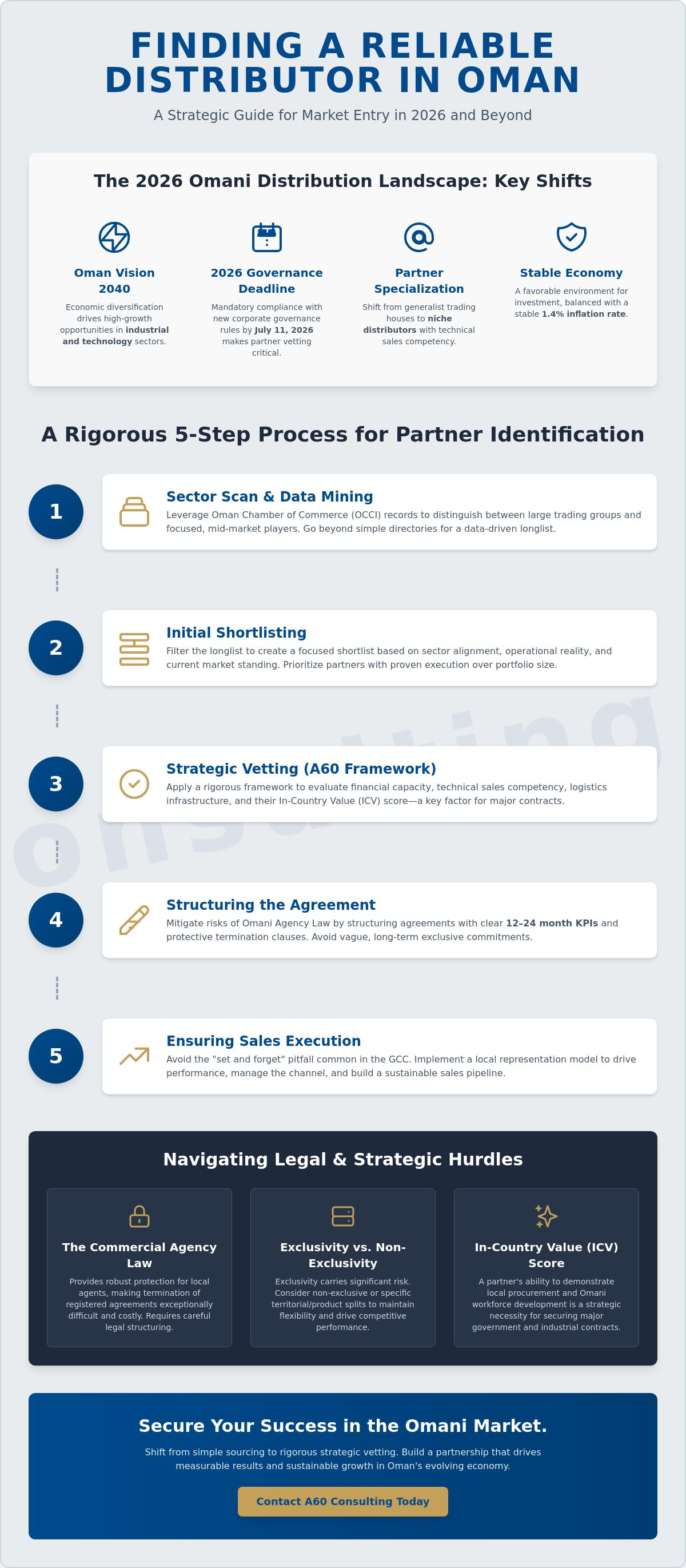
- Master a rigorous 5-step process for finding a reliable distributor in oman that moves beyond simple directories to data-driven sector scans.
- Apply the A60 Strategic Framework to evaluate a partner's financial capacity and technical sales competency before signing any long-term agreements.
- Learn to structure Omani distributor agreements with clear 12–24 month KPIs and protective termination clauses that mitigate the risks of local Agency Laws.
- Discover why a local representation model is essential for sales execution and how to avoid the common "set and forget" pitfalls in the GCC region.
Understanding the Omani Distribution Landscape in 2026
Oman's economic transformation is no longer a theoretical projection; it's a measurable reality driven by the Oman Vision 2040 framework. As the government allocates OMR 400 million annually to economic diversification, the opportunities for finding a reliable distributor in oman have shifted toward high-tech and industrial sectors. This transition is clearly reflected in Oman's economic landscape, where non-oil sectors are becoming the primary engines of growth. The ports of Sohar, Salalah, and Duqm are evolving into integrated logistics hubs, creating a demand for partners who can navigate sophisticated supply chains rather than just managing simple port-to-shelf logistics.
Traditional trading houses, once the gatekeepers of the market, are gradually losing their dominance. Modern principals now prefer specialized niche distributors who possess the technical competency to manage complex sales cycles in manufacturing or renewable energy. This shift is partly driven by In-Country Value (ICV) requirements. Choosing a partner with a high ICV score isn't just a preference; it's a strategic necessity for any firm aiming to secure government contracts or major industrial projects. A partner's ability to demonstrate local procurement and Omani workforce development is now as critical as their sales figures.
Deciding between exclusive and non-exclusive distribution is a critical crossroads for foreign entities. While exclusivity offers a partner a strong incentive to invest in your brand, it carries significant risks under Omani law. If a partner fails to perform, the legal hurdles to terminate an exclusive agreement can be substantial. Many successful firms are now opting for non-exclusive arrangements or highly specific territorial splits to maintain strategic flexibility in a market where 100% foreign ownership of LLCs is now the standard for most commercial activities.
The Role of the Commercial Agency Law
The Agency Law is the primary legal framework for foreign-local commercial partnerships. Historically, this law provided local agents with robust protections, often making them difficult to replace without significant compensation. However, the regulatory environment is tightening. By July 11, 2026, all companies must comply with new corporate governance rules, including the mandatory registration of Ultimate Beneficial Owners (UBOs). These 2026 updates aim to increase transparency, but they also mean that vetting a partner's compliance status is now a non-negotiable step in the selection process.
Market Maturity and Sector-Specific Trends
The Omani market has matured into distinct silos. Industrial distribution requires heavy logistics and warehousing, while software distribution focuses on implementation and local support. Generalist firms often lack the depth needed for these specialized channels. To succeed, your approach must align with a broader 2026 GCC market entry strategy. Identifying a partner who understands the nuances of technical specialists rather than general trade is the key to finding a reliable distributor in oman. This specialization ensures that your brand isn't lost in a massive portfolio of unrelated products.
A 5-Step Process for Identifying Potential Partners
Identifying potential partners in a market as nuanced as Oman requires a shift from passive searching to active, strategic scouting. The process of finding a reliable distributor in oman begins with a high-level sector scan to establish a baseline of active entities. While digital directories offer a starting point, they rarely capture the operational reality or the current market standing of a local firm. A professional identification process involves five distinct stages that bridge the gap between public data and on-the-ground performance. This systematic funnel ensures that your shortlist isn't just a list of names, but a collection of vetted opportunities.
Leveraging Local Institutional Data
The first step involves a deep dive into the records of the Oman Chamber of Commerce and Industry (OCCI). These records are essential for distinguishing between large Tier 1 conglomerate trading groups and more agile, mid-market players. While the major groups offer prestige and financial stability, they often manage hundreds of brands, which can lead to your product being deprioritized. Mid-market firms often provide more focused attention and a higher commitment to sales execution. According to the Country Commercial Guide for Oman, understanding these organizational structures is vital for assessing a partner's true capabilities. Always verify a distributor’s existing portfolio; if they represent three direct competitors, your growth will likely be stifled.
The Power of Strategic Networking
In the Omani business culture, personal influence and local reputation remain significant factors in uncovering non-public opportunities. LinkedIn is a useful tool for initial contact, but it's often insufficient for verifying a partner’s reputation or discovering upcoming shifts in the local market. High-level searches require soft inquiries within industry circles to gauge how a distributor treats their current principals. This qualitative data is often more valuable than a balance sheet. For a broader perspective on regional nuances, you can consult our strategic guide to distributor search in the Middle East. This framework helps align local Omani practices with wider GCC standards.
Once a shortlist is established, a digital footprint analysis serves as a preliminary vetting tool. Does the distributor maintain an active presence in the market? Is their technical team visible at regional forums? A lack of digital transparency in 2026 is often a red flag, especially as firms must now align with the July 11, 2026, corporate governance compliance deadline. If you find the identification process overwhelming, our team can assist with partner identification and selection to ensure you start with a vetted pool of candidates. This systematic approach ensures that you don't just find a partner, but the right partner for long-term growth.
Vetting for Reliability: The A60 Strategic Framework
Moving from a shortlist to a final selection requires an analytical deep dive into a partner's operational reality. While certifications are a baseline, true reliability is found in the intersection of financial strength and market agility. The process of finding a reliable distributor in oman involves evaluating five core pillars: financial stability, sales execution, logistical reach, regulatory compliance, and cultural alignment. Each pillar serves as a safeguard against the risks of a static or underperforming partnership. When assessing creditworthiness, look beyond the surface; a partner must have the investment capacity to maintain inventory levels that can withstand global supply chain fluctuations.
Logistical reach is another critical factor. Verifying warehouse standards and national coverage ensures your products reach customers in Muscat, Salalah, and Sohar with consistent quality. According to the World Bank's Doing Business report, enforcing contracts and getting credit are key indicators of a market's maturity, and your distributor must demonstrate a track record of excellence in these areas. Finally, cultural alignment ensures that your corporate ethics aren't compromised in local negotiations. A partner who shares your long-term vision is more likely to invest in the relationship during the initial 12–24 month market penetration phase.
Evaluating Sales Performance and Technical Support
Sales execution is the distributor’s ability to move beyond order-taking to active market development. We don't just look for a sales team; we look for technical competency. You should ask specific questions about their after-sales support infrastructure and their current access to key decision-makers in your target industry. It's not enough to have a contact list. A reliable partner must show they can influence the procurement process for complex industrial or tech solutions. This proactive stance is what separates high-performers from passive agents who simply wait for inquiries to arrive.
Due Diligence and Compliance Checks
On-site visits are non-negotiable. You must physically verify warehouse and office facilities to ensure they meet your brand's standards. During these visits, check for conflicts of interest with competing brands in their portfolio. If a distributor represents a direct rival, your products might only be used as a "price filler" in their bids. For a deeper understanding of regional trade laws, refer to our GCC regulatory compliance guide. Ensuring they have the necessary permits before the July 11, 2026, compliance deadline is essential for a seamless market entry. This level of due diligence creates a foundation of trust and measurable success.
Negotiating the Distributor Agreement in Oman
Negotiation is the critical phase where strategic intent is codified into a binding partnership. In the Omani context, this process is heavily influenced by the Commercial Agency Law, which dictates the long-term dynamics of foreign-local cooperation. Finding a reliable distributor in oman is only half the battle; the other half is ensuring the agreement allows for strategic flexibility and performance-based accountability. You must move beyond standard templates to create a document that addresses marketing contributions, intellectual property protection, and specific brand usage guidelines from the outset. A well-structured contract acts as a roadmap for the first 24 months of market entry.
Termination clauses are perhaps the most contentious yet vital part of the negotiation. Given the historical legal protections for local agents, it's essential to define "material breach" with absolute clarity. This includes failure to meet agreed-upon technical support standards or non-compliance with the July 11, 2026, corporate governance requirements. By setting these benchmarks early, you create a transparent path for either scaling the partnership or exiting it without protracted legal disputes. Clear guidelines on co-op advertising and marketing budget contributions also ensure that both parties are financially committed to the brand's success.
Setting Realistic KPIs for the Omani Market
Many principals make the mistake of setting aggressive volume-based targets for the first 12 months. In a market focused on long-term stability and Vision 2040 goals, market penetration metrics are often more telling than immediate sales figures. Focus on customer acquisition costs and the number of technical demonstrations performed by the distributor's team. Aligning distributor incentives with these lead indicators ensures they invest in building the brand's reputation rather than just clearing existing stock. This approach fosters a partnership based on sustainable growth rather than short-term gains.
Navigating Cultural Nuances in Negotiations
Business in Oman is deeply personal and often conducted through a "Majlis" style of discussion, where rapport-building is as important as the contract terms. You can't rush these conversations; they require physical presence and a genuine interest in the local business environment. Understanding these social dynamics is a core part of mastering business culture in the Middle East. Taking the time to meet face-to-face demonstrates a level of commitment that digital communication simply cannot replicate. This trust is the foundation upon which all successful Omani distribution networks are built.
If you're concerned about the legal complexities of these agreements, our regulatory and compliance advisory services can help you structure a contract that protects your interests while fostering a productive local partnership.
Scaling Your Presence with Professional Representation
Market entry is a continuous process of refinement rather than a single event. While finding a reliable distributor in oman is a significant achievement, the long-term health of your sales pipeline depends on how you manage that relationship after the ink has dried. Many international firms fall into the trap of assuming that a local partner's existing network is enough to sustain growth. In reality, Omani distributors often balance multiple principals; without consistent engagement, your brand can easily lose momentum. Scaling your presence requires a shift from passive oversight to active partnership management that bridges the gap between global strategy and local execution.
A regional sales office or professional local representation acts as a force multiplier for your distribution network. This presence allows you to maintain a direct pulse on the market, ensuring that the distributor remains focused on your specific KPIs. It also provides a platform for transitioning from a pure distribution model to a direct local presence as your volume grows. With the removal of minimum capital requirements for LLCs and the allowance for 100% foreign ownership, the path to establishing a direct footprint is more accessible in 2026 than ever before. This progression ensures that you don't just enter the market, but eventually own your segment within it.
The Need for Active Distributor Management
Identifying early warning signs of underperformance is crucial for protecting your market share. If technical inquiries from the distributor's staff decrease or if they fail to leverage the digital transformation trends of 2026, it's time to intervene. Providing ongoing sales enablement and technical training ensures the partner’s staff remains competent and motivated to sell your solutions. You can utilize our frameworks for mastering B2B sales in the GCC to maintain a high standard of sales execution and ensure your partner isn't just taking orders, but actively developing the market.
How A60 Consulting Facilitates Omani Market Success
A60 Consulting acts as your strategic partner on the ground, providing the analytical depth needed to navigate the Omani market's complexities. Our Partner Search and Vetting service for 2026 goes beyond simple identification; we provide a rigorous framework to ensure your chosen partner aligns with your corporate culture and the July 11, 2026, compliance standards. We act as your eyes and ears, monitoring the performance of your distribution network and identifying growth opportunities that a distant principal might miss. This level of professional representation ensures that your Omani operations are efficient, compliant, and positioned for sustainable growth.
Ready to secure a high-performing partner in the region? Contact A60 Consulting for a customized distributor search in Oman and take the first step toward a measurable and successful market entry.
Building Your Strategic Future in Oman
The Omani market in 2026 offers a unique combination of stability and transformation, but long-term success depends on moving beyond the traditional trading house model. Finding a reliable distributor in oman requires a disciplined approach that balances technical vetting with the July 11, 2026, corporate governance compliance deadline. By prioritizing niche specialists over generalist firms, you ensure your brand receives the dedicated focus it needs to thrive under the Oman Vision 2040 framework. Success here isn't just about making a sale; it's about building a resilient partnership that can navigate regional shifts with agility.
At A60 Consulting, we bring over 30 years of regional GCC experience to your market entry strategy. Our proven vetting methodology is specifically designed for complex tech and industrial products, ensuring your partners possess the actual technical competency to deliver results. With a physical presence in the GCC to manage local alliances, we act as your strategic representative on the ground. Secure your Omani market entry with A60 Consulting’s professional partner search services. We look forward to helping you transform your regional vision into a measurable and sustainable commercial success.
Strategic Frequently Asked Questions
Do I need a local distributor to sell products in Oman?
Yes, for most physical products, a local distributor is essential to manage customs clearance and local sales channels effectively. While the 2019 Foreign Capital Investment Law allows 100% foreign ownership of LLCs, establishing your own logistics and sales force from scratch is often capital-intensive. Most firms find that a local partner provides the immediate infrastructure and market access needed to scale their presence without the immediate overhead of direct operations.
What is the Omani Commercial Agency Law and how does it affect me?
The Omani Commercial Agency Law is the primary legal framework that governs the relationship between a foreign principal and a local agent. It provides significant protections to the Omani partner, often making it difficult to terminate an agreement without proving a material breach. Under the 2026 regulatory updates, these agreements must be registered with the Ministry of Commerce to be legally enforceable, which highlights the need for precise contractual language from day one.
Can I have multiple distributors in Oman for the same product?
You can appoint multiple distributors provided your agreements are non-exclusive. Many principals choose to split the market by territory, such as Muscat versus Salalah, or by specific industry sectors like healthcare versus industrial manufacturing. This approach reduces your dependency on a single entity and allows you to leverage the specialized strengths of different partners across the Sultanate's diverse economic landscape.
How long does it typically take to find and vet a reliable distributor in Oman?
The process of finding a reliable distributor in oman typically takes three to six months to complete properly. This window allows for a rigorous identification phase, on-site facility inspections, and the negotiation of performance-based KPIs. Hurrying this timeline often leads to overlooked red flags, which can result in long-term legal and commercial complications that are far more time-consuming to resolve later.
What are the most common mistakes foreign companies make when choosing an Omani partner?
The most frequent error is choosing a partner based solely on their size or the prestige of their conglomerate name. Large trading houses often manage hundreds of brands, meaning your product might not receive the dedicated sales focus it requires. Another common mistake is failing to verify the technical competency of the distributor's staff, which is essential for complex industrial or software products that require ongoing after-sales support.
Is it better to have one distributor for the whole GCC or a specific one for Oman?
A specific distributor for Oman is usually the superior choice because of the country's unique Agency Law and local procurement requirements. While a master distributor for the GCC might seem simpler, they often lack the deep local relationships and In-Country Value (ICV) scores necessary to win major Omani contracts. Localized representation ensures that your partner is fully committed to the Sultanate's specific market dynamics and regulatory environment.
How can I terminate a distribution agreement in Oman if the partner underperforms?
Terminating an agreement is challenging and usually requires proof of a material breach of contract or mutual consent. If a partner underperforms, you must have documented evidence of their failure to meet the specific KPIs defined in your agreement. The July 11, 2026, compliance deadline for corporate governance also adds a layer of scrutiny, making it vital to have a clear, performance-linked exit strategy codified in your original contract.
What role does "Wasta" play in finding a reliable distributor?
Wasta, or social influence, remains a significant factor in Omani business culture for uncovering non-public opportunities and verifying reputations. It isn't about bypassing rules, but rather about leveraging trusted networks to gain insights that aren't available in digital directories. Using professional representation to navigate these networks helps you identify which distributors are truly respected by local decision-makers before you commit to a long-term partnership.